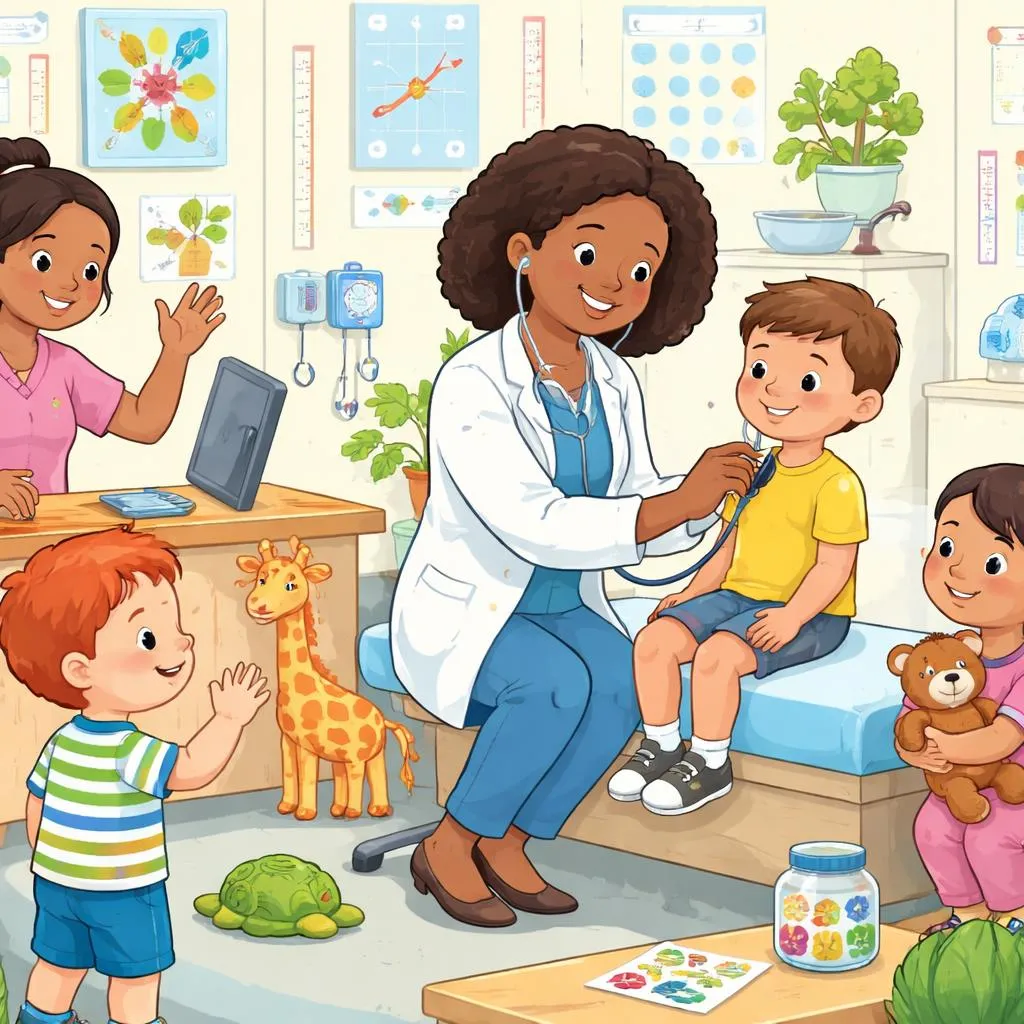

A visit to the doctor can feel unfamiliar to young children. There are new people. There are new tools. There are new routines. Teaching children what happens at doctor's visits helps reduce fear and builds understanding. It also provides rich opportunities for language learning. Children learn body parts, health vocabulary, and polite expressions. As teachers, we can use this theme to prepare children for real-life experiences while building essential English skills. Let's explore how to bring the doctor's office into our classroom.
What Happens at the Doctor's Office? The doctor's office is a place where we go to stay healthy. Doctors help us when we are sick. They also check our bodies when we are well to make sure everything is working right.
A visit at doctor's office usually follows a pattern. First, we check in with the receptionist. We wait in the waiting room. Then a nurse calls our name. The nurse checks our height and weight. They might check our temperature. Then the doctor comes in. The doctor asks how we are feeling. They listen to our heart. They look in our ears and throat. They might ask us to take a deep breath. At the end, the doctor tells us how to stay healthy.
Understanding this routine helps children know what to expect. This reduces anxiety and builds confidence.
Meaning and Explanation: Why Learn About the Doctor? Teaching about the doctor serves several important purposes.
First, it builds health vocabulary. Children learn words like stethoscope, thermometer, and bandage. They learn to describe how they feel. "My throat hurts." "I have a fever."
Second, it reduces fear. When children know what happens at doctor's visits, they are less scared. They understand that the tools are not scary. They are there to help.
Third, it teaches self-care. Children learn why we go to the doctor. They learn how doctors help us stay healthy.
Fourth, it builds language for real situations. If a child needs to visit the doctor, they have words to describe what is happening. They can communicate with the doctor.
Finally, this theme connects to many subject areas. We can do math with doctor tools. We can do science about the body. We can do dramatic play as doctors and patients.
Categories or Lists: Things at the Doctor's Office We can organize at doctor's vocabulary into useful categories.
People at the Doctor's Office:
Doctor: The person who checks our health and helps us feel better.
Nurse: The person who helps the doctor and does some checks.
Receptionist: The person at the front desk who helps us check in.
Patient: The person who comes to see the doctor.
Things in the Waiting Room:
Waiting room: The area where we wait for our turn.
Chair: Where we sit while waiting.
Magazines: Books we can read while waiting.
Toys: Sometimes there are toys for children.
Things the Nurse or Doctor Uses:
Stethoscope: The tool doctors use to listen to our heart and breathing.
Thermometer: The tool that measures our temperature.
Scale: The machine that measures how much we weigh.
Height measurer: The tool that measures how tall we are.
Otoscope: The tool doctors use to look in our ears.
Tongue depressor: A small stick to hold down our tongue.
Blood pressure cuff: The wrap that checks our blood pressure.
Bandage: A sticky cover for cuts or shots.
Syringe: A tool for giving medicine or shots (sometimes called a needle).
Things We Might Say at the Doctor's:
"My head hurts."
"I have a cough."
"My tummy feels funny."
"I feel hot."
"Thank you, doctor."
Learning these categories helps children understand what happens at doctor's visits.
Daily Life Examples: Talking About the Doctor We can talk about doctor visits throughout our daily routine.
During Morning Circle: "Has anyone been to the doctor lately? What happened there?"
During Health Discussions: "If we feel sick, who can help us?" "The doctor can help us."
When Someone Is Absent: "Maria is not here today. Maybe she went to the doctor to feel better."
During Story Time: We read books about visiting the doctor. "In this story, the little bear goes to the doctor. Let's see what happens."
During Dramatic Play: We set up a doctor's office in the classroom. Children take turns being the doctor, nurse, and patient.
By weaving the theme into daily conversation, we make it familiar and comfortable.
Printable Flashcards: Visual Tools for Learning Flashcards support learning about what happens at doctor's visits.
People Cards: We create cards with pictures of the doctor, nurse, receptionist, and patient. On the back, we write the word and a simple sentence. "The doctor helps us feel better."
Tool Cards: We create cards with pictures of doctor tools. Stethoscope, thermometer, otoscope, tongue depressor, bandage, syringe. We talk about what each tool does.
Action Cards: We create cards showing actions at the doctor's. Listening to heart, looking in ears, checking height, giving a shot, putting on a bandage.
Feeling Cards: We create cards showing how people might feel. Sick, healthy, scared, brave, happy, better.
These flashcards become a resource for many at doctor's themed activities.
Learning Activities or Games: Hands-On Ideas Here are specific activities to teach about what happens at doctor's visits.
Activity 1: Doctor's Office Dramatic Play We transform a corner of the room into a doctor's office. We add a white shirt for a doctor's coat. We add a play stethoscope, thermometer, and bandages. We have a clipboard for the receptionist. Children take turns being the doctor, nurse, receptionist, and patients. This imaginative play builds vocabulary and reduces fear.
Activity 2: What Does the Doctor Use? We place several doctor tools in a bag. Children reach in without looking. They feel one tool. They describe how it feels. They guess what it might be. Then we pull it out and talk about what it does. This builds descriptive language and familiarity.
Activity 3: Patient Interview Children work in pairs. One is the doctor. One is the patient. The doctor asks questions. "Where does it hurt?" "How do you feel?" The patient answers. Then they switch roles. This builds conversation skills.
Activity 4: Body Check-Up We use a large doll or a child volunteer. We demonstrate a check-up. We listen to the heart. We look in the ears. We check the throat. We name each step as we do it. Children then practice on dolls or each other.
Activity 5: Shot Practice Many children fear shots. We talk about why shots are important. They keep us healthy. We practice with a clean, unused syringe (without needle) or a dropper. We give pretend shots to dolls. We put on a bandage afterward. This demystifies the experience.
Activity 6: Waiting Room Role Play We set up chairs and books in a waiting area. Children practice waiting patiently. The receptionist calls names when it's time to see the doctor. This teaches the routine of waiting.
Activity 7: Prescription Writing Children write "prescriptions" on small pieces of paper. "Rest and drink water." "Take medicine." "Eat healthy food." This builds writing skills.
Activity 8: Bandage Art We provide paper bandages and markers. Children decorate bandages. They can put them on a paper "patient" (a doll drawing). This makes bandages feel less scary.
Activity 9: Temperature Check We use a play thermometer. Children check each other's temperature. They read the number. They say, "Your temperature is normal" or "You have a fever." This introduces health vocabulary.
Activity 10: Emergency or Not? We discuss different situations. A scraped knee. A broken arm. A cough. A headache. A cut that needs stitches. Children decide if they need to see a doctor right away or if they can wait. This builds health awareness.
By using these at doctor's activities, we prepare children for real medical visits. They learn vocabulary. They learn routines. They learn that doctors are helpers, not scary strangers. They become confident patients who can communicate about their health.