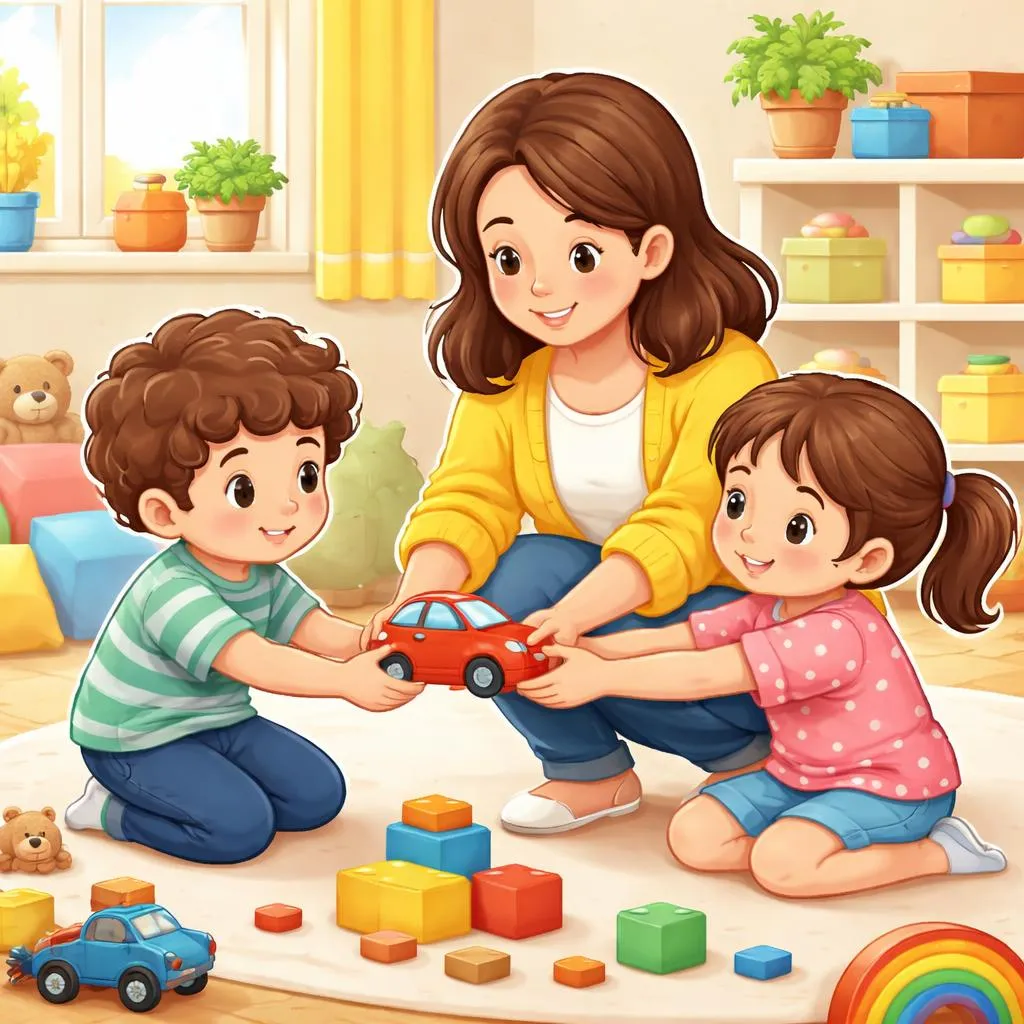

What Do These Expressions Mean? “Share your toys” and “take turns” both teach children how to play together fairly. They tell a child that others also want to use the same things. Children hear these words during playdates, at school, or with siblings. Both build friendship skills.
“Share your toys” means let another child use what you are using. It is direct and common. A parent says it when two children want the same truck. It focuses on giving access.
“Take turns” means one child uses the toy, then the other child uses it next. It is more structured and fair. A parent says it when children are fighting over a swing. It focuses on order and waiting.
These expressions seem similar. Both teach children to cooperate. Both prevent fights over toys. But one is about giving while one is about waiting.
What's the Difference? One is about sharing at the same time. One is about taking turns in order. “Share your toys” can mean playing together with the same toy. Building a block tower together is sharing. It is about joint play.
“Take turns” means using the toy one after the other. I go, then you go, then I go again. It is about waiting for your turn. It is more structured.
Think of children with one swing. “Share the swing” does not work. Two children cannot swing together. “Take turns on the swing” works perfectly. One pushes. One waits. Then they switch.
One is for toys that can be used together. The other is for single-use items. “Share your toys” for blocks, crayons, or play dough. “Take turns” for swings, video games, or one bicycle. Choose based on the toy.
Also, “take turns” teaches patience and waiting. “Share your toys” teaches generosity. Both are important. Both build kind children.
When Do We Use Each One? Use “share your toys” for toys that can be used together. Use it for crayons, clay, blocks, or books. Use it to encourage joint play. It fits creative play.
Examples at home: “Share your toys so your friend can build too.” “Let's share the crayons. You use red, I use blue.” “Sharing is kind. Can you share your blocks?”
Use “take turns” for toys that one person uses at a time. Use it for swings, bikes, video games, or a popular toy. Use it to create fair order. It fits high-demand items.
Examples for turns: “Take turns on the swing. Five pushes each.” “Let's take turns with the new tablet. You get ten minutes, then your brother gets ten.” “Take turns. You go first, then your friend.”
Children need both phrases. “Share your toys” for together play. “Take turns” for single-use items. Both build fair, happy play.
Example Sentences for Kids Share your toys: “Share your toys so everyone can play.” “Please share your Legos with your cousin.” “Sharing is caring. Can you share your snack?”
Take turns: “Take turns on the slide. One at a time.” “Let's take turns picking the movie.” “You had a long turn. Now take turns and let your sister play.”
Notice “share your toys” is about giving access. “Take turns” is about waiting and order. Children learn both. One for together. One for waiting.
Parents can use both. Blocks: “share your toys.” Swing: “take turns.” Children learn different fairness rules.
Common Mistakes to Avoid Some parents say “share your toys” for a swing. That is confusing. You cannot share a swing. Say “take turns on the swing.” Match the phrase to the toy.
Wrong: “Share the swing with your brother.” (impossible) Right: “Take turns on the swing. You go first, then your brother.”
Another mistake: forcing a child to share a favorite toy immediately. Children need to feel safe. Say “you can have five more minutes, then take turns.” Warning helps letting go.
Wrong: “Share your new doll right now.” (child not ready) Better: “You have five more minutes. Then it's your friend's turn.”
Some learners forget that sharing does not mean giving away. Sharing means letting someone use it while you watch or do something else. Explain that the toy comes back. Sharing is borrowing, not losing.
Also avoid punishing a child who will not share. Teach first. Model sharing yourself. Punishment teaches fear, not generosity. Patient teaching works better.
Easy Memory Tips Think of “share your toys” as a circle. Everyone puts their toys in the middle. Everyone plays together. For together toys.
Think of “take turns” as a line. One person goes. Then the next. Then the next. Order and waiting. For single-use toys.
Another trick: remember the toy type. “Share” is for many kids at once. “Take turns” is for one kid at a time. Many at once gets “share.” One at a time gets “take turns.”
Parents can say: “Share for many. Turns for any single penny.” That means together toys get “share.” One-person toys get “take turns.”
Practice at home. Crayons: “share your toys.” Swing: “take turns.” Two different fairness lessons.
Quick Practice Time Let us try a small exercise. Choose the better phrase for each situation.
Two children both want to play with a bucket of toy dinosaurs at the same time. a) “Take turns with the dinosaurs.” b) “Share the dinosaurs. You can play together.”
One child is on the trampoline. Another child wants a turn. a) “Share the trampoline.” b) “Take turns on the trampoline. Ten jumps, then switch.”
Answers: 1 – b. Toy dinosaurs can be played with together. “Share.” 2 – b. A trampoline is one person at a time. “Take turns.”
Fill in the blank: “When two children want to paint with the same watercolors, I say ______.” (“Share the paints” fits because painting can be together.)
One more: “When two children want to ride a bicycle that only fits one, I say ______.” (“Take turns on the bike” fits the single-user item.)
Fair play makes friends. “Share your toys” teaches generous hearts. “Take turns” teaches patient waiting. Teach your child both. A child who shares and waits grows into a beloved friend.
Wrap-up “Share your toys” teaches children to let others use the same toy at the same time. “Take turns” teaches children to use a toy one after another in an orderly way. Use “share” for crayons, blocks, and play dough. Use “take turns” for swings, bikes, and single-player games. Both phrases build kind, fair children. A child who shares and takes turns makes the world more fun for everyone.