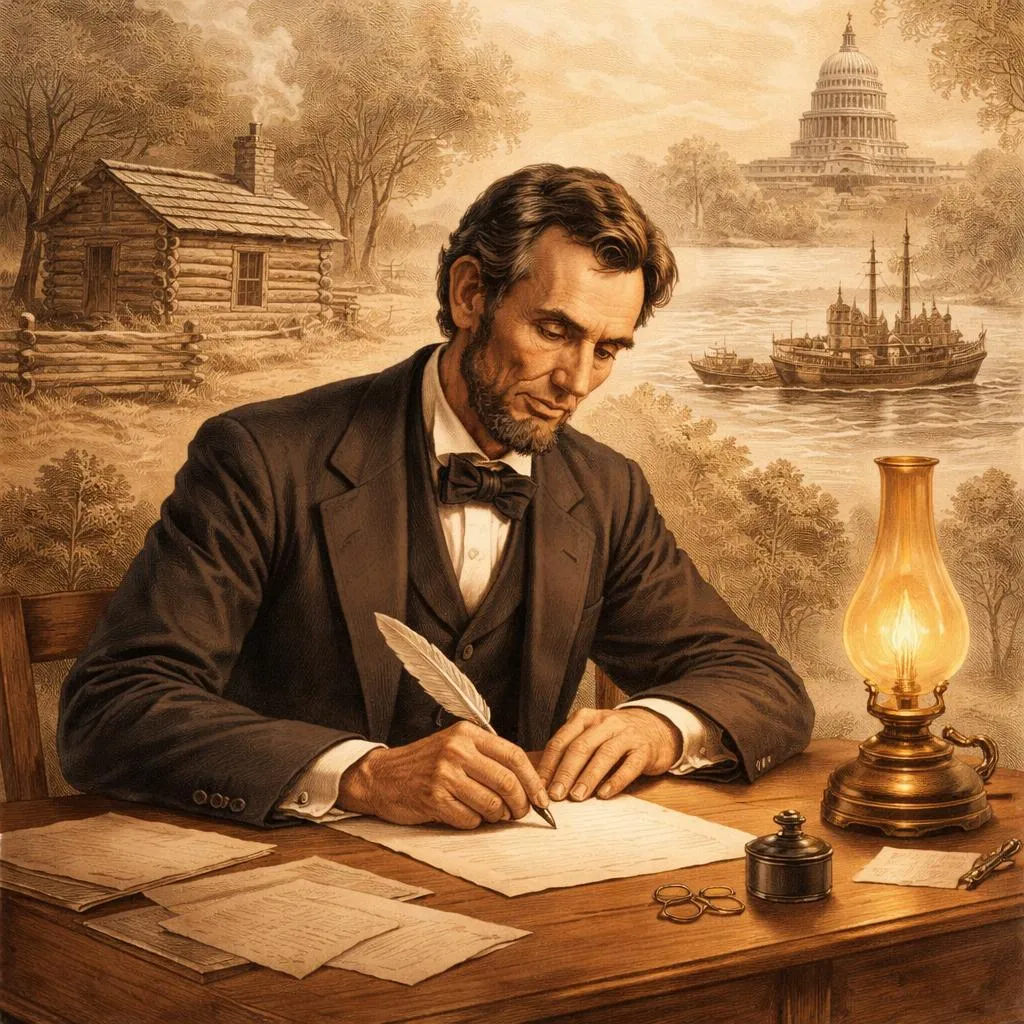

I was born February 12, 1809, in Hardin County, Kentucky. My parents were both born in Virginia, of undistinguished families—second families, perhaps I should say. My mother, who died in my tenth year, was of a family of the name of Hanks, some of whom now reside in Adams, and others in Macon County, Illinois. My paternal grandfather, Abraham Lincoln, emigrated from Rockingham County, Virginia, to Kentucky about 1781 or 1782, where a year or two later he was killed by the Indians, not in battle, but by stealth, when he was laboring to open a farm in the forest. His ancestors, who were Quakers, went to Virginia from Berks County, Pennsylvania. An effort to identify them with the New England family of the same name ended in nothing more definite than a similarity of Christian names in both families, such as Enoch, Levi, Mordecai, Solomon, Abraham, and the like.
My father, at the death of his father, was but six years of age, and he grew up literally without education. He removed from Kentucky to what is now Spencer County, Indiana in my eighth year. We reached our new home about the time the state came into the Union. It was a wild region, with many bears and other wild animals still in the woods. There I grew up. There were some schools, so called, but no qualification was ever required of a teacher beyond “readin’, writin’, and cipherin’” to the rule of three. If a straggler supposed to understand Latin happened to sojourn in the neighborhood, he was looked upon as a wizard. There was absolutely nothing to excite ambition for education. Of course, when I came of age I did not know much. Still, somehow I could read, write, and cipher to the rule of three, but that was all. I have not been to school since. The little advance I now have upon this store of education I have picked up from time to time under the pressure of necessity.
I was raised to farm work, which I continued till I was twenty-two. At twenty-one I came to Illinois, Macon County. Then I got to New Salem, at that time in Sangamon, now in Menard, County, where I remained a year as a sort of clerk in a store.
Then came the Black Hawk war, and I was elected a captain of volunteers, a success which gave me more pleasure than any I have had since. I went the campaign, was elated, ran for the legislature the same year (1832), and was beaten—the only time I have ever been beaten by the people. The next and three succeeding biennial elections I was elected to the legislature. I was not a candidate afterward. During this legislative period I had studied law, and removed to Springfield to practice it. In 1846 I was once elected to the lower house of Congress. I was not a candidate for reelection. From 1849 to 1854, both inclusive practiced law more assiduously than ever before. Always a Whig in politics; and generally on the Whig electoral tickets, making active canvasses. I was losing interest in politics when the repeal of the Missouri Compromise aroused me again. What I have done since then is pretty well known.
If any personal description of me is thought desirable, it may be said I am, in height, six feet four inches, nearly; lean in flesh, weighing on an average one hundred and eighty pounds; dark complexion, with coarse black hair and gray eyes. No other marks or brands recollected.
背景介绍和作者介绍
这段文字摘自美国第16任总统亚伯拉罕·林肯的早期生活。林肯于1809年出生于一个简朴的边疆家庭,他的故事是关于毅力、自学和对公共服务的奉献。他在艰苦和未开发的地区长大,接受正规教育的机会有限,这塑造了他的性格和价值观。尽管面临这些挑战,林肯自学法律,并成为美国历史上的关键人物,带领国家度过了最大的危机——内战。
详细解读和意义
林肯的叙述揭示了19世纪初期美国边疆生活的严酷现实。缺乏正规教育和恶劣的环境并没有阻止他寻求知识和自我提升。他早期在农业和体力劳动方面的经历使他扎根于普通人的现实,这影响了他后来的同情心和领导风格。
这段文字也强调了韧性的重要性。林肯在他的第一次政治竞选中遭遇失败,但他并没有放弃。相反,他继续追求自己的目标,最终取得了重大的政治成就。他的故事强调了挫折是成长的一部分,决心可以带来伟大的成就。
给学生的教训和启示
-
自学的重要性: 林肯的一生告诉学生,正规教育很有价值,但学习可以在课堂之外继续进行。好奇心、阅读和实践经验是个人成长的强大工具。
-
克服挑战的毅力: 学生们了解到失败不是终点,而是垫脚石。林肯最初的政治失败并没有让他气馁,反而激励他更加努力。
-
谦逊和努力工作: 林肯出身卑微,他的故事表明,成功不在于你从哪里开始,而在于你如何努力和成长。
-
领导和服务: 林肯致力于服务他的社区和国家,鼓励学生们思考如何为社会做出积极贡献。
在日常生活中运用这些教训
-
在学习中: 学生们可以效仿林肯的自学习惯,探索超出他们学校课程的课题,培养批判性思维和解决问题的能力。
-
在社交场合: 林肯的同情心和理解力提醒学生们尊重他人的背景和经历,培养善良和合作精神。
-
在面对困难时: 当学生们在学校或个人生活中遇到挫折时,他们可以记住林肯的韧性,并继续为他们的目标而奋斗。
从林肯的故事中培养积极的品质
- 好奇心: 鼓励积极提问和寻求知识。
- 决心: 设定目标,即使进展缓慢也要坚持下去。
- 正直: 在所有行动中坚持诚实和公正。
- 领导力: 练习责任感,并在小组活动或社区项目中帮助他人。
通过反思亚伯拉罕·林肯的早期生活和价值观,学生们可以找到灵感来发展他们的性格和技能,为未来的挑战和机遇做好准备。