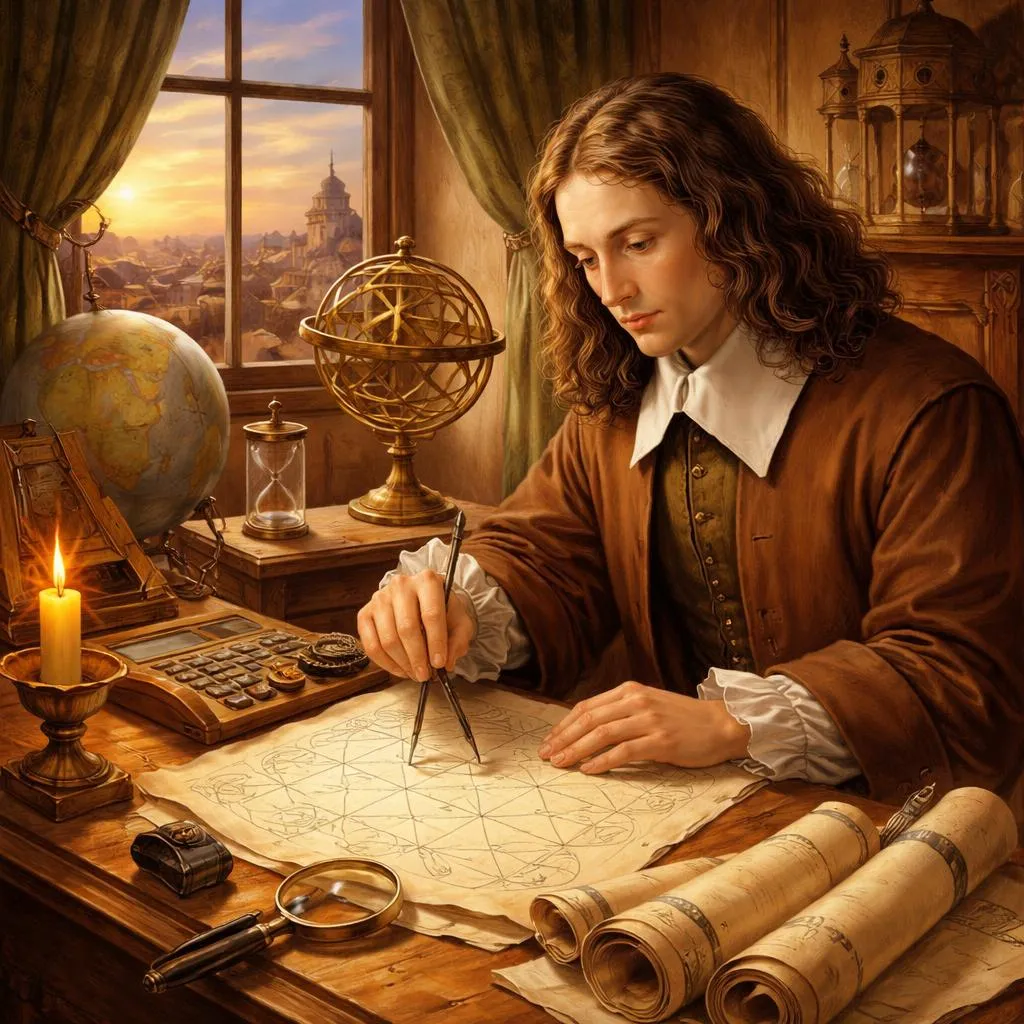

Among the contemporaries of Descartes none displayed greater natural genius than Pascal, but his mathematical reputation rests more on what he might have done than on what he actually effected, as during a considerable part of his life he deemed it his duty to devote his whole time to religious exercises.
Blaise Pascal was born at Clermont on June 19, 1623, and died at Paris on Aug. 19, 1662. His father, a local judge at Clermont, and himself of some scientific reputation, moved to Paris in 1631, partly to prosecute his own scientific studies, partly to carry on the education of his only son, who had already displayed exceptional ability. Pascal was kept at home in order to ensure his not being overworked, and with the same object it was directed that his education should be at first confined to the study of languages, and should not include any mathematics. This naturally excited the boy's curiosity, and one day, being then twelve years old, he asked in what geometry consisted. His tutor replied that it was the science of constructing exact figures and of determining the proportions between their different parts. Pascal, stimulated no doubt by the injunction against reading it, gave up his play-time to this new study, and in a few weeks had discovered for himself many properties of figures, and in particular the proposition that the sum of the angles of a triangle is equal to two right angles. I have read somewhere, but I cannot lay my hand on the authority, that his proof merely consisted in turning the angular points of a triangular piece of paper over so as to meet in the centre of the inscribed circle: a similar demonstration can be got by turning the angular points over so as to meet at the foot of the perpendicular drawn from the biggest angle to the opposite side. His father, struck by this display of ability, gave him a copy of Euclid's Elements , a book which Pascal read with avidity and soon mastered.
At the age of fourteen he was admitted to the weekly meetings of Roberval, Mersenne, Mydorge, and other French geometricians; from which, ultimately, the French Academy sprung. At sixteen Pascal wrote an essay on conic sections; and in 1641, at the age of eighteen, he constructed the first arithmetical machine, an instrument which, eight years later, he further improved. His correspondence with Fermat about this time shews that he was then turning his attention to analytical geometry and physics. He repeated Torricelli's experiments, by which the pressure of the atmosphere could be estimated as a weight, and he confirmed his theory of the cause of barometrical variations by obtaining at the same instant readings at different altitudes on the hill of Puy-de-Dôme.
In 1650, when in the midst of these researches, Pascal suddenly abandoned his favourite pursuits to study religion, or, as he says in his Pensées , "contemplate the greatness and the misery of man"; and about the same time he persuaded the younger of his two sisters to enter the Port Royal society.
In 1653 he had to administer his father's estate. He now took up his old life again, and made several experiments on the pressure exerted by gases and liquids; it was also about this period that he invented the arithmetical triangle, and together with Fermat created the calculus of probabilities. He was meditating marriage when an accident again turned the current of his thoughts to a religious life. He was driving a four-in-hand on November 23, 1654, when the horses ran away; the two leaders dashed over the parapet of the bridge at Neuilly, and Pascal was saved only by the traces breaking. Always somewhat of a mystic, he considered this a special summons to abandon the world. He wrote an account of the accident on a small piece of parchment, which for the rest of his life he wore next to his heart, to perpetually remind him of his covenant; and shortly moved to Port Royal, where he continued to live until his death in 1662. Constitutionally delicate, he had injured his health by his incessant study; from the age of seventeen or eighteen he suffered from insomnia and acute dyspepsia, and at the time of his death was physically worn out.
His famous Provincial Letters directed against the Jesuits, and his Pensées , were written towards the close of his life, and are the first example of that finished form which is characteristic of the best French literature. The only mathematical work that he produced after retiring to Port Royal was the essay on the cycloid in 1658. He was suffering from sleeplessness and toothache when the idea occurred to him, and to his surprise his teeth immediately ceased to ache. Regarding this as a divine intimation to proceed with the problem, he worked incessantly for eight days at it, and completed a tolerably full account of the geometry of the cycloid.
I now proceed to consider his mathematical works in rather greater detail.
His early essay on the geometry of conics, written in 1639, but not published till 1779, seems to have been founded on the teaching of Desargues. Two of the results are important as well as interesting. The first of these is the theorem known now as "Pascal's Theorem," namely, that if a hexagon be inscribed in a conic, the points of intersection of the opposite sides will lie in a straight line. The second, which is really due to Desargues, is that if a quadrilateral be inscribed in a conic, and a straight line be drawn cutting the sides taken in order in the points A , B , C , and D , and the conic in P and Q , then
PA . PC : PB . PD = QA . QC : QB . QD .
Pascal employed his arithmetical triangle in 1653, but no account of his method was printed till 1665. The triangle is constructed as in the figure below, each horizontal line being formed form the one above it by making every number in it equal to the sum of those above and to the left of it in the row immediately above it; ex. gr. the fourth number in the fourth line, namely, 20, is equal to 1 + 3 + 6 + 10.
The numbers in each line are what are now called figurate numbers. Those in the first line are called numbers of the first order; those in the second line, natural numbers or numbers of the second order; those in the third line, numbers of the third order, and so on. It is easily shewn that the mth number in the nth row is (m+n-2)! / (m-1)!(n-1)!
Pascal's arithmetical triangle, to any required order, is got by drawing a diagonal downwards from right to left as in the figure. The numbers in any diagonal give the coefficients of the expansion of a binomial; for example, the figures in the fifth diagonal, namely 1, 4, 6, 4, 1, are the coefficients of the expansion ( a + b ) 4 . Pascal used the triangle partly for this purpose, and partly to find the numbers of combinations of m things taken n at a time, which he stated, correctly, to be (n+1)(n+2)(n+3) ... m / (m-n)!
Perhaps as a mathematician Pascal is best known in connection with his correspondence with Fermat in 1654 in which he laid down the principles of the theory of probabilities. This correspondence arose from a problem proposed by a gamester, the Chevalier de Méré, to Pascal, who communicated it to Fermat. The problem was this. Two players of equal skill want to leave the table before finishing their game. Their scores and the number of points which constitute the game being given, it is desired to find in what proportion they should divide the stakes. Pascal and Fermat agreed on the answer, but gave different proofs. The following is a translation of Pascal's solution. That of Fermat is given later.
The following is my method for determining the share of each player when, for example, two players play a game of three points and each player has staked 32 pistoles.
Suppose that the first player has gained two points, and the second player one point; they have now to play for a point on this condition, that, if the first player gain, he takes all the money which is at stake, namely, 64 pistoles; while, if the second player gain, each player has two points, so that there are on terms of equality, and, if they leave off playing, each ought to take 32 pistoles. Thus if the first player gain, then 64 pistoles belong to him, and if he lose, then 32 pistoles belong to him. If therefore the players do not wish to play this game but to separate without playing it, the first player would say to the second, "I am certain of 32 pistoles even if I lose this game, and as for the other 32 pistoles perhaps I will have them and perhaps you will have them; the chances are equal. Let us then divide these 32 pistoles equally, and give me also the 32 pistoles of which I am certain." Thus the first player will have 48 pistoles and the second 16 pistoles.
Next, suppose that the first player has gained two points and the second player none, and that they are about to play for a point; the condition then is that, if the first player gain this point, he secures the game and takes the 64 pistoles, and, if the second player gain this point, then the players will be in the situation already examined, in which the first player is entitled to 48 pistoles and the second to 16 pistoles. Thus if they do not wish to play, the first player would say to the second, "If I gain the point I gain 64 pistoles; if I lose it, I am entitled to 48 pistoles. Give me then the 48 pistoles of which I am certain, and divide the other 16 equally, since our chances of gaining the point are equal." Thus the first player will have 56 pistoles and the second player 8 pistoles.
Finally, suppose that the first player has gained one point and the second player none. If they proceed to play for a point, the condition is that, if the first player gain it, the players will be in the situation first examined, in which the first player is entitled to 56 pistoles; if the first player lose the point, each player has then a point, and each is entitled to 32 pistoles. Thus, if they do not wish to play, the first player would say to the second, "Give me the 32 pistoles of which I am certain, and divide the remainder of the 56 pistoles equally, that is divide 24 pistoles equally." Thus the first player will have the sum of 32 and 12 pistoles, that is, 44 pistoles, and consequently the second will have 20 pistoles.
Pascal proceeds next to consider the similar problems when the game is won by whoever first obtains m + n points, and one player has m while the other has n points. The answer is obtained using the arithmetical triangle. The general solution (in which the skill of the players is unequal) is given in many modern text-books on algebra, and agrees with Pascal's result, though of course the notation of the latter is different and less convenient.
Pascal made an illegitimate use of the new theory in the seventh chapter of his Pensées . In effect, he puts his argument that, as the value of eternal happiness must be infinite, then, even if the probability of a religious life ensuring eternal happiness be very small, still the expectation (which is measured by the product of the two) must be of sufficient magnitude to make it worth while to be religious. The argument, if worth anything, would apply equally to any religion which promised eternal happiness to those who accepted its doctrines. If any conclusion may be drawn from the statement, it is the undersirability of applying mathematics to questions of morality of which some of the data are necessarily outside the range of an exact science. It is only fair to add that no one had more contempt than Pascal for those who changes their opinions according to the prospect of material benefit, and this isolated passage is at variance with the spirit of his writings.
The last mathematical work of Pascal was that on the cycloid in 1658. The cycloid is the curve traced out by a point on the circumference of a circular hoop which rolls along a straight line. Galileo, in 1630, had called attention to this curve, the shape of which is particularly graceful, and had suggested that the arches of bridges should be built in this form. Four years later, in 1634, Roberval found the area of the cycloid; Descartes thought little of this solution and defied him to find its tangents, the same challenge being also sent to Fermat who at once solved the problem. Several questions connected with the curve, and with the surface and volume generated by its revolution about its axis, base, or the tangent at its vertex, were then proposed by various mathematicians. These and some analogous question, as well as the positions of the centres of the mass of the solids formed, were solved by Pascal in 1658, and the results were issued as a challenge to the world, Wallis succeeded in solving all the questions except those connected with the centre of mass. Pascal's own solutions were effected by the method of indivisibles, and are similar to those which a modern mathematician would give by the aid of the integral calculus. He obtained by summation what are equivalent to the integrals of sin φ , sin 2 φ , and φ sin φ , one limit being either 0 or 1/2π. He also investigated the geometry of the Archimedean spiral. These researches, according to D'Alembert, form a connecting link between the geometry of Archimedes and the infinitesimal calculus of Newton.
介绍布莱兹·帕斯卡及其遗产
布莱兹·帕斯卡是一位杰出的法国数学家、物理学家、发明家、作家和哲学家,生活在17世纪。帕斯卡于1623年出生,从小就展现出非凡的天赋,尤其是在数学和科学方面。尽管他早年就很有前途并做出了重大贡献,但他一生的大部分时间都致力于宗教反思和哲学。他的工作对许多领域产生了持久的影响,包括几何学、概率论,甚至文学。
背景和历史背景
帕斯卡生活在一个科学和宗教经常交汇,有时甚至相互冲突的时代。17世纪是一个伟大的科学发现时期,笛卡尔和伽利略等人物挑战旧观念,为现代科学奠定了基础。帕斯卡是这场知识革命的一部分,但也深深地参与了宗教思想,特别是通过他与皇家港口(一个强调虔诚和道德严谨的宗教团体)的詹森主义运动的联系。
他的父亲本身是一位法官和科学家,在培养帕斯卡的早期教育方面发挥了关键作用。有趣的是,帕斯卡最初被禁止学习数学,这反而激发了他的好奇心,并促使他自己发现了许多数学真理。这种早期的自主学习为他后来的成就奠定了基础。
帕斯卡的主要贡献
-
数学和几何学: 帕斯卡在射影几何学方面取得了重要发现,包括关于圆锥曲线内接六边形的帕斯卡定理。他还开发了著名的帕斯卡三角形,这是一种有助于计算组合和二项式展开的工具,至今仍在学校教授。
-
概率论: 帕斯卡与皮埃尔·德·费马一起为现代概率论奠定了基础。他们的通信始于一个赌博问题,并演变成一个正式的数学理论,帮助我们理解机会和风险——这是统计学、经济学和决策的关键领域。
-
物理学和发明: 帕斯卡进行了关于大气压力的实验,证实并扩展了托里拆利早期的工作。他发明了最早的机械计算器之一,这是迈向现代计算的早期一步。
-
哲学和文学: 帕斯卡的《思想录》是他对人性、宗教和哲学的反思集。他著名的“赌注”论证使用概率来推论对上帝的信仰,展示了他独特的科学推理和灵性的结合。
对学生们的意义和重要性
帕斯卡的生活和工作为学生和年轻读者提供了丰富的教训:
-
好奇心和自学: 帕斯卡早期对限制的反抗以及他的自主学习表明了好奇心和独立学习的力量。学生们可以了解到,有时质疑规则并自己探索会带来伟大的发现。
-
跨学科思维: 帕斯卡将数学、科学和哲学结合起来,表明知识是相互关联的。这鼓励学生们保持开放的心态,并了解不同的学科如何相互影响和丰富。
-
平衡激情和反思: 帕斯卡从科学转向宗教沉思,提醒我们平衡智力追求与个人价值观和反思的重要性。
-
韧性和目标: 尽管健康问题和个人挑战重重,帕斯卡仍然继续工作,并深入思考重要的问题。他的毅力对任何面临困难的人都具有启发意义。
在日常生活和学习中的应用
-
数学和解决问题: 理解帕斯卡三角形和概率可以提高学生的逻辑思维和决策能力,这在游戏、学习和涉及风险的现实生活中都很有用。
-
伦理和批判性思维: 帕斯卡的哲学反思鼓励学生思考大问题——关于幸福、目标和信仰——这可以帮助他们发展自己的价值观和道德推理。
-
科学探究: 帕斯卡的实验表明了观察、测试和好奇心在科学中的重要性,鼓励学生探索和质疑周围的世界。
-
文学欣赏: 帕斯卡在书信和《思想录》中清晰优雅的写作风格是简单而优美地表达复杂思想的绝佳例子,这项技能在所有交流中都很有价值。
如何培养帕斯卡精神
-
保持好奇心: 像帕斯卡一样,不要害怕探索新话题,即使是那些看起来很难或被禁止的话题。
-
跨学科思考: 尝试将不同领域(数学、科学、文学、哲学)的想法联系起来,以获得更深入的理解。
-
反思你的信仰: 像帕斯卡晚年一样,花时间思考对你来说重要的事情。
-
坚持不懈: 挑战和挫折是学习的一部分;坚持不懈地朝着你的目标努力。
结论
布莱兹·帕斯卡的故事不仅仅是关于数学或科学;它讲述了一个年轻的头脑在好奇心、发现、信仰和反思中旅程。对于今天的学生来说,他的一生教会了我们智力激情、道德质疑和韧性的价值。通过学习帕斯卡,年轻的学习者可以培养帮助他们在学业上取得成功并成长为有思想、全面发展的人的技能和态度。