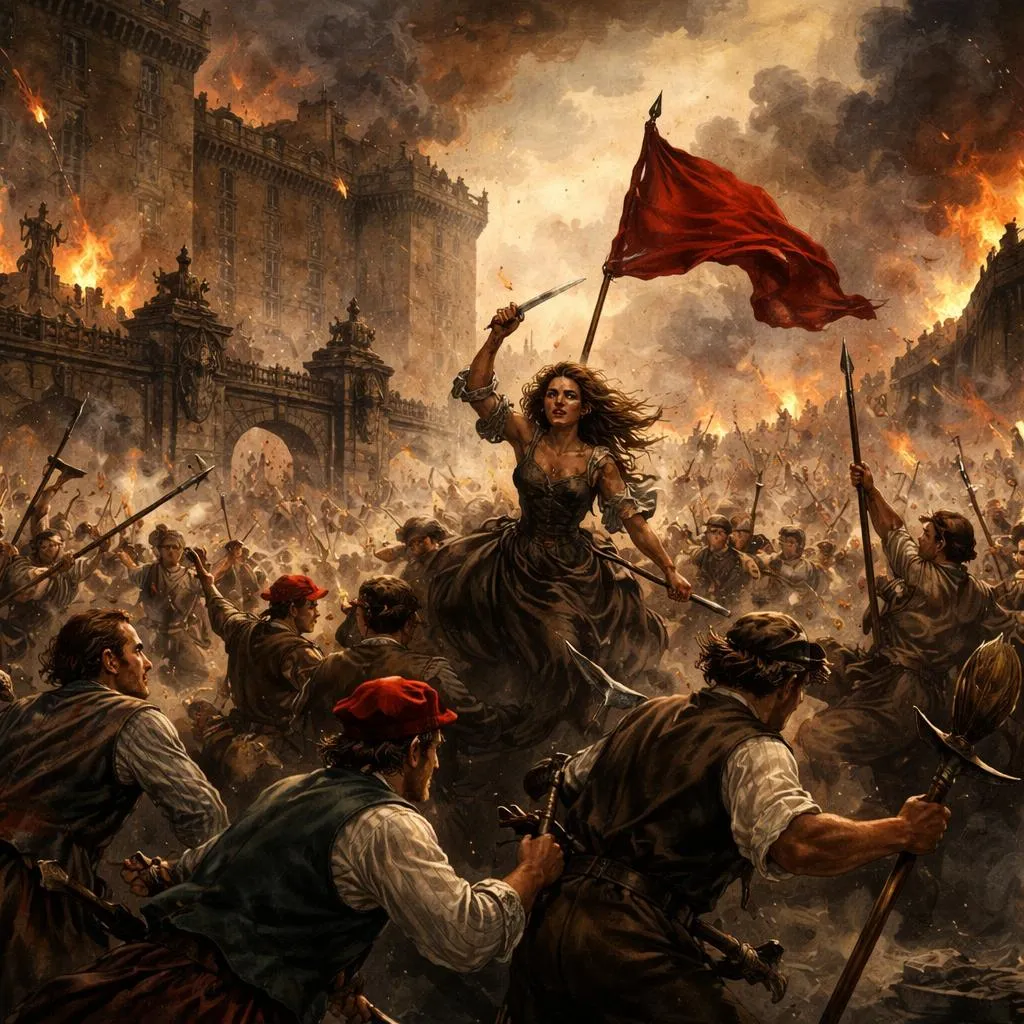

Haggard Saint Antoine had had only one exultant week, in which to soften his modicum of hard and bitter bread to such extent as he could, with the relish of fraternal embraces and congratulations, when Madame Defarge sat at her counter, as usual, presiding over the customers. Madame Defarge wore no rose in her head, for the great brotherhood of Spies had become, even in one short week, extremely chary of trusting themselves to the saint’s mercies. The lamps across his streets had a portentously elastic swing with them.
Madame Defarge, with her arms folded, sat in the morning light and heat, contemplating the wine-shop and the street. In both, there were several knots of loungers, squalid and miserable, but now with a manifest sense of power enthroned on their distress. The raggedest nightcap, awry on the wretchedest head, had this crooked significance in it: “I know how hard it has grown for me, the wearer of this, to support life in myself; but do you know how easy it has grown for me, the wearer of this, to destroy life in you?” Every lean bare arm, that bad been without work before, had this work always ready for it now, that it could strike. The fingers of the knitting women were vicious, with the experience that they could tear. There was a change in the appearance of Saint Antoine; the image had been hammering into this for hundreds of years, and the last finishing blows had told mightily on the expression.
Madame Defarge sat observing it, with such suppressed approval as was to be desired in the leader of the Saint Antoine women. One of her sisterhood knitted beside her. The short, rather plump wife of a starved grocer, and the mother of two children withal, this lieutenant had already earned the complimentary name of The Vengeance.
“Hark!” said The Vengeance. “Listen, then! Who comes?”
As if a train of powder laid from the outermost bound of Saint Antoine Quarter to the wine-shop door, had been suddenly fired, a fast-spreading murmur came rushing along.
“It is Defarge,” said madame. “Silence, patriots!”
Defarge came in breathless, pulled off a red cap he wore, and looked around him! “Listen, everywhere!” said madame again. “Listen to him!” Defarge stood, panting, against a background of eager eyes and open mouths, formed outside the door; all those within the wine-shop had sprung to their feet.
“Say then, my husband. What is it?”
“News from the other world!”
“How, then?” cried madame, contemptuously. “The other world?”
“Does everybody here recall old Foulon, who told the famished people that they might eat grass, and who died, and went to Hell?”
“Everybody!” from all throats.
“The news is of him. He is among us!”
“Among us!” from the universal throat again. “And dead?”
“Not dead! He feared us so much—and with reason—that he caused himself to be represented as dead, and had a grand mock-funeral. But they have found him alive, hiding in the country, and have brought him in. I have seen him but now, on his way to the Hotel de Ville, a prisoner. I have said that he had reason to fear us. Say all! HAD he reason?”
Wretched old sinner of more than threescore years and ten, if he had never known it yet, he would have known it in his heart of hearts if he could have heard the answering cry.
A moment of profound silence followed. Defarge and his wife looked steadfastly at one another. The Vengeance stooped, and the jar of a drum was heard as she moved it at her feet behind the counter.
“Patriots!” said Defarge, in a determined voice, “are we ready?”
Instantly Madame Defarge’s knife was in her girdle; the drum was beating in the streets, as if it and a drummer had flown together by magic; and The Vengeance, uttering terrific shrieks, and flinging her arms about her head like all the forty Furies at once, was tearing from house to house, rousing the women.
The men were terrible, in the bloody-minded anger with which they looked from windows, caught up what arms they had, and came pouring down into the streets; but, the women were a sight to chill the boldest. From such household occupations as their bare poverty yielded, from their children, from their aged and their sick crouching on the bare ground famished and naked, they ran out with streaming hair, urging one another, and themselves, to madness with the wildest cries and actions. Villain Foulon taken, my sister! Old Foulon taken, my mother! Miscreant Foulon taken, my daughter! Then, a score of others ran into the midst of these, beating their breasts, tearing their hair, and screaming, Foulon alive! Foulon who told the starving people they might eat grass! Foulon who told my old father that he might eat grass, when I had no bread to give him! Foulon who told my baby it might suck grass, when these breasts where dry with want! O mother of God, this Foulon! O Heaven our suffering! Hear me, my dead baby and my withered father: I swear on my knees, on these stones, to avenge you on Foulon! Husbands, and brothers, and young men, Give us the blood of Foulon, Give us the head of Foulon, Give us the heart of Foulon, Give us the body and soul of Foulon, Rend Foulon to pieces, and dig him into the ground, that grass may grow from him! With these cries, numbers of the women, lashed into blind frenzy, whirled about, striking and tearing at their own friends until they dropped into a passionate swoon, and were only saved by the men belonging to them from being trampled under foot.
Nevertheless, not a moment was lost; not a moment! This Foulon was at the Hotel de Ville, and might be loosed. Never, if Saint Antoine knew his own sufferings, insults, and wrongs! Armed men and women flocked out of the Quarter so fast, and drew even these last dregs after them with such a force of suction, that within a quarter of an hour there was not a human creature in Saint Antoine’s bosom but a few old crones and the wailing children.
No. They were all by that time choking the Hall of Examination where this old man, ugly and wicked, was, and overflowing into the adjacent open space and streets. The Defarges, husband and wife, The Vengeance, and Jacques Three, were in the first press, and at no great distance from him in the Hall.
“See!” cried madame, pointing with her knife. “See the old villain bound with ropes. That was well done to tie a bunch of grass upon his back. Ha, ha! That was well done. Let him eat it now!” Madame put her knife under her arm, and clapped her hands as at a play.
The people immediately behind Madame Defarge, explaining the cause of her satisfaction to those behind them, and those again explaining to others, and those to others, the neighbouring streets resounded with the clapping of hands. Similarly, during two or three hours of drawl, and the winnowing of many bushels of words, Madame Defarge’s frequent expressions of impatience were taken up, with marvellous quickness, at a distance: the more readily, because certain men who had by some wonderful exercise of agility climbed up the external architecture to look in from the windows, knew Madame Defarge well, and acted as a telegraph between her and the crowd outside the building.
At length the sun rose so high that it struck a kindly ray as of hope or protection, directly down upon the old prisoner’s head. The favour was too much to bear; in an instant the barrier of dust and chaff that had stood surprisingly long, went to the winds, and Saint Antoine had got him!
It was known directly, to the furthest confines of the crowd. Defarge had but sprung over a railing and a table, and folded the miserable wretch in a deadly embrace—Madame Defarge had but followed and turned her hand in one of the ropes with which he was tied—The Vengeance and Jacques Three were not yet up with them, and the men at the windows had not yet swooped into the Hall, like birds of prey from their high perches—when the cry seemed to go up, all over the city, “Bring him out! Bring him to the lamp!”
Down, and up, and head foremost on the steps of the building; now, on his knees; now, on his feet; now, on his back; dragged, and struck at, and stifled by the bunches of grass and straw that were thrust into his face by hundreds of hands; torn, bruised, panting, bleeding, yet always entreating and beseeching for mercy; now full of vehement agony of action, with a small clear space about him as the people drew one another back that they might see; now, a log of dead wood drawn through a forest of legs; he was hauled to the nearest street corner where one of the fatal lamps swung, and there Madame Defarge let him go—as a cat might have done to a mouse—and silently and composedly looked at him while they made ready, and while he besought her: the women passionately screeching at him all the time, and the men sternly calling out to have him killed with grass in his mouth. Once, he went aloft, and the rope broke, and they caught him shrieking; twice, he went aloft, and the rope broke, and they caught him shrieking; then, the rope was merciful, and held him, and his head was soon upon a pike, with grass enough in the mouth for all Saint Antoine to dance at the sight of.
Nor was this the end of the day’s bad work, for Saint Antoine so shouted and danced his angry blood up, that it boiled again, on hearing when the day closed in that the son-in-law of the despatched, another of the people’s enemies and insulters, was coming into Paris under a guard five hundred strong, in cavalry alone. Saint Antoine wrote his crimes on flaring sheets of paper, seized him—would have torn him out of the breast of an army to bear Foulon company—set his head and heart on pikes, and carried the three spoils of the day, in Wolf-procession through the streets.
Not before dark night did the men and women come back to the children, wailing and breadless. Then, the miserable bakers’ shops were beset by long files of them, patiently waiting to buy bad bread; and while they waited with stomachs faint and empty, they beguiled the time by embracing one another on the triumphs of the day, and achieving them again in gossip. Gradually, these strings of ragged people shortened and frayed away; and then poor lights began to shine in high windows, and slender fires were made in the streets, at which neighbours cooked in common, afterwards supping at their doors.
Scanty and insufficient suppers those, and innocent of meat, as of most other sauce to wretched bread. Yet, human fellowship infused some nourishment into the flinty viands, and struck some sparks of cheerfulness out of them. Fathers and mothers who had had their full share in the worst of the day, played gently with their meagre children; and lovers, with such a world around them and before them, loved and hoped.
It was almost morning, when Defarge’s wine-shop parted with its last knot of customers, and Monsieur Defarge said to madame his wife, in husky tones, while fastening the door:
“At last it is come, my dear!”
“Eh well!” returned madame. “Almost.”
Saint Antoine slept, the Defarges slept: even The Vengeance slept with her starved grocer, and the drum was at rest. The drum’s was the only voice in Saint Antoine that blood and hurry had not changed. The Vengeance, as custodian of the drum, could have wakened him up and had the same speech out of him as before the Bastille fell, or old Foulon was seized; not so with the hoarse tones of the men and women in Saint Antoine’s bosom.
背景介绍和作者介绍
这段文字选自查尔斯·狄更斯所著的《双城记》,这是一部历史小说,狄更斯是19世纪最受推崇的英国小说家之一。这部小说于1859年出版,背景设定在法国大革命的动荡时期,这是一个社会动荡、不公正和剧烈变革的时期。狄更斯写这部小说是为了探讨复活、牺牲以及暴政与自由之间的斗争等主题。故事对比了伦敦和巴黎这两个城市,重点讲述了在革命的混乱中挣扎的人物的生活。
详细解读和意义
这段摘录生动地描绘了巴黎圣安东尼区的气氛,这是一个贫民区,被压迫的人民正处于起义的边缘。德伐夫人是革命运动中的关键人物,象征着对贵族和那些迫害平民的人的激烈而无情的复仇精神。富隆的被捕,这位嘲笑饥饿民众的残忍贵族,点燃了人群的愤怒,导致了暴力的报复。
这一幕展现了集体愤怒的原始力量,以及被压迫者对正义的渴望。它也突出了普通人转变为革命行动者的过程,他们被苦难和对变革的渴望所驱使。狄更斯运用生动的意象和强烈的情感来传达当时的紧张局势和动荡,强调社会不公如何导致动乱和暴力。
给学生的教训和见解
-
理解历史背景: 这个故事帮助学生掌握法国大革命的原因和后果,鼓励他们探索社会不平等如何导致重大的社会变革。
-
同情心和正义: 读者了解了对遭受不公正待遇的人表示同情的重要性。这个故事挑战我们去思考残忍和忽视对人类行为和社会的影响。
-
团结的力量: 圣安东尼区人民的集体行动表明,团结可以成为变革的强大力量,激励学生在面对挑战时重视合作和团结。
-
复仇的后果: 虽然对正义的渴望是自然的,但故事也警告了不受控制的复仇的危险,促使人们反思宽恕和法治。
在生活中运用故事的精神
-
在学习中: 学生可以从人物的勇气和决心,面对困难并坚持正义,培养韧性和道德责任感。
-
在社会交往中: 故事鼓励年轻读者关注社会问题,并在社区中支持公平和善良,从而促进社会正义和同情心。
-
在个人成长中: 理解愤怒和悲伤等复杂的人类情感,有助于学生培养情商,并学习以建设性的方式处理冲突。
培养积极的价值观
-
正义与公平: 鼓励学生认识到不公正,并在日常生活中倡导公平,无论是在学校还是在社区。
-
同情心: 传授对他人的善良和理解的重要性,特别是对那些弱势或被边缘化的人。
-
勇气和希望: 激励学生勇敢地面对挑战,即使在困难的情况下也要保持希望,就像那些梦想着更美好未来的角色一样。
结论
《双城记》中的这段文字为学生提供了丰富的材料,让他们探索历史、人性以及道德价值观。通过反思故事的主题和人物,年轻的读者可以深入了解正义与革命的复杂性,并学习如何以积极和有意义的方式将这些教训应用于自己的生活。