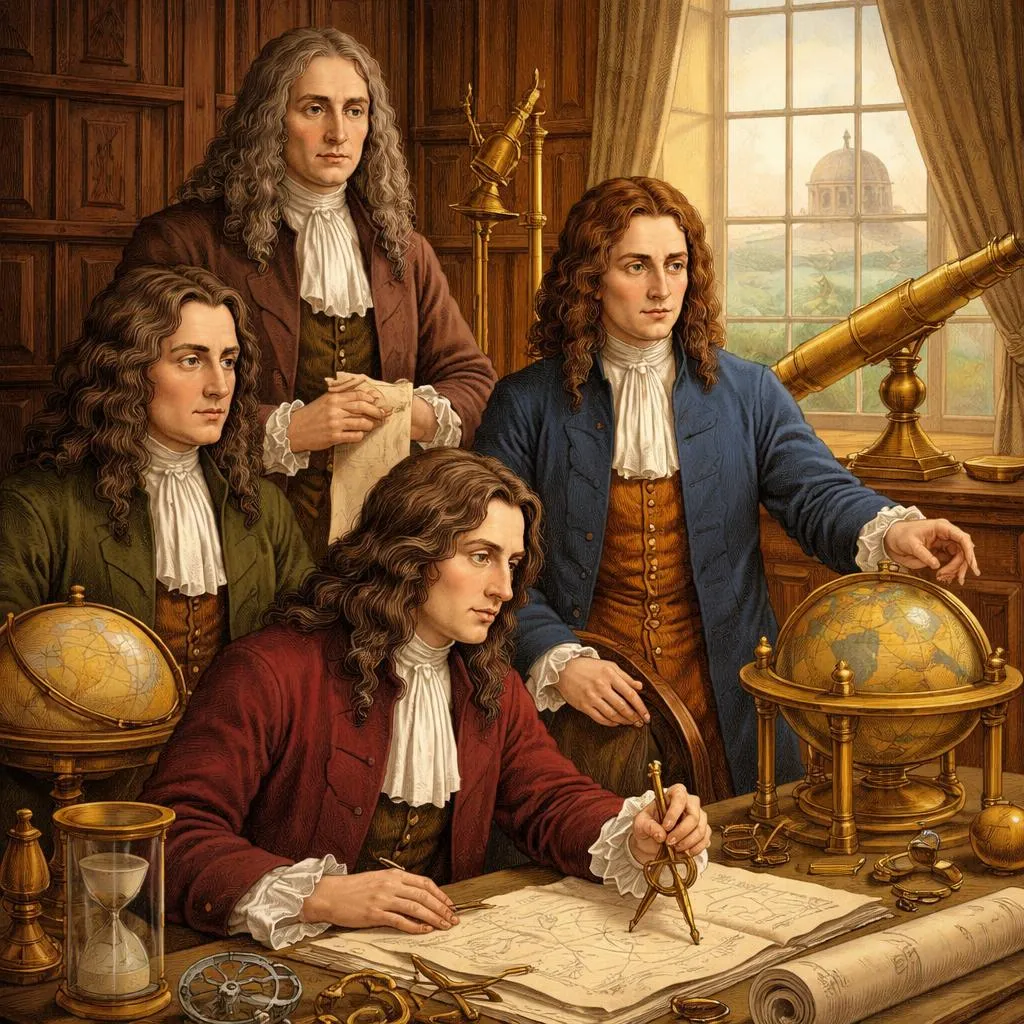

It was almost a matter of course that the English should at first have adopted the notation of Newton in the infinitesimal calculus in preference to that of Leibnitz and consequently the English school would in any case have developed on somewhat different lines to that on the continent, where a knowledge of the infinitesimal calculus was derived solely from Leibnitz and the Bernoullis. But this separation into two distinct schools became very marked owing to the action of Leibnitz and John Bernoulli, which was naturally resented by Newton's friends; and so for forty or fifty years, to the disadvantage of both sides, the quarrel raged. The leading members of the English school were Cotes, Demoivre, Ditton, David Gregory, Halley, Maclaurin, Simpson, and Taylor. I may, however, again remind my readers that as we approach modern times the number of capable mathematicians in Britain, France, Germany and Italy becomes very considerable, but that in a popular sketch like this book it is only the leading men whom I propose to mention.
To David Gregory, Halley and Ditton I need devote but few words.
David Gregory
David Gregory, the nephew of the James Gregory mentioned above, born at Aberdeen on June 24, 1661, and died at Maidenhead on Oct. 10, 1708, was appointed professor at Edinburgh in 1684, and in 1691 was on Newton's recommendation elected Savilian professor at Oxford. His chief works are one on geometry, issued in 1684; one on optics, published in 1695, which contains [p. 98] the earliest suggestion of the possibility of making an achromatic combinations of lenses; and one on the Newtonian geometry, physics, and astronomy, issued in 1702.
Halley
Edmund Halley, born in London in 1656, and died at Greenwich in 1742, was educated at St. Paul's School, London, and Queen's College, Oxford, in 1703 succeeded Wallis as Savilian professor, and subsequently in 1720 was appointed astronomer-royal in succession to Flamsteed, whose Historia Coelestis Britannica he edited; the first and imperfect edition was issued in 1712. Halley's name will be recollected for the generous manner in which he secured the immediate publication of Newton's Principia in 1687. Most of his original work was on astronomy and allied subjects, and lies outside the limits of this book; it may be, however, said that the work is of excellent quality, and both Lalande and Mairan speak of it in the highest terms. Halley conjecturally restored the eighth and lost book of the conics of Apollonius, and in 1710 brought out a magnificent edition of the whole work; he also edited the works of Serenus, those of Menelaus, and some of the minor works of Apollonius. He was in his turn succeeded at Greenwich as astronomer-royal by Bradley.
Ditton
Humphry Ditton was born at Salisbury on May 29, 1675, and died in London in 1715 at Christ's Hospital, where he was mathematical master. He does not seem to have paid much attention to mathematics until he came to London about 1705, and his early death was a distinct loss to English science. He published in 1706 a text book on fluxions; this and another similar work by William Jones, which was issued in 1711, occupied in England much the same place as l'Hospital's treatise did in France. In 1709 Ditton issued an algebra, and in 1712 a treatise on perspective. He also wrote numerous papers in the Philosophical Transactions . He was the earliest writer to attempt to explain the phenomenon of capillarity on mathematical principles; and he invented a method for finding the longditude, which has been since used on various occasions.
Cotes
Roger Cotes was born near Leicester on July 10, 1682, and died at Cambridge on June 5, 1716. He was educated at Trinity College, Cambridge, of which society he was a fellow, and in 1706 was elected to the newly-created Plumian chair of astronomy in the university of Cambridge. From 1709 to 1713 his time was mainly occupied in editing the second edition of the Principia . The remark of Newton that if only Cotes had lived "we might have known something" indicates the opinion of his abilities held by most of his contemporaries.
Cotes's writings were collected and published in 1722 under the titles Harmonia Mensurarum and Opera Miscellanea . His lectures on hydrostatics were published in 1738. A large part of the Harmonia Mensurarum is given up to the decomposition and integration of rational algebraical expressions. That part which deals with the theory of partial fractions was left unfinished, but was completed by de Moivre. Cotes's theorem in trigonometry, which depends on forming the quadratic factors of x n - 1, is well known. The proposition that "if from a fixed point O a line be drawn cutting a curve in Q 1 , Q 2 , ... , Q n , and a point P be taken on the line so that the reciprocal of OP is the arithmetic mean of the reciprocals of OQ 1 , OQ 2 , ... , OQ n , then the locus of P will be a straight line" is also due to Cotes. The title of the book was derived from the latter theorem. The Opera Miscellanea contains a paper on the method for determining the most probable result from a number of observations. This was the earliest attempt to frame a theory of errors. It also contains essays on Newton's Methodus Differentialis , on the construction of tables by the method of differences, on the descent of a body under gravity, on the cycloidal pendulum, and on projectiles.
de Moivre
Abraham de Moivre was born at Vitry on May 26, 1667, and died in London on November 27, 1754. His parents came to England when he was a boy, and his education and friends were alike English. His interest in the higher mathematics is said to have originated in his coming by chance across a copy of Newton's Principia . From the éloge on him delivered in 1754 before the French Academy it would seem that his work as a teacher of mathematics had led him to the house of the Earl of Devonshire at the instant when Newton, who had asked permission to present a copy of his work to the earl, was coming out. Taking up the book, and charmed by the far-reaching conclusions and the apparent simplicity of the reasoning, de Moivre thought nothing would be easier than to master the subject, but to his surprise found that to follow the argument overtaxed his powers. He, however, bought a copy, and as he had but little leisure he tore out the pages in order to carry one or two of them loose in his pocket so that he could study them in the intervals of his work as a teacher. Subsequently he joined the Royal Society, and became intimately connected with Newton, Halley, and other mathematicians of the English school. The manner of his death has a certain interest for psychologists. Shortly before it he declared that it was necessary for him to sleep some ten minutes or a quarter of an hour longer each day than the preceding one. The day after he had thus reached a total of something over twenty-three hours he slept up to the limit of twenty-four hours, and then died in his sleep.
He is best known for having, together with Lambert, created that part of trigonometry which deals with imaginary quantities. Two theorems on this part of the subject are still connected with his name, namely, that which asserts that sin nx + i cos nx is one of the values of (sin x + i cos x ) n , and that which gives the various quadratic factors of x 2 n - 2 px n + 1. His chief works, other than numerous papers in the Philosophical Transactions , were The Doctrine of Chances , published in 1718, and the Miscellanea Analytica , published in 1730. In the former the theory of recurring series was first given, and the theory of partial fractions which Cotes's premature death had left unfinished was completed, while the rule for finding the probability of a compound event was enunciated. The latter book, besides the trigonometrical propositions mentioned above, contains some theorems in astronomy, but they are treated as problems in analysis.
Stewart
Maclaurin was succeeded in his chair at Edinburgh by his pupil Matthew Stewart, born at Rothesay in 1717 and died at Edinburgh on January 23, 1785, a mathematician of considerable power, to whom I allude in passing, for his theorems on the problem of three bodies, and for his discussion, treated by transversals and involution, of the properties of the circle and straight line.
背景和历史背景
本文让人们得以一窥17世纪末和18世纪初英国数学和天文学的发展。它描述了英国和欧洲大陆微积分学派之间的竞争,重点介绍了艾萨克·牛顿和戈特弗里德·威廉·莱布尼茨的追随者。这场竞争塑造了数十年来数学思想的走向。文中提到的——大卫·格雷戈里、埃德蒙·哈雷、汉弗莱·迪顿、罗杰·科茨、亚伯拉罕·德·莫弗和马修·斯图尔特——是这一时期科学和数学进步的关键贡献者。
关于作者和数学家
- 艾萨克·牛顿(1643–1727):虽然这里没有详细介绍,但牛顿的著作奠定了所讨论的大部分微积分和物理学的基础。他的《自然哲学的数学原理》彻底改变了对运动和引力的理解。
- 大卫·格雷戈里(1661–1708):一位数学家和天文学家,他对几何学和光学做出了贡献,包括关于消色差透镜的早期想法。
- 埃德蒙·哈雷(1656–1742):因哈雷彗星而闻名,他还帮助出版了牛顿的著作,并对天文学做出了重大贡献。
- 汉弗莱·迪顿(1675–1715):以其关于流数(微积分)和代数的教科书而闻名,并因其在毛细管作用和经度计算方面的早期工作而闻名。
- 罗杰·科茨(1682–1716):牛顿《原理》第二版的编辑,以其在三角学中的重要定理和关于误差理论的早期工作而闻名。
- 亚伯拉罕·德·莫弗(1667–1754):概率论和涉及虚数的三角学的先驱,他的工作为统计学奠定了基础。
- 马修·斯图尔特(1717–1785):以其关于三体问题和几何性质的工作而闻名。
详细解释和意义
这一系列传记和成就突出了科学进步的协作性和有时竞争性。英国学派对牛顿符号的偏好影响了英国微积分的发展方向,而欧洲大陆的数学家则遵循莱布尼茨的方法。这两个学派之间的争论减缓了进展,但也提高了数学的严谨性。
这些作品——从几何学和光学到天文学和概率论——展示了这些领域之间的相互联系。例如,哈雷的努力确保了牛顿的革命性思想能够被更广泛的受众所接受,而德·莫弗的概率论至今已成为统计学和风险分析的基础。
给学生的经验教训和见解
- 毅力和好奇心:这些数学家中有许多都面临着挑战,从知识上的争论到个人的困境。他们孜孜不倦地研究复杂问题的精神,教会了学生奉献的价值。
- 跨学科学习:几何学、物理学、天文学和概率论的融合说明了连接不同领域以解决问题的重要性。
- 合作与尊重:尽管存在竞争,但这些学者经常在彼此的工作基础上进行研究。这表明了尊重他人的贡献和共同工作的重要性。
- 创新和批判性思维:德·莫弗对虚数和概率论的探讨,展示了创新思维如何开辟新的知识领域。
- 实际应用:从通过计算经度来改进导航到理解毛细管作用,这些发现都具有现实世界的影响,鼓励学生看到数学和科学的相关性。
在日常生活中应用这些经验教训
- 在学习中:效仿这些数学家的好奇心和纪律性,逐步解决具有挑战性的科目,并努力了解它们的实际应用。
- 在社交场合:欣赏不同的观点并互相尊重地合作,认识到进步往往来自共同的努力。
- 在解决问题中:使用跨学科的方法——结合来自不同领域的知识来寻找创造性的解决方案。
- 在个人成长中:培养耐心和毅力,知道掌握需要时间和努力。
从这些故事中培养积极的品质
学生可以学会重视终身学习,迎接挑战,并保持知识上的谦逊。这些故事鼓励拥抱新思想,即使这些思想很难理解,并强调为更大的知识社区做出贡献的重要性。
通过研究这些历史人物及其工作,学生不仅可以获得数学知识,还可以获得在科学、技术、工程和数学(STEM)领域追求自己道路的灵感,从而培养一种重视好奇心、合作和毅力的心态。