
The Round Table soon heard of the challenge, and of course it was a good deal discussed, for such things interested the boys. The king thought I ought now to set forth in quest of adventures, so that I might gain renown and be the more worthy to meet Sir Sagramor when the several years should have rolled away. I excused myself for the present; I said it would take me three or four years yet to get things well fixed up and going smoothly; then I should be ready; all the chances were that at the end of that time Sir Sagramor would still be out grailing, so no valuable time would be lost by the postponement; I should then have been in office six or seven years, and I believed my system and machinery would be so well developed that I could take a holiday without its working any harm.
I was pretty well satisfied with what I had already accomplished. In various quiet nooks and corners I had the beginnings of all sorts of industries under way—nuclei of future vast factories, the iron and steel missionaries of my future civilization. In these were gathered together the brightest young minds I could find, and I kept agents out raking the country for more, all the time. I was training a crowd of ignorant folk into experts—experts in every sort of handiwork and scientific calling. These nurseries of mine went smoothly and privately along undisturbed in their obscure country retreats, for nobody was allowed to come into their precincts without a special permit—for I was afraid of the Church.
I had started a teacher-factory and a lot of Sunday-schools the first thing; as a result, I now had an admirable system of graded schools in full blast in those places, and also a complete variety of Protestant congregations all in a prosperous and growing condition. Everybody could be any kind of a Christian he wanted to; there was perfect freedom in that matter. But I confined public religious teaching to the churches and the Sunday-schools, permitting nothing of it in my other educational buildings. I could have given my own sect the preference and made everybody a Presbyterian without any trouble, but that would have been to affront a law of human nature: spiritual wants and instincts are as various in the human family as are physical appetites, complexions, and features, and a man is only at his best, morally, when he is equipped with the religious garment whose color and shape and size most nicely accommodate themselves to the spiritual complexion, angularities, and stature of the individual who wears it; and, besides, I was afraid of a united Church; it makes a mighty power, the mightiest conceivable, and then when it by and by gets into selfish hands, as it is always bound to do, it means death to human liberty and paralysis to human thought.
All mines were royal property, and there were a good many of them. They had formerly been worked as savages always work mines—holes grubbed in the earth and the mineral brought up in sacks of hide by hand, at the rate of a ton a day; but I had begun to put the mining on a scientific basis as early as I could.
Yes, I had made pretty handsome progress when Sir Sagramor’s challenge struck me.
Four years rolled by—and then! Well, you would never imagine it in the world. Unlimited power is the ideal thing when it is in safe hands. The despotism of heaven is the one absolutely perfect government. An earthly despotism would be the absolutely perfect earthly government, if the conditions were the same, namely, the despot the perfectest individual of the human race, and his lease of life perpetual. But as a perishable perfect man must die, and leave his despotism in the hands of an imperfect successor, an earthly despotism is not merely a bad form of government, it is the worst form that is possible.
My works showed what a despot could do with the resources of a kingdom at his command. Unsuspected by this dark land, I had the civilization of the nineteenth century booming under its very nose! It was fenced away from the public view, but there it was, a gigantic and unassailable fact—and to be heard from, yet, if I lived and had luck. There it was, as sure a fact and as substantial a fact as any serene volcano, standing innocent with its smokeless summit in the blue sky and giving no sign of the rising hell in its bowels. My schools and churches were children four years before; they were grown-up now; my shops of that day were vast factories now; where I had a dozen trained men then, I had a thousand now; where I had one brilliant expert then, I had fifty now. I stood with my hand on the cock, so to speak, ready to turn it on and flood the midnight world with light at any moment. But I was not going to do the thing in that sudden way. It was not my policy. The people could not have stood it; and, moreover, I should have had the Established Roman Catholic Church on my back in a minute.
No, I had been going cautiously all the while. I had had confidential agents trickling through the country some time, whose office was to undermine knighthood by imperceptible degrees, and to gnaw a little at this and that and the other superstition, and so prepare the way gradually for a better order of things. I was turning on my light one-candle-power at a time, and meant to continue to do so.
I had scattered some branch schools secretly about the kingdom, and they were doing very well. I meant to work this racket more and more, as time wore on, if nothing occurred to frighten me. One of my deepest secrets was my West Point—my military academy. I kept that most jealously out of sight; and I did the same with my naval academy which I had established at a remote seaport. Both were prospering to my satisfaction.
Clarence was twenty-two now, and was my head executive, my right hand. He was a darling; he was equal to anything; there wasn’t anything he couldn’t turn his hand to. Of late I had been training him for journalism, for the time seemed about right for a start in the newspaper line; nothing big, but just a small weekly for experimental circulation in my civilization-nurseries. He took to it like a duck; there was an editor concealed in him, sure. Already he had doubled himself in one way; he talked sixth century and wrote nineteenth. His journalistic style was climbing, steadily; it was already up to the back settlement Alabama mark, and couldn’t be told from the editorial output of that region either by matter or flavor.
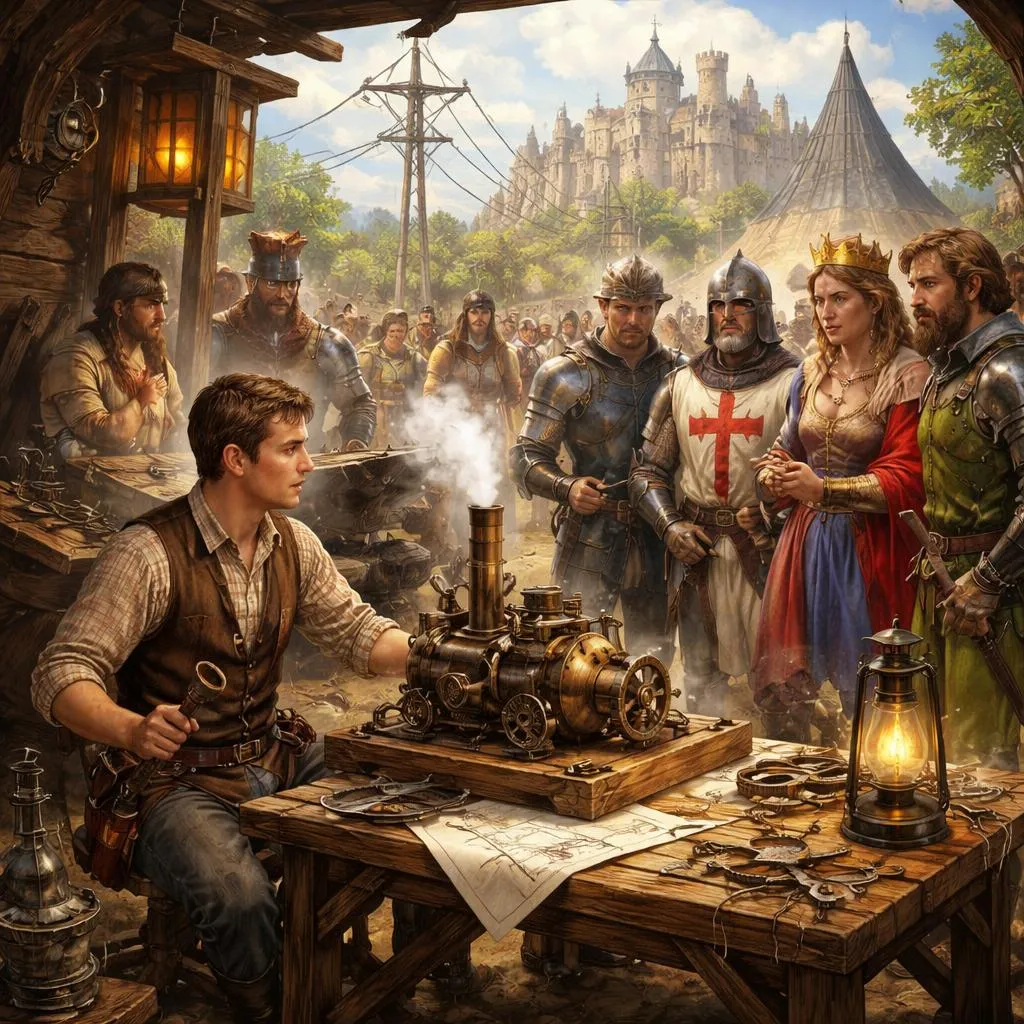
We had another large departure on hand, too. This was a telegraph and a telephone; our first venture in this line. These wires were for private service only, as yet, and must be kept private until a riper day should come. We had a gang of men on the road, working mainly by night. They were stringing ground wires; we were afraid to put up poles, for they would attract too much inquiry. Ground wires were good enough, in both instances, for my wires were protected by an insulation of my own invention which was perfect. My men had orders to strike across country, avoiding roads, and establishing connection with any considerable towns whose lights betrayed their presence, and leaving experts in charge. Nobody could tell you how to find any place in the kingdom, for nobody ever went intentionally to any place, but only struck it by accident in his wanderings, and then generally left it without thinking to inquire what its name was. At one time and another we had sent out topographical expeditions to survey and map the kingdom, but the priests had always interfered and raised trouble. So we had given the thing up, for the present; it would be poor wisdom to antagonize the Church.
As for the general condition of the country, it was as it had been when I arrived in it, to all intents and purposes. I had made changes, but they were necessarily slight, and they were not noticeable. Thus far, I had not even meddled with taxation, outside of the taxes which provided the royal revenues. I had systematized those, and put the service on an effective and righteous basis. As a result, these revenues were already quadrupled, and yet the burden was so much more equably distributed than before, that all the kingdom felt a sense of relief, and the praises of my administration were hearty and general.
Personally, I struck an interruption, now, but I did not mind it, it could not have happened at a better time. Earlier it could have annoyed me, but now everything was in good hands and swimming right along. The king had reminded me several times, of late, that the postponement I had asked for, four years before, had about run out now. It was a hint that I ought to be starting out to seek adventures and get up a reputation of a size to make me worthy of the honor of breaking a lance with Sir Sagramor, who was still out grailing, but was being hunted for by various relief expeditions, and might be found any year, now. So you see I was expecting this interruption; it did not take me by surprise.
背景介绍和作者介绍
这段文字选自马克·吐温的经典小说《亚瑟王朝廷里的康涅狄格美国佬》,马克·吐温是美国最伟大的作家之一,以其敏锐的智慧和对社会的评论而闻名。这部小说于1889年出版,融合了冒险、幻想和讽刺。吐温用这个故事探讨了进步、技术以及现代价值观与中世纪价值观之间的冲突等主题。
小说讲述了一个19世纪的美国工程师,通过一次神秘的事故,发现自己被传送回了亚瑟王和圆桌骑士的时代。他利用自己对科学和技术的了解,试图使中世纪社会现代化,经常与既定的教会和封建制度发生冲突。
详细解读和意义
在这段摘录中,叙述者描述了他为落后的王国带来进步和启蒙的努力。他秘密地建立了学校、工厂,甚至军事学院,培养年轻人并传播知识。他的目标是为社会准备一个更美好的未来,但他必须谨慎行事,以免激怒强大的教会和根深蒂固的传统。
这个故事突出了创新与传统、自由与控制之间的紧张关系,以及绝对权力的危险——即使是由一个好心的暴君掌握。叙述者对专制主义的反思揭示了吐温对集中权力的怀疑,强调即使是最好的统治者也会死亡,他们的继任者也会不完美。
给学生的启示和见解
-
教育和知识的价值: 叙述者致力于创建学校和培养专家,这表明教育是进步的基础。学生们可以了解到,持续学习和好奇心对于个人成长和社会进步至关重要。
-
挑战传统的勇气: 故事鼓励年轻读者质疑过时的信仰和制度,特别是当它们阻碍进步或自由时。它教会了批判性思维的重要性,以及坚持正确的事情,即使这很困难。
-
耐心和战略规划: 叙述者并没有仓促进行改革,而是小心谨慎地工作,他明白改变需要时间。这是一个关于毅力和深思熟虑的行动的重要一课。
-
对多样性的尊重: 通过允许宗教自由,避免强加自己的信仰,叙述者尊重个人差异。这促进了宽容和理解——和平共处的重要品质。
-
权力的责任: 这段话警告了绝对权力的危险,以及领导者需要公正和明智。学生们可以反思公平、谦逊和在领导角色中的责任感的重要性。
在日常生活中应用这些教训
-
在学习中: 将教育视为一个终生的旅程。就像叙述者建立学校和培养专家一样,学生们应该积极寻求知识,提出问题,并发展新技能。
-
在社交互动中: 尊重他人的信仰和观点,就像叙述者允许宗教自由一样。这有助于建立友谊和一个和谐的社区。
-
在面对挑战时: 在制定目标时要耐心并仔细计划。改变通常需要时间和持续的努力,所以坚持是关键。
-
在领导和责任中: 无论是在学校团体还是在家里,都要实践公平并倾听他人。要明白领导力是关于服务和帮助,而不是控制。
从故事中培养积极的特质
-
创新: 鼓励创造力和解决问题,思考改善环境或帮助他人的新方法。
-
勇气: 坚持你的价值观,并愿意以尊重的态度挑战不公平的规则或想法。
-
宽容: 欣赏多样性,并向具有不同背景和观点的人学习。
-
智慧: 做出深思熟虑的决定,并考虑你的行为的后果。
通过参与这个故事,学生们不仅可以享受一次激动人心的冒险,还可以获得对历史、伦理和个人发展的宝贵见解。马克·吐温的小说仍然是理解进步和人性的复杂性的永恒指南。