
The train had started punctually. Among the passengers were a number of officers, Government officials, and opium and indigo merchants, whose business called them to the eastern coast. Passepartout rode in the same carriage with his master, and a third passenger occupied a seat opposite to them. This was Sir Francis Cromarty, one of Mr. Fogg's whist partners on the Mongolia, now on his way to join his corps at Benares. Sir Francis was a tall, fair man of fifty, who had greatly distinguished himself in the last Sepoy revolt. He made India his home, only paying brief visits to England at rare intervals; and was almost as familiar as a native with the customs, history, and character of India and its people. But Phileas Fogg, who was not travelling, but only describing a circumference, took no pains to inquire into these subjects; he was a solid body, traversing an orbit around the terrestrial globe, according to the laws of rational mechanics. He was at this moment calculating in his mind the number of hours spent since his departure from London, and, had it been in his nature to make a useless demonstration, would have rubbed his hands for satisfaction. Sir Francis Cromarty had observed the oddity of his travelling companion—although the only opportunity he had for studying him had been while he was dealing the cards, and between two rubbers—and questioned himself whether a human heart really beat beneath this cold exterior, and whether Phileas Fogg had any sense of the beauties of nature. The brigadier–general was free to mentally confess that, of all the eccentric persons he had ever met, none was comparable to this product of the exact sciences.
Phileas Fogg had not concealed from Sir Francis his design of going round the world, nor the circumstances under which he set out; and the general only saw in the wager a useless eccentricity and a lack of sound common sense. In the way this strange gentleman was going on, he would leave the world without having done any good to himself or anybody else.
An hour after leaving Bombay the train had passed the viaducts and the Island of Salcette, and had got into the open country. At Callyan they reached the junction of the branch line which descends towards south–eastern India by Kandallah and Pounah; and, passing Pauwell, they entered the defiles of the mountains, with their basalt bases, and their summits crowned with thick and verdant forests. Phileas Fogg and Sir Francis Cromarty exchanged a few words from time to time, and now Sir Francis, reviving the conversation, observed, "Some years ago, Mr. Fogg, you would have met with a delay at this point which would probably have lost you your wager."
"How so, Sir Francis?"
"Because the railway stopped at the base of these mountains, which the passengers were obliged to cross in palanquins or on ponies to Kandallah, on the other side."
"Such a delay would not have deranged my plans in the least," said Mr. Fogg. "I have constantly foreseen the likelihood of certain obstacles."
"But, Mr. Fogg," pursued Sir Francis, "you run the risk of having some difficulty about this worthy fellow's adventure at the pagoda." Passepartout, his feet comfortably wrapped in his travelling–blanket, was sound asleep and did not dream that anybody was talking about him. "The Government is very severe upon that kind of offence. It takes particular care that the religious customs of the Indians should be respected, and if your servant were caught—"
"Very well, Sir Francis," replied Mr. Fogg; "if he had been caught he would have been condemned and punished, and then would have quietly returned to Europe. I don't see how this affair could have delayed his master."
The conversation fell again. During the night the train left the mountains behind, and passed Nassik, and the next day proceeded over the flat, well–cultivated country of the Khandeish, with its straggling villages, above which rose the minarets of the pagodas. This fertile territory is watered by numerous small rivers and limpid streams, mostly tributaries of the Godavery.
Passepartout, on waking and looking out, could not realise that he was actually crossing India in a railway train. The locomotive, guided by an English engineer and fed with English coal, threw out its smoke upon cotton, coffee, nutmeg, clove, and pepper plantations, while the steam curled in spirals around groups of palm–trees, in the midst of which were seen picturesque bungalows, viharis (sort of abandoned monasteries), and marvellous temples enriched by the exhaustless ornamentation of Indian architecture. Then they came upon vast tracts extending to the horizon, with jungles inhabited by snakes and tigers, which fled at the noise of the train; succeeded by forests penetrated by the railway, and still haunted by elephants which, with pensive eyes, gazed at the train as it passed. The travellers crossed, beyond Milligaum, the fatal country so often stained with blood by the sectaries of the goddess Kali. Not far off rose Ellora, with its graceful pagodas, and the famous Aurungabad, capital of the ferocious Aureng–Zeb, now the chief town of one of the detached provinces of the kingdom of the Nizam. It was thereabouts that Feringhea, the Thuggee chief, king of the stranglers, held his sway. These ruffians, united by a secret bond, strangled victims of every age in honour of the goddess Death, without ever shedding blood; there was a period when this part of the country could scarcely be travelled over without corpses being found in every direction. The English Government has succeeded in greatly diminishing these murders, though the Thuggees still exist, and pursue the exercise of their horrible rites.
At half–past twelve the train stopped at Burhampoor where Passepartout was able to purchase some Indian slippers, ornamented with false pearls, in which, with evident vanity, he proceeded to encase his feet. The travellers made a hasty breakfast and started off for Assurghur, after skirting for a little the banks of the small river Tapty, which empties into the Gulf of Cambray, near Surat.
Passepartout was now plunged into absorbing reverie. Up to his arrival at Bombay, he had entertained hopes that their journey would end there; but, now that they were plainly whirling across India at full speed, a sudden change had come over the spirit of his dreams. His old vagabond nature returned to him; the fantastic ideas of his youth once more took possession of him. He came to regard his master's project as intended in good earnest, believed in the reality of the bet, and therefore in the tour of the world and the necessity of making it without fail within the designated period. Already he began to worry about possible delays, and accidents which might happen on the way. He recognised himself as being personally interested in the wager, and trembled at the thought that he might have been the means of losing it by his unpardonable folly of the night before. Being much less cool–headed than Mr. Fogg, he was much more restless, counting and recounting the days passed over, uttering maledictions when the train stopped, and accusing it of sluggishness, and mentally blaming Mr. Fogg for not having bribed the engineer. The worthy fellow was ignorant that, while it was possible by such means to hasten the rate of a steamer, it could not be done on the railway.
The train entered the defiles of the Sutpour Mountains, which separate the Khandeish from Bundelcund, towards evening. The next day Sir Francis Cromarty asked Passepartout what time it was; to which, on consulting his watch, he replied that it was three in the morning. This famous timepiece, always regulated on the Greenwich meridian, which was now some seventy–seven degrees westward, was at least four hours slow. Sir Francis corrected Passepartout's time, whereupon the latter made the same remark that he had done to Fix; and upon the general insisting that the watch should be regulated in each new meridian, since he was constantly going eastward, that is in the face of the sun, and therefore the days were shorter by four minutes for each degree gone over, Passepartout obstinately refused to alter his watch, which he kept at London time. It was an innocent delusion which could harm no one.
The train stopped, at eight o'clock, in the midst of a glade some fifteen miles beyond Rothal, where there were several bungalows, and workmen's cabins. The conductor, passing along the carriages, shouted, "Passengers will get out here!"
Phileas Fogg looked at Sir Francis Cromarty for an explanation; but the general could not tell what meant a halt in the midst of this forest of dates and acacias.
Passepartout, not less surprised, rushed out and speedily returned, crying: "Monsieur, no more railway!"
"What do you mean?" asked Sir Francis.
"I mean to say that the train isn't going on."
The general at once stepped out, while Phileas Fogg calmly followed him, and they proceeded together to the conductor.
"Where are we?" asked Sir Francis.
"At the hamlet of Kholby."
"Do we stop here?"
"Certainly. The railway isn't finished."
"What! not finished?"
"No. There's still a matter of fifty miles to be laid from here to Allahabad, where the line begins again."
"But the papers announced the opening of the railway throughout."
"What would you have, officer? The papers were mistaken."
"Yet you sell tickets from Bombay to Calcutta," retorted Sir Francis, who was growing warm.
"No doubt," replied the conductor; "but the passengers know that they must provide means of transportation for themselves from Kholby to Allahabad."
Sir Francis was furious. Passepartout would willingly have knocked the conductor down, and did not dare to look at his master.
"Sir Francis," said Mr. Fogg quietly, "we will, if you please, look about for some means of conveyance to Allahabad."
"Mr. Fogg, this is a delay greatly to your disadvantage."
"No, Sir Francis; it was foreseen."
"What! You knew that the way—"
"Not at all; but I knew that some obstacle or other would sooner or later arise on my route. Nothing, therefore, is lost. I have two days, which I have already gained, to sacrifice. A steamer leaves Calcutta for Hong Kong at noon, on the 25th. This is the 22nd, and we shall reach Calcutta in time."
There was nothing to say to so confident a response.
It was but too true that the railway came to a termination at this point. The papers were like some watches, which have a way of getting too fast, and had been premature in their announcement of the completion of the line. The greater part of the travellers were aware of this interruption, and, leaving the train, they began to engage such vehicles as the village could provide four–wheeled palkigharis, waggons drawn by zebus, carriages that looked like perambulating pagodas, palanquins, ponies, and what not.
Mr. Fogg and Sir Francis Cromarty, after searching the village from end to end, came back without having found anything.
"I shall go afoot," said Phileas Fogg.
Passepartout, who had now rejoined his master, made a wry grimace, as he thought of his magnificent, but too frail Indian shoes. Happily he too had been looking about him, and, after a moment's hesitation, said, "Monsieur, I think I have found a means of conveyance."
"What?"
"An elephant! An elephant that belongs to an Indian who lives but a hundred steps from here."
"Let's go and see the elephant," replied Mr. Fogg.
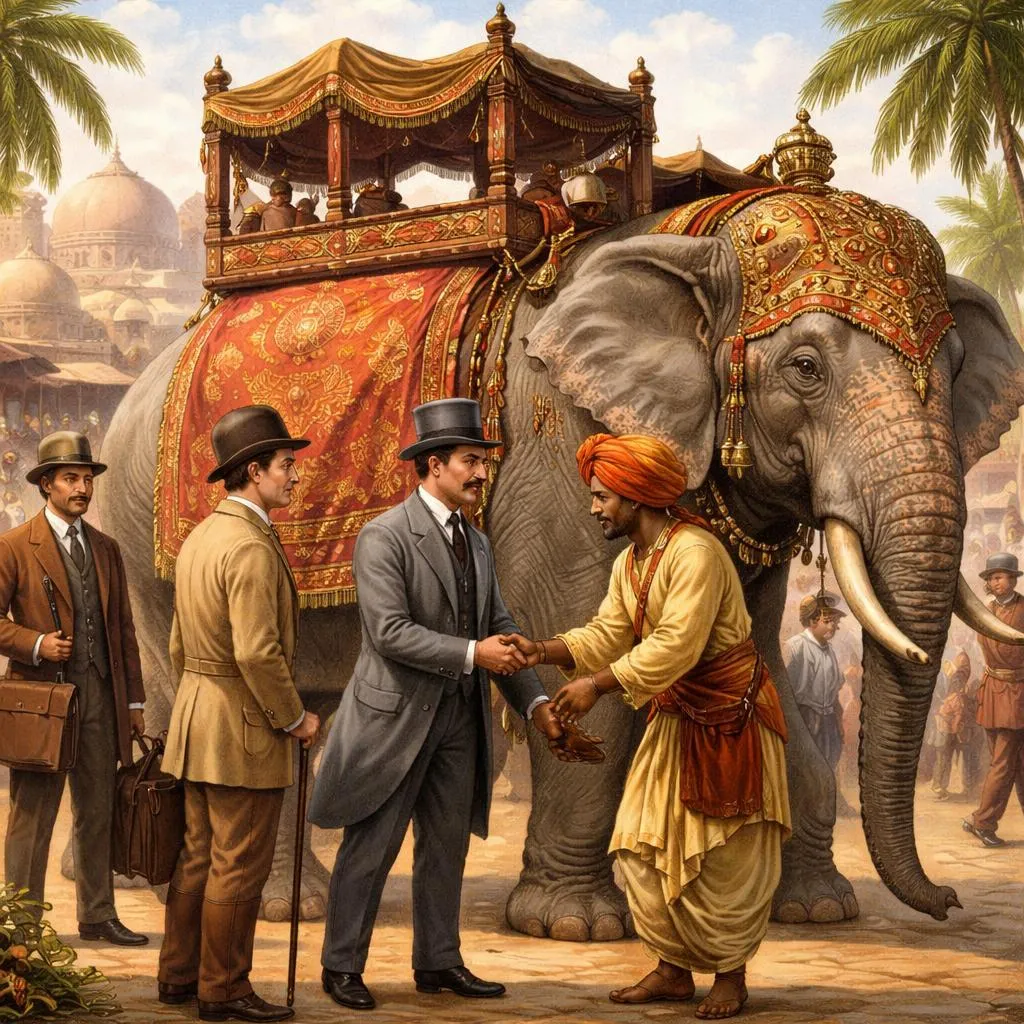
They soon reached a small hut, near which, enclosed within some high palings, was the animal in question. An Indian came out of the hut, and, at their request, conducted them within the enclosure. The elephant, which its owner had reared, not for a beast of burden, but for warlike purposes, was half domesticated. The Indian had begun already, by often irritating him, and feeding him every three months on sugar and butter, to impart to him a ferocity not in his nature, this method being often employed by those who train the Indian elephants for battle. Happily, however, for Mr. Fogg, the animal's instruction in this direction had not gone far, and the elephant still preserved his natural gentleness. Kiouni—this was the name of the beast—could doubtless travel rapidly for a long time, and, in default of any other means of conveyance, Mr. Fogg resolved to hire him. But elephants are far from cheap in India, where they are becoming scarce, the males, which alone are suitable for circus shows, are much sought, especially as but few of them are domesticated. When therefore Mr. Fogg proposed to hire Kiouni, he refused point–blank. Mr. Fogg persisted, offering the excessive sum of ten pounds an hour for the loan of the beast to Allahabad. Refused. Twenty pounds? Refused also. Forty pounds? Still refused. Passepartout jumped at each advance; but the Indian declined to be tempted. Yet the offer was an alluring one, for, supposing it took the elephant fifteen hours to reach Allahabad, his owner would receive no less than six hundred pounds sterling.
Phileas Fogg, without getting in the least flurried, then proposed to purchase the animal outright, and at first offered a thousand pounds for him. The Indian, perhaps thinking he was going to make a great bargain, still refused.
Sir Francis Cromarty took Mr. Fogg aside, and begged him to reflect before he went any further; to which that gentleman replied that he was not in the habit of acting rashly, that a bet of twenty thousand pounds was at stake, that the elephant was absolutely necessary to him, and that he would secure him if he had to pay twenty times his value. Returning to the Indian, whose small, sharp eyes, glistening with avarice, betrayed that with him it was only a question of how great a price he could obtain. Mr. Fogg offered first twelve hundred, then fifteen hundred, eighteen hundred, two thousand pounds. Passepartout, usually so rubicund, was fairly white with suspense.
At two thousand pounds the Indian yielded.
"What a price, good heavens!" cried Passepartout, "for an elephant."
It only remained now to find a guide, which was comparatively easy. A young Parsee, with an intelligent face, offered his services, which Mr. Fogg accepted, promising so generous a reward as to materially stimulate his zeal. The elephant was led out and equipped. The Parsee, who was an accomplished elephant driver, covered his back with a sort of saddle–cloth, and attached to each of his flanks some curiously uncomfortable howdahs. Phileas Fogg paid the Indian with some banknotes which he extracted from the famous carpet–bag, a proceeding that seemed to deprive poor Passepartout of his vitals. Then he offered to carry Sir Francis to Allahabad, which the brigadier gratefully accepted, as one traveller the more would not be likely to fatigue the gigantic beast. Provisions were purchased at Kholby, and, while Sir Francis and Mr. Fogg took the howdahs on either side, Passepartout got astride the saddle–cloth between them. The Parsee perched himself on the elephant's neck, and at nine o'clock they set out from the village, the animal marching off through the dense forest of palms by the shortest cut.
背景介绍和作者介绍
这段摘录选自儒勒·凡尔纳的经典冒险小说《八十天环游地球》,儒勒·凡尔纳是一位著名的法国作家,以其在科幻和冒险文学领域的开创性作品而闻名。这部小说写于1873年,讲述了细致而沉着冷静的英国绅士福克先生试图在短短八十天内环游地球一周,以赢得一笔巨额赌注的故事。凡尔纳的小说捕捉了19世纪的技术进步精神,以及蒸汽时代和铁路时代的探险热情。
故事的详细解读和意义
这段描述了福克先生在印度旅程中的一段经历,突出了他面对障碍时冷静和理性的方法,这与他仆人帕斯帕图的更情绪化和冲动的性格形成了对比。叙述揭示了19世纪旅行的挑战,例如不完善的铁路和文化复杂性,同时也生动地描述了印度景观和社会。与大象的相遇象征着适应性和足智多谋,这是小说中的关键主题。
福克先生的性格体现了理性、精确和决心。尽管遇到了意想不到的挫折,他仍然保持镇定和自信,展现了解决问题的能力和远见。帕斯帕图的态度从怀疑到完全投入的转变,说明了个人成长以及对共同目标的信念的力量。故事还触及了文化尊重和理解当地习俗的重要性,这体现在关于宗教敏感性的讨论中。
给学生的启示和见解
-
毅力和适应性: 福克先生的旅程教会学生在面对意想不到的困难时保持冷静和灵活的重要性。生活常常会遇到障碍,但保持清晰的头脑并调整计划可以带来成功。
-
文化意识: 故事鼓励尊重不同的文化和传统。在当今全球化的世界中,理解和尊重他人的习俗至关重要,这有助于培养同情心和合作精神。
-
批判性思维和规划: 福克先生的细致计算和准备工作突出了精心规划和逻辑思维的价值。学生可以学习有条不紊地应对挑战,而不是冲动行事。
-
团队合作和信任: 福克先生和帕斯帕图之间的关系表明了团队成员之间的信任和支持是多么重要。认识到彼此的优势有助于共同克服困难。
-
好奇心和开放心态: 帕斯帕图对旅程日益增长的兴趣鼓励学生拥抱好奇心,并对新体验持开放态度,这可以开阔视野并丰富理解。
在日常生活中实际应用
- 在学习中: 学生可以将福克先生的逻辑方法应用于学习中的问题解决,通过组织工作、预见挑战和有效管理时间。
- 在社交场合: 效仿福克先生对他人和蔼可亲的态度和冷静的举止,可以改善同伴之间的沟通和冲突解决。
- 在个人成长中: 像帕斯帕图一样,学生可以培养对变化和新想法的开放态度,从而培养韧性和适应能力。
- 在设定目标中: 这部小说激发了设定雄心勃勃的目标并稳步努力实现它们,提醒学生决心和耐心是取得成功的关键。
从故事中培养积极的价值观
- 纪律: 福克先生的准时和精确教会了纪律在实现目标中的重要性。
- 尊重: 对印度习俗表现出的敏感性体现了文化尊重和谦逊。
- 勇气: 勇敢地面对未知的领域和挑战,鼓励学生走出舒适区。
- 足智多谋: 寻找创造性的解决方案,例如雇用大象,表明跳出传统思维模式可以解决问题。
- 乐观: 尽管遇到挫折,仍保持信心,这是积极思考的有力一课。
通过思考这些主题,学生不仅可以培养学术技能,还可以培养社交和情感智力,为应对生活中的各种挑战做好准备。《八十天环游地球》仍然是一个永恒的故事,它激发了冒险、学习和个人成长。