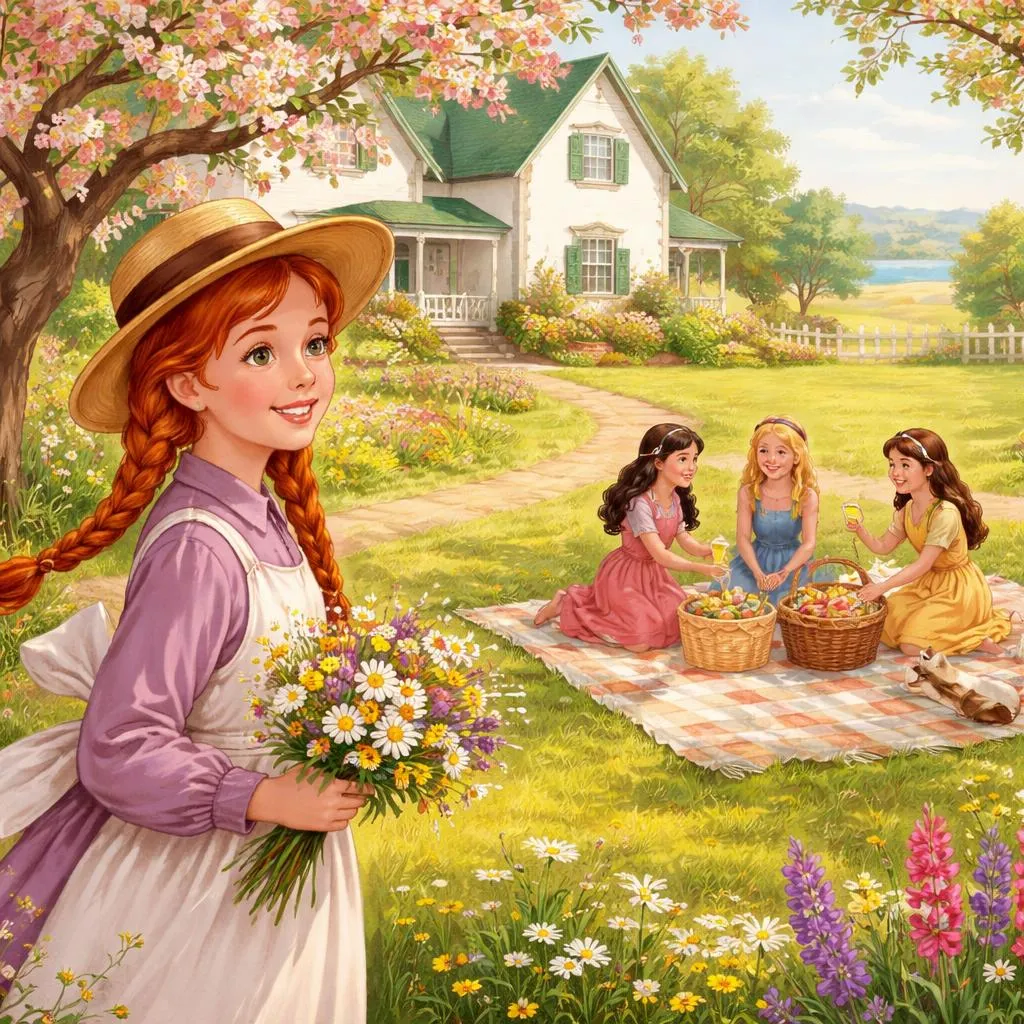

THE next afternoon Anne, bending over her patchwork at the kitchen window, happened to glance out and beheld Diana down by the Dryad’s Bubble beckoning mysteriously. In a trice Anne was out of the house and flying down to the hollow, astonishment and hope struggling in her expressive eyes. But the hope faded when she saw Diana’s dejected countenance.
“Your mother hasn’t relented?” she gasped.
Diana shook her head mournfully.
“No; and oh, Anne, she says I’m never to play with you again. I’ve cried and cried and I told her it wasn’t your fault, but it wasn’t any use. I had ever such a time coaxing her to let me come down and say good-bye to you. She said I was only to stay ten minutes and she’s timing me by the clock.”
“Ten minutes isn’t very long to say an eternal farewell in,” said Anne tearfully. “Oh, Diana, will you promise faithfully never to forget me, the friend of your youth, no matter what dearer friends may caress thee?”
“Indeed I will,” sobbed Diana, “and I’ll never have another bosom friend—I don’t want to have. I couldn’t love anybody as I love you.”
“Oh, Diana,” cried Anne, clasping her hands, “do you LOVE me?”
“Why, of course I do. Didn’t you know that?”
“No.” Anne drew a long breath. “I thought you LIKED me of course but I never hoped you LOVED me. Why, Diana, I didn’t think anybody could love me. Nobody ever has loved me since I can remember. Oh, this is wonderful! It’s a ray of light which will forever shine on the darkness of a path severed from thee, Diana. Oh, just say it once again.”
“I love you devotedly, Anne,” said Diana stanchly, “and I always will, you may be sure of that.”
“And I will always love thee, Diana,” said Anne, solemnly extending her hand. “In the years to come thy memory will shine like a star over my lonely life, as that last story we read together says. Diana, wilt thou give me a lock of thy jet-black tresses in parting to treasure forevermore?”
“Have you got anything to cut it with?” queried Diana, wiping away the tears which Anne’s affecting accents had caused to flow afresh, and returning to practicalities.
“Yes. I’ve got my patchwork scissors in my apron pocket fortunately,” said Anne. She solemnly clipped one of Diana’s curls. “Fare thee well, my beloved friend. Henceforth we must be as strangers though living side by side. But my heart will ever be faithful to thee.”
Anne stood and watched Diana out of sight, mournfully waving her hand to the latter whenever she turned to look back. Then she returned to the house, not a little consoled for the time being by this romantic parting.
“It is all over,” she informed Marilla. “I shall never have another friend. I’m really worse off than ever before, for I haven’t Katie Maurice and Violetta now. And even if I had it wouldn’t be the same. Somehow, little dream girls are not satisfying after a real friend. Diana and I had such an affecting farewell down by the spring. It will be sacred in my memory forever. I used the most pathetic language I could think of and said ‘thou’ and ‘thee.’ ‘Thou’ and ‘thee’ seem so much more romantic than ‘you.’ Diana gave me a lock of her hair and I’m going to sew it up in a little bag and wear it around my neck all my life. Please see that it is buried with me, for I don’t believe I’ll live very long. Perhaps when she sees me lying cold and dead before her Mrs. Barry may feel remorse for what she has done and will let Diana come to my funeral.”
“I don’t think there is much fear of your dying of grief as long as you can talk, Anne,” said Marilla unsympathetically.
The following Monday Anne surprised Marilla by coming down from her room with her basket of books on her arm and hip and her lips primmed up into a line of determination.
“I’m going back to school,” she announced. “That is all there is left in life for me, now that my friend has been ruthlessly torn from me. In school I can look at her and muse over days departed.”
“You’d better muse over your lessons and sums,” said Marilla, concealing her delight at this development of the situation. “If you’re going back to school I hope we’ll hear no more of breaking slates over people’s heads and such carryings on. Behave yourself and do just what your teacher tells you.”
“I’ll try to be a model pupil,” agreed Anne dolefully. “There won’t be much fun in it, I expect. Mr. Phillips said Minnie Andrews was a model pupil and there isn’t a spark of imagination or life in her. She is just dull and poky and never seems to have a good time. But I feel so depressed that perhaps it will come easy to me now. I’m going round by the road. I couldn’t bear to go by the Birch Path all alone. I should weep bitter tears if I did.”
Anne was welcomed back to school with open arms. Her imagination had been sorely missed in games, her voice in the singing and her dramatic ability in the perusal aloud of books at dinner hour. Ruby Gillis smuggled three blue plums over to her during testament reading; Ella May MacPherson gave her an enormous yellow pansy cut from the covers of a floral catalogue—a species of desk decoration much prized in Avonlea school. Sophia Sloane offered to teach her a perfectly elegant new pattern of knit lace, so nice for trimming aprons. Katie Boulter gave her a perfume bottle to keep slate water in, and Julia Bell copied carefully on a piece of pale pink paper scalloped on the edges the following effusion:“
When twilight drops her curtain down And pins it with a star Remember that you have a friend Though she may wander far.
It’s so nice to be appreciated,” sighed Anne rapturously to Marilla that night.
The girls were not the only scholars who “appreciated” her. When Anne went to her seat after dinner hour—she had been told by Mr. Phillips to sit with the model Minnie Andrews—she found on her desk a big luscious “strawberry apple.” Anne caught it up all ready to take a bite when she remembered that the only place in Avonlea where strawberry apples grew was in the old Blythe orchard on the other side of the Lake of Shining Waters. Anne dropped the apple as if it were a red-hot coal and ostentatiously wiped her fingers on her handkerchief. The apple lay untouched on her desk until the next morning, when little Timothy Andrews, who swept the school and kindled the fire, annexed it as one of his perquisites. Charlie Sloane’s slate pencil, gorgeously bedizened with striped red and yellow paper, costing two cents where ordinary pencils cost only one, which he sent up to her after dinner hour, met with a more favorable reception. Anne was graciously pleased to accept it and rewarded the donor with a smile which exalted that infatuated youth straightway into the seventh heaven of delight and caused him to make such fearful errors in his dictation that Mr. Phillips kept him in after school to rewrite it.
But as,
The Caesar's pageant shorn of Brutus' bust Did but of Rome's best son remind her more.
so the marked absence of any tribute or recognition from Diana Barry who was sitting with Gertie Pye embittered Anne’s little triumph.
“Diana might just have smiled at me once, I think,” she mourned to Marilla that night. But the next morning a note most fearfully and wonderfully twisted and folded, and a small parcel were passed across to Anne.
Dear Anne (ran the former)
Mother says I’m not to play with you or talk to you even in school. It isn’t my fault and don’t be cross at me, because I love you as much as ever. I miss you awfully to tell all my secrets to and I don’t like Gertie Pye one bit. I made you one of the new bookmarkers out of red tissue paper. They are awfully fashionable now and only three girls in school know how to make them. When you look at it remember
Your true friend
Diana Barry.
Anne read the note, kissed the bookmark, and dispatched a prompt reply back to the other side of the school.
My own darling Diana:—
Of course I am not cross at you because you have to obey your mother. Our spirits can commune. I shall keep your lovely present forever. Minnie Andrews is a very nice little girl—although she has no imagination—but after having been Diana’s busum friend I cannot be Minnie’s. Please excuse mistakes because my spelling isn’t very good yet, although much improoved.
Yours until death us do part
Anne or Cordelia Shirley.
P.S. I shall sleep with your letter under my pillow tonight. A. OR C.S.
Marilla pessimistically expected more trouble since Anne had again begun to go to school. But none developed. Perhaps Anne caught something of the “model” spirit from Minnie Andrews; at least she got on very well with Mr. Phillips thenceforth. She flung herself into her studies heart and soul, determined not to be outdone in any class by Gilbert Blythe. The rivalry between them was soon apparent; it was entirely good natured on Gilbert’s side; but it is much to be feared that the same thing cannot be said of Anne, who had certainly an unpraiseworthy tenacity for holding grudges. She was as intense in her hatreds as in her loves. She would not stoop to admit that she meant to rival Gilbert in schoolwork, because that would have been to acknowledge his existence which Anne persistently ignored; but the rivalry was there and honors fluctuated between them. Now Gilbert was head of the spelling class; now Anne, with a toss of her long red braids, spelled him down. One morning Gilbert had all his sums done correctly and had his name written on the blackboard on the roll of honor; the next morning Anne, having wrestled wildly with decimals the entire evening before, would be first. One awful day they were ties and their names were written up together. It was almost as bad as a take-notice and Anne’s mortification was as evident as Gilbert’s satisfaction. When the written examinations at the end of each month were held the suspense was terrible. The first month Gilbert came out three marks ahead. The second Anne beat him by five. But her triumph was marred by the fact that Gilbert congratulated her heartily before the whole school. It would have been ever so much sweeter to her if he had felt the sting of his defeat.
Mr. Phillips might not be a very good teacher; but a pupil so inflexibly determined on learning as Anne was could hardly escape making progress under any kind of teacher. By the end of the term Anne and Gilbert were both promoted into the fifth class and allowed to begin studying the elements of “the branches”—by which Latin, geometry, French, and algebra were meant. In geometry Anne met her Waterloo.
“It’s perfectly awful stuff, Marilla,” she groaned. “I’m sure I’ll never be able to make head or tail of it. There is no scope for imagination in it at all. Mr. Phillips says I’m the worst dunce he ever saw at it. And Gil—I mean some of the others are so smart at it. It is extremely mortifying, Marilla.
“Even Diana gets along better than I do. But I don’t mind being beaten by Diana. Even although we meet as strangers now I still love her with an INEXTINGUISHABLE love. It makes me very sad at times to think about her. But really, Marilla, one can’t stay sad very long in such an interesting world, can one?”
背景介绍与作者简介
本文摘自《绿山墙的安妮》,这是一部由加拿大作家露西·莫德·蒙哥马利创作的经典小说,于1908年首次出版。故事讲述了充满想象力和活力的孤儿安妮·雪莉,她被误送到马修和玛丽拉·卡斯伯特那里。这对兄妹原本打算收养一个男孩来帮助他们在爱德华王子岛上的农场工作。安妮的冒险、友谊和成长构成了这部小说的核心,这部小说因其温暖、幽默以及对童年和社区生活的生动描绘而享誉全球。
露西·莫德·蒙哥马利从她自己的童年和爱德华王子岛的风景中汲取灵感,使她的作品充满了对地方和人物的强烈感受。《绿山墙的安妮》是记录安妮生活的系列书籍中的第一本,它已被改编成无数电影、电视剧和舞台剧。
详细解读与意义
这段文字捕捉了安妮生命中一个令人心酸的时刻——黛安娜·巴里与她最好的朋友黛安娜·巴里被迫分离,这是黛安娜的母亲强加的。告别场景突出了友谊、忠诚以及成长的苦乐参半的本质。安妮的诗意语言和对黛安娜的深厚情感依恋,揭示了她敏感而浪漫的个性。那一缕头发象征着一种持久的纽带,即使在环境迫使身体分离时也是如此。
安妮重返学校以及她与同学的互动,说明了融入、竞争以及对接受和认可的渴望所面临的挑战。她与吉尔伯特·布莱斯之间的竞争引入了一种贯穿整个系列的动态,将竞争与最终的友谊融为一体。这段文字还触及了安妮在几何等学术科目上的挣扎,表明即使是聪明而坚定的学生也会面临困难,这对年轻读者来说是一个现实而令人鼓舞的信息。
给学生的启示和灵感
-
**真挚友谊的价值:**安妮和黛安娜之间的纽带教会了我们忠诚、信任和分离的痛苦。真正的朋友会在情感上互相支持,即使外部力量造成距离。学生们可以学会珍惜他们的友谊,并在困难时期与朋友们坦诚沟通。
-
**情感表达和韧性:**安妮发自内心的告别和她的诗意表达表明,深刻地表达情感是健康的。与此同时,安妮决定重返学校并专注于学业,这表明了韧性——面对悲伤并继续前进的能力。
-
**积极处理竞争:**安妮和吉尔伯特之间的竞争既有竞争性,也互相尊重。这表明竞争可以激励我们进步,但它不应该导致痛苦或怨恨。学生们可以通过努力争取个人最佳成绩,同时保持对同伴的友善来应用这一点。
-
**拥抱挑战:**安妮在几何方面的困难提醒我们,每个人都有优点和缺点。对学习新事物的坚持和积极态度至关重要。学生们不应该因为他们觉得困难的科目而气馁,而应该寻求帮助并不断尝试。
-
**想象力和个性:**安妮富有想象力的天性丰富了她自己和周围人的生活。鼓励学生们重视他们独特的品质和创造才能,这可以帮助他们解决问题并更充分地享受生活。
在日常生活中应用这些经验教训
-
**在学校:**学生们可以通过友善、值得信赖和支持来培养友谊。当面临学业挑战时,他们应该记住安妮的决心,并在需要时寻求帮助。健康的竞争可以成为成长的工具,而不是冲突。
-
**在社交场合:**诚实和尊重地表达感受可以加深人际关系。当友谊面临困难时,保持希望和沟通很重要。像安妮一样,学生们可以在回忆和友谊的小标记中找到安慰。
-
**在个人成长中:**培养韧性有助于克服挫折。拥抱一个人的独特性和想象力可以带来充实而快乐的生活。学生们应该庆祝他们的成功,并从失败中学习,而不会失去信心。
从故事中培养积极的特质
- **忠诚:**做一个可靠的朋友,在顺境和逆境中都支持他人。
- **同情心:**理解并分享朋友的感受,尤其是在艰难的时刻。
- **毅力:**即使任务看起来很困难或令人沮丧,也要努力工作。
- **尊重的竞争:**公平竞争并庆祝他人的成就。
- **创造力:**运用想象力来丰富学习和解决问题。
通过反思安妮的经历,学生们可以培养情商、社交技能和对学习的热爱,这将使他们在整个生活中受益。《绿山墙的安妮》仍然是一个永恒的故事,它激励读者以勇气、善良和希望拥抱生活的欢乐和挑战。