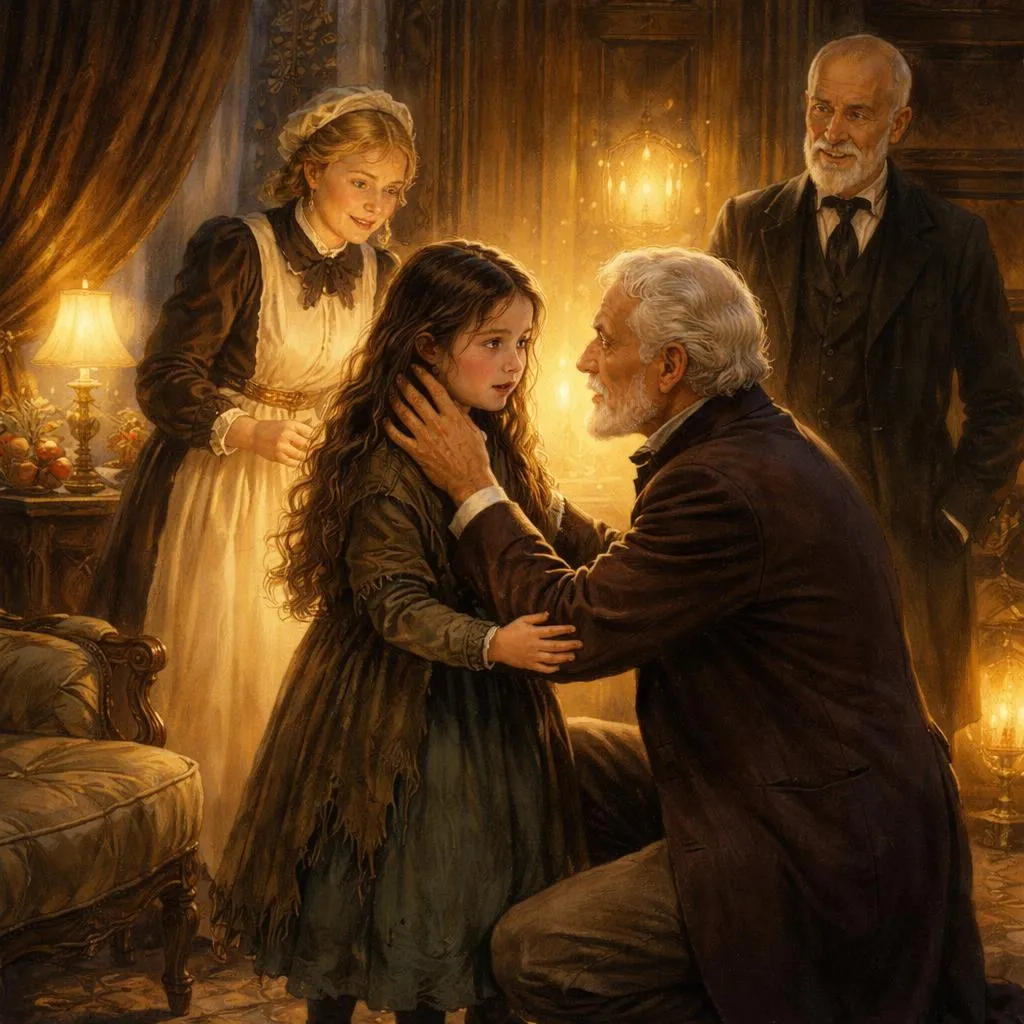

The next afternoon three members of the Large Family sat in the Indian gentleman’s library, doing their best to cheer him up. They had been allowed to come in to perform this office because he had specially invited them. He had been living in a state of suspense for some time, and today he was waiting for a certain event very anxiously. This event was the return of Mr. Carmichael from Moscow. His stay there had been prolonged from week to week. On his first arrival there, he had not been able satisfactorily to trace the family he had gone in search of. When he felt at last sure that he had found them and had gone to their house, he had been told that they were absent on a journey. His efforts to reach them had been unavailing, so he had decided to remain in Moscow until their return. Mr. Carrisford sat in his reclining chair, and Janet sat on the floor beside him. He was very fond of Janet. Nora had found a footstool, and Donald was astride the tiger’s head which ornamented the rug made of the animal’s skin. It must be owned that he was riding it rather violently.
“Don’t chirrup so loud, Donald,” Janet said. “When you come to cheer an ill person up you don’t cheer him up at the top of your voice. Perhaps cheering up is too loud, Mr. Carrisford?” turning to the Indian gentleman.
But he only patted her shoulder.
“No, it isn’t,” he answered. “And it keeps me from thinking too much.”
“I’m going to be quiet,” Donald shouted. “We’ll all be as quiet as mice.”
“Mice don’t make a noise like that,” said Janet.
Donald made a bridle of his handkerchief and bounced up and down on the tiger’s head.
“A whole lot of mice might,” he said cheerfully. “A thousand mice might.”
“I don’t believe fifty thousand mice would,” said Janet, severely; “and we have to be as quiet as one mouse.”
Mr. Carrisford laughed and patted her shoulder again.
“Papa won’t be very long now,” she said. “May we talk about the lost little girl?”
“I don’t think I could talk much about anything else just now,” the Indian gentleman answered, knitting his forehead with a tired look.
“We like her so much,” said Nora. “We call her the little un- fairy princess.”
“Why?” the Indian gentleman inquired, because the fancies of the Large Family always made him forget things a little.
It was Janet who answered.
“It is because, though she is not exactly a fairy, she will be so rich when she is found that she will be like a princess in a fairy tale. We called her the fairy princess at first, but it didn’t quite suit.”
“Is it true,” said Nora, “that her papa gave all his money to a friend to put in a mine that had diamonds in it, and then the friend thought he had lost it all and ran away because he felt as if he was a robber?”
“But he wasn’t really, you know,” put in Janet, hastily.
The Indian gentleman took hold of her hand quickly.
“No, he wasn’t really,” he said.
“I am sorry for the friend,” Janet said; “I can’t help it. He didn’t mean to do it, and it would break his heart. I am sure it would break his heart.”
“You are an understanding little woman, Janet,” the Indian gentleman said, and he held her hand close.
“Did you tell Mr. Carrisford,” Donald shouted again, “about the little-girl-who-isn’t-a-beggar? Did you tell him she has new nice clothes? P’r’aps she’s been found by somebody when she was lost.”
“There’s a cab!” exclaimed Janet. “It’s stopping before the door. It is papa!”
They all ran to the windows to look out.
“Yes, it’s papa,” Donald proclaimed. “But there is no little girl.”
All three of them incontinently fled from the room and tumbled into the hall. It was in this way they always welcomed their father. They were to be heard jumping up and down, clapping their hands, and being caught up and kissed.
Mr. Carrisford made an effort to rise and sank back again.
“It is no use,” he said. “What a wreck I am!”
Mr. Carmichael’s voice approached the door.
“No, children,” he was saying; “you may come in after I have talked to Mr. Carrisford. Go and play with Ram Dass.”
Then the door opened and he came in. He looked rosier than ever, and brought an atmosphere of freshness and health with him; but his eyes were disappointed and anxious as they met the invalid’s look of eager question even as they grasped each other’s hands.
“What news?” Mr. Carrisford asked. “The child the Russian people adopted?”
“She is not the child we are looking for,” was Mr. Carmichael’s answer. “She is much younger than Captain Crewe’s little girl. Her name is Emily Carew. I have seen and talked to her. The Russians were able to give me every detail.”
How wearied and miserable the Indian gentleman looked! His hand dropped from Mr. Carmichael’s.
“Then the search has to be begun over again,” he said. “That is all. Please sit down.”
Mr. Carmichael took a seat. Somehow, he had gradually grown fond of this unhappy man. He was himself so well and happy, and so surrounded by cheerfulness and love, that desolation and broken health seemed pitifully unbearable things. If there had been the sound of just one gay little high-pitched voice in the house, it would have been so much less forlorn. And that a man should be compelled to carry about in his breast the thought that he had seemed to wrong and desert a child was not a thing one could face.
“Come, come,” he said in his cheery voice; “we’ll find her yet.”
“We must begin at once. No time must be lost,” Mr. Carrisford fretted. “Have you any new suggestion to make—any whatsoever?”
Mr. Carmichael felt rather restless, and he rose and began to pace the room with a thoughtful, though uncertain face.
“Well, perhaps,” he said. “I don’t know what it may be worth. The fact is, an idea occurred to me as I was thinking the thing over in the train on the journey from Dover.”
“What was it? If she is alive, she is somewhere.”
“Yes; she is somewhere. We have searched the schools in Paris. Let us give up Paris and begin in London. That was my idea—to search London.”
“There are schools enough in London,” said Mr. Carrisford. Then he slightly started, roused by a recollection. “By the way, there is one next door.”
“Then we will begin there. We cannot begin nearer than next door.”
“No,” said Carrisford. “There is a child there who interests me; but she is not a pupil. And she is a little dark, forlorn creature, as unlike poor Crewe as a child could be.”
Perhaps the Magic was at work again at that very moment—the beautiful Magic. It really seemed as if it might be so. What was it that brought Ram Dass into the room—even as his master spoke—salaaming respectfully, but with a scarcely concealed touch of excitement in his dark, flashing eyes?
“Sahib,” he said, “the child herself has come—the child the sahib felt pity for. She brings back the monkey who had again run away to her attic under the roof. I have asked that she remain. It was my thought that it would please the sahib to see and speak with her.”
“Who is she?” inquired Mr. Carmichael.
“God knows,” Mr. Carrrisford answered. “She is the child I spoke of. A little drudge at the school.” He waved his hand to Ram Dass, and addressed him. “Yes, I should like to see her. Go and bring her in.” Then he turned to Mr. Carmichael. “While you have been away,” he explained, “I have been desperate. The days were so dark and long. Ram Dass told me of this child’s miseries, and together we invented a romantic plan to help her. I suppose it was a childish thing to do; but it gave me something to plan and think of. Without the help of an agile, soft-footed Oriental like Ram Dass, however, it could not have been done.”
Then Sara came into the room. She carried the monkey in her arms, and he evidently did not intend to part from her, if it could be helped. He was clinging to her and chattering, and the interesting excitement of finding herself in the Indian gentleman’s room had brought a flush to Sara’s cheeks.
“Your monkey ran away again,” she said, in her pretty voice. “He came to my garret window last night, and I took him in because it was so cold. I would have brought him back if it had not been so late. I knew you were ill and might not like to be disturbed.”
The Indian gentleman’s hollow eyes dwelt on her with curious interest.
“That was very thoughtful of you,” he said.
Sara looked toward Ram Dass, who stood near the door.
“Shall I give him to the Lascar?” she asked.
“How do you know he is a Lascar?” said the Indian gentleman, smiling a little.
“Oh, I know Lascars,” Sara said, handing over the reluctant monkey. “I was born in India.”
The Indian gentleman sat upright so suddenly, and with such a change of expression, that she was for a moment quite startled.
“You were born in India,” he exclaimed, “were you? Come here.” And he held out his hand.
Sara went to him and laid her hand in his, as he seemed to want to take it. She stood still, and her green-gray eyes met his wonderingly. Something seemed to be the matter with him.
“You live next door?” he demanded.
“Yes; I live at Miss Minchin’s seminary.”
“But you are not one of her pupils?”
A strange little smile hovered about Sara’s mouth. She hesitated a moment.
“I don’t think I know exactly what I am,” she replied.
“Why not?”
“At first I was a pupil, and a parlor boarder; but now—”
“You were a pupil! What are you now?”
The queer little sad smile was on Sara’s lips again.
“I sleep in the attic, next to the scullery maid,” she said. “I run errands for the cook—I do anything she tells me; and I teach the little ones their lessons.”
“Question her, Carmichael,” said Mr. Carrisford, sinking back as if he had lost his strength. “Question her; I cannot.”
The big, kind father of the Large Family knew how to question little girls. Sara realized how much practice he had had when he spoke to her in his nice, encouraging voice.
“What do you mean by `At first,’ my child?” he inquired.
“When I was first taken there by my papa.”
“Where is your papa?”
“He died,” said Sara, very quietly. “He lost all his money and there was none left for me. There was no one to take care of me or to pay Miss Minchin.”
“Carmichael!” the Indian gentleman cried out loudly. “Carmichael!”
“We must not frighten her,” Mr. Carmichael said aside to him in a quick, low voice. And he added aloud to Sara, “So you were sent up into the attic, and made into a little drudge. That was about it, wasn’t it?”
“There was no one to take care of me,” said Sara. “There was no money; I belong to nobody.”
“How did your father lose his money?” the Indian gentleman broke in breathlessly.
“He did not lose it himself,” Sara answered, wondering still more each moment. “He had a friend he was very fond of—he was very fond of him. It was his friend who took his money. He trusted his friend too much.”
The Indian gentleman’s breath came more quickly.
“The friend might have meant to do no harm,” he said. “It might have happened through a mistake.”
Sara did not know how unrelenting her quiet young voice sounded as she answered. If she had known, she would surely have tried to soften it for the Indian gentleman’s sake.
“The suffering was just as bad for my papa,” she said. It killed him.”
“What was your father’s name?” the Indian gentleman said. “Tell me.”
“His name was Ralph Crewe,” Sara answered, feeling startled. “Captain Crewe. He died in India.”
The haggard face contracted, and Ram Dass sprang to his master’s side.
“Carmichael,” the invalid gasped, “it is the child—the child!”
For a moment Sara thought he was going to die. Ram Dass poured out drops from a bottle, and held them to his lips. Sara stood near, trembling a little. She looked in a bewildered way at Mr. Carmichael.
“What child am I?” she faltered.
“He was your father’s friend,” Mr. Carmichael answered her. “Don’t be frightened. We have been looking for you for two years.”
Sara put her hand up to her forehead, and her mouth trembled. She spoke as if she were in a dream.
“And I was at Miss Minchin’s all the while,” she half whispered. “Just on the other side of the wall.”
背景介绍和作者介绍
这段摘录选自弗朗西丝·霍奇森·伯内特的经典小说《小公主》,该书于1905年首次出版。伯内特是一位英裔美国作家,以其儿童文学作品而闻名,包括《秘密花园》和《小法兰克罗伊》。她的故事经常探讨坚韧、善良和转变的主题,激励了一代又一代的读者。
《小公主》的故事背景设定在维多利亚时代的英国,讲述了萨拉·克鲁的故事,一个面临困境和失去的年轻女孩,但她保持着尊严和善良。叙事反映了当时的社会问题,例如阶级差异以及对孤儿和没有财富的儿童的待遇。
详细分析和意义
这段话捕捉了希望与绝望交织的关键时刻。卡里斯福德先生,这位印度绅士,焦急地等待着关于萨拉的消息,萨拉是失去的小女孩,也是一笔财富的合法继承人。大户人家的孩子们,天真而充满爱心,在卡里斯福德先生生病期间给他带来了安慰。他们富有想象力的绰号和顽皮的行为与搜寻的严肃基调形成了对比,突出了天真和同情的主题。
萨拉在这场戏中的出场令人动容。尽管她被贬为明钦小姐的寄宿学校里的仆人,但她的精神依然不屈不挠。她父亲悲惨的命运和背叛的揭示增加了情感深度,表明信任和不幸如何塑造了她的人生。这位印度绅士的反应强调了萨拉身份的重要性以及对她获救和恢复的希望。
这个故事强调了即使在逆境中,善良、勇气和希望的力量。萨拉的性格体现了优雅和韧性,教导读者真正的贵族来自一个人的内心和行动,而不是财富或地位。
给学生的教训和启发
-
韧性和乐观: 萨拉在逆境中保持善良和希望的能力激励读者以勇气和积极的态度面对自己的挑战。
-
同情心和同情: 大户人家对卡里斯福德先生的关怀以及他们对萨拉的喜爱,表明了支持他人的重要性,尤其是那些正在受苦或孤独的人。
-
内在力量的价值: 故事告诉我们,真正的力量在于性格和善良,而不是外部环境或物质财富。
-
信任和宽恕: 萨拉的故事涉及背叛和失去,但它也展示了宽恕和新开始的可能性,鼓励读者理解和充满希望。
在日常生活中运用故事的精神
- 在学校: 学生可以学会成为友善的同学,帮助可能正在挣扎的朋友,并在小组作业或社交场合表现出同情心。
- 在家庭中: 像大户人家一样,孩子们可以通过开朗和支持来给生病或悲伤的家人带来欢乐和安慰。
- 在友谊中: 萨拉的故事鼓励诚实、忠诚,并在艰难时期支持朋友。
- 个人成长: 读者可以通过以耐心和希望面对困难,从萨拉的榜样中学习来培养韧性。
从故事中培养积极的品质
- 想象力和趣味性: 大户人家富有想象力的绰号和顽皮的精神表明,即使在严肃的时刻,创造力也能带来轻松。
- 责任感和乐于助人: 萨拉在教导年幼的孩子和跑腿方面的作用反映了责任感和乐于助人的态度,这是个人发展的重要特质。
- 希望和耐心: 持续寻找萨拉提醒我们,在朝着目标努力或等待改变时,希望和耐心是必不可少的。
结论
《小公主》仍然是一个永恒的故事,引起了所有年龄段读者的共鸣。它丰富的人物和衷心的主题提供了关于善良、韧性和希望的宝贵教训。通过反思萨拉的旅程和大户人家的温暖,学生可以学习如何以优雅和同情心面对生活的挑战,通过他们的行动和态度让世界变得更美好。