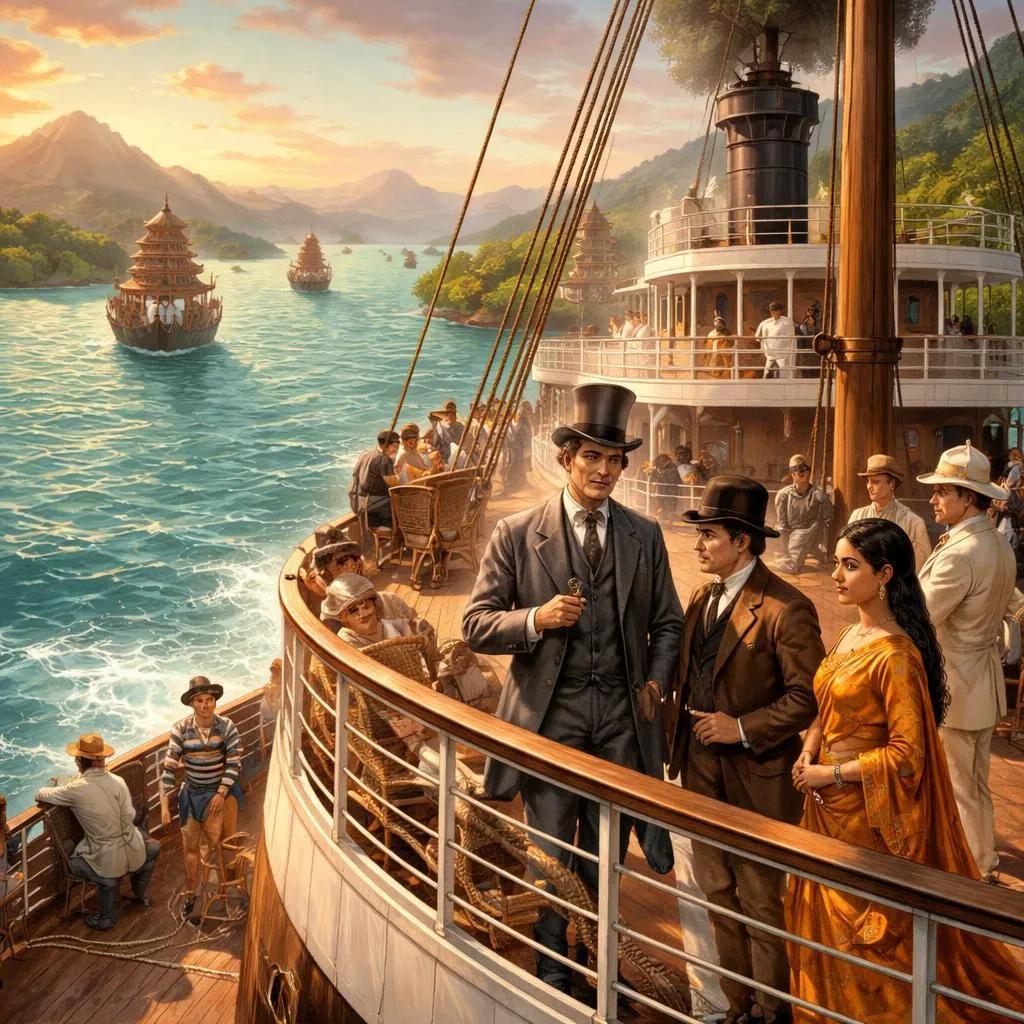

The detective and Passepartout met often on deck after this interview, though Fix was reserved, and did not attempt to induce his companion to divulge any more facts concerning Mr. Fogg. He caught a glimpse of that mysterious gentleman once or twice; but Mr. Fogg usually confined himself to the cabin, where he kept Aouda company, or, according to his inveterate habit, took a hand at whist.
Passepartout began very seriously to conjecture what strange chance kept Fix still on the route that his master was pursuing. It was really worth considering why this certainly very amiable and complacent person, whom he had first met at Suez, had then encountered on board the Mongolia, who disembarked at Bombay, which he announced as his destination, and now turned up so unexpectedly on the Rangoon, was following Mr. Fogg's tracks step by step. What was Fix's object? Passepartout was ready to wager his Indian shoes—which he religiously preserved—that Fix would also leave Hong Kong at the same time with them, and probably on the same steamer.
Passepartout might have cudgelled his brain for a century without hitting upon the real object which the detective had in view. He never could have imagined that Phileas Fogg was being tracked as a robber around the globe. But, as it is in human nature to attempt the solution of every mystery, Passepartout suddenly discovered an explanation of Fix's movements, which was in truth far from unreasonable. Fix, he thought, could only be an agent of Mr. Fogg's friends at the Reform Club, sent to follow him up, and to ascertain that he really went round the world as had been agreed upon.
"It's clear!" repeated the worthy servant to himself, proud of his shrewdness. "He's a spy sent to keep us in view! That isn't quite the thing, either, to be spying Mr. Fogg, who is so honourable a man! Ah, gentlemen of the Reform, this shall cost you dear!"
Passepartout, enchanted with his discovery, resolved to say nothing to his master, lest he should be justly offended at this mistrust on the part of his adversaries. But he determined to chaff Fix, when he had the chance, with mysterious allusions, which, however, need not betray his real suspicions.
During the afternoon of Wednesday, 30th October, the Rangoon entered the Strait of Malacca, which separates the peninsula of that name from Sumatra. The mountainous and craggy islets intercepted the beauties of this noble island from the view of the travellers. The Rangoon weighed anchor at Singapore the next day at four a.m., to receive coal, having gained half a day on the prescribed time of her arrival. Phileas Fogg noted this gain in his journal, and then, accompanied by Aouda, who betrayed a desire for a walk on shore, disembarked.
Fix, who suspected Mr. Fogg's every movement, followed them cautiously, without being himself perceived; while Passepartout, laughing in his sleeve at Fix's manoeuvres, went about his usual errands.
The island of Singapore is not imposing in aspect, for there are no mountains; yet its appearance is not without attractions. It is a park checkered by pleasant highways and avenues. A handsome carriage, drawn by a sleek pair of New Holland horses, carried Phileas Fogg and Aouda into the midst of rows of palms with brilliant foliage, and of clove–trees, whereof the cloves form the heart of a half–open flower. Pepper plants replaced the prickly hedges of European fields; sago–bushes, large ferns with gorgeous branches, varied the aspect of this tropical clime; while nutmeg–trees in full foliage filled the air with a penetrating perfume. Agile and grinning bands of monkeys skipped about in the trees, nor were tigers wanting in the jungles.
After a drive of two hours through the country, Aouda and Mr. Fogg returned to the town, which is a vast collection of heavy–looking, irregular houses, surrounded by charming gardens rich in tropical fruits and plants; and at ten o'clock they re–embarked, closely followed by the detective, who had kept them constantly in sight.
Passepartout, who had been purchasing several dozen mangoes—a fruit as large as good–sized apples, of a dark–brown colour outside and a bright red within, and whose white pulp, melting in the mouth, affords gourmands a delicious sensation—was waiting for them on deck. He was only too glad to offer some mangoes to Aouda, who thanked him very gracefully for them.
At eleven o'clock the Rangoon rode out of Singapore harbour, and in a few hours the high mountains of Malacca, with their forests, inhabited by the most beautifully–furred tigers in the world, were lost to view. Singapore is distant some thirteen hundred miles from the island of Hong Kong, which is a little English colony near the Chinese coast. Phileas Fogg hoped to accomplish the journey in six days, so as to be in time for the steamer which would leave on the 6th of November for Yokohama, the principal Japanese port.
The Rangoon had a large quota of passengers, many of whom disembarked at Singapore, among them a number of Indians, Ceylonese, Chinamen, Malays, and Portuguese, mostly second–class travellers.
The weather, which had hitherto been fine, changed with the last quarter of the moon. The sea rolled heavily, and the wind at intervals rose almost to a storm, but happily blew from the south–west, and thus aided the steamer's progress. The captain as often as possible put up his sails, and under the double action of steam and sail the vessel made rapid progress along the coasts of Anam and Cochin China. Owing to the defective construction of the Rangoon, however, unusual precautions became necessary in unfavourable weather; but the loss of time which resulted from this cause, while it nearly drove Passepartout out of his senses, did not seem to affect his master in the least. Passepartout blamed the captain, the engineer, and the crew, and consigned all who were connected with the ship to the land where the pepper grows. Perhaps the thought of the gas, which was remorselessly burning at his expense in Saville Row, had something to do with his hot impatience.
"You are in a great hurry, then," said Fix to him one day, "to reach Hong Kong?"
"A very great hurry!"
"Mr. Fogg, I suppose, is anxious to catch the steamer for Yokohama?"
"Terribly anxious."
"You believe in this journey around the world, then?"
"Absolutely. Don't you, Mr. Fix?"
"I? I don't believe a word of it."
"You're a sly dog!" said Passepartout, winking at him.
This expression rather disturbed Fix, without his knowing why. Had the Frenchman guessed his real purpose? He knew not what to think. But how could Passepartout have discovered that he was a detective? Yet, in speaking as he did, the man evidently meant more than he expressed.
Passepartout went still further the next day; he could not hold his tongue.
"Mr. Fix," said he, in a bantering tone, "shall we be so unfortunate as to lose you when we get to Hong Kong?"
"Why," responded Fix, a little embarrassed, "I don't know; perhaps—"
"Ah, if you would only go on with us! An agent of the Peninsular Company, you know, can't stop on the way! You were only going to Bombay, and here you are in China. America is not far off, and from America to Europe is only a step."
Fix looked intently at his companion, whose countenance was as serene as possible, and laughed with him. But Passepartout persisted in chaffing him by asking him if he made much by his present occupation.
"Yes, and no," returned Fix; "there is good and bad luck in such things. But you must understand that I don't travel at my own expense."
"Oh, I am quite sure of that!" cried Passepartout, laughing heartily.
Fix, fairly puzzled, descended to his cabin and gave himself up to his reflections. He was evidently suspected; somehow or other the Frenchman had found out that he was a detective. But had he told his master? What part was he playing in all this: was he an accomplice or not? Was the game, then, up? Fix spent several hours turning these things over in his mind, sometimes thinking that all was lost, then persuading himself that Fogg was ignorant of his presence, and then undecided what course it was best to take.
Nevertheless, he preserved his coolness of mind, and at last resolved to deal plainly with Passepartout. If he did not find it practicable to arrest Fogg at Hong Kong, and if Fogg made preparations to leave that last foothold of English territory, he, Fix, would tell Passepartout all. Either the servant was the accomplice of his master, and in this case the master knew of his operations, and he should fail; or else the servant knew nothing about the robbery, and then his interest would be to abandon the robber.
Such was the situation between Fix and Passepartout. Meanwhile Phileas Fogg moved about above them in the most majestic and unconscious indifference. He was passing methodically in his orbit around the world, regardless of the lesser stars which gravitated around him. Yet there was near by what the astronomers would call a disturbing star, which might have produced an agitation in this gentleman's heart. But no! the charms of Aouda failed to act, to Passepartout's great surprise; and the disturbances, if they existed, would have been more difficult to calculate than those of Uranus which led to the discovery of Neptune.
It was every day an increasing wonder to Passepartout, who read in Aouda's eyes the depths of her gratitude to his master. Phileas Fogg, though brave and gallant, must be, he thought, quite heartless. As to the sentiment which this journey might have awakened in him, there was clearly no trace of such a thing; while poor Passepartout existed in perpetual reveries.
One day he was leaning on the railing of the engine–room, and was observing the engine, when a sudden pitch of the steamer threw the screw out of the water. The steam came hissing out of the valves; and this made Passepartout indignant.
"The valves are not sufficiently charged!" he exclaimed. "We are not going. Oh, these English! If this was an American craft, we should blow up, perhaps, but we should at all events go faster!"
背景介绍和作者介绍
这段文字选自儒勒·凡尔纳的经典冒险小说《八十天环游地球》,儒勒·凡尔纳是一位法国作家,以其在科幻小说和冒险文学方面的开创性作品而闻名。这部小说写于1872年,捕捉了探索精神和19世纪的快速技术进步,特别是全球交通网络的扩张,如轮船和铁路。凡尔纳富有想象力的叙事邀请读者踏上激动人心的旅程,将细致的细节与悬念和幽默融为一体。
故事的详细解读
在这段摘录中,我们见证了一个复杂而引人入胜的阴谋,一个冷静而神秘的英国绅士福格先生继续他雄心勃勃的旅程,要在八十天内环游地球。他忠诚的仆人路路通观察到可疑的侦探费克斯,他暗中跟踪福格,确信福格是一个罪犯。路路通误解了费克斯的真实意图,增加了戏剧性的反讽,因为读者比角色自己知道得更多。
叙述还生动地描述了他们在旅途中遇到的异国情调和多样化的景观,例如新加坡的热带动植物以及海上旅行带来的挑战。冷静、有条不紊的福格和焦虑、冲动的路路通之间的对比突出了人类对冒险和不确定性的不同反应。
给学生的教训和见解
-
好奇心和批判性思维:路路通试图理解费克斯的动机,这表明了质疑和分析情况而不是接受表面价值的重要性。学生可以通过观察和反思他人的行为和意图来学习培养批判性思维能力。
-
毅力和镇定:福格先生的冷静和稳重的性格,即使在面对延误和障碍时,也教会了人们毅力和在压力下保持镇定的价值。这种态度在学术挑战、体育和个人目标中至关重要。
-
文化意识和欣赏:对新加坡环境和人民的生动描述鼓励读者欣赏文化多样性和世界不同地区的美丽。这培养了开放的心态和对全球文化的尊重,这是当今互联世界中的一项基本技能。
-
信任和友谊:福格、路路通和奥达之间的关系说明了忠诚、信任和善良的主题。学生可以反思支持朋友和表达感激之情如何丰富人际关系并帮助克服困难。
将这些教训应用于日常生活
- 在学习中,学生可以效仿福格的纪律,设定明确的目标,并冷静地朝着目标努力,即使进展似乎很慢。
- 在社交互动中,他们可以练习同情心,避免对他人妄下结论,就像路路通最初对费克斯的误判一样。
- 在探索和创造力中,鼓励学生对世界充满好奇,提出问题,并欣赏不同的观点和文化。
- 为了培养积极的性格特征,学生可能会尝试在压力大的情况下保持冷静,对朋友忠诚,并对周围的人表现出善良,就像角色在整个旅程中所展示的那样。
培养积极的精神和行为
学生可以通过以下方式培养这个故事的冒险和尊重的精神:
- 广泛阅读以拓宽视野,了解不同的文化和历史。
- 参与需要团队合作和信任的集体活动,反映角色之间的合作。
- 在面对挫折时练习耐心和韧性,认识到坚持往往会带来成功。
- 反思自己的判断,并努力在形成观点之前理解他人的观点。
结论
《八十天环游地球》不仅仅是一次激动人心的冒险;它还是一个充满生活教训和灵感的丰富源泉。通过其人物和生动的场景,年轻读者可以深入了解勇气、好奇心和正直的重要性。通过运用这些教训,学生不仅可以在学业上成长,而且可以成长为有思想、有同情心的个体,准备好应对现代世界的复杂性。