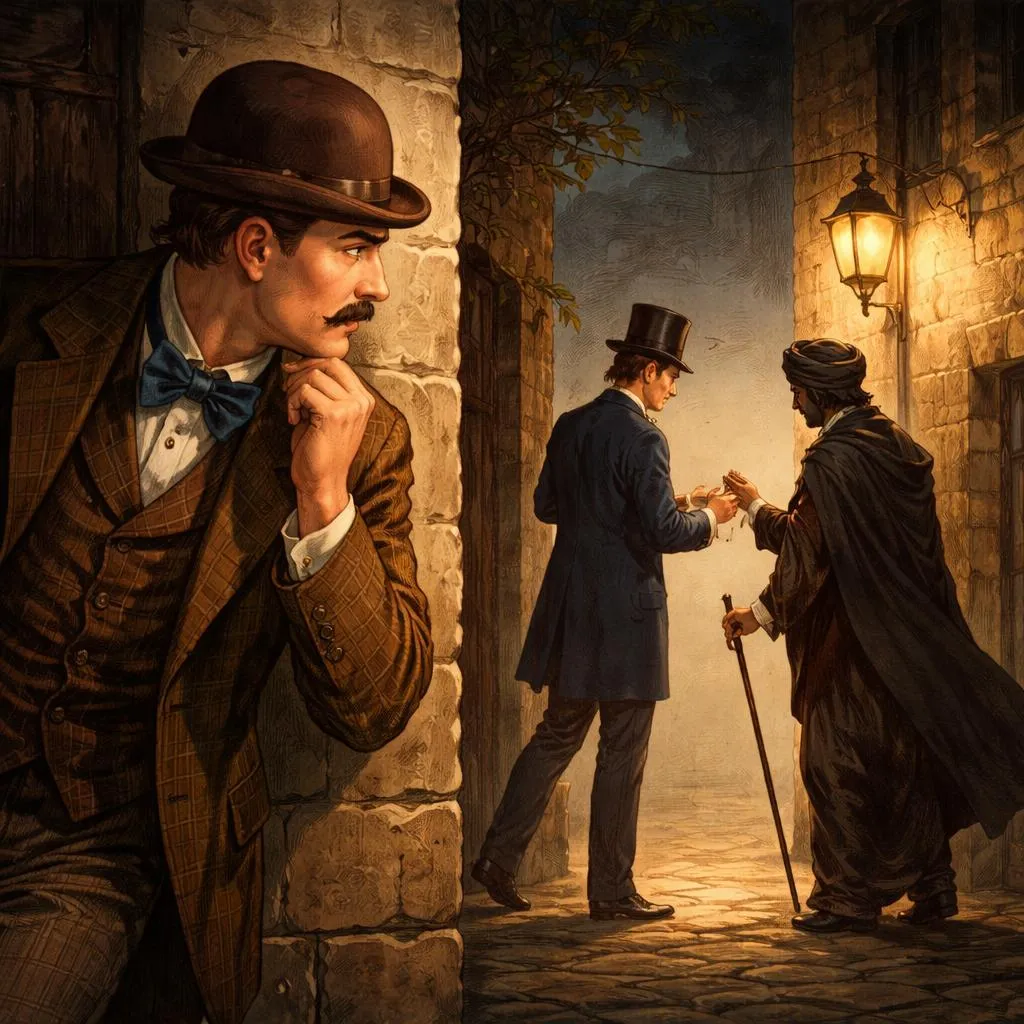

Hong Kong is an island which came into the possession of the English by the Treaty of Nankin, after the war of 1842; and the colonising genius of the English has created upon it an important city and an excellent port. The island is situated at the mouth of the Canton River, and is separated by about sixty miles from the Portuguese town of Macao, on the opposite coast. Hong Kong has beaten Macao in the struggle for the Chinese trade, and now the greater part of the transportation of Chinese goods finds its depot at the former place. Docks, hospitals, wharves, a Gothic cathedral, a government house, macadamised streets, give to Hong Kong the appearance of a town in Kent or Surrey transferred by some strange magic to the antipodes.
Passepartout wandered, with his hands in his pockets, towards the Victoria port, gazing as he went at the curious palanquins and other modes of conveyance, and the groups of Chinese, Japanese, and Europeans who passed to and fro in the streets. Hong Kong seemed to him not unlike Bombay, Calcutta, and Singapore, since, like them, it betrayed everywhere the evidence of English supremacy. At the Victoria port he found a confused mass of ships of all nations: English, French, American, and Dutch, men–of–war and trading vessels, Japanese and Chinese junks, sempas, tankas, and flower–boats, which formed so many floating parterres. Passepartout noticed in the crowd a number of the natives who seemed very old and were dressed in yellow. On going into a barber's to get shaved he learned that these ancient men were all at least eighty years old, at which age they are permitted to wear yellow, which is the Imperial colour. Passepartout, without exactly knowing why, thought this very funny.
On reaching the quay where they were to embark on the Carnatic, he was not astonished to find Fix walking up and down. The detective seemed very much disturbed and disappointed.
"This is bad," muttered Passepartout, "for the gentlemen of the Reform Club!" He accosted Fix with a merry smile, as if he had not perceived that gentleman's chagrin. The detective had, indeed, good reasons to inveigh against the bad luck which pursued him. The warrant had not come! It was certainly on the way, but as certainly it could not now reach Hong Kong for several days; and, this being the last English territory on Mr. Fogg's route, the robber would escape, unless he could manage to detain him.
"Well, Monsieur Fix," said Passepartout, "have you decided to go with us so far as America?"
"Yes," returned Fix, through his set teeth.
"Good!" exclaimed Passepartout, laughing heartily. "I knew you could not persuade yourself to separate from us. Come and engage your berth."
They entered the steamer office and secured cabins for four persons. The clerk, as he gave them the tickets, informed them that, the repairs on the Carnatic having been completed, the steamer would leave that very evening, and not next morning, as had been announced.
"That will suit my master all the better," said Passepartout. "I will go and let him know."
Fix now decided to make a bold move; he resolved to tell Passepartout all. It seemed to be the only possible means of keeping Phileas Fogg several days longer at Hong Kong. He accordingly invited his companion into a tavern which caught his eye on the quay. On entering, they found themselves in a large room handsomely decorated, at the end of which was a large camp–bed furnished with cushions. Several persons lay upon this bed in a deep sleep. At the small tables which were arranged about the room some thirty customers were drinking English beer, porter, gin, and brandy; smoking, the while, long red clay pipes stuffed with little balls of opium mingled with essence of rose. From time to time one of the smokers, overcome with the narcotic, would slip under the table, whereupon the waiters, taking him by the head and feet, carried and laid him upon the bed. The bed already supported twenty of these stupefied sots.
Fix and Passepartout saw that they were in a smoking–house haunted by those wretched, cadaverous, idiotic creatures to whom the English merchants sell every year the miserable drug called opium, to the amount of one million four hundred thousand pounds—thousands devoted to one of the most despicable vices which afflict humanity! The Chinese government has in vain attempted to deal with the evil by stringent laws. It passed gradually from the rich, to whom it was at first exclusively reserved, to the lower classes, and then its ravages could not be arrested. Opium is smoked everywhere, at all times, by men and women, in the Celestial Empire; and, once accustomed to it, the victims cannot dispense with it, except by suffering horrible bodily contortions and agonies. A great smoker can smoke as many as eight pipes a day; but he dies in five years. It was in one of these dens that Fix and Passepartout, in search of a friendly glass, found themselves. Passepartout had no money, but willingly accepted Fix's invitation in the hope of returning the obligation at some future time.
They ordered two bottles of port, to which the Frenchman did ample justice, whilst Fix observed him with close attention. They chatted about the journey, and Passepartout was especially merry at the idea that Fix was going to continue it with them. When the bottles were empty, however, he rose to go and tell his master of the change in the time of the sailing of the Carnatic.
Fix caught him by the arm, and said, "Wait a moment."
"What for, Mr. Fix?"
"I want to have a serious talk with you."
"A serious talk!" cried Passepartout, drinking up the little wine that was left in the bottom of his glass. "Well, we'll talk about it to–morrow; I haven't time now."
"Stay! What I have to say concerns your master."
Passepartout, at this, looked attentively at his companion. Fix's face seemed to have a singular expression. He resumed his seat.
"What is it that you have to say?"
Fix placed his hand upon Passepartout's arm, and, lowering his voice, said, "You have guessed who I am?"
"Parbleu!" said Passepartout, smiling.
"Then I'm going to tell you everything—"
"Now that I know everything, my friend! Ah! that's very good. But go on, go on. First, though, let me tell you that those gentlemen have put themselves to a useless expense."
"Useless!" said Fix. "You speak confidently. It's clear that you don't know how large the sum is."
"Of course I do," returned Passepartout. "Twenty thousand pounds."
"Fifty–five thousand!" answered Fix, pressing his companion's hand.
"What!" cried the Frenchman. "Has Monsieur Fogg dared—fifty–five thousand pounds! Well, there's all the more reason for not losing an instant," he continued, getting up hastily.
Fix pushed Passepartout back in his chair, and resumed: "Fifty–five thousand pounds; and if I succeed, I get two thousand pounds. If you'll help me, I'll let you have five hundred of them."
"Help you?" cried Passepartout, whose eyes were standing wide open.
"Yes; help me keep Mr. Fogg here for two or three days."
"Why, what are you saying? Those gentlemen are not satisfied with following my master and suspecting his honour, but they must try to put obstacles in his way! I blush for them!"
"What do you mean?"
"I mean that it is a piece of shameful trickery. They might as well waylay Mr. Fogg and put his money in their pockets!"
"That's just what we count on doing."
"It's a conspiracy, then," cried Passepartout, who became more and more excited as the liquor mounted in his head, for he drank without perceiving it. "A real conspiracy! And gentlemen, too. Bah!"
Fix began to be puzzled.
"Members of the Reform Club!" continued Passepartout. "You must know, Monsieur Fix, that my master is an honest man, and that, when he makes a wager, he tries to win it fairly!"
"But who do you think I am?" asked Fix, looking at him intently.
"Parbleu! An agent of the members of the Reform Club, sent out here to interrupt my master's journey. But, though I found you out some time ago, I've taken good care to say nothing about it to Mr. Fogg."
"He knows nothing, then?"
"Nothing," replied Passepartout, again emptying his glass.
The detective passed his hand across his forehead, hesitating before he spoke again. What should he do? Passepartout's mistake seemed sincere, but it made his design more difficult. It was evident that the servant was not the master's accomplice, as Fix had been inclined to suspect.
"Well," said the detective to himself, "as he is not an accomplice, he will help me."
He had no time to lose: Fogg must be detained at Hong Kong, so he resolved to make a clean breast of it.
"Listen to me," said Fix abruptly. "I am not, as you think, an agent of the members of the Reform Club—"
"Bah!" retorted Passepartout, with an air of raillery.
"I am a police detective, sent out here by the London office."
"You, a detective?"
"I will prove it. Here is my commission."
Passepartout was speechless with astonishment when Fix displayed this document, the genuineness of which could not be doubted.
"Mr. Fogg's wager," resumed Fix, "is only a pretext, of which you and the gentlemen of the Reform are dupes. He had a motive for securing your innocent complicity."
"But why?"
"Listen. On the 28th of last September a robbery of fifty–five thousand pounds was committed at the Bank of England by a person whose description was fortunately secured. Here is his description; it answers exactly to that of Mr. Phileas Fogg."
"What nonsense!" cried Passepartout, striking the table with his fist. "My master is the most honourable of men!"
"How can you tell? You know scarcely anything about him. You went into his service the day he came away; and he came away on a foolish pretext, without trunks, and carrying a large amount in banknotes. And yet you are bold enough to assert that he is an honest man!"
"Yes, yes," repeated the poor fellow, mechanically.
"Would you like to be arrested as his accomplice?"
Passepartout, overcome by what he had heard, held his head between his hands, and did not dare to look at the detective. Phileas Fogg, the saviour of Aouda, that brave and generous man, a robber! And yet how many presumptions there were against him! Passepartout essayed to reject the suspicions which forced themselves upon his mind; he did not wish to believe that his master was guilty.
"Well, what do you want of me?" said he, at last, with an effort.
"See here," replied Fix; "I have tracked Mr. Fogg to this place, but as yet I have failed to receive the warrant of arrest for which I sent to London. You must help me to keep him here in Hong Kong—"
"I! But I—"
"I will share with you the two thousand pounds reward offered by the Bank of England."
"Never!" replied Passepartout, who tried to rise, but fell back, exhausted in mind and body.
"Mr. Fix," he stammered, "even should what you say be true—if my master is really the robber you are seeking for—which I deny—I have been, am, in his service; I have seen his generosity and goodness; and I will never betray him—not for all the gold in the world. I come from a village where they don't eat that kind of bread!"
"You refuse?"
"I refuse."
"Consider that I've said nothing," said Fix; "and let us drink."
"Yes; let us drink!"
Passepartout felt himself yielding more and more to the effects of the liquor. Fix, seeing that he must, at all hazards, be separated from his master, wished to entirely overcome him. Some pipes full of opium lay upon the table. Fix slipped one into Passepartout's hand. He took it, put it between his lips, lit it, drew several puffs, and his head, becoming heavy under the influence of the narcotic, fell upon the table.
"At last!" said Fix, seeing Passepartout unconscious. "Mr. Fogg will not be informed of the Carnatic's departure; and, if he is, he will have to go without this cursed Frenchman!"
And, after paying his bill, Fix left the tavern.
背景和作者介绍
这段文字选自儒勒·凡尔纳于1873年创作的经典冒险小说《八十天环游地球》。凡尔纳常被称为“科幻小说之父”,他以充满想象力和细节的故事而闻名,这些故事将冒险与科学和地理知识相结合。 这部小说讲述了富有的英国人福格先生的故事,他打赌自己可以在短短八十天内环游地球,这在19世纪是一个了不起的挑战。 故事捕捉了那个时代的探险精神和快速的科技进步,例如轮船和铁路。
详细解读和意义
在这段摘录中,我们看到了繁华的殖民城市香港,它被生动地描述为一个文化的大熔炉和英国帝国主义权力的象征。 主人公的仆人路路通探索了这座城市热闹的街道和不同的居民,突出了当时的全球联系。 随着菲克斯的出现,紧张局势加剧,菲克斯是一名侦探,他怀疑福格先生犯有盗窃罪,并试图通过操纵路路通来延误他的旅程。
故事的这一部分介绍了信任、忠诚和正义的主题。 路路通对主人的坚定信念与菲克斯的怀疑和抓捕罪犯的决心形成了鲜明对比。 对鸦片馆的描写也揭示了当时的社会问题和罪恶,增加了现实主义和历史背景。
给学生的教训和见解
- 文化意识: 故事让读者接触到不同的文化和历史背景,鼓励他们对自身环境之外的世界产生好奇心。
- 忠诚和正直: 路路通对福格的忠诚教会了我们,即使在困难时期,也要支持你所信任的人。
- 批判性思维: 菲克斯的怀疑和路路通的信念之间的冲突促使读者在评判他人之前考虑证据和公平的重要性。
- 历史背景: 了解殖民时代的复杂性,包括贸易、帝国主义和社会问题(如鸦片成瘾),有助于学生掌握历史如何塑造社会。
将故事的精神应用于生活和学习
- 毅力: 就像福格先生不顾障碍完成旅程的决心一样,学生们可以学会坚持自己的目标,无论是学术上的还是个人的。
- 开放的心态: 路路通对不同人民的观察鼓励拥抱多样性并向他人学习。
- 道德行为: 故事中的道德困境突出了诚实和坚持正义的重要性,这在社交和学校环境中很有用。
- 解决问题: 角色们面临的挑战需要快速的思考和适应能力,这些技能在日常生活中很有价值。
从故事中培养积极的品质
- 忠诚: 鼓励学生用信任和友善来支持朋友和家人。
- 好奇心: 激励他们通过阅读和旅行来探索新的文化、历史和想法。
- 正义: 传授公平的重要性,并在了解所有事实之前不要妄下判断。
- 勇气: 展示勇敢面对恐惧和挑战如何带来成长和成功。
结论
儒勒·凡尔纳的《八十天环游地球》不仅仅是一次激动人心的冒险;它还是一个丰富的历史知识、文化洞察和道德教训的来源。 阅读这部小说的学生可以培养更广阔的世界观,加深对人类价值观的理解,并找到勇气和正直地追求自己旅程的灵感。