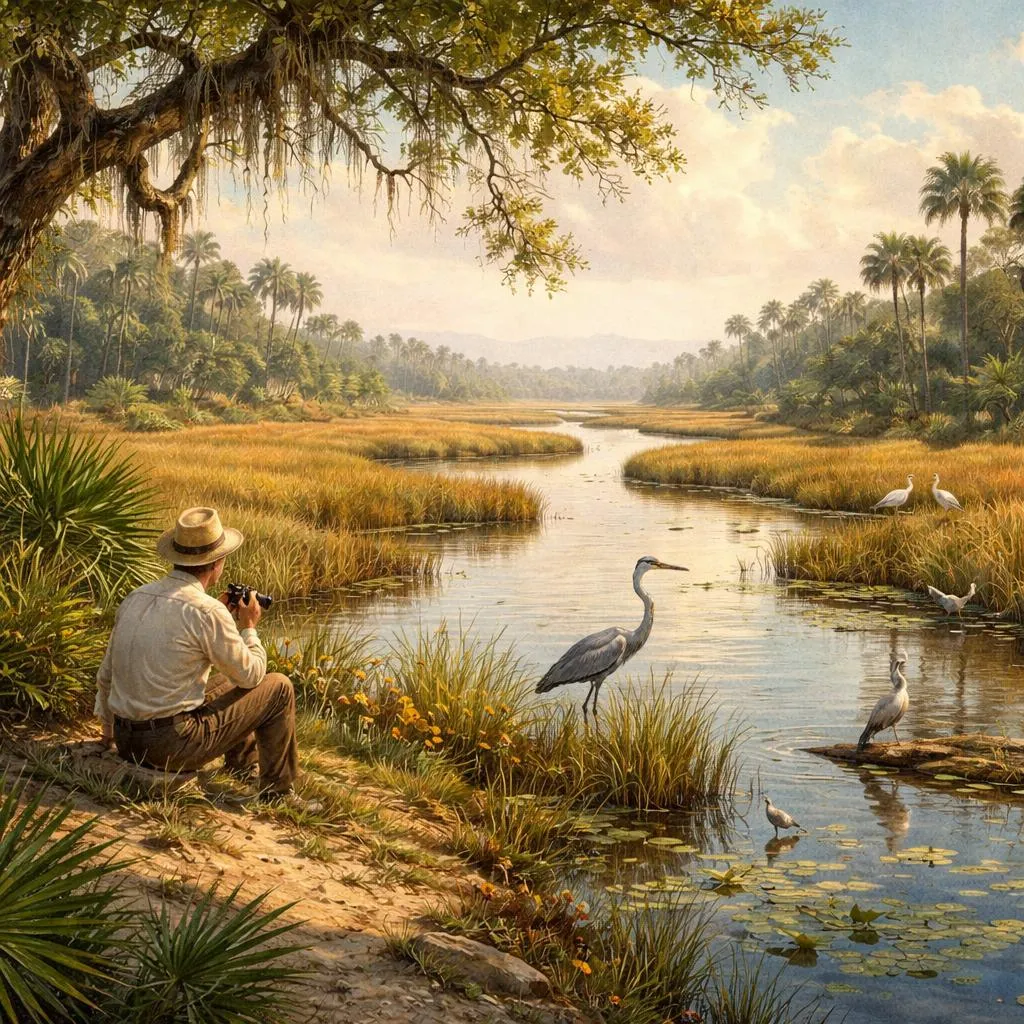

I am sitting upon the upland bank of a narrow winding creek. Before me is a sea of grass, brown and green of many shades. To the north themarsh is bounded by live-oak woods,—a line with numberlessindentations,—beyond which runs the Matanzas River, as I know by thepassing and repassing of sails behind the trees. Eastward aresand-hills, dazzling white in the sun, with a ragged green fringe alongtheir tops. Then comes a stretch of the open sea, and then, more to thesouth, St. Anastasia Island, with its tall black-and-white lighthouseand the cluster of lower buildings at its base. Small sailboats, and nowand then a tiny steamer, pass up and down the river to and from St.Augustine.
A delicious south wind is blowing (it is the 15th of February), and Isit in the shade of a cedar-tree and enjoy the air and the scene. Acontrast, this, to the frozen world I was living in, less than a weekago.
As I approached the creek, a single spotted sandpiper was teeteringalong the edge of the water, and the next moment a big blue heron rosejust beyond him and went flapping away to the middle of the marsh. Now,an hour afterward, he is still standing there, towering above the tallgrass. Once when I turned that way I saw, as I thought, a stake, andthen something moved upon it,—a bird of some kind. And what an enormousbeak! I raised my field-glass. It was the heron. His body was the post,and his head was the bird. Meanwhile, the sandpiper has stolen away, Iknow not when or where. He must have omitted the “tweet, tweet,” withwhich ordinarily he signalizes his flight. He is the first of his kindthat I have seen during my brief stay in these parts.
Now a multitude of crows pass over; fish crows, I think they must be,from their small size and their strange, ridiculous voices. And now asecond great blue heron comes in sight, and keeps on over the marsh andover the live-oak wood, on his way to the San Sebastian marshes, or somepoint still more remote. A fine show he makes, with his wide expanse ofwing, and his feet drawn up and standing out behind him. Next a marshhawk in brown plumage comes skimming over the grass. This way and thathe swerves in ever graceful lines. For one to whom ease and grace comeby nature, even the chase of meadow mice is an act of beauty, whileanother goes awkwardly though in pursuit of a goddess.
Several times I have noticed a kingfisher hovering above the grass (soit looks, but no doubt he is over an arm of the creek), striking the airwith quick strokes, and keeping his head pointed downward, after themanner of a tern. Then he disappeared while I was looking at somethingelse. Now I remark him sitting motionless upon the top of a post in themidst of the marsh.
A third blue heron appears, and he too flies over without stopping.Number One still keeps his place; through the glass I can see himdressing his feathers with his clumsy beak. The lively strain of awhite-eyed vireo, pertest of songsters, comes to me from somewhere on myright, and the soft chipping of myrtle warblers is all but incessant. Ilook up from my paper to see a turkey buzzard sailing majesticallynorthward. I watch him till he fades in the distance. Not once does heflap his wings, but sails and sails, going with the wind, yet turningagain and again to rise against it,—helping himself thus to itsadverse, uplifting pressure in the place of wing-strokes, perhaps,—andpassing onward all the while in beautiful circles. He, too, scavengerthough he is, has a genius for being graceful. One might almost bewilling to be a buzzard, to fly like that!
The kingfisher and the heron are still at their posts. An exquisiteyellow butterfly, of a sort strange to my Yankee eyes, flits past,followed by a red admiral. The marsh hawk is on the wing again, andwhile looking at him I descry a second hawk, too far away to be madeout. Now the air behind me is dark with crows,—a hundred or two, atleast, circling over the low cedars. Some motive they have for all theirclamor, but it passes my owlish wisdom to guess what it can be. A fourthblue heron appears, and drops into the grass out of sight.
Between my feet is a single blossom of the yellow oxalis, the onlyflower to be seen; and very pretty it is, each petal with an orange spotat the base.
Another buzzard, another marsh hawk, another yellow butterfly, and thena smaller one, darker, almost orange. It passes too quickly over thecreek and away. The marsh hawk comes nearer, and I see the strong yellowtinge of his plumage, especially underneath. He will grow handsomer ashe grows older. A pity the same could not be true of men. Behind me aresharp cries of titlarks. From the direction of the river come frequentreports of guns. Somebody is doing his best to be happy! All at once Iprick up my ears. From the grass just across the creek rises the brief,hurried song of a long-billed marsh wren. So he is in Florida, is he?Already I have heard confused noises which I feel sure are the work ofrails of some kind. No doubt there is abundant life concealed in thoseacres on acres of close grass.
The heron and the kingfisher are still quiet. Their morning hunt wassuccessful, and for to-day Fate cannot harm them. A buzzard, withnervous, rustling beats, goes directly above the low cedar under which Iam resting.
At last, after a siesta of two hours, the heron has changed his place. Ilooked up just in season to see him sweeping over the grass, into whichhe dropped the next instant. The tide is falling. The distant sand-hillsare winking in the heat, but the breeze is deliciously cool, the veryperfection of temperature, if a man is to sit still in the shade. It iseleven o’clock. I have a mile to go in the hot sun, and turn away. Butfirst I sweep the line once more with my glass. Yonder to the south aretwo more blue herons standing in the grass. Perhaps there are morestill. I sweep the line. Yes, far, far away I can see four heads in arow. Heads and necks rise above the grass. But so far away! Are theybirds, or only posts made alive by my imagination? I look again. Ibelieve I was deceived. They are nothing but stakes. See how in a rowthey stand. I smile at myself. Just then one of them moves, and anotheris pulled down suddenly into the grass. I smile again. “Ten great blueherons,” I say to myself.
All this has detained me, and meantime the kingfisher has taken wing andgone noisily up the creek. The marsh hawk appears once more. Akilldeer’s sharp, rasping note—a familiar sound in St. Augustine—comesfrom I know not where. A procession of more than twenty black vulturespasses over my head. I can see their feet drawn up under them. My own Imust use in plodding homeward.
背景介绍和作者介绍
这篇生动的自然叙事详细地观察了沼泽地生态系统,捕捉了沿海环境的美丽和生命力。作者的身份在这里没有具体说明,但他展现了敏锐的观察力和对野生动物,特别是鸟类的深刻欣赏。这种描述性的写作方式是自然主义作家的典型风格,他们将科学观察与诗意的语言相结合,使大自然在读者面前栩栩如生。这种风格鼓励读者,尤其是学生和年轻人,放慢脚步,注意到周围自然界中的微小奇迹。
详细解读和意义
这篇文章描绘了佛罗里达州圣奥古斯丁附近沼泽地一个阳光明媚的宁静日子的景象。作者对鸟类的行为和外观的细致关注——蓝鹭、滨鹬、翠鸟、沼泽鹰、秃鹫等——邀请读者欣赏野生动物的多样性和优雅。叙事还对比了温暖、生动的场景与作者最近经历的冰冻的冬季景观,强调了温暖气候下大自然的复苏和活力。
这个故事不仅仅是关于鸟类的,更是关于生命的相互联系以及自然界的宁静节奏。鸟类的活动、鸣叫和互动揭示了一个复杂的生态系统,其中每个生物都扮演着自己的角色。作者对秃鹫等食腐鸟类的美丽和优雅的思考,暗示了在所有生命形式中寻找价值和尊严的信息。
给学生的启示和见解
-
观察技巧:详细的描述鼓励学生培养仔细的观察技巧。注意到小的细节——比如花瓣上的橙色斑点或鹰的飞行模式——可以加深对自然的理解和欣赏。
-
耐心和正念:作者花几个小时安静地观察沼泽,展现了耐心和正念。学生可以学习放慢脚步并专注于当下,从而真正体验并从他们的环境中学习。
-
对自然的尊重:叙事培养了对野生动物和环境的尊重。了解不同动物所扮演的角色有助于建立对自然世界的管理意识。
-
与地方的联系:作者与沼泽及其生物的联系表明了地方可以具有特殊意义。可以鼓励学生探索并与他们当地的环境建立联系。
在生活、学习和社会环境中的应用
-
在学习中:学生可以将这里展示的观察技巧应用于科学研究,提高他们记录和解释数据的能力。这个故事可以激发自然日记或实地研究。
-
在社会生活中:对所有生物的尊重,包括那些不太受人喜爱(如秃鹫)的生物,教会了同情心和对多样性的接受,这些都是社会关系中宝贵的品质。
-
在个人成长中:展现出的耐心和冷静可以帮助学生管理压力并培养正念实践。
从故事中培养积极的品质
-
好奇心和惊奇:鼓励对自然世界的好奇心可以带来终身学习和发现。
-
耐心:学会等待和仔细观察是一项对生活许多方面都有益的技能。
-
尊重和同情心:看到所有生物的价值可以促进对他人的善良和理解。
-
与自然的联系:在户外度过时光并观察野生动物可以改善心理健康并培养环境责任感。
结论
这篇文章是自然写作的一个很好的例子,它邀请年轻读者放慢脚步,观察并欣赏他们周围的生命世界。它传授了关于耐心、尊重和生命以各种形式存在的美丽的宝贵教训。通过参与这样的故事,学生可以培养技能和态度,丰富他们的教育和个人生活,帮助他们成长为有思想、有爱心、与自然和社区相连的个体。