
Between six and nine we made ten miles, which was plenty for a horse carrying triple—man, woman, and armor; then we stopped for a long nooning under some trees by a limpid brook.
Right so came by and by a knight riding; and as he drew near he made dolorous moan, and by the words of it I perceived that he was cursing and swearing; yet nevertheless was I glad of his coming, for that I saw he bore a bulletin-board whereon in letters all of shining gold was writ:
“USE PETERSON’S PROPHYLACTIC TOOTH-BRUSH—ALL THE GO.” I was glad of his coming, for even by this token I knew him for knight of mine. It was Sir Madok de la Montaine, a burly great fellow whose chief distinction was that he had come within an ace of sending Sir Launcelot down over his horse-tail once. He was never long in a stranger’s presence without finding some pretext or other to let out that great fact. But there was another fact of nearly the same size, which he never pushed upon anybody unasked, and yet never withheld when asked: that was, that the reason he didn’t quite succeed was, that he was interrupted and sent down over horse-tail himself. This innocent vast lubber did not see any particular difference between the two facts. I liked him, for he was earnest in his work, and very valuable. And he was so fine to look at, with his broad mailed shoulders, and the grand leonine set of his plumed head, and his big shield with its quaint device of a gauntleted hand clutching a prophylactic tooth-brush, with motto: “Try Noyoudont.” This was a tooth-wash that I was introducing.
He was aweary, he said, and indeed he looked it; but he would not alight. He said he was after the stove-polish man; and with this he broke out cursing and swearing anew. The bulletin-boarder referred to was Sir Ossaise of Surluse, a brave knight, and of considerable celebrity on account of his having tried conclusions in a tournament once, with no less a Mogul than Sir Gaheris himself—although not successfully. He was of a light and laughing disposition, and to him nothing in this world was serious. It was for this reason that I had chosen him to work up a stove-polish sentiment. There were no stoves yet, and so there could be nothing serious about stove-polish. All that the agent needed to do was to deftly and by degrees prepare the public for the great change, and have them established in predilections toward neatness against the time when the stove should appear upon the stage.
Sir Madok was very bitter, and brake out anew with cursings. He said he had cursed his soul to rags; and yet he would not get down from his horse, neither would he take any rest, or listen to any comfort, until he should have found Sir Ossaise and settled this account. It appeared, by what I could piece together of the unprofane fragments of his statement, that he had chanced upon Sir Ossaise at dawn of the morning, and been told that if he would make a short cut across the fields and swamps and broken hills and glades, he could head off a company of travelers who would be rare customers for prophylactics and tooth-wash. With characteristic zeal Sir Madok had plunged away at once upon this quest, and after three hours of awful crosslot riding had overhauled his game. And behold, it was the five patriarchs that had been released from the dungeons the evening before! Poor old creatures, it was all of twenty years since any one of them had known what it was to be equipped with any remaining snag or remnant of a tooth.
“Blank-blank-blank him,” said Sir Madok, “an I do not stove-polish him an I may find him, leave it to me; for never no knight that hight Ossaise or aught else may do me this disservice and bide on live, an I may find him, the which I have thereunto sworn a great oath this day.”
And with these words and others, he lightly took his spear and gat him thence. In the middle of the afternoon we came upon one of those very patriarchs ourselves, in the edge of a poor village. He was basking in the love of relatives and friends whom he had not seen for fifty years; and about him and caressing him were also descendants of his own body whom he had never seen at all till now; but to him these were all strangers, his memory was gone, his mind was stagnant. It seemed incredible that a man could outlast half a century shut up in a dark hole like a rat, but here were his old wife and some old comrades to testify to it. They could remember him as he was in the freshness and strength of his young manhood, when he kissed his child and delivered it to its mother’s hands and went away into that long oblivion. The people at the castle could not tell within half a generation the length of time the man had been shut up there for his unrecorded and forgotten offense; but this old wife knew; and so did her old child, who stood there among her married sons and daughters trying to realize a father who had been to her a name, a thought, a formless image, a tradition, all her life, and now was suddenly concreted into actual flesh and blood and set before her face.
It was a curious situation; yet it is not on that account that I have made room for it here, but on account of a thing which seemed to me still more curious. To wit, that this dreadful matter brought from these downtrodden people no outburst of rage against these oppressors. They had been heritors and subjects of cruelty and outrage so long that nothing could have startled them but a kindness. Yes, here was a curious revelation, indeed, of the depth to which this people had been sunk in slavery. Their entire being was reduced to a monotonous dead level of patience, resignation, dumb uncomplaining acceptance of whatever might befall them in this life. Their very imagination was dead. When you can say that of a man, he has struck bottom, I reckon; there is no lower deep for him.
I rather wished I had gone some other road. This was not the sort of experience for a statesman to encounter who was planning out a peaceful revolution in his mind. For it could not help bringing up the unget-aroundable fact that, all gentle cant and philosophizing to the contrary notwithstanding, no people in the world ever did achieve their freedom by goody-goody talk and moral suasion: it being immutable law that all revolutions that will succeed must begin in blood, whatever may answer afterward. If history teaches anything, it teaches that. What this folk needed, then, was a Reign of Terror and a guillotine, and I was the wrong man for them.
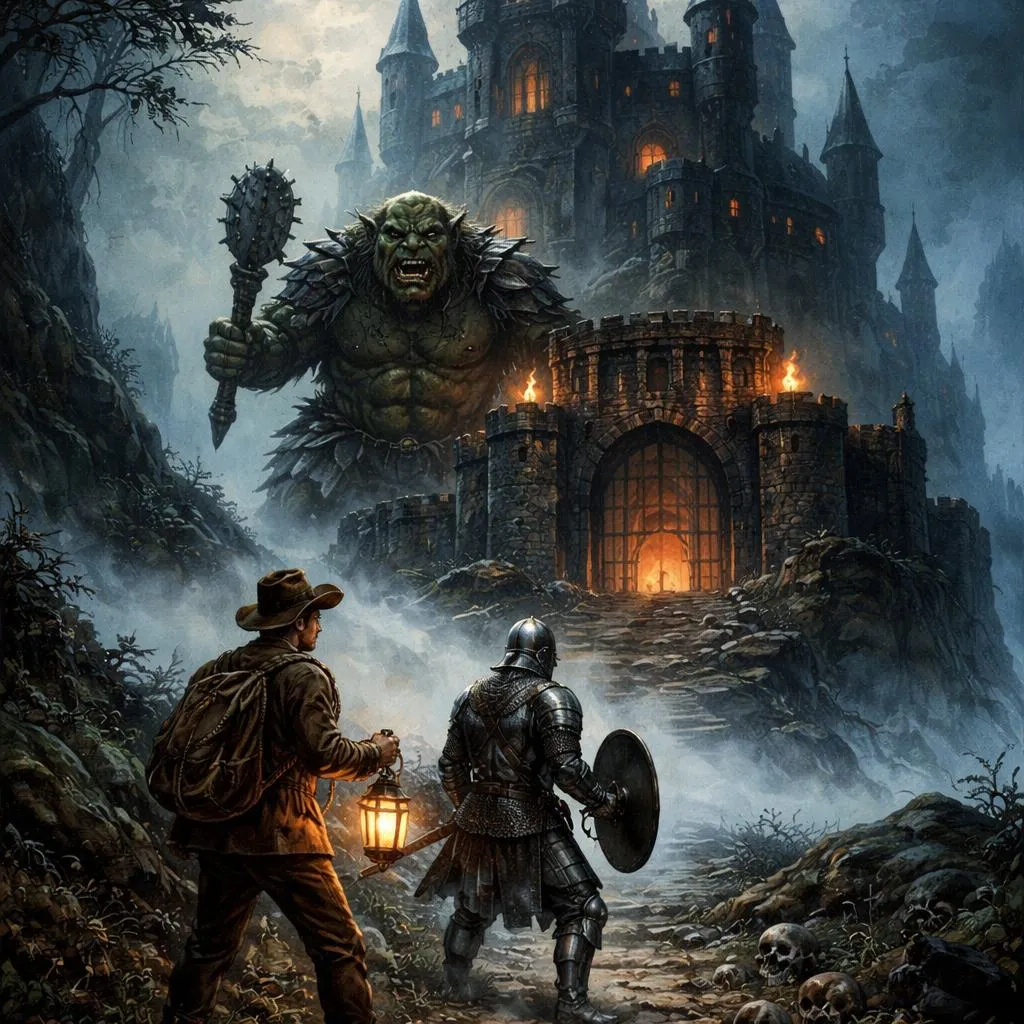
Two days later, toward noon, Sandy began to show signs of excitement and feverish expectancy. She said we were approaching the ogre’s castle. I was surprised into an uncomfortable shock. The object of our quest had gradually dropped out of my mind; this sudden resurrection of it made it seem quite a real and startling thing for a moment, and roused up in me a smart interest. Sandy’s excitement increased every moment; and so did mine, for that sort of thing is catching. My heart got to thumping. You can’t reason with your heart; it has its own laws, and thumps about things which the intellect scorns. Presently, when Sandy slid from the horse, motioned me to stop, and went creeping stealthily, with her head bent nearly to her knees, toward a row of bushes that bordered a declivity, the thumpings grew stronger and quicker. And they kept it up while she was gaining her ambush and getting her glimpse over the declivity; and also while I was creeping to her side on my knees. Her eyes were burning now, as she pointed with her finger, and said in a panting whisper:
“The castle! The castle! Lo, where it looms!”
What a welcome disappointment I experienced! I said:
“Castle? It is nothing but a pigsty; a pigsty with a wattled fence around it.”
She looked surprised and distressed. The animation faded out of her face; and during many moments she was lost in thought and silent. Then:
“It was not enchanted aforetime,” she said in a musing fashion, as if to herself. “And how strange is this marvel, and how awful —that to the one perception it is enchanted and dight in a base and shameful aspect; yet to the perception of the other it is not enchanted, hath suffered no change, but stands firm and stately still, girt with its moat and waving its banners in the blue air from its towers. And God shield us, how it pricks the heart to see again these gracious captives, and the sorrow deepened in their sweet faces! We have tarried along, and are to blame.”
I saw my cue. The castle was enchanted to me , not to her. It would be wasted time to try to argue her out of her delusion, it couldn’t be done; I must just humor it. So I said:
“This is a common case—the enchanting of a thing to one eye and leaving it in its proper form to another. You have heard of it before, Sandy, though you haven’t happened to experience it. But no harm is done. In fact, it is lucky the way it is. If these ladies were hogs to everybody and to themselves, it would be necessary to break the enchantment, and that might be impossible if one failed to find out the particular process of the enchantment. And hazardous, too; for in attempting a disenchantment without the true key, you are liable to err, and turn your hogs into dogs, and the dogs into cats, the cats into rats, and so on, and end by reducing your materials to nothing finally, or to an odorless gas which you can’t follow—which, of course, amounts to the same thing. But here, by good luck, no one’s eyes but mine are under the enchantment, and so it is of no consequence to dissolve it. These ladies remain ladies to you, and to themselves, and to everybody else; and at the same time they will suffer in no way from my delusion, for when I know that an ostensible hog is a lady, that is enough for me, I know how to treat her.”
“Thanks, oh, sweet my lord, thou talkest like an angel. And I know that thou wilt deliver them, for that thou art minded to great deeds and art as strong a knight of your hands and as brave to will and to do, as any that is on live.”
“I will not leave a princess in the sty, Sandy. Are those three yonder that to my disordered eyes are starveling swine-herds—”
“The ogres, Are they changed also? It is most wonderful. Now am I fearful; for how canst thou strike with sure aim when five of their nine cubits of stature are to thee invisible? Ah, go warily, fair sir; this is a mightier emprise than I wend.”
“You be easy, Sandy. All I need to know is, how much of an ogre is invisible; then I know how to locate his vitals. Don’t you be afraid, I will make short work of these bunco-steerers. Stay where you are.”
I left Sandy kneeling there, corpse-faced but plucky and hopeful, and rode down to the pigsty, and struck up a trade with the swine-herds. I won their gratitude by buying out all the hogs at the lump sum of sixteen pennies, which was rather above latest quotations. I was just in time; for the Church, the lord of the manor, and the rest of the tax-gatherers would have been along next day and swept off pretty much all the stock, leaving the swine-herds very short of hogs and Sandy out of princesses. But now the tax people could be paid in cash, and there would be a stake left besides. One of the men had ten children; and he said that last year when a priest came and of his ten pigs took the fattest one for tithes, the wife burst out upon him, and offered him a child and said:
“Thou beast without bowels of mercy, why leave me my child, yet rob me of the wherewithal to feed it?”
How curious. The same thing had happened in the Wales of my day, under this same old Established Church, which was supposed by many to have changed its nature when it changed its disguise.
I sent the three men away, and then opened the sty gate and beckoned Sandy to come—which she did; and not leisurely, but with the rush of a prairie fire. And when I saw her fling herself upon those hogs, with tears of joy running down her cheeks, and strain them to her heart, and kiss them, and caress them, and call them reverently by grand princely names, I was ashamed of her, ashamed of the human race.
We had to drive those hogs home—ten miles; and no ladies were ever more fickle-minded or contrary. They would stay in no road, no path; they broke out through the brush on all sides, and flowed away in all directions, over rocks, and hills, and the roughest places they could find. And they must not be struck, or roughly accosted; Sandy could not bear to see them treated in ways unbecoming their rank. The troublesomest old sow of the lot had to be called my Lady, and your Highness, like the rest. It is annoying and difficult to scour around after hogs, in armor. There was one small countess, with an iron ring in her snout and hardly any hair on her back, that was the devil for perversity. She gave me a race of an hour, over all sorts of country, and then we were right where we had started from, having made not a rod of real progress. I seized her at last by the tail, and brought her along squealing. When I overtook Sandy she was horrified, and said it was in the last degree indelicate to drag a countess by her train.
We got the hogs home just at dark—most of them. The princess Nerovens de Morganore was missing, and two of her ladies in waiting: namely, Miss Angela Bohun, and the Demoiselle Elaine Courtemains, the former of these two being a young black sow with a white star in her forehead, and the latter a brown one with thin legs and a slight limp in the forward shank on the starboard side—a couple of the tryingest blisters to drive that I ever saw. Also among the missing were several mere baronesses—and I wanted them to stay missing; but no, all that sausage-meat had to be found; so servants were sent out with torches to scour the woods and hills to that end.
Of course, the whole drove was housed in the house, and, great guns!—well, I never saw anything like it. Nor ever heard anything like it. And never smelt anything like it. It was like an insurrection in a gasometer.
背景和作者介绍
这个故事是马克·吐温的讽刺和富有想象力的故事《预防性骑士》的节选,马克·吐温是一位以其敏锐的智慧和社会评论而闻名的美国作家。 吐温的作品经常将幽默与对人性和社会的深刻反思相结合。 这部小说写于 19 世纪后期,它利用中世纪的骑士精神和幻想的框架来探索社会不公、变革和争取自由的主题。
马克·吐温(塞缪尔·克莱门斯)以《汤姆·索亚历险记》和《哈克贝利·费恩历险记》等经典作品而闻名。 他的故事经常挑战社会规范,并鼓励读者质疑权威和传统。
故事解读和意义
乍一看,这个故事似乎是一场充满骑士、食人魔和魔法城堡的异想天开的冒险。 然而,在表面之下,隐藏着一个关于压迫和解放的有力寓言。 骑士代表变革的推动者,而魔法城堡和被改变的公主则象征着被困在困境中、被社会误解或虐待的人们。
故事中对被监禁和遗忘的“族长”的描述,以及村民们对命运的顺从接受,突出了长期压迫的毁灭性影响。 缺乏愤怒和对痛苦的麻木接受揭示了奴役或暴政可以多么深刻地摧毁人类精神。
叙述者和桑迪对城堡的不同看法说明了感知如何塑造现实。 这种双重视野邀请读者思考希望和信念如何改变即使是最黑暗的情况。
给学生的教训和见解
-
理解压迫和同情心: 这个故事教导年轻读者关于不公正的影响以及对默默忍受的人的同情心的重要性。 它鼓励学生超越表面现象,了解人们可能面临的更深层次的斗争。
-
视角的强大力量: 对城堡的不同看法提醒我们,我们的心态会影响我们如何解读世界。 培养积极和充满希望的前景可以帮助我们在别人看到绝望的地方看到潜力。
-
勇气和决心: 马多克爵士不顾疲惫和挫折,对正义的不懈追求,体现了毅力。 学生们可以学习奉献精神和为正义而战的价值,即使任务很困难。
-
幽默和讽刺的作用: 吐温用幽默来处理严肃的话题,表明笑声和智慧可以成为挑战不公正和引发思考的有力工具。 这种方法可以激励学生在表达自己的观点时运用创造力。
在日常生活中运用故事的精神
-
在学习中: 学生们可以效仿马多克爵士的认真态度,以奉献和韧性来对待学习,明白进步往往需要努力和坚持。
-
在社交互动中: 故事鼓励友善和尊重,即使是对那些看起来与众不同或难以相处的人,就像桑迪对实际上是受了魔法的公主的猪的温柔对待一样。
-
在面对挑战时: 就像叙述者接受了魔法城堡的双重现实一样,学生们可以学会灵活地拥抱挑战,将障碍视为成长的机会。
-
在培养同情心时: 通过认识到被压迫村民的深刻顺从,学生们被提醒要对可能默默挣扎的同伴充满同情和支持。
从故事中培养积极的价值观
-
正义和倡导: 鼓励学生反对不公正,并支持那些无法为自己辩护的人。
-
希望和乐观: 传授保持希望的重要性,即使情况看起来很糟糕。
-
尊重他人: 强调每个人固有的尊严,无论其外表或环境如何。
-
创造性思维: 激励学生运用想象力和幽默来理解复杂的问题并有效地沟通。
结论
这个故事虽然包裹在幻想和幽默之中,但却对人性、社会和对自由的追求提供了深刻的反思。 对于年轻读者来说,它既提供了一个引人入胜的叙事,也提供了关于勇气、同情心和视角力量的丰富教训。 通过探索这些主题,学生可以加深对自身和世界的理解,为他们做好准备,以智慧和爱心面对生活的挑战。