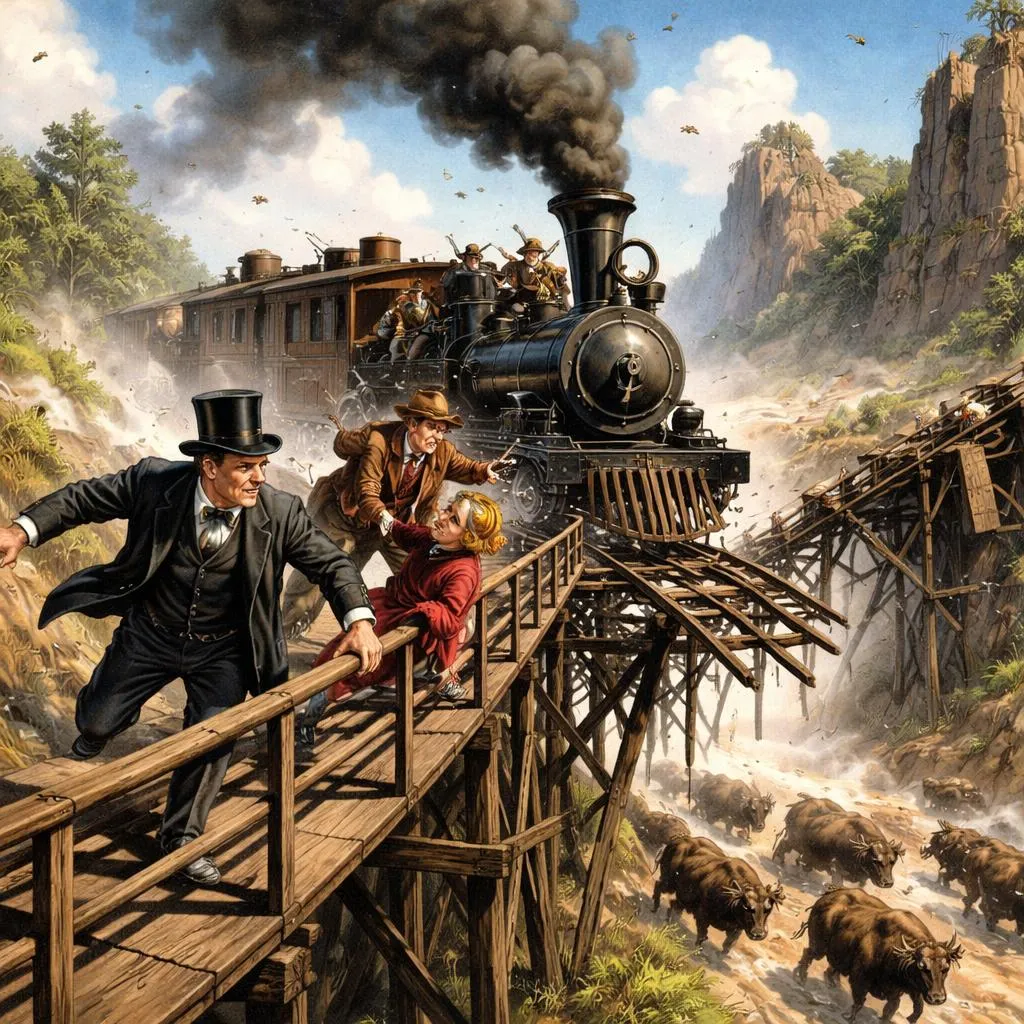

The train pursued its course, that evening, without interruption, passing Fort Saunders, crossing Cheyne Pass, and reaching Evans Pass. The road here attained the highest elevation of the journey, eight thousand and ninety–two feet above the level of the sea. The travellers had now only to descend to the Atlantic by limitless plains, levelled by nature. A branch of the "grand trunk" led off southward to Denver, the capital of Colorado. The country round about is rich in gold and silver, and more than fifty thousand inhabitants are already settled there.
Thirteen hundred and eighty–two miles had been passed over from San Francisco, in three days and three nights; four days and nights more would probably bring them to New York. Phileas Fogg was not as yet behind–hand.
During the night Camp Walbach was passed on the left; Lodge Pole Creek ran parallel with the road, marking the boundary between the territories of Wyoming and Colorado. They entered Nebraska at eleven, passed near Sedgwick, and touched at Julesburg, on the southern branch of the Platte River.
It was here that the Union Pacific Railroad was inaugurated on the 23rd of October, 1867, by the chief engineer, General Dodge. Two powerful locomotives, carrying nine cars of invited guests, amongst whom was Thomas C. Durant, vice–president of the road, stopped at this point; cheers were given, the Sioux and Pawnees performed an imitation Indian battle, fireworks were let off, and the first number of the Railway Pioneer was printed by a press brought on the train. Thus was celebrated the inauguration of this great railroad, a mighty instrument of progress and civilisation, thrown across the desert, and destined to link together cities and towns which do not yet exist. The whistle of the locomotive, more powerful than Amphion's lyre, was about to bid them rise from American soil.
Fort McPherson was left behind at eight in the morning, and three hundred and fifty–seven miles had yet to be traversed before reaching Omaha. The road followed the capricious windings of the southern branch of the Platte River, on its left bank. At nine the train stopped at the important town of North Platte, built between the two arms of the river, which rejoin each other around it and form a single artery, a large tributary, whose waters empty into the Missouri a little above Omaha.
The one hundred and first meridian was passed.
Mr. Fogg and his partners had resumed their game; no one—not even the dummy—complained of the length of the trip. Fix had begun by winning several guineas, which he seemed likely to lose; but he showed himself a not less eager whist–player than Mr. Fogg. During the morning, chance distinctly favoured that gentleman. Trumps and honours were showered upon his hands.
Once, having resolved on a bold stroke, he was on the point of playing a spade, when a voice behind him said, "I should play a diamond."
Mr. Fogg, Aouda, and Fix raised their heads, and beheld Colonel Proctor.
Stamp Proctor and Phileas Fogg recognised each other at once.
"Ah! it's you, is it, Englishman?" cried the colonel; "it's you who are going to play a spade!"
"And who plays it," replied Phileas Fogg coolly, throwing down the ten of spades.
"Well, it pleases me to have it diamonds," replied Colonel Proctor, in an insolent tone.
He made a movement as if to seize the card which had just been played, adding, "You don't understand anything about whist."
"Perhaps I do, as well as another," said Phileas Fogg, rising.
"You have only to try, son of John Bull," replied the colonel.
Aouda turned pale, and her blood ran cold. She seized Mr. Fogg's arm and gently pulled him back. Passepartout was ready to pounce upon the American, who was staring insolently at his opponent. But Fix got up, and, going to Colonel Proctor said, "You forget that it is I with whom you have to deal, sir; for it was I whom you not only insulted, but struck!"
"Mr. Fix," said Mr. Fogg, "pardon me, but this affair is mine, and mine only. The colonel has again insulted me, by insisting that I should not play a spade, and he shall give me satisfaction for it."
"When and where you will," replied the American, "and with whatever weapon you choose."
Aouda in vain attempted to retain Mr. Fogg; as vainly did the detective endeavour to make the quarrel his. Passepartout wished to throw the colonel out of the window, but a sign from his master checked him. Phileas Fogg left the car, and the American followed him upon the platform. "Sir," said Mr. Fogg to his adversary, "I am in a great hurry to get back to Europe, and any delay whatever will be greatly to my disadvantage."
"Well, what's that to me?" replied Colonel Proctor.
"Sir," said Mr. Fogg, very politely, "after our meeting at San Francisco, I determined to return to America and find you as soon as I had completed the business which called me to England."
"Really!"
"Will you appoint a meeting for six months hence?"
"Why not ten years hence?"
"I say six months," returned Phileas Fogg; "and I shall be at the place of meeting promptly."
"All this is an evasion," cried Stamp Proctor. "Now or never!"
"Very good. You are going to New York?"
"No."
"To Chicago?"
"No."
"To Omaha?"
"What difference is it to you? Do you know Plum Creek?"
"No," replied Mr. Fogg.
"It's the next station. The train will be there in an hour, and will stop there ten minutes. In ten minutes several revolver–shots could be exchanged."
"Very well," said Mr. Fogg. "I will stop at Plum Creek."
"And I guess you'll stay there too," added the American insolently.
"Who knows?" replied Mr. Fogg, returning to the car as coolly as usual. He began to reassure Aouda, telling her that blusterers were never to be feared, and begged Fix to be his second at the approaching duel, a request which the detective could not refuse. Mr. Fogg resumed the interrupted game with perfect calmness.
At eleven o'clock the locomotive's whistle announced that they were approaching Plum Creek station. Mr. Fogg rose, and, followed by Fix, went out upon the platform. Passepartout accompanied him, carrying a pair of revolvers. Aouda remained in the car, as pale as death.
The door of the next car opened, and Colonel Proctor appeared on the platform, attended by a Yankee of his own stamp as his second. But just as the combatants were about to step from the train, the conductor hurried up, and shouted, "You can't get off, gentlemen!"
"Why not?" asked the colonel.
"We are twenty minutes late, and we shall not stop."
"But I am going to fight a duel with this gentleman."
"I am sorry," said the conductor; "but we shall be off at once. There's the bell ringing now."
The train started.
"I'm really very sorry, gentlemen," said the conductor. "Under any other circumstances I should have been happy to oblige you. But, after all, as you have not had time to fight here, why not fight as we go along?"
"That wouldn't be convenient, perhaps, for this gentleman," said the colonel, in a jeering tone.
"It would be perfectly so," replied Phileas Fogg.
"Well, we are really in America," thought Passepartout, "and the conductor is a gentleman of the first order!"
So muttering, he followed his master.
The two combatants, their seconds, and the conductor passed through the cars to the rear of the train. The last car was only occupied by a dozen passengers, whom the conductor politely asked if they would not be so kind as to leave it vacant for a few moments, as two gentlemen had an affair of honour to settle. The passengers granted the request with alacrity, and straightway disappeared on the platform.
The car, which was some fifty feet long, was very convenient for their purpose. The adversaries might march on each other in the aisle, and fire at their ease. Never was duel more easily arranged. Mr. Fogg and Colonel Proctor, each provided with two six–barrelled revolvers, entered the car. The seconds, remaining outside, shut them in. They were to begin firing at the first whistle of the locomotive. After an interval of two minutes, what remained of the two gentlemen would be taken from the car.
Nothing could be more simple. Indeed, it was all so simple that Fix and Passepartout felt their hearts beating as if they would crack. They were listening for the whistle agreed upon, when suddenly savage cries resounded in the air, accompanied by reports which certainly did not issue from the car where the duellists were. The reports continued in front and the whole length of the train. Cries of terror proceeded from the interior of the cars.
Colonel Proctor and Mr. Fogg, revolvers in hand, hastily quitted their prison, and rushed forward where the noise was most clamorous. They then perceived that the train was attacked by a band of Sioux.
This was not the first attempt of these daring Indians, for more than once they had waylaid trains on the road. A hundred of them had, according to their habit, jumped upon the steps without stopping the train, with the ease of a clown mounting a horse at full gallop.
The Sioux were armed with guns, from which came the reports, to which the passengers, who were almost all armed, responded by revolver–shots.
The Indians had first mounted the engine, and half stunned the engineer and stoker with blows from their muskets. A Sioux chief, wishing to stop the train, but not knowing how to work the regulator, had opened wide instead of closing the steam–valve, and the locomotive was plunging forward with terrific velocity.
The Sioux had at the same time invaded the cars, skipping like enraged monkeys over the roofs, thrusting open the doors, and fighting hand to hand with the passengers. Penetrating the baggage–car, they pillaged it, throwing the trunks out of the train. The cries and shots were constant. The travellers defended themselves bravely; some of the cars were barricaded, and sustained a siege, like moving forts, carried along at a speed of a hundred miles an hour.
Aouda behaved courageously from the first. She defended herself like a true heroine with a revolver, which she shot through the broken windows whenever a savage made his appearance. Twenty Sioux had fallen mortally wounded to the ground, and the wheels crushed those who fell upon the rails as if they had been worms. Several passengers, shot or stunned, lay on the seats.
It was necessary to put an end to the struggle, which had lasted for ten minutes, and which would result in the triumph of the Sioux if the train was not stopped. Fort Kearney station, where there was a garrison, was only two miles distant; but, that once passed, the Sioux would be masters of the train between Fort Kearney and the station beyond.
The conductor was fighting beside Mr. Fogg, when he was shot and fell. At the same moment he cried, "Unless the train is stopped in five minutes, we are lost!"
"It shall be stopped," said Phileas Fogg, preparing to rush from the car.
"Stay, monsieur," cried Passepartout; "I will go."
Mr. Fogg had not time to stop the brave fellow, who, opening a door unperceived by the Indians, succeeded in slipping under the car; and while the struggle continued and the balls whizzed across each other over his head, he made use of his old acrobatic experience, and with amazing agility worked his way under the cars, holding on to the chains, aiding himself by the brakes and edges of the sashes, creeping from one car to another with marvellous skill, and thus gaining the forward end of the train.
There, suspended by one hand between the baggage–car and the tender, with the other he loosened the safety chains; but, owing to the traction, he would never have succeeded in unscrewing the yoking–bar, had not a violent concussion jolted this bar out. The train, now detached from the engine, remained a little behind, whilst the locomotive rushed forward with increased speed.
Carried on by the force already acquired, the train still moved for several minutes; but the brakes were worked and at last they stopped, less than a hundred feet from Kearney station.
The soldiers of the fort, attracted by the shots, hurried up; the Sioux had not expected them, and decamped in a body before the train entirely stopped.
But when the passengers counted each other on the station platform several were found missing; among others the courageous Frenchman, whose devotion had just saved them.
背景介绍和作者介绍
这段激动人心的文字出自儒勒·凡尔纳于 1873 年创作的经典冒险小说《八十天环游地球》。凡尔纳常被称为“科幻小说之父”,因为他将冒险与科学思想相结合,创作了充满想象力的故事。 这部小说讲述了精确而富有的英国绅士福格的故事,他打赌自己能在短短八十天内环游世界。 在他忠诚的法国仆人路路通和勇敢的印度公主奥达的陪伴下,福格在这段惊险的旅程中面临着许多挑战和危险。
故事的详细解读和意义
这段摘录描述了美国铁路上一段紧张而戏剧性的时刻,福格和他的同伴们正快速穿越美国广阔的土地。 叙述突出了 19 世纪美国铁路的快速扩张,象征着进步和连接遥远的地方。 故事还通过普罗克特上校的决斗挑战引入了冲突,代表了荣誉和对抗的主题,然后升级为苏族战士的危险袭击,展示了当时边境旅行的危险。
这段文字展现了人物的勇气、冷静和快速的思维,尤其是福格和他的仆人路路通。 福格在压力下的冷静举止和路路通为拯救火车所做的英勇行为,展现了勇敢、忠诚和足智多谋的品质。 故事还触及了美国扩张时期的文化遭遇和紧张关系。
给学生的经验教训和见解
-
在困难情况下的勇气和镇定: 即使面对危险和冲突,福格仍然保持冷静和镇定。 这教导学生在面对生活中的挑战时保持镇定和清晰思考的重要性。
-
忠诚和团队合作: 路路通冒着生命危险拯救火车,展现了忠诚和帮助他人的价值。 共同努力并支持朋友或队友对于克服障碍至关重要。
-
尊重和理解: 故事中包括文化冲突和误解,提醒读者尊重不同的文化,寻求和平的解决方案而不是冲突。
-
冒险精神和好奇心: 福格的旅程鼓励了对世界的冒险精神和好奇心。 学生可以学会开阔视野,探索新想法,并在直接环境之外拥抱学习。
如何在日常生活中运用这些经验教训
- 在学校: 面对考试或困难的项目时,学生可以像福格一样练习保持冷静,组织他们的想法,并逐步解决问题。
- 在社交场合: 像路路通一样对朋友忠诚和友善,有助于建立牢固的关系和信任。
- 在学习中: 通过广泛阅读、探索新科目并对不同观点持开放态度来拥抱好奇心。
- 在解决冲突时: 不要急于争论或打架,尝试理解他人的观点并寻求和平的解决方案。
从故事中培养积极的品质
- 勇敢: 充满信心地迎接挑战,即使它们一开始看起来很可怕。
- 冷静: 练习正念或深呼吸,以在压力下保持冷静。
- 忠诚: 对家人、朋友和同学保持可靠和支持。
- 尊重: 了解不同的文化和传统,以培养同情心和尊重。
结论
儒勒·凡尔纳的《八十天环游地球》不仅仅是一次激动人心的冒险; 这是一个充满关于勇气、忠诚、尊重和发现乐趣的宝贵教训的故事。 通过阅读和思考这些故事,学生可以培养重要的生活技能和态度,这将帮助他们在学校取得成功,建立有意义的关系,并充满信心和善良地驾驭世界。