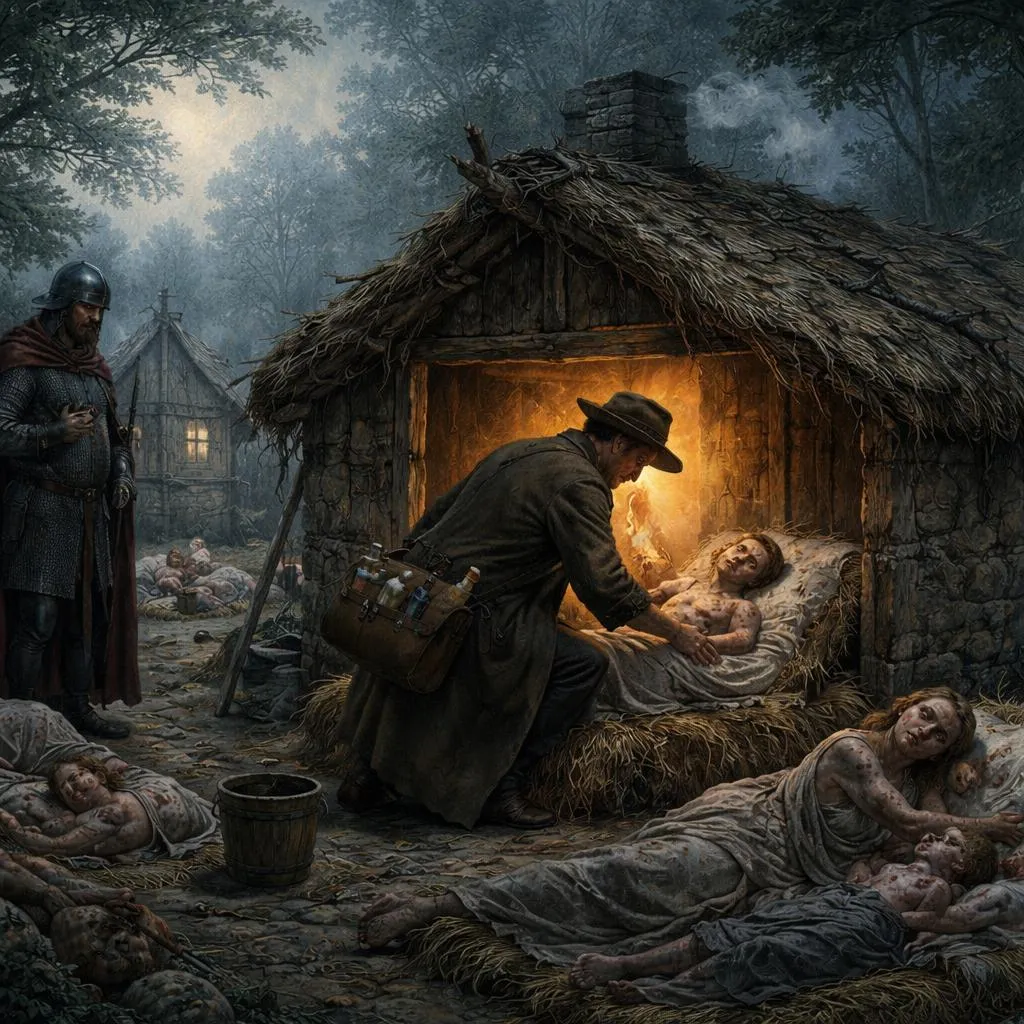

When we arrived at that hut at mid-afternoon, we saw no signs of life about it. The field near by had been denuded of its crop some time before, and had a skinned look, so exhaustively had it been harvested and gleaned. Fences, sheds, everything had a ruined look, and were eloquent of poverty. No animal was around anywhere, no living thing in sight. The stillness was awful, it was like the stillness of death. The cabin was a one-story one, whose thatch was black with age, and ragged from lack of repair.
The door stood a trifle ajar. We approached it stealthily—on tiptoe and at half-breath—for that is the way one’s feeling makes him do, at such a time. The king knocked. We waited. No answer. Knocked again. No answer. I pushed the door softly open and looked in. I made out some dim forms, and a woman started up from the ground and stared at me, as one does who is wakened from sleep. Presently she found her voice:
“Have mercy!” she pleaded. “All is taken, nothing is left.”
“I have not come to take anything, poor woman.”
“You are not a priest?”
“No.”
“Nor come not from the lord of the manor?”
“No, I am a stranger.”
“Oh, then, for the fear of God, who visits with misery and death such as be harmless, tarry not here, but fly! This place is under his curse—and his Church’s.”
“Let me come in and help you—you are sick and in trouble.”
I was better used to the dim light now. I could see her hollow eyes fixed upon me. I could see how emaciated she was.
“I tell you the place is under the Church’s ban. Save yourself —and go, before some straggler see thee here, and report it.”
“Give yourself no trouble about me; I don’t care anything for the Church’s curse. Let me help you.”
“Now all good spirits—if there be any such—bless thee for that word. Would God I had a sup of water!—but hold, hold, forget I said it, and fly; for there is that here that even he that feareth not the Church must fear: this disease whereof we die. Leave us, thou brave, good stranger, and take with thee such whole and sincere blessing as them that be accursed can give.”
But before this I had picked up a wooden bowl and was rushing past the king on my way to the brook. It was ten yards away. When I got back and entered, the king was within, and was opening the shutter that closed the window-hole, to let in air and light. The place was full of a foul stench. I put the bowl to the woman’s lips, and as she gripped it with her eager talons the shutter came open and a strong light flooded her face. Smallpox!
I sprang to the king, and said in his ear:
“Out of the door on the instant, sire! the woman is dying of that disease that wasted the skirts of Camelot two years ago.”
He did not budge.
“Of a truth I shall remain—and likewise help.”
I whispered again:
“King, it must not be. You must go.”
“Ye mean well, and ye speak not unwisely. But it were shame that a king should know fear, and shame that belted knight should withhold his hand where be such as need succor. Peace, I will not go. It is you who must go. The Church’s ban is not upon me, but it forbiddeth you to be here, and she will deal with you with a heavy hand an word come to her of your trespass.”
It was a desperate place for him to be in, and might cost him his life, but it was no use to argue with him. If he considered his knightly honor at stake here, that was the end of argument; he would stay, and nothing could prevent it; I was aware of that. And so I dropped the subject. The woman spoke:
“Fair sir, of your kindness will ye climb the ladder there, and bring me news of what ye find? Be not afraid to report, for times can come when even a mother’s heart is past breaking —being already broke.”
“Abide,” said the king, “and give the woman to eat. I will go.” And he put down the knapsack.
I turned to start, but the king had already started. He halted, and looked down upon a man who lay in a dim light, and had not noticed us thus far, or spoken.
“Is it your husband?” the king asked.
“Yes.”
“Is he asleep?”
“God be thanked for that one charity, yes—these three hours. Where shall I pay to the full, my gratitude! for my heart is bursting with it for that sleep he sleepeth now.”
I said:
“We will be careful. We will not wake him.”
“Ah, no, that ye will not, for he is dead.”
“Dead?”
“Yes, what triumph it is to know it! None can harm him, none insult him more. He is in heaven now, and happy; or if not there, he bides in hell and is content; for in that place he will find neither abbot nor yet bishop. We were boy and girl together; we were man and wife these five and twenty years, and never separated till this day. Think how long that is to love and suffer together. This morning was he out of his mind, and in his fancy we were boy and girl again and wandering in the happy fields; and so in that innocent glad converse wandered he far and farther, still lightly gossiping, and entered into those other fields we know not of, and was shut away from mortal sight. And so there was no parting, for in his fancy I went with him; he knew not but I went with him, my hand in his—my young soft hand, not this withered claw. Ah, yes, to go, and know it not; to separate and know it not; how could one go peace—fuller than that? It was his reward for a cruel life patiently borne.”
There was a slight noise from the direction of the dim corner where the ladder was. It was the king descending. I could see that he was bearing something in one arm, and assisting himself with the other. He came forward into the light; upon his breast lay a slender girl of fifteen. She was but half conscious; she was dying of smallpox. Here was heroism at its last and loftiest possibility, its utmost summit; this was challenging death in the open field unarmed, with all the odds against the challenger, no reward set upon the contest, and no admiring world in silks and cloth of gold to gaze and applaud; and yet the king’s bearing was as serenely brave as it had always been in those cheaper contests where knight meets knight in equal fight and clothed in protecting steel. He was great now; sublimely great. The rude statues of his ancestors in his palace should have an addition—I would see to that; and it would not be a mailed king killing a giant or a dragon, like the rest, it would be a king in commoner’s garb bearing death in his arms that a peasant mother might look her last upon her child and be comforted.
He laid the girl down by her mother, who poured out endearments and caresses from an overflowing heart, and one could detect a flickering faint light of response in the child’s eyes, but that was all. The mother hung over her, kissing her, petting her, and imploring her to speak, but the lips only moved and no sound came. I snatched my liquor flask from my knapsack, but the woman forbade me, and said:
“No—she does not suffer; it is better so. It might bring her back to life. None that be so good and kind as ye are would do her that cruel hurt. For look you—what is left to live for? Her brothers are gone, her father is gone, her mother goeth, the Church’s curse is upon her, and none may shelter or befriend her even though she lay perishing in the road. She is desolate. I have not asked you, good heart, if her sister be still on live, here overhead; I had no need; ye had gone back, else, and not left the poor thing forsaken—”
“She lieth at peace,” interrupted the king, in a subdued voice.
“I would not change it. How rich is this day in happiness! Ah, my Annis, thou shalt join thy sister soon—thou’rt on thy way, and these be merciful friends that will not hinder.”
And so she fell to murmuring and cooing over the girl again, and softly stroking her face and hair, and kissing her and calling her by endearing names; but there was scarcely sign of response now in the glazing eyes. I saw tears well from the king’s eyes, and trickle down his face. The woman noticed them, too, and said:
“Ah, I know that sign: thou’st a wife at home, poor soul, and you and she have gone hungry to bed, many’s the time, that the little ones might have your crust; you know what poverty is, and the daily insults of your betters, and the heavy hand of the Church and the king.”
The king winced under this accidental home-shot, but kept still; he was learning his part; and he was playing it well, too, for a pretty dull beginner. I struck up a diversion. I offered the woman food and liquor, but she refused both. She would allow nothing to come between her and the release of death. Then I slipped away and brought the dead child from aloft, and laid it by her. This broke her down again, and there was another scene that was full of heartbreak. By and by I made another diversion, and beguiled her to sketch her story.
“Ye know it well yourselves, having suffered it—for truly none of our condition in Britain escape it. It is the old, weary tale. We fought and struggled and succeeded; meaning by success, that we lived and did not die; more than that is not to be claimed. No troubles came that we could not outlive, till this year brought them; then came they all at once, as one might say, and overwhelmed us. Years ago the lord of the manor planted certain fruit trees on our farm; in the best part of it, too—a grievous wrong and shame—”
“But it was his right,” interrupted the king.
“None denieth that, indeed; an the law mean anything, what is the lord’s is his, and what is mine is his also. Our farm was ours by lease, therefore ‘twas likewise his, to do with it as he would. Some little time ago, three of those trees were found hewn down. Our three grown sons ran frightened to report the crime. Well, in his lordship’s dungeon there they lie, who saith there shall they lie and rot till they confess. They have naught to confess, being innocent, wherefore there will they remain until they die. Ye know that right well, I ween. Think how this left us; a man, a woman and two children, to gather a crop that was planted by so much greater force, yes, and protect it night and day from pigeons and prowling animals that be sacred and must not be hurt by any of our sort. When my lord’s crop was nearly ready for the harvest, so also was ours; when his bell rang to call us to his fields to harvest his crop for nothing, he would not allow that I and my two girls should count for our three captive sons, but for only two of them; so, for the lacking one were we daily fined. All this time our own crop was perishing through neglect; and so both the priest and his lordship fined us because their shares of it were suffering through damage. In the end the fines ate up our crop—and they took it all; they took it all and made us harvest it for them, without pay or food, and we starving. Then the worst came when I, being out of my mind with hunger and loss of my boys, and grief to see my husband and my little maids in rags and misery and despair, uttered a deep blasphemy—oh! a thousand of them! —against the Church and the Church’s ways. It was ten days ago. I had fallen sick with this disease, and it was to the priest I said the words, for he was come to chide me for lack of due humility under the chastening hand of God. He carried my trespass to his betters; I was stubborn; wherefore, presently upon my head and upon all heads that were dear to me, fell the curse of Rome.
“Since that day we are avoided, shunned with horror. None has come near this hut to know whether we live or not. The rest of us were taken down. Then I roused me and got up, as wife and mother will. It was little they could have eaten in any case; it was less than little they had to eat. But there was water, and I gave them that. How they craved it! and how they blessed it! But the end came yesterday; my strength broke down. Yesterday was the last time I ever saw my husband and this youngest child alive. I have lain here all these hours—these ages, ye may say—listening, listening for any sound up there that—”
She gave a sharp quick glance at her eldest daughter, then cried out, “Oh, my darling!” and feebly gathered the stiffening form to her sheltering arms. She had recognized the death-rattle.
背景和作者介绍
这个故事是作品中一个生动而令人难忘的片段,探讨了贫困、疾病、社会不公和人类同情心等主题。叙事背景设定在一个严酷的中世纪环境,国王和他的同伴遇到一个被天花摧毁的家庭,以及封建和宗教权威的残酷。作者的身份在这里没有具体说明,他使用丰富、描述性的语言来描绘在绝望中挣扎的痛苦和英雄主义的画面。
这个故事反映了历史现实,如天花等疾病的爆发摧毁了社区,穷人常常独自受苦,被社会和教会排斥。国王冒着风险留下来帮助的勇敢决定,突出了高尚、牺牲和真正领导力的主题。
详细解读和意义
这段话不仅仅是一个关于疾病和死亡的故事;它还是对人类尊严和当权者责任的有力评论。国王拒绝抛弃患病家庭,这与庄园主的残忍和教会的严厉禁令形成了鲜明对比,象征着压迫性的社会结构。
这位女性的故事揭示了农民面临的不公正:他们的劳动被剥削,他们的家庭被拆散,他们的声音被压制。她对教会的亵渎和随后的诅咒反映了源于痛苦和忽视的绝望和愤怒。这个故事促使读者思考社会制度如何未能帮助弱势群体,以及同情心和勇气如何在最黑暗的时刻闪耀。
给学生的教训和启发
-
同情心和同理心: 国王的行动教会了我们同理心的重要性——即使在危险或不便的情况下也要帮助有需要的人。学生可以学会更加关注他人的痛苦,并在不期望回报的情况下提供帮助。
-
勇气和责任: 国王体现了勇气,不是在战斗中,而是在道德力量中。为正确的事情挺身而出,即使冒着人身安全或声誉的风险,对年轻人来说也是至关重要的一课。
-
社会意识: 这个故事鼓励批判性地思考社会正义和不平等。了解历史和社会背景有助于学生欣赏人类社会的复杂性以及公平的重要性。
-
逆境中的韧性: 尽管遭受了损失和痛苦,这位女性的坚韧表现了人类的韧性。学生可以从中找到灵感,以力量和希望面对自己的挑战。
将故事的精神应用于日常生活
- 在学校: 学生可以通过支持正在挣扎的同学、反对欺凌行为以及尊重多样性来实践善良。
- 在家庭和社区中: 他们可以帮助有需要的家庭成员,参加社区服务,并倡导公平和对弱势群体的支持。
- 在个人成长中: 培养同情心、勇气和韧性有助于学生培养性格和领导能力,这将使他们终身受益。
从故事中培养积极的价值观
- 同理心练习: 反思有人帮助你或你帮助他人的时刻。讨论感受如何以及为什么重要。
- 角色扮演: 想象自己是国王或那位女性,探索你在困难情况下会如何行动。
- 社区项目: 参与帮助弱势群体的活动,例如食物捐赠或宣传活动。
通过阅读和反思这样的故事,学生不仅可以提高他们的语言和理解能力,还可以加深对人性的理解以及他们在建设更美好世界中的作用。