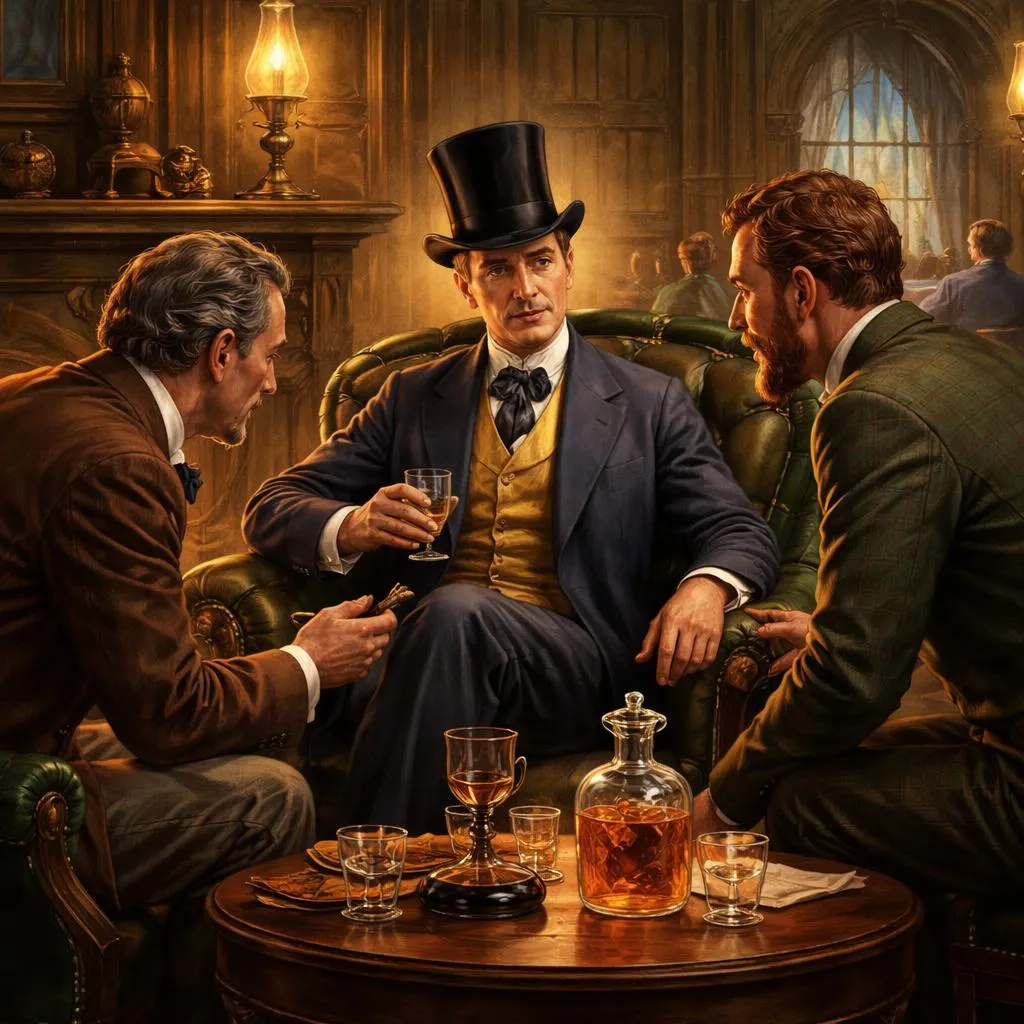

Phileas Fogg, having shut the door of his house at half–past eleven, and having put his right foot before his left five hundred and seventy–five times, and his left foot before his right five hundred and seventy–six times, reached the Reform Club, an imposing edifice in Pall Mall, which could not have cost less than three millions. He repaired at once to the dining–room, the nine windows of which open upon a tasteful garden, where the trees were already gilded with an autumn colouring; and took his place at the habitual table, the cover of which had already been laid for him. His breakfast consisted of a side–dish, a broiled fish with Reading sauce, a scarlet slice of roast beef garnished with mushrooms, a rhubarb and gooseberry tart, and a morsel of Cheshire cheese, the whole being washed down with several cups of tea, for which the Reform is famous. He rose at thirteen minutes to one, and directed his steps towards the large hall, a sumptuous apartment adorned with lavishly–framed paintings. A flunkey handed him an uncut Times, which he proceeded to cut with a skill which betrayed familiarity with this delicate operation. The perusal of this paper absorbed Phileas Fogg until a quarter before four, whilst the Standard, his next task, occupied him till the dinner hour. Dinner passed as breakfast had done, and Mr. Fogg re–appeared in the reading–room and sat down to the Pall Mall at twenty minutes before six. Half an hour later several members of the Reform came in and drew up to the fireplace, where a coal fire was steadily burning. They were Mr. Fogg's usual partners at whist: Andrew Stuart, an engineer; John Sullivan and Samuel Fallentin, bankers; Thomas Flanagan, a brewer; and Gauthier Ralph, one of the Directors of the Bank of England—all rich and highly respectable personages, even in a club which comprises the princes of English trade and finance.
"Well, Ralph," said Thomas Flanagan, "what about that robbery?"
"Oh," replied Stuart, "the Bank will lose the money."
"On the contrary," broke in Ralph, "I hope we may put our hands on the robber. Skilful detectives have been sent to all the principal ports of America and the Continent, and he'll be a clever fellow if he slips through their fingers."
"But have you got the robber's description?" asked Stuart.
"In the first place, he is no robber at all," returned Ralph, positively.
"What! a fellow who makes off with fifty–five thousand pounds, no robber?"
"No."
"Perhaps he's a manufacturer, then."
"The Daily Telegraph says that he is a gentleman."
It was Phileas Fogg, whose head now emerged from behind his newspapers, who made this remark. He bowed to his friends, and entered into the conversation. The affair which formed its subject, and which was town talk, had occurred three days before at the Bank of England. A package of banknotes, to the value of fifty–five thousand pounds, had been taken from the principal cashier's table, that functionary being at the moment engaged in registering the receipt of three shillings and sixpence. Of course, he could not have his eyes everywhere. Let it be observed that the Bank of England reposes a touching confidence in the honesty of the public. There are neither guards nor gratings to protect its treasures; gold, silver, banknotes are freely exposed, at the mercy of the first comer. A keen observer of English customs relates that, being in one of the rooms of the Bank one day, he had the curiosity to examine a gold ingot weighing some seven or eight pounds. He took it up, scrutinised it, passed it to his neighbour, he to the next man, and so on until the ingot, going from hand to hand, was transferred to the end of a dark entry; nor did it return to its place for half an hour. Meanwhile, the cashier had not so much as raised his head. But in the present instance things had not gone so smoothly. The package of notes not being found when five o'clock sounded from the ponderous clock in the "drawing office," the amount was passed to the account of profit and loss. As soon as the robbery was discovered, picked detectives hastened off to Liverpool, Glasgow, Havre, Suez, Brindisi, New York, and other ports, inspired by the proffered reward of two thousand pounds, and five per cent. on the sum that might be recovered. Detectives were also charged with narrowly watching those who arrived at or left London by rail, and a judicial examination was at once entered upon.
There were real grounds for supposing, as the Daily Telegraph said, that the thief did not belong to a professional band. On the day of the robbery a well–dressed gentleman of polished manners, and with a well–to–do air, had been observed going to and fro in the paying room where the crime was committed. A description of him was easily procured and sent to the detectives; and some hopeful spirits, of whom Ralph was one, did not despair of his apprehension. The papers and clubs were full of the affair, and everywhere people were discussing the probabilities of a successful pursuit; and the Reform Club was especially agitated, several of its members being Bank officials.
Ralph would not concede that the work of the detectives was likely to be in vain, for he thought that the prize offered would greatly stimulate their zeal and activity. But Stuart was far from sharing this confidence; and, as they placed themselves at the whist–table, they continued to argue the matter. Stuart and Flanagan played together, while Phileas Fogg had Fallentin for his partner. As the game proceeded the conversation ceased, excepting between the rubbers, when it revived again.
"I maintain," said Stuart, "that the chances are in favour of the thief, who must be a shrewd fellow."
"Well, but where can he fly to?" asked Ralph. "No country is safe for him."
"Pshaw!"
"Where could he go, then?"
"Oh, I don't know that. The world is big enough."
"It was once," said Phileas Fogg, in a low tone. "Cut, sir," he added, handing the cards to Thomas Flanagan.
The discussion fell during the rubber, after which Stuart took up its thread.
"What do you mean by `once'? Has the world grown smaller?"
"Certainly," returned Ralph. "I agree with Mr. Fogg. The world has grown smaller, since a man can now go round it ten times more quickly than a hundred years ago. And that is why the search for this thief will be more likely to succeed."
"And also why the thief can get away more easily."
"Be so good as to play, Mr. Stuart," said Phileas Fogg.
But the incredulous Stuart was not convinced, and when the hand was finished, said eagerly: "You have a strange way, Ralph, of proving that the world has grown smaller. So, because you can go round it in three months—"
"In eighty days," interrupted Phileas Fogg.
"That is true, gentlemen," added John Sullivan. "Only eighty days, now that the section between Rothal and Allahabad, on the Great Indian Peninsula Railway, has been opened. Here is the estimate made by the Daily Telegraph:
From London to Suez via Mont Cenis and Brindisi, by rail and steamboats ................... 7 days From Suez to Bombay, by steamer .................... 13 " From Bombay to Calcutta, by rail ................... 3 " From Calcutta to Hong Kong, by steamer ............. 13 " From Hong Kong to Yokohama (Japan), by steamer ..... 6 " From Yokohama to San Francisco, by steamer ......... 22 " From San Francisco to New York, by rail ............. 7 " From New York to London, by steamer and rail ........ 9 " ––––––– Total ............................................ 80 days."
"Yes, in eighty days!" exclaimed Stuart, who in his excitement made a false deal. "But that doesn't take into account bad weather, contrary winds, shipwrecks, railway accidents, and so on."
"All included," returned Phileas Fogg, continuing to play despite the discussion.
"But suppose the Hindoos or Indians pull up the rails," replied Stuart; "suppose they stop the trains, pillage the luggage–vans, and scalp the passengers!"
"All included," calmly retorted Fogg; adding, as he threw down the cards, "Two trumps."
Stuart, whose turn it was to deal, gathered them up, and went on: "You are right, theoretically, Mr. Fogg, but practically—"
"Practically also, Mr. Stuart."
"I'd like to see you do it in eighty days."
"It depends on you. Shall we go?"
"Heaven preserve me! But I would wager four thousand pounds that such a journey, made under these conditions, is impossible."
"Quite possible, on the contrary," returned Mr. Fogg.
"Well, make it, then!"
"The journey round the world in eighty days?"
"Yes."
"I should like nothing better."
"When?"
"At once. Only I warn you that I shall do it at your expense."
"It's absurd!" cried Stuart, who was beginning to be annoyed at the persistency of his friend. "Come, let's go on with the game."
"Deal over again, then," said Phileas Fogg. "There's a false deal."
Stuart took up the pack with a feverish hand; then suddenly put them down again.
"Well, Mr. Fogg," said he, "it shall be so: I will wager the four thousand on it."
"Calm yourself, my dear Stuart," said Fallentin. "It's only a joke."
"When I say I'll wager," returned Stuart, "I mean it." "All right," said Mr. Fogg; and, turning to the others, he continued: "I have a deposit of twenty thousand at Baring's which I will willingly risk upon it."
"Twenty thousand pounds!" cried Sullivan. "Twenty thousand pounds, which you would lose by a single accidental delay!"
"The unforeseen does not exist," quietly replied Phileas Fogg.
"But, Mr. Fogg, eighty days are only the estimate of the least possible time in which the journey can be made."
"A well–used minimum suffices for everything."
"But, in order not to exceed it, you must jump mathematically from the trains upon the steamers, and from the steamers upon the trains again."
"I will jump—mathematically."
"You are joking."
"A true Englishman doesn't joke when he is talking about so serious a thing as a wager," replied Phileas Fogg, solemnly. "I will bet twenty thousand pounds against anyone who wishes that I will make the tour of the world in eighty days or less; in nineteen hundred and twenty hours, or a hundred and fifteen thousand two hundred minutes. Do you accept?"
"We accept," replied Messrs. Stuart, Fallentin, Sullivan, Flanagan, and Ralph, after consulting each other.
"Good," said Mr. Fogg. "The train leaves for Dover at a quarter before nine. I will take it."
"This very evening?" asked Stuart.
"This very evening," returned Phileas Fogg. He took out and consulted a pocket almanac, and added, "As today is Wednesday, the 2nd of October, I shall be due in London in this very room of the Reform Club, on Saturday, the 21st of December, at a quarter before nine p.m.; or else the twenty thousand pounds, now deposited in my name at Baring's, will belong to you, in fact and in right, gentlemen. Here is a cheque for the amount."
A memorandum of the wager was at once drawn up and signed by the six parties, during which Phileas Fogg preserved a stoical composure. He certainly did not bet to win, and had only staked the twenty thousand pounds, half of his fortune, because he foresaw that he might have to expend the other half to carry out this difficult, not to say unattainable, project. As for his antagonists, they seemed much agitated; not so much by the value of their stake, as because they had some scruples about betting under conditions so difficult to their friend.
The clock struck seven, and the party offered to suspend the game so that Mr. Fogg might make his preparations for departure.
"I am quite ready now," was his tranquil response. "Diamonds are trumps: be so good as to play, gentlemen."
背景和作者介绍
这篇摘录选自儒勒·凡尔纳的经典冒险小说《八十天环游地球》,儒勒·凡尔纳是一位法国作家,被誉为科幻小说和冒险文学的先驱。这部小说写于1872年,捕捉了19世纪的精神,当时世界通过铁路和汽船等新技术变得更加紧密。凡尔纳富有想象力的叙事与科学知识相结合,激励了一代又一代的读者去梦想探索和发现。
故事详细解释
故事的开始是菲利亚斯·福克,一位富有且守时的英国绅士,在伦敦过着非常有规律的生活。有一天,他打了一个大胆的赌,说他可以在短短八十天内环游世界,这在当时看来几乎是不可能完成的任务。你阅读的段落描述了福克接受挑战的时刻,他赌了一大笔钱,并准备开始他的旅程。故事充满了悬念,福克面临着无数的障碍,包括自然灾害、延误和意想不到的冒险,所有这些都在与时间赛跑。
主题和意义
《八十天环游地球》的核心是关于决心、勇气和人类智慧的力量。它突出了交通和通讯的进步如何缩小了世界,使全球旅行变得更加可行。小说还探讨了文化多样性的主题,因为福克在他的旅程中遇到了来自许多不同国家和背景的人。此外,它强调了在面对挑战时保持冷静和理性思考的重要性,正如福克冷静的态度和精确的计划所证明的那样。
给学生的教训和见解
阅读这个故事的学生可以学到关于毅力和时间管理的重要教训。菲利亚斯·福克对目标的坚定承诺告诉我们,只要有周密的计划和决心,即使是最困难的任务也能完成。这个故事也鼓励对世界和不同文化的好奇心,培养对多样性的开放态度。
此外,小说还提供了对适应性重要性的见解。尽管福克计划周密,但他必须适应意外事件,这向读者表明,灵活性是克服障碍的关键。
在生活和学习中的实际应用
- 时间管理: 像福克一样,学生可以学会仔细安排他们的日程,并优先处理任务,以有效地实现他们的目标。
- 解决问题: 福克的旅程充满了惊喜。学生可以运用他冷静和理性的方法来解决学习或日常生活中的问题。
- 文化意识: 故事鼓励尊重和对不同文化的兴趣,这对于社会和谐和全球公民意识至关重要。
- 勇气和冒险: 福克愿意冒险,这告诉学生,走出舒适区有时是成功的必要条件。
如何从故事中培养积极的特质
- 准时守纪: 福克的准时是传奇的。学生应该练习准时并遵守他们的日常作息。
- 在压力下保持冷静: 即使面对困难,保持镇定也有助于做出更好的决定。
- 保持好奇心和开放心态: 探索新的想法和文化可以开阔视野,培养同情心。
- 设定明确的目标: 像福克的旅程一样,拥有明确的目标可以激励持续的努力和专注。
反思和欣赏
阅读《八十天环游地球》不仅仅是一次激动人心的冒险;它也是一次对决心、好奇心和尊重他人的价值观的探索。学生可以反思福克的品质如何应用于他们自己的生活,无论是在学校、友谊还是未来的愿望中。这部小说激励我们大胆梦想,并提醒我们,只要有勇气和计划,不可能的事情就会变成可能。