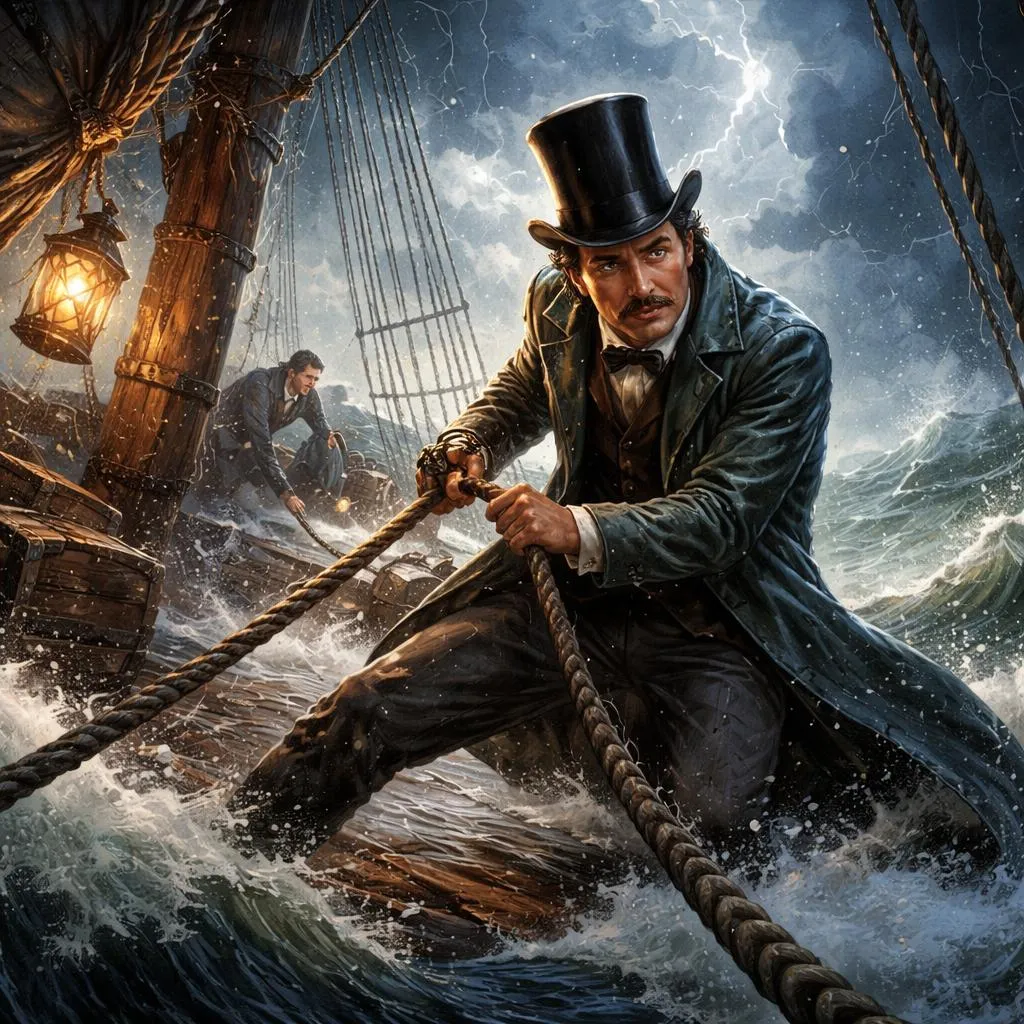

The China, in leaving, seemed to have carried off Phileas Fogg's last hope. None of the other steamers were able to serve his projects. The Pereire, of the French Transatlantic Company, whose admirable steamers are equal to any in speed and comfort, did not leave until the 14th; the Hamburg boats did not go directly to Liverpool or London, but to Havre; and the additional trip from Havre to Southampton would render Phileas Fogg's last efforts of no avail. The Inman steamer did not depart till the next day, and could not cross the Atlantic in time to save the wager.
Mr. Fogg learned all this in consulting his Bradshaw, which gave him the daily movements of the trans–Atlantic steamers.
Passepartout was crushed; it overwhelmed him to lose the boat by three–quarters of an hour. It was his fault, for, instead of helping his master, he had not ceased putting obstacles in his path! And when he recalled all the incidents of the tour, when he counted up the sums expended in pure loss and on his own account, when he thought that the immense stake, added to the heavy charges of this useless journey, would completely ruin Mr. Fogg, he overwhelmed himself with bitter self–accusations. Mr. Fogg, however, did not reproach him; and, on leaving the Cunard pier, only said: "We will consult about what is best to–morrow. Come."
The party crossed the Hudson in the Jersey City ferryboat, and drove in a carriage to the St. Nicholas Hotel, on Broadway. Rooms were engaged, and the night passed, briefly to Phileas Fogg, who slept profoundly, but very long to Aouda and the others, whose agitation did not permit them to rest.
The next day was the 12th of December. From seven in the morning of the 12th to a quarter before nine in the evening of the 21st there were nine days, thirteen hours, and forty–five minutes. If Phileas Fogg had left in the China, one of the fastest steamers on the Atlantic, he would have reached Liverpool, and then London, within the period agreed upon.
Mr. Fogg left the hotel alone, after giving Passepartout instructions to await his return, and inform Aouda to be ready at an instant's notice. He proceeded to the banks of the Hudson, and looked about among the vessels moored or anchored in the river, for any that were about to depart. Several had departure signals, and were preparing to put to sea at morning tide; for in this immense and admirable port there is not one day in a hundred that vessels do not set out for every quarter of the globe. But they were mostly sailing vessels, of which, of course, Phileas Fogg could make no use.
He seemed about to give up all hope, when he espied, anchored at the Battery, a cable's length off at most, a trading vessel, with a screw, well–shaped, whose funnel, puffing a cloud of smoke, indicated that she was getting ready for departure.
Phileas Fogg hailed a boat, got into it, and soon found himself on board the Henrietta, iron–hulled, wood–built above. He ascended to the deck, and asked for the captain, who forthwith presented himself. He was a man of fifty, a sort of sea–wolf, with big eyes, a complexion of oxidised copper, red hair and thick neck, and a growling voice.
"The captain?" asked Mr. Fogg.
"I am the captain."
"I am Phileas Fogg, of London."
"And I am Andrew Speedy, of Cardiff."
"You are going to put to sea?"
"In an hour."
"You are bound for—"
"Bordeaux."
"And your cargo?"
"No freight. Going in ballast."
"Have you any passengers?"
"No passengers. Never have passengers. Too much in the way."
"Is your vessel a swift one?"
"Between eleven and twelve knots. The Henrietta, well known."
"Will you carry me and three other persons to Liverpool?"
"To Liverpool? Why not to China?"
"I said Liverpool."
"No!"
"No?"
"No. I am setting out for Bordeaux, and shall go to Bordeaux."
"Money is no object?"
"None."
The captain spoke in a tone which did not admit of a reply.
"But the owners of the Henrietta—" resumed Phileas Fogg.
"The owners are myself," replied the captain. "The vessel belongs to me."
"I will freight it for you."
"No."
"I will buy it of you."
"No."
Phileas Fogg did not betray the least disappointment; but the situation was a grave one. It was not at New York as at Hong Kong, nor with the captain of the Henrietta as with the captain of the Tankadere. Up to this time money had smoothed away every obstacle. Now money failed.
Still, some means must be found to cross the Atlantic on a boat, unless by balloon—which would have been venturesome, besides not being capable of being put in practice. It seemed that Phileas Fogg had an idea, for he said to the captain, "Well, will you carry me to Bordeaux?"
"No, not if you paid me two hundred dollars."
"I offer you two thousand."
"Apiece?"
"Apiece."
"And there are four of you?"
"Four."
Captain Speedy began to scratch his head. There were eight thousand dollars to gain, without changing his route; for which it was well worth conquering the repugnance he had for all kinds of passengers. Besides, passenger's at two thousand dollars are no longer passengers, but valuable merchandise. "I start at nine o'clock," said Captain Speedy, simply. "Are you and your party ready?"
"We will be on board at nine o'clock," replied, no less simply, Mr. Fogg.
It was half–past eight. To disembark from the Henrietta, jump into a hack, hurry to the St. Nicholas, and return with Aouda, Passepartout, and even the inseparable Fix was the work of a brief time, and was performed by Mr. Fogg with the coolness which never abandoned him. They were on board when the Henrietta made ready to weigh anchor.
When Passepartout heard what this last voyage was going to cost, he uttered a prolonged "Oh!" which extended throughout his vocal gamut.
As for Fix, he said to himself that the Bank of England would certainly not come out of this affair well indemnified. When they reached England, even if Mr. Fogg did not throw some handfuls of bank–bills into the sea, more than seven thousand pounds would have been spent!
背景介绍和作者介绍
这段文字选自儒勒·凡尔纳的经典小说《八十天环游地球》,他是一位法国作家,以其冒险故事和科幻小说的先驱作品而闻名。这部小说写于1873年,捕捉了19世纪的探险精神和快速的技术进步,特别是使全球旅行更快、更容易的轮船和铁路的发展。
儒勒·凡尔纳的作品经常将详细的科学知识与富有想象力的故事讲述相结合,激励了一代又一代的读者去梦想遥远的地方和人类智慧的可能性。《八十天环游地球》是他最受欢迎的故事之一,不仅展现了一场惊险的冒险,还说明了决心、足智多谋和文化理解的重要性。
详细解读和意义
这段摘录展示了故事中的一个关键时刻,主人公福格面临着在他八十天内环游地球的尝试中的一个重大挫折。汽船“中国号”的离开代表着一个失去的机会,迫使福格寻找其他方式来按时继续他的旅程。尽管遇到了障碍,金钱也无法解决所有问题,但福格的冷静和战略思维却闪耀着光芒。他与斯皮迪船长谈判,以确保在较慢的贸易船“亨丽埃塔号”上的通行,这体现了他的毅力和适应能力。
这一幕突出了小说中的几个关键主题:人类意志与旅行的不可预测性之间的冲突,在压力下快速思考的价值,以及即使在情况看起来不利时也不放弃的重要性。它也反映了那个时代对新交通技术的迷恋,以及通过更快的通信和旅行而缩小的世界。
给学生的教训和见解
-
毅力和解决问题: 福格在面对障碍时的冷静举止和拒绝恐慌,教会学生保持镇定和创造性地思考以克服挑战的重要性。生活常常会遇到意想不到的困难,而成功取决于我们如何回应。
-
足智多谋: 尽管困难重重,福格仍能谈判并找到解决方案,这鼓励年轻读者变得足智多谋和思想开放。有时,前进的最佳道路并非显而易见或最容易的道路。
-
时间管理和规划: 小说的核心赌注强调了周密计划和时间管理的重要性。学生可以学习如何设定明确的目标和监控进度是学术和个人生活中必不可少的技能。
-
文化意识和开放心态: 当福格环游世界时,他遇到了不同的文化和习俗。这培养了对全球多样性的欣赏,以及尊重和学习不同人群的重要性。
-
金钱的作用: 虽然金钱是一种强大的工具,但这段文字表明它无法解决所有问题。学生可以反思物质财富的局限性,以及智慧、品格和人际关系的重要性。
在日常生活和学习中的应用
-
在学校: 学生可以通过以耐心和毅力攻克难题来运用福格的决心。当遇到挫折时,例如成绩不好或误解,他们可以记住保持冷静并寻求替代策略。
-
在社交场合: 福格即使在压力下也能保持尊重和镇定的互动,这为有效沟通和解决冲突树立了榜样。学生可以学会倾听、谈判和保持良好的人际关系。
-
在个人成长中: 这个故事鼓励年轻人将挑战视为成长的机会。培养适应能力、勇气和乐观等品质将帮助他们应对生活的复杂性。
从故事中培养积极的特质
-
在压力下保持冷静: 像福格一样,练习正念和呼吸技巧,在紧张时刻保持冷静。
-
战略思维: 将问题分解成更小的部分,并在采取行动之前考虑多种解决方案。
-
尊重他人: 对不同的文化和观点保持好奇,培养同情心和全球公民意识。
-
对目标的承诺: 设定明确的目标并跟踪进度,根据需要调整计划,但不要忘记最终目标。
结论
《八十天环游地球》不仅仅是一场激动人心的冒险;它还是关于勇气、智慧和人类精神的永恒教训。通过学习这部小说,学生不仅获得了文学鉴赏力,还获得了可以激励他们学术之旅和个人发展的实用智慧。通过福格的旅程,年轻读者了解到,只要有决心、创造力和对他人的尊重,就没有什么挑战是不可逾越的。