
“Matthew—Matthew—what is the matter? Matthew, are you sick?”
It was Marilla who spoke, alarm in every jerky word. Anne came through the hall, her hands full of white narcissus,—it was long before Anne could love the sight or odor of white narcissus again,—in time to hear her and to see Matthew standing in the porch doorway, a folded paper in his hand, and his face strangely drawn and gray. Anne dropped her flowers and sprang across the kitchen to him at the same moment as Marilla. They were both too late; before they could reach him Matthew had fallen across the threshold.
“He’s fainted,” gasped Marilla. “Anne, run for Martin—quick, quick! He’s at the barn.”
Martin, the hired man, who had just driven home from the post office, started at once for the doctor, calling at Orchard Slope on his way to send Mr. and Mrs. Barry over. Mrs. Lynde, who was there on an errand, came too. They found Anne and Marilla distractedly trying to restore Matthew to consciousness.
Mrs. Lynde pushed them gently aside, tried his pulse, and then laid her ear over his heart. She looked at their anxious faces sorrowfully and the tears came into her eyes.
“Oh, Marilla,” she said gravely. “I don’t think—we can do anything for him.”
“Mrs. Lynde, you don’t think—you can’t think Matthew is—is—” Anne could not say the dreadful word; she turned sick and pallid.
“Child, yes, I’m afraid of it. Look at his face. When you’ve seen that look as often as I have you’ll know what it means.”
Anne looked at the still face and there beheld the seal of the Great Presence.
When the doctor came he said that death had been instantaneous and probably painless, caused in all likelihood by some sudden shock. The secret of the shock was discovered to be in the paper Matthew had held and which Martin had brought from the office that morning. It contained an account of the failure of the Abbey Bank.
The news spread quickly through Avonlea, and all day friends and neighbors thronged Green Gables and came and went on errands of kindness for the dead and living. For the first time shy, quiet Matthew Cuthbert was a person of central importance; the white majesty of death had fallen on him and set him apart as one crowned.
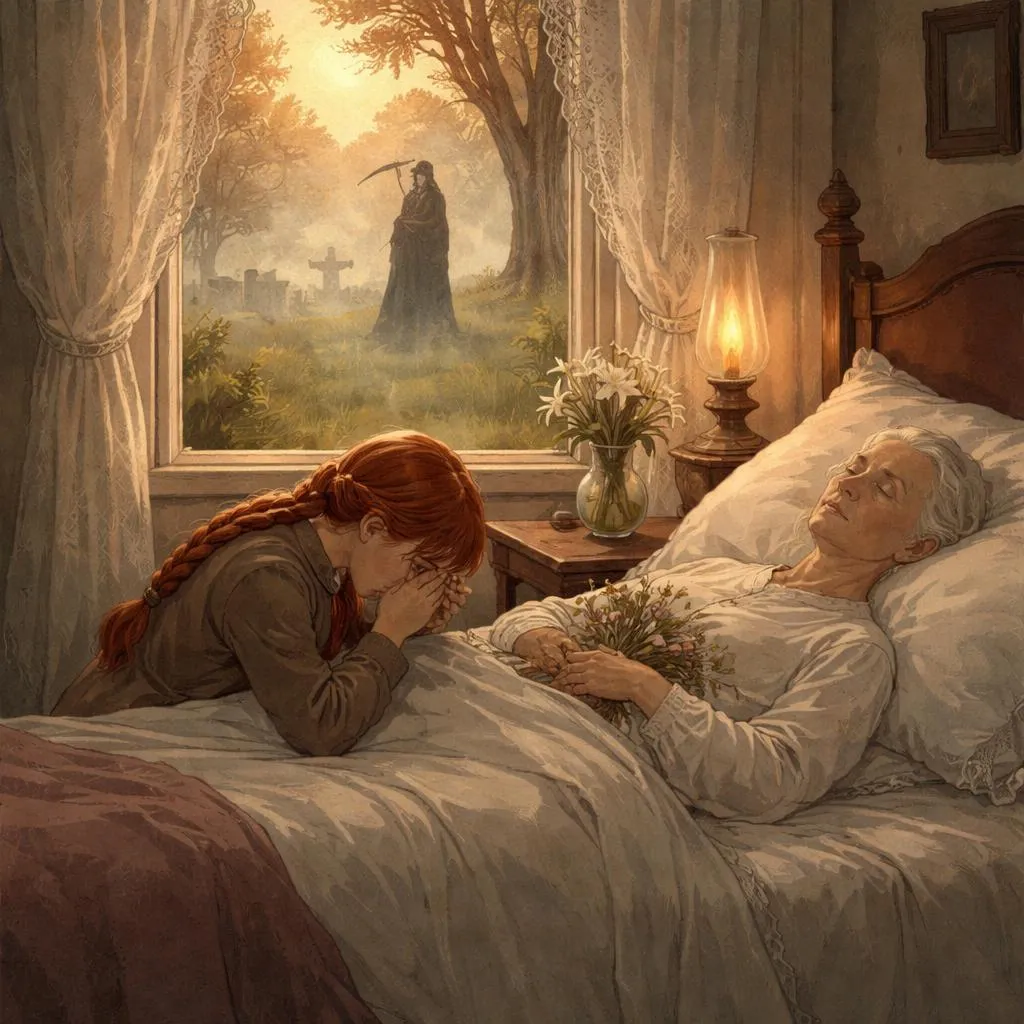
When the calm night came softly down over Green Gables the old house was hushed and tranquil. In the parlor lay Matthew Cuthbert in his coffin, his long gray hair framing his placid face on which there was a little kindly smile as if he but slept, dreaming pleasant dreams. There were flowers about him—sweet old-fashioned flowers which his mother had planted in the homestead garden in her bridal days and for which Matthew had always had a secret, wordless love. Anne had gathered them and brought them to him, her anguished, tearless eyes burning in her white face. It was the last thing she could do for him.
The Barrys and Mrs. Lynde stayed with them that night. Diana, going to the east gable, where Anne was standing at her window, said gently:
“Anne dear, would you like to have me sleep with you tonight?”
“Thank you, Diana.” Anne looked earnestly into her friend’s face. “I think you won’t misunderstand me when I say I want to be alone. I’m not afraid. I haven’t been alone one minute since it happened—and I want to be. I want to be quite silent and quiet and try to realize it. I can’t realize it. Half the time it seems to me that Matthew can’t be dead; and the other half it seems as if he must have been dead for a long time and I’ve had this horrible dull ache ever since.”
Diana did not quite understand. Marilla’s impassioned grief, breaking all the bounds of natural reserve and lifelong habit in its stormy rush, she could comprehend better than Anne’s tearless agony. But she went away kindly, leaving Anne alone to keep her first vigil with sorrow.
Anne hoped that the tears would come in solitude. It seemed to her a terrible thing that she could not shed a tear for Matthew, whom she had loved so much and who had been so kind to her, Matthew who had walked with her last evening at sunset and was now lying in the dim room below with that awful peace on his brow. But no tears came at first, even when she knelt by her window in the darkness and prayed, looking up to the stars beyond the hills—no tears, only the same horrible dull ache of misery that kept on aching until she fell asleep, worn out with the day’s pain and excitement.
In the night she awakened, with the stillness and the darkness about her, and the recollection of the day came over her like a wave of sorrow. She could see Matthew’s face smiling at her as he had smiled when they parted at the gate that last evening—she could hear his voice saying, “My girl—my girl that I’m proud of.” Then the tears came and Anne wept her heart out. Marilla heard her and crept in to comfort her.
“There—there—don’t cry so, dearie. It can’t bring him back. It—it—isn’t right to cry so. I knew that today, but I couldn’t help it then. He’d always been such a good, kind brother to me—but God knows best.”
“Oh, just let me cry, Marilla,” sobbed Anne. “The tears don’t hurt me like that ache did. Stay here for a little while with me and keep your arm round me—so. I couldn’t have Diana stay, she’s good and kind and sweet—but it’s not her sorrow—she’s outside of it and she couldn’t come close enough to my heart to help me. It’s our sorrow—yours and mine. Oh, Marilla, what will we do without him?”
“We’ve got each other, Anne. I don’t know what I’d do if you weren’t here—if you’d never come. Oh, Anne, I know I’ve been kind of strict and harsh with you maybe—but you mustn’t think I didn’t love you as well as Matthew did, for all that. I want to tell you now when I can. It’s never been easy for me to say things out of my heart, but at times like this it’s easier. I love you as dear as if you were my own flesh and blood and you’ve been my joy and comfort ever since you came to Green Gables.”
Two days afterwards they carried Matthew Cuthbert over his homestead threshold and away from the fields he had tilled and the orchards he had loved and the trees he had planted; and then Avonlea settled back to its usual placidity and even at Green Gables affairs slipped into their old groove and work was done and duties fulfilled with regularity as before, although always with the aching sense of “loss in all familiar things.” Anne, new to grief, thought it almost sad that it could be so—that they COULD go on in the old way without Matthew. She felt something like shame and remorse when she discovered that the sunrises behind the firs and the pale pink buds opening in the garden gave her the old inrush of gladness when she saw them—that Diana’s visits were pleasant to her and that Diana’s merry words and ways moved her to laughter and smiles—that, in brief, the beautiful world of blossom and love and friendship had lost none of its power to please her fancy and thrill her heart, that life still called to her with many insistent voices.
“It seems like disloyalty to Matthew, somehow, to find pleasure in these things now that he has gone,” she said wistfully to Mrs. Allan one evening when they were together in the manse garden. “I miss him so much—all the time—and yet, Mrs. Allan, the world and life seem very beautiful and interesting to me for all. Today Diana said something funny and I found myself laughing. I thought when it happened I could never laugh again. And it somehow seems as if I oughtn’t to.”
“When Matthew was here he liked to hear you laugh and he liked to know that you found pleasure in the pleasant things around you,” said Mrs. Allan gently. “He is just away now; and he likes to know it just the same. I am sure we should not shut our hearts against the healing influences that nature offers us. But I can understand your feeling. I think we all experience the same thing. We resent the thought that anything can please us when someone we love is no longer here to share the pleasure with us, and we almost feel as if we were unfaithful to our sorrow when we find our interest in life returning to us.”
“I was down to the graveyard to plant a rosebush on Matthew’s grave this afternoon,” said Anne dreamily. “I took a slip of the little white Scotch rosebush his mother brought out from Scotland long ago; Matthew always liked those roses the best—they were so small and sweet on their thorny stems. It made me feel glad that I could plant it by his grave—as if I were doing something that must please him in taking it there to be near him. I hope he has roses like them in heaven. Perhaps the souls of all those little white roses that he has loved so many summers were all there to meet him. I must go home now. Marilla is all alone and she gets lonely at twilight.”
“She will be lonelier still, I fear, when you go away again to college,” said Mrs. Allan.
Anne did not reply; she said good night and went slowly back to green Gables. Marilla was sitting on the front door-steps and Anne sat down beside her. The door was open behind them, held back by a big pink conch shell with hints of sea sunsets in its smooth inner convolutions.
Anne gathered some sprays of pale-yellow honeysuckle and put them in her hair. She liked the delicious hint of fragrance, as some aerial benediction, above her every time she moved.
“Doctor Spencer was here while you were away,” Marilla said. “He says that the specialist will be in town tomorrow and he insists that I must go in and have my eyes examined. I suppose I’d better go and have it over. I’ll be more than thankful if the man can give me the right kind of glasses to suit my eyes. You won’t mind staying here alone while I’m away, will you? Martin will have to drive me in and there’s ironing and baking to do.”
“I shall be all right. Diana will come over for company for me. I shall attend to the ironing and baking beautifully—you needn’t fear that I’ll starch the handkerchiefs or flavor the cake with liniment.”
Marilla laughed.
“What a girl you were for making mistakes in them days, Anne. You were always getting into scrapes. I did use to think you were possessed. Do you mind the time you dyed your hair?”
“Yes, indeed. I shall never forget it,” smiled Anne, touching the heavy braid of hair that was wound about her shapely head. “I laugh a little now sometimes when I think what a worry my hair used to be to me—but I don’t laugh MUCH, because it was a very real trouble then. I did suffer terribly over my hair and my freckles. My freckles are really gone; and people are nice enough to tell me my hair is auburn now—all but Josie Pye. She informed me yesterday that she really thought it was redder than ever, or at least my black dress made it look redder, and she asked me if people who had red hair ever got used to having it. Marilla, I’ve almost decided to give up trying to like Josie Pye. I’ve made what I would once have called a heroic effort to like her, but Josie Pye won’t BE liked.”
“Josie is a Pye,” said Marilla sharply, “so she can’t help being disagreeable. I suppose people of that kind serve some useful purpose in society, but I must say I don’t know what it is any more than I know the use of thistles. Is Josie going to teach?”
“No, she is going back to Queen’s next year. So are Moody Spurgeon and Charlie Sloane. Jane and Ruby are going to teach and they have both got schools—Jane at Newbridge and Ruby at some place up west.”
“Gilbert Blythe is going to teach too, isn’t he?”
“Yes”—briefly.
“What a nice-looking fellow he is,” said Marilla absently. “I saw him in church last Sunday and he seemed so tall and manly. He looks a lot like his father did at the same age. John Blythe was a nice boy. We used to be real good friends, he and I. People called him my beau.”
Anne looked up with swift interest.
“Oh, Marilla—and what happened?—why didn’t you—”
“We had a quarrel. I wouldn’t forgive him when he asked me to. I meant to, after awhile—but I was sulky and angry and I wanted to punish him first. He never came back—the Blythes were all mighty independent. But I always felt—rather sorry. I’ve always kind of wished I’d forgiven him when I had the chance.”
“So you’ve had a bit of romance in your life, too,” said Anne softly.
“Yes, I suppose you might call it that. You wouldn’t think so to look at me, would you? But you never can tell about people from their outsides. Everybody has forgot about me and John. I’d forgotten myself. But it all came back to me when I saw Gilbert last Sunday.”
背景和作者介绍
这段文字选自《绿山墙的安妮》,这是一部备受喜爱的经典小说,由加拿大作家露西·莫德·蒙哥马利创作。该小说于1908年出版,讲述了充满想象力和活力的孤儿安妮·雪莉的故事,她被误送到马修和玛丽拉·卡斯伯特那里,这对兄妹原本打算收养一个男孩来帮助他们在爱德华王子岛虚构的艾凡里村庄的农场工作。这部小说以其对乡村生活的生动描写、人际关系的温暖以及一个年轻女孩成长为成熟女性的过程而闻名。
露西·莫德·蒙哥马利从她自己的童年和爱德华王子岛的风景中汲取灵感。她的写作风格融合了幽默、情感深度和强烈的地域感,这使得《绿山墙的安妮》成为一部被世界各地读者珍视的永恒故事。
详细解读和意义
这段摘录描绘了故事中一个关键且充满情感的时刻:马修·卡斯伯特的突然去世,他是安妮深爱的监护人,也是一个温柔善良的人,默默地支持着安妮的梦想和成长。他的去世震惊了社区,让安妮和玛丽拉深感悲痛。这段文字探讨了关于失去、悲伤和治愈过程的主题。
马修的去世是突然的,是由一个打击造成的——银行倒闭的消息,这象征着生命的脆弱和悲剧的突发性。安妮最初无法哭泣,最终的情感宣泄突出了人们体验悲伤的复杂方式。故事还触及了在悲伤中陪伴和理解的重要性,这体现在安妮、玛丽拉、戴安娜和林德太太之间的互动中。
尽管痛苦,生活仍在继续,安妮了解到再次找到快乐和欢笑并不是对逝者的不忠,而是治愈的自然组成部分。这种认识是关于韧性和希望的有力信息。
给学生的教训和见解
-
理解悲伤: 这段文字告诉我们,悲伤是一种个人且常常复杂的体验。它可能并不总是立即涉及眼泪;有时,它感觉像一种沉闷的疼痛。认识到这一点有助于学生理解自己在面对失去时的情绪以及他人的情绪。
-
同情心的价值: 玛丽拉和林德太太对安妮的支持表明,善良和陪伴可以安慰那些受伤的人。学生可以学习同情心的重要性,并在困难时期陪伴朋友和家人。
-
韧性和前进: 安妮从震惊到接受的旅程说明了韧性。它鼓励年轻读者在内心找到力量,去面对挑战,并继续充实地生活,通过拥抱生活的美好来纪念所爱的人。
-
对自然和简单快乐的欣赏: 安妮对花卉和自然的喜爱,即使在悲伤中,也提醒学生从自然世界和日常时刻中寻找慰藉和灵感。
-
诚实和情感表达: 安妮和玛丽拉之间的对话强调了公开和诚实地表达感受的重要性,而不是把它们压抑在心里。
在日常生活中应用这些教训
-
在学校: 学生可以通过提供倾听或简单的善行来支持可能正在经历艰难时期的同学。他们也可以反思自己的感受,并在不堪重负时寻求帮助。
-
在友谊中: 了解每个人悲伤的方式不同,有助于在友谊中保持耐心和同情心。在场并尊重他人的情感可以加强联系。
-
在家庭中: 与家人分享感受,就像安妮和玛丽拉所做的那样,可以建立信任和相互支持,这在困境中至关重要。
-
个人成长: 拥抱韧性意味着从困难中学习,并继续充满希望和勇气地追求目标,就像安妮所做的那样。
从故事中培养积极的价值观
- 善良: 马修的温柔天性和安妮的感激之情突出了善良在建立有意义的关系中的力量。
- 勇气: 面对失去并继续充实地生活需要勇气,这是年轻人需要培养的重要特质。
- 希望: 安妮最终的欢笑和喜悦象征着希望在治愈中的作用。
- 友谊: 来自戴安娜和其他人的支持表明,朋友在快乐和悲伤的时刻都至关重要。
- 自我反思: 安妮对自己的感受和经历的内省鼓励学生深入思考自己的生活和情感。
结论
《绿山墙的安妮》中的这段文字提供了对悲伤、爱和韧性的丰富探索。它邀请学生理解人类情感的复杂性以及同情、希望和友谊的重要性。通过从安妮的经历中学习,年轻读者可以培养情商和积极的价值观,这将帮助他们以力量和善良的方式驾驭自己的生活。