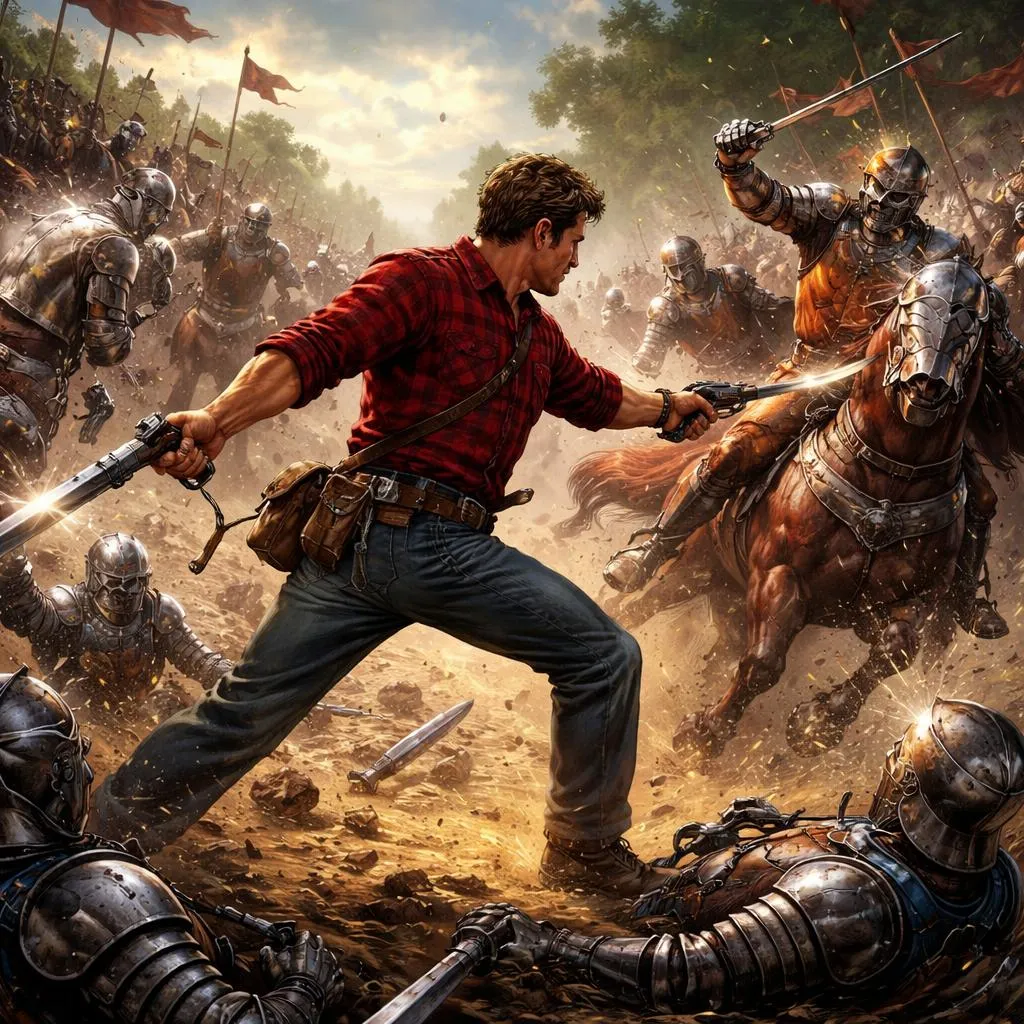

Home again, at Camelot. A morning or two later I found the paper, damp from the press, by my plate at the breakfast table. I turned to the advertising columns, knowing I should find something of personal interest to me there. It was this:
Up to the day set, there was no talk in all Britain of anything but this combat. All other topics sank into insignificance and passed out of men’s thoughts and interest. It was not because a tournament was a great matter, it was not because Sir Sagramor had found the Holy Grail, for he had not, but had failed; it was not because the second (official) personage in the kingdom was one of the duellists; no, all these features were commonplace. Yet there was abundant reason for the extraordinary interest which this coming fight was creating. It was born of the fact that all the nation knew that this was not to be a duel between mere men, so to speak, but a duel between two mighty magicians; a duel not of muscle but of mind, not of human skill but of superhuman art and craft; a final struggle for supremacy between the two master enchanters of the age. It was realized that the most prodigious achievements of the most renowned knights could not be worthy of comparison with a spectacle like this; they could be but child’s play, contrasted with this mysterious and awful battle of the gods. Yes, all the world knew it was going to be in reality a duel between Merlin and me, a measuring of his magic powers against mine. It was known that Merlin had been busy whole days and nights together, imbuing Sir Sagramor’s arms and armor with supernal powers of offense and defense, and that he had procured for him from the spirits of the air a fleecy veil which would render the wearer invisible to his antagonist while still visible to other men. Against Sir Sagramor, so weaponed and protected, a thousand knights could accomplish nothing; against him no known enchantments could prevail. These facts were sure; regarding them there was no doubt, no reason for doubt. There was but one question: might there be still other enchantments, to Merlin, which could render Sir Sagramor’s veil transparent to me, and make his enchanted mail vulnerable to my weapons? This was the one thing to be decided in the lists. Until then the world must remain in suspense.
So the world thought there was a vast matter at stake here, and the world was right, but it was not the one they had in their minds. No, a far vaster one was upon the cast of this die: the life of knight-errantry . I was a champion, it was true, but not the champion of the frivolous black arts, I was the champion of hard unsentimental common-sense and reason. I was entering the lists to either destroy knight-errantry or be its victim.
Vast as the show-grounds were, there were no vacant spaces in them outside of the lists, at ten o’clock on the morning of the 16th. The mammoth grand-stand was clothed in flags, streamers, and rich tapestries, and packed with several acres of small-fry tributary kings, their suites, and the British aristocracy; with our own royal gang in the chief place, and each and every individual a flashing prism of gaudy silks and velvets—well, I never saw anything to begin with it but a fight between an Upper Mississippi sunset and the aurora borealis. The huge camp of beflagged and gay-colored tents at one end of the lists, with a stiff-standing sentinel at every door and a shining shield hanging by him for challenge, was another fine sight. You see, every knight was there who had any ambition or any caste feeling; for my feeling toward their order was not much of a secret, and so here was their chance. If I won my fight with Sir Sagramor, others would have the right to call me out as long as I might be willing to respond.
Down at our end there were but two tents; one for me, and another for my servants. At the appointed hour the king made a sign, and the heralds, in their tabards, appeared and made proclamation, naming the combatants and stating the cause of quarrel. There was a pause, then a ringing bugle-blast, which was the signal for us to come forth. All the multitude caught their breath, and an eager curiosity flashed into every face.
Out from his tent rode great Sir Sagramor, an imposing tower of iron, stately and rigid, his huge spear standing upright in its socket and grasped in his strong hand, his grand horse’s face and breast cased in steel, his body clothed in rich trappings that almost dragged the ground—oh, a most noble picture. A great shout went up, of welcome and admiration.
And then out I came. But I didn’t get any shout. There was a wondering and eloquent silence for a moment, then a great wave of laughter began to sweep along that human sea, but a warning bugle-blast cut its career short. I was in the simplest and comfortablest of gymnast costumes—flesh-colored tights from neck to heel, with blue silk puffings about my loins, and bareheaded. My horse was not above medium size, but he was alert, slender-limbed, muscled with watchsprings, and just a greyhound to go. He was a beauty, glossy as silk, and naked as he was when he was born, except for bridle and ranger-saddle.
The iron tower and the gorgeous bedquilt came cumbrously but gracefully pirouetting down the lists, and we tripped lightly up to meet them. We halted; the tower saluted, I responded; then we wheeled and rode side by side to the grand-stand and faced our king and queen, to whom we made obeisance. The queen exclaimed:
“Alack, Sir Boss, wilt fight naked, and without lance or sword or—”
But the king checked her and made her understand, with a polite phrase or two, that this was none of her business. The bugles rang again; and we separated and rode to the ends of the lists, and took position. Now old Merlin stepped into view and cast a dainty web of gossamer threads over Sir Sagramor which turned him into Hamlet’s ghost; the king made a sign, the bugles blew, Sir Sagramor laid his great lance in rest, and the next moment here he came thundering down the course with his veil flying out behind, and I went whistling through the air like an arrow to meet him —cocking my ear the while, as if noting the invisible knight’s position and progress by hearing, not sight. A chorus of encouraging shouts burst out for him, and one brave voice flung out a heartening word for me—said:
“Go it, slim Jim!”
It was an even bet that Clarence had procured that favor for me —and furnished the language, too. When that formidable lance-point was within a yard and a half of my breast I twitched my horse aside without an effort, and the big knight swept by, scoring a blank. I got plenty of applause that time. We turned, braced up, and down we came again. Another blank for the knight, a roar of applause for me. This same thing was repeated once more; and it fetched such a whirlwind of applause that Sir Sagramor lost his temper, and at once changed his tactics and set himself the task of chasing me down. Why, he hadn’t any show in the world at that; it was a game of tag, with all the advantage on my side; I whirled out of his path with ease whenever I chose, and once I slapped him on the back as I went to the rear. Finally I took the chase into my own hands; and after that, turn, or twist, or do what he would, he was never able to get behind me again; he found himself always in front at the end of his maneuver. So he gave up that business and retired to his end of the lists. His temper was clear gone now, and he forgot himself and flung an insult at me which disposed of mine. I slipped my lasso from the horn of my saddle, and grasped the coil in my right hand. This time you should have seen him come!—it was a business trip, sure; by his gait there was blood in his eye. I was sitting my horse at ease, and swinging the great loop of my lasso in wide circles about my head; the moment he was under way, I started for him; when the space between us had narrowed to forty feet, I sent the snaky spirals of the rope a-cleaving through the air, then darted aside and faced about and brought my trained animal to a halt with all his feet braced under him for a surge. The next moment the rope sprang taut and yanked Sir Sagramor out of the saddle! Great Scott, but there was a sensation!
Unquestionably, the popular thing in this world is novelty. These people had never seen anything of that cowboy business before, and it carried them clear off their feet with delight. From all around and everywhere, the shout went up:
“Encore! encore!”
I wondered where they got the word, but there was no time to cipher on philological matters, because the whole knight-errantry hive was just humming now, and my prospect for trade couldn’t have been better. The moment my lasso was released and Sir Sagramor had been assisted to his tent, I hauled in the slack, took my station and began to swing my loop around my head again. I was sure to have use for it as soon as they could elect a successor for Sir Sagramor, and that couldn’t take long where there were so many hungry candidates. Indeed, they elected one straight off —Sir Hervis de Revel.
Bzz ! Here he came, like a house afire; I dodged: he passed like a flash, with my horse-hair coils settling around his neck; a second or so later, fst ! his saddle was empty.
I got another encore; and another, and another, and still another. When I had snaked five men out, things began to look serious to the ironclads, and they stopped and consulted together. As a result, they decided that it was time to waive etiquette and send their greatest and best against me. To the astonishment of that little world, I lassoed Sir Lamorak de Galis, and after him Sir Galahad. So you see there was simply nothing to be done now, but play their right bower—bring out the superbest of the superb, the mightiest of the mighty, the great Sir Launcelot himself!
A proud moment for me? I should think so. Yonder was Arthur, King of Britain; yonder was Guenever; yes, and whole tribes of little provincial kings and kinglets; and in the tented camp yonder, renowned knights from many lands; and likewise the selectest body known to chivalry, the Knights of the Table Round, the most illustrious in Christendom; and biggest fact of all, the very sun of their shining system was yonder couching his lance, the focal point of forty thousand adoring eyes; and all by myself, here was I laying for him. Across my mind flitted the dear image of a certain hello-girl of West Hartford, and I wished she could see me now. In that moment, down came the Invincible, with the rush of a whirlwind—the courtly world rose to its feet and bent forward —the fateful coils went circling through the air, and before you could wink I was towing Sir Launcelot across the field on his back, and kissing my hand to the storm of waving kerchiefs and the thunder-crash of applause that greeted me!
Said I to myself, as I coiled my lariat and hung it on my saddle-horn, and sat there drunk with glory, “The victory is perfect—no other will venture against me—knight-errantry is dead.” Now imagine my astonishment—and everybody else’s, too—to hear the peculiar bugle-call which announces that another competitor is about to enter the lists! There was a mystery here; I couldn’t account for this thing. Next, I noticed Merlin gliding away from me; and then I noticed that my lasso was gone! The old sleight-of-hand expert had stolen it, sure, and slipped it under his robe.
The bugle blew again. I looked, and down came Sagramor riding again, with his dust brushed off and his veil nicely re-arranged. I trotted up to meet him, and pretended to find him by the sound of his horse’s hoofs. He said:
“Thou’rt quick of ear, but it will not save thee from this!” and he touched the hilt of his great sword. “An ye are not able to see it, because of the influence of the veil, know that it is no cumbrous lance, but a sword—and I ween ye will not be able to avoid it.”
His visor was up; there was death in his smile. I should never be able to dodge his sword, that was plain. Somebody was going to die this time. If he got the drop on me, I could name the corpse. We rode forward together, and saluted the royalties. This time the king was disturbed. He said:
“Where is thy strange weapon?”
“It is stolen, sire.”
“Hast another at hand?”
“No, sire, I brought only the one.”
Then Merlin mixed in:
“He brought but the one because there was but the one to bring. There exists none other but that one. It belongeth to the king of the Demons of the Sea. This man is a pretender, and ignorant, else he had known that that weapon can be used in but eight bouts only, and then it vanisheth away to its home under the sea.”
“Then is he weaponless,” said the king. “Sir Sagramore, ye will grant him leave to borrow.”
“And I will lend!” said Sir Launcelot, limping up. “He is as brave a knight of his hands as any that be on live, and he shall have mine.”
He put his hand on his sword to draw it, but Sir Sagramor said:
“Stay, it may not be. He shall fight with his own weapons; it was his privilege to choose them and bring them. If he has erred, on his head be it.”
“Knight!” said the king. “Thou’rt overwrought with passion; it disorders thy mind. Wouldst kill a naked man?”
“An he do it, he shall answer it to me,” said Sir Launcelot.
“I will answer it to any he that desireth!” retorted Sir Sagramor hotly.
Merlin broke in, rubbing his hands and smiling his lowdownest smile of malicious gratification:
“‘Tis well said, right well said! And ‘tis enough of parleying, let my lord the king deliver the battle signal.”
The king had to yield. The bugle made proclamation, and we turned apart and rode to our stations. There we stood, a hundred yards apart, facing each other, rigid and motionless, like horsed statues. And so we remained, in a soundless hush, as much as a full minute, everybody gazing, nobody stirring. It seemed as if the king could not take heart to give the signal. But at last he lifted his hand, the clear note of the bugle followed, Sir Sagramor’s long blade described a flashing curve in the air, and it was superb to see him come. I sat still. On he came. I did not move. People got so excited that they shouted to me:
“Fly, fly! Save thyself! This is murther!”
I never budged so much as an inch till that thundering apparition had got within fifteen paces of me; then I snatched a dragoon revolver out of my holster, there was a flash and a roar, and the revolver was back in the holster before anybody could tell what had happened.
Here was a riderless horse plunging by, and yonder lay Sir Sagramor, stone dead.
The people that ran to him were stricken dumb to find that the life was actually gone out of the man and no reason for it visible, no hurt upon his body, nothing like a wound. There was a hole through the breast of his chain-mail, but they attached no importance to a little thing like that; and as a bullet wound there produces but little blood, none came in sight because of the clothing and swaddlings under the armor. The body was dragged over to let the king and the swells look down upon it. They were stupefied with astonishment naturally. I was requested to come and explain the miracle. But I remained in my tracks, like a statue, and said:
“If it is a command, I will come, but my lord the king knows that I am where the laws of combat require me to remain while any desire to come against me.”
I waited. Nobody challenged. Then I said:
“If there are any who doubt that this field is well and fairly won, I do not wait for them to challenge me, I challenge them.”
“It is a gallant offer,” said the king, “and well beseems you. Whom will you name first?”
“I name none, I challenge all! Here I stand, and dare the chivalry of England to come against me—not by individuals, but in mass!”
“What!” shouted a score of knights.
“You have heard the challenge. Take it, or I proclaim you recreant knights and vanquished, every one!”
It was a “bluff” you know. At such a time it is sound judgment to put on a bold face and play your hand for a hundred times what it is worth; forty-nine times out of fifty nobody dares to “call,” and you rake in the chips. But just this once—well, things looked squally! In just no time, five hundred knights were scrambling into their saddles, and before you could wink a widely scattering drove were under way and clattering down upon me. I snatched both revolvers from the holsters and began to measure distances and calculate chances.
Bang! One saddle empty. Bang! another one. Bang—bang, and I bagged two. Well, it was nip and tuck with us, and I knew it. If I spent the eleventh shot without convincing these people, the twelfth man would kill me, sure. And so I never did feel so happy as I did when my ninth downed its man and I detected the wavering in the crowd which is premonitory of panic. An instant lost now could knock out my last chance. But I didn’t lose it. I raised both revolvers and pointed them—the halted host stood their ground just about one good square moment, then broke and fled.
The day was mine. Knight-errantry was a doomed institution. The march of civilization was begun. How did I feel? Ah, you never could imagine it.
And Brer Merlin? His stock was flat again. Somehow, every time the magic of fol-de-rol tried conclusions with the magic of science, the magic of fol-de-rol got left.
背景和作者介绍
这个故事是一个现代的重述,灵感来自于亚瑟王和他的骑士的传说,融合了传统的中古骑士精神和幽默而富有想象力的转折。最初的亚瑟王传说已经被讲述和重述了几个世纪,起源于中世纪的民间传说,后来被作家如托马斯·马洛里爵士和阿尔弗雷德·丁尼生勋爵改编。这个特别的叙述介绍了一种冲突,不仅仅是骑士之间的冲突,还有魔法和理性之间的冲突,象征着从旧世界的神秘主义到现代理性主义的转变。
作者借鉴了亚瑟王传说的丰富内容,运用讽刺和富有创造力的叙事方式来挑战骑士精神的浪漫理想。故事的叙述者将自己定位为常识和现代智慧的拥护者,与梅林和传统骑士的神秘力量对抗。这反映了一种更广泛的文化转变,即重视科学和实践知识,而不是迷信。
详细解读和意义
故事的核心是探讨传统与进步之间的冲突。叙述者与萨格拉摩爵士之间的决斗,后者得到了梅林的魔法加持,不仅仅是一场身体上的较量;它象征着魔法与理性之间的战斗。叙述者使用套索和左轮手枪——现代世界的工具——对抗身穿盔甲的骑士和隐形的魔法斗篷,生动地突出了这个主题。
这个故事也批判了过时的骑士精神理想,暗示着骑士精神时代,及其规章制度,正在让位于一个由实用性和创新定义的新的时代。叙述者的胜利标志着骑士精神的“死亡”和基于科学和常识的文明的兴起。
此外,故事幽默地描绘了人群和骑士的反应,强调了人性的新奇和壮观的魅力。叙述者牛仔式的套索技巧吸引了观众,展示了新思想如何颠覆旧传统并赢得大众支持。
给学生的教训和见解
-
拥抱理性和创新: 故事鼓励年轻读者重视批判性思维和创造力。正如叙述者使用现代工具来克服魔法力量一样,学生们可以学会用逻辑和创造力来解决问题,而不是仅仅依赖传统或迷信。
-
尊重地挑战旧观念: 虽然叙述者挑战了骑士精神,但他是在战斗规则内进行的,这表明进步可以在不尊重或混乱的情况下实现。学生们可以通过深思熟虑和建设性地质疑过时的信念来应用这一点。
-
适应性是关键: 叙述者躲避攻击和改变战术的能力教会了在面对挑战时灵活的重要性。在生活和学习中,适应性有助于克服障碍并抓住机会。
-
勇气和自信: 独自一人对抗许多骑士并大胆地提出挑战反映了勇气和自信。学生们可以从中汲取灵感,去面对自己的恐惧,并捍卫自己的想法。
-
新奇和参与的力量: 人群对套索的热烈反应表明了新方法如何激励和吸引他人。在社交和学术环境中,创造力和热情可以帮助建立联系和产生影响。
在日常生活中应用故事的精神
-
在学习中: 以好奇心和探索新方法的热情来学习。不要害怕使用创造性的解决问题方法或质疑标准的思维方式。
-
在社交场合: 接受新想法,并在讨论不同观点时保持尊重。运用幽默和创新来与他人建立联系并建立友谊。
-
在个人成长中: 通过为自己设定挑战并从胜利和挫折中学习来培养自信。像叙述者一样,坚定地坚守你的价值观,但也要保持开放的心态。
-
在培养性格中: 故事突出了勇气、公平和智慧等品质。学生们可以通过诚实、坚持正义和批判性思考来实践这些品质。
通过讲故事鼓励积极的价值观
老师和家长可以使用这个故事来引发关于传统与进步之间的平衡、科学和理性的作用以及勇气和创造力的重要性的讨论。活动可能包括:
- 关于旧习俗与新思想价值的辩论。
- 创作想象现代“骑士”在当今世界的创意写作作业。
- 角色扮演游戏,练习解决问题和适应能力。
- 关于克服挑战的个人经历的反思性文章。
通过参与这个故事,学生们不仅可以欣赏到骑士和魔法的惊险故事,还可以获得关于如何以智慧和勇气来驾驭自己旅程的有意义的见解。