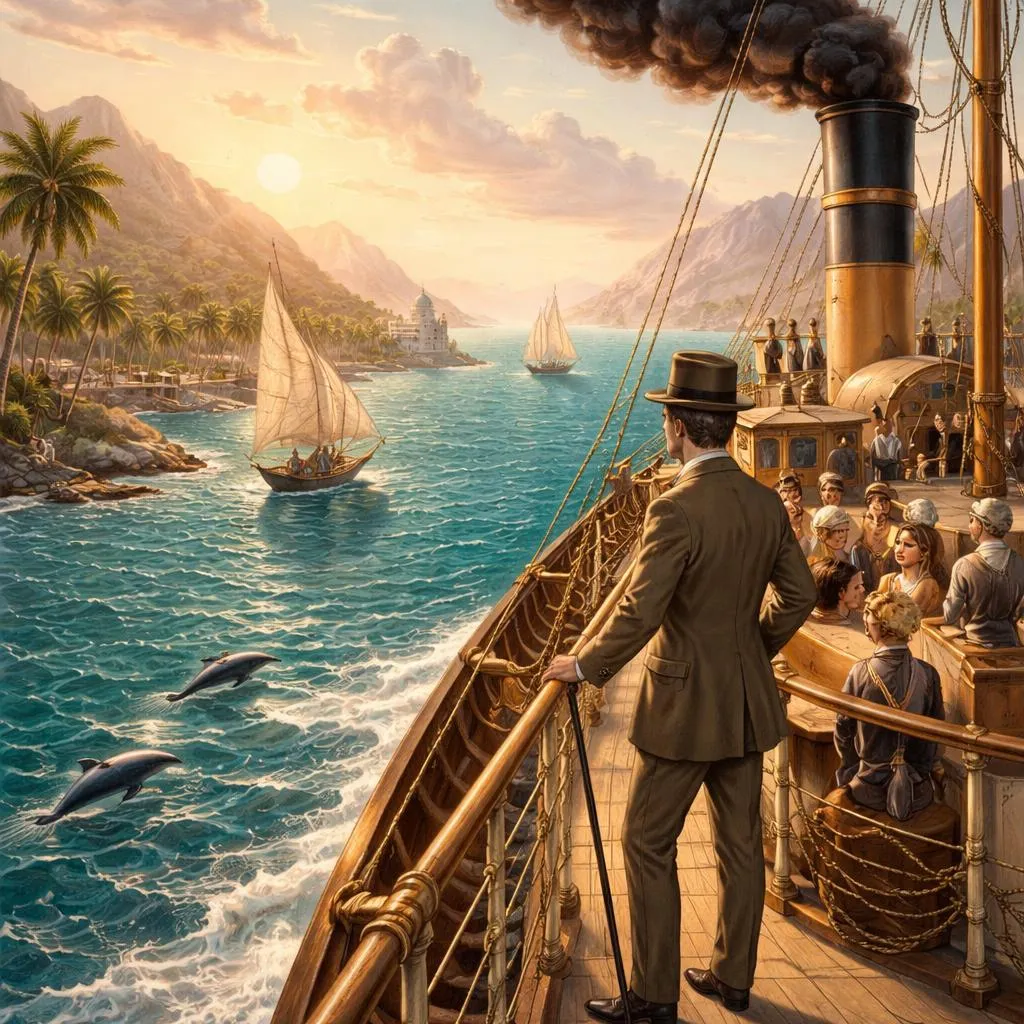

The distance between Suez and Aden is precisely thirteen hundred and ten miles, and the regulations of the company allow the steamers one hundred and thirty–eight hours in which to traverse it. The Mongolia, thanks to the vigorous exertions of the engineer, seemed likely, so rapid was her speed, to reach her destination considerably within that time. The greater part of the passengers from Brindisi were bound for India some for Bombay, others for Calcutta by way of Bombay, the nearest route thither, now that a railway crosses the Indian peninsula. Among the passengers was a number of officials and military officers of various grades, the latter being either attached to the regular British forces or commanding the Sepoy troops, and receiving high salaries ever since the central government has assumed the powers of the East India Company: for the sub–lieutenants get 280 pounds, brigadiers, 2,400 pounds, and generals of divisions, 4,000 pounds. What with the military men, a number of rich young Englishmen on their travels, and the hospitable efforts of the purser, the time passed quickly on the Mongolia. The best of fare was spread upon the cabin tables at breakfast, lunch, dinner, and the eight o'clock supper, and the ladies scrupulously changed their toilets twice a day; and the hours were whirled away, when the sea was tranquil, with music, dancing, and games.
But the Red Sea is full of caprice, and often boisterous, like most long and narrow gulfs. When the wind came from the African or Asian coast the Mongolia, with her long hull, rolled fearfully. Then the ladies speedily disappeared below; the pianos were silent; singing and dancing suddenly ceased. Yet the good ship ploughed straight on, unretarded by wind or wave, towards the straits of Bab–el–Mandeb. What was Phileas Fogg doing all this time? It might be thought that, in his anxiety, he would be constantly watching the changes of the wind, the disorderly raging of the billows—every chance, in short, which might force the Mongolia to slacken her speed, and thus interrupt his journey. But, if he thought of these possibilities, he did not betray the fact by any outward sign.
Always the same impassible member of the Reform Club, whom no incident could surprise, as unvarying as the ship's chronometers, and seldom having the curiosity even to go upon the deck, he passed through the memorable scenes of the Red Sea with cold indifference; did not care to recognise the historic towns and villages which, along its borders, raised their picturesque outlines against the sky; and betrayed no fear of the dangers of the Arabic Gulf, which the old historians always spoke of with horror, and upon which the ancient navigators never ventured without propitiating the gods by ample sacrifices. How did this eccentric personage pass his time on the Mongolia? He made his four hearty meals every day, regardless of the most persistent rolling and pitching on the part of the steamer; and he played whist indefatigably, for he had found partners as enthusiastic in the game as himself. A tax–collector, on the way to his post at Goa; the Rev. Decimus Smith, returning to his parish at Bombay; and a brigadier–general of the English army, who was about to rejoin his brigade at Benares, made up the party, and, with Mr. Fogg, played whist by the hour together in absorbing silence.
As for Passepartout, he, too, had escaped sea–sickness, and took his meals conscientiously in the forward cabin. He rather enjoyed the voyage, for he was well fed and well lodged, took a great interest in the scenes through which they were passing, and consoled himself with the delusion that his master's whim would end at Bombay. He was pleased, on the day after leaving Suez, to find on deck the obliging person with whom he had walked and chatted on the quays.
"If I am not mistaken," said he, approaching this person, with his most amiable smile, "you are the gentleman who so kindly volunteered to guide me at Suez?"
"Ah! I quite recognise you. You are the servant of the strange Englishman—"
"Just so, monsieur—"
"Fix."
"Monsieur Fix," resumed Passepartout, "I'm charmed to find you on board. Where are you bound?"
"Like you, to Bombay."
"That's capital! Have you made this trip before?"
"Several times. I am one of the agents of the Peninsular Company."
"Then you know India?"
"Why yes," replied Fix, who spoke cautiously.
"A curious place, this India?"
"Oh, very curious. Mosques, minarets, temples, fakirs, pagodas, tigers, snakes, elephants! I hope you will have ample time to see the sights."
"I hope so, Monsieur Fix. You see, a man of sound sense ought not to spend his life jumping from a steamer upon a railway train, and from a railway train upon a steamer again, pretending to make the tour of the world in eighty days! No; all these gymnastics, you may be sure, will cease at Bombay."
"And Mr. Fogg is getting on well?" asked Fix, in the most natural tone in the world.
"Quite well, and I too. I eat like a famished ogre; it's the sea air."
"But I never see your master on deck."
"Never; he hasn't the least curiosity."
"Do you know, Mr. Passepartout, that this pretended tour in eighty days may conceal some secret errand—perhaps a diplomatic mission?"
"Faith, Monsieur Fix, I assure you I know nothing about it, nor would I give half a crown to find out."
After this meeting, Passepartout and Fix got into the habit of chatting together, the latter making it a point to gain the worthy man's confidence. He frequently offered him a glass of whiskey or pale ale in the steamer bar–room, which Passepartout never failed to accept with graceful alacrity, mentally pronouncing Fix the best of good fellows.
Meanwhile the Mongolia was pushing forward rapidly; on the 13th, Mocha, surrounded by its ruined walls whereon date–trees were growing, was sighted, and on the mountains beyond were espied vast coffee–fields. Passepartout was ravished to behold this celebrated place, and thought that, with its circular walls and dismantled fort, it looked like an immense coffee–cup and saucer. The following night they passed through the Strait of Bab–el–Mandeb, which means in Arabic The Bridge of Tears, and the next day they put in at Steamer Point, north–west of Aden harbour, to take in coal. This matter of fuelling steamers is a serious one at such distances from the coal–mines; it costs the Peninsular Company some eight hundred thousand pounds a year. In these distant seas, coal is worth three or four pounds sterling a ton.
The Mongolia had still sixteen hundred and fifty miles to traverse before reaching Bombay, and was obliged to remain four hours at Steamer Point to coal up. But this delay, as it was foreseen, did not affect Phileas Fogg's programme; besides, the Mongolia, instead of reaching Aden on the morning of the 15th, when she was due, arrived there on the evening of the 14th, a gain of fifteen hours.
Mr. Fogg and his servant went ashore at Aden to have the passport again visaed; Fix, unobserved, followed them. The visa procured, Mr. Fogg returned on board to resume his former habits; while Passepartout, according to custom, sauntered about among the mixed population of Somalis, Banyans, Parsees, Jews, Arabs, and Europeans who comprise the twenty–five thousand inhabitants of Aden. He gazed with wonder upon the fortifications which make this place the Gibraltar of the Indian Ocean, and the vast cisterns where the English engineers were still at work, two thousand years after the engineers of Solomon.
"Very curious, very curious," said Passepartout to himself, on returning to the steamer. "I see that it is by no means useless to travel, if a man wants to see something new." At six p.m. the Mongolia slowly moved out of the roadstead, and was soon once more on the Indian Ocean. She had a hundred and sixty–eight hours in which to reach Bombay, and the sea was favourable, the wind being in the north–west, and all sails aiding the engine. The steamer rolled but little, the ladies, in fresh toilets, reappeared on deck, and the singing and dancing were resumed. The trip was being accomplished most successfully, and Passepartout was enchanted with the congenial companion which chance had secured him in the person of the delightful Fix. On Sunday, October 20th, towards noon, they came in sight of the Indian coast: two hours later the pilot came on board. A range of hills lay against the sky in the horizon, and soon the rows of palms which adorn Bombay came distinctly into view. The steamer entered the road formed by the islands in the bay, and at half–past four she hauled up at the quays of Bombay.
Phileas Fogg was in the act of finishing the thirty–third rubber of the voyage, and his partner and himself having, by a bold stroke, captured all thirteen of the tricks, concluded this fine campaign with a brilliant victory.
The Mongolia was due at Bombay on the 22nd; she arrived on the 20th. This was a gain to Phileas Fogg of two days since his departure from London, and he calmly entered the fact in the itinerary, in the column of gains.
背景介绍和作者介绍
这段摘录出自儒勒·凡尔纳的经典冒险小说《八十天环游地球》,这位法国作家被广泛认为是科幻小说和冒险文学的先驱之一。这部小说写于1873年,捕捉了19世纪的探险精神和技术进步的兴奋之情。凡尔纳富有想象力的叙事和对地理和文化的详细描述,使他的作品永恒,并受到所有年龄段读者的喜爱。
故事概述和意义
故事讲述了福格先生,一位冷静而有条理的英国绅士,他打赌自己可以在短短八十天内环游世界。在忠诚的法国仆人路路通的陪伴下,福格先生开始了一段充满意想不到的挑战、多元文化和非凡景观的激动人心的旅程。这段特别的段落描述了他们乘坐蒙古号汽船穿越红海的航行,突出了乘客的构成、海洋的自然挑战以及福格先生坚定的决心。
这部小说不仅是一部令人兴奋的游记,也是对人类智慧、毅力和冒险精神的颂扬。它展示了当时的交通运输的进步——汽船、铁路和电报——使世界比以往任何时候都更加紧密地联系在一起。
学生可以学到什么
-
毅力和压力下的冷静: 福格先生在风暴肆虐的大海和不确定的条件下,依然保持着坚定不移的冷静,这教导学生在面对困难时保持镇定和专注的价值。
-
好奇心和开放的心态: 路路通对他们所到之处的着迷,鼓励年轻读者对不同的文化和历史充满好奇,培养全球视野。
-
规划和时间管理的重要性: 福格先生精确的行程安排和仔细的时间管理,突出了规划和纪律如何帮助实现雄心勃勃的目标。
-
友谊和信任: 福格先生和路路通之间的关系表明了忠诚和团队合作在克服挑战中的重要性。
生活应用和性格培养
-
在学习中: 学生可以通过组织他们的学习计划,并在考试或压力大的项目中保持冷静,来应用福格先生有条理的方法。
-
在社交场合: 像路路通一样,对别人的背景和文化表现出真正的兴趣,可以建立同情心,丰富友谊。
-
在个人成长中: 将挑战视为成长的机会,而不是障碍,有助于培养韧性——这是成功的关键特质。
鼓励积极的价值观
老师和家长可以使用这个故事来鼓励年轻人培养耐心、纪律和冒险精神。讨论人物的特质和决定可以激励学生在他们的日常生活中,无论是在学校、运动还是社交互动中,都采取类似的姿态。
反思和欣赏
阅读完这段话后,学生们可能会反思旅行和探索如何拓宽一个人的视野——不仅是地理上的,也是智力和情感上的。他们可以欣赏到参与伟大旅程所涉及的兴奋和责任的结合,以及每一次经历,即使是充满挑战的经历,如何促进个人成长。
通过阅读《八十天环游地球》,年轻读者不仅可以获得一个有趣的故事,还可以获得宝贵的教训,鼓励他们敢于梦想,仔细计划,并以好奇心和勇气拥抱世界。