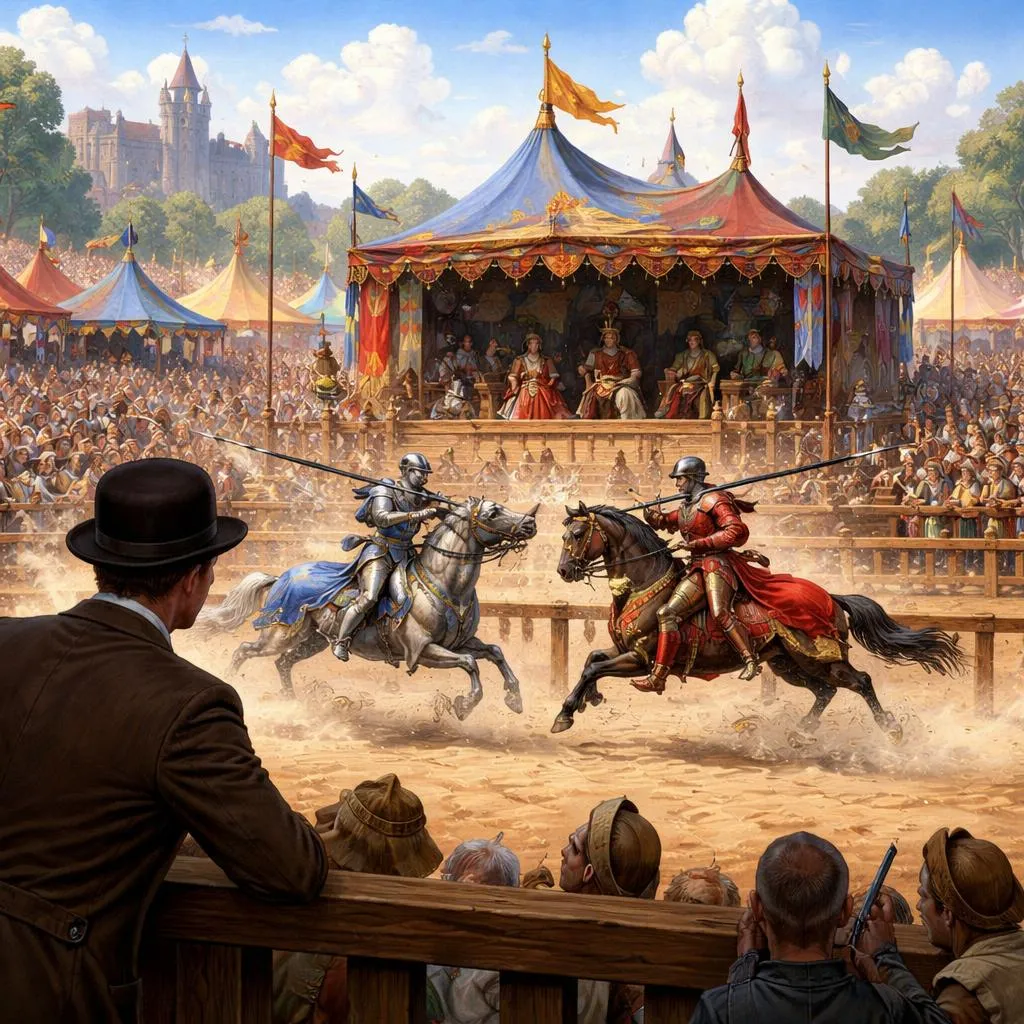

They were always having grand tournaments there at Camelot; and very stirring and picturesque and ridiculous human bull-fights they were, too, but just a little wearisome to the practical mind. However, I was generally on hand—for two reasons: a man must not hold himself aloof from the things which his friends and his community have at heart if he would be liked—especially as a statesman; and both as business man and statesman I wanted to study the tournament and see if I couldn’t invent an improvement on it. That reminds me to remark, in passing, that the very first official thing I did, in my administration—and it was on the very first day of it, too—was to start a patent office; for I knew that a country without a patent office and good patent laws was just a crab, and couldn’t travel any way but sideways or backways.
Things ran along, a tournament nearly every week; and now and then the boys used to want me to take a hand—I mean Sir Launcelot and the rest—but I said I would by and by; no hurry yet, and too much government machinery to oil up and set to rights and start a-going.
We had one tournament which was continued from day to day during more than a week, and as many as five hundred knights took part in it, from first to last. They were weeks gathering. They came on horseback from everywhere; from the very ends of the country, and even from beyond the sea; and many brought ladies, and all brought squires and troops of servants. It was a most gaudy and gorgeous crowd, as to costumery, and very characteristic of the country and the time, in the way of high animal spirits, innocent indecencies of language, and happy-hearted indifference to morals. It was fight or look on, all day and every day; and sing, gamble, dance, carouse half the night every night. They had a most noble good time. You never saw such people. Those banks of beautiful ladies, shining in their barbaric splendors, would see a knight sprawl from his horse in the lists with a lanceshaft the thickness of your ankle clean through him and the blood spouting, and instead of fainting they would clap their hands and crowd each other for a better view; only sometimes one would dive into her handkerchief, and look ostentatiously broken-hearted, and then you could lay two to one that there was a scandal there somewhere and she was afraid the public hadn’t found it out.
The noise at night would have been annoying to me ordinarily, but I didn’t mind it in the present circumstances, because it kept me from hearing the quacks detaching legs and arms from the day’s cripples. They ruined an uncommon good old cross-cut saw for me, and broke the saw-buck, too, but I let it pass. And as for my axe—well, I made up my mind that the next time I lent an axe to a surgeon I would pick my century.
I not only watched this tournament from day to day, but detailed an intelligent priest from my Department of Public Morals and Agriculture, and ordered him to report it; for it was my purpose by and by, when I should have gotten the people along far enough, to start a newspaper. The first thing you want in a new country, is a patent office; then work up your school system; and after that, out with your paper. A newspaper has its faults, and plenty of them, but no matter, it’s hark from the tomb for a dead nation, and don’t you forget it. You can’t resurrect a dead nation without it; there isn’t any way. So I wanted to sample things, and be finding out what sort of reporter-material I might be able to rake together out of the sixth century when I should come to need it.
Well, the priest did very well, considering. He got in all the details, and that is a good thing in a local item: you see, he had kept books for the undertaker-department of his church when he was younger, and there, you know, the money’s in the details; the more details, the more swag: bearers, mutes, candles, prayers —everything counts; and if the bereaved don’t buy prayers enough you mark up your candles with a forked pencil, and your bill shows up all right. And he had a good knack at getting in the complimentary thing here and there about a knight that was likely to advertise—no, I mean a knight that had influence; and he also had a neat gift of exaggeration, for in his time he had kept door for a pious hermit who lived in a sty and worked miracles.
Of course this novice’s report lacked whoop and crash and lurid description, and therefore wanted the true ring; but its antique wording was quaint and sweet and simple, and full of the fragrances and flavors of the time, and these little merits made up in a measure for its more important lacks. Here is an extract from it:
Then Sir Brian de les Isles and Grummore Grummorsum, knights of the castle, encountered with Sir Aglovale and Sir Tor, and Sir Tor smote down Sir Grummore Grummorsum to the earth. Then came Sir Carados of the dolorous tower, and Sir Turquine, knights of the castle, and there encountered with them Sir Percivale de Galis and Sir Lamorak de Galis, that were two brethren, and there encountered Sir Percivale with Sir Carados, and either brake their spears unto their hands, and then Sir Turquine with Sir Lamorak, and either of them smote down other, horse and all, to the earth, and either parties rescued other and horsed them again. And Sir Arnold, and Sir Gauter, knights of the castle, encountered with Sir Brandiles and Sir Kay, and these four knights encountered mightily, and brake their spears to their hands. Then came Sir Pertolope from the castle, and there encountered with him Sir Lionel, and there Sir Pertolope the green knight smote down Sir Lionel, brother to Sir Launcelot. All this was marked by noble heralds, who bare him best, and their names. Then Sir Bleobaris brake his spear upon Sir Gareth, but of that stroke Sir Bleobaris fell to the earth. When Sir Galihodin saw that, he bad Sir Gareth keep him, and Sir Gareth smote him to the earth. Then Sir Galihud gat a spear to avenge his brother, and in the same wise Sir Gareth served him, and Sir Dinadan and his brother La Cote Male Taile, and Sir Sagramore le Disirous, and Sir Dodinas le Savage; all these he bare down with one spear. When King Aswisance of Ireland saw Sir Gareth fare so he marveled what he might be, that one time seemed green, and another time, at his again coming, he seemed blue. And thus at every course that he rode to and fro he changed his color, so that there might neither king nor knight have ready cognizance of him. Then Sir Agwisance the King of Ireland encountered with Sir Gareth, and there Sir Gareth smote him from his horse, saddle and all. And then came King Carados of Scotland, and Sir Gareth smote him down horse and man. And in the same wise he served King Uriens of the land of Gore. And then there came in Sir Bagdemagus, and Sir Gareth smote him down horse and man to the earth. And Bagdemagus’s son Meliganus brake a spear upon Sir Gareth mightily and knightly. And then Sir Galahault the noble prince cried on high, Knight with the many colors, well hast thou justed; now make thee ready that I may just with thee. Sir Gareth heard him, and he gat a great spear, and so they encountered together, and there the prince brake his spear; but Sir Gareth smote him upon the left side of the helm, that he reeled here and there, and he had fallen down had not his men recovered him. Truly, said King Arthur, that knight with the many colors is a good knight. Wherefore the king called unto him Sir Launcelot, and prayed him to encounter with that knight. Sir, said Launcelot, I may as well find in my heart for to forbear him at this time, for he hath had travail enough this day, and when a good knight doth so well upon some day, it is no good knight’s part to let him of his worship, and, namely, when he seeth a knight hath done so great labour; for peradventure, said Sir Launcelot, his quarrel is here this day, and peradventure he is best beloved with this lady of all that be here, for I see well he paineth himself and enforceth him to do great deeds, and therefore, said Sir Launcelot, as for me, this day he shall have the honour; though it lay in my power to put him from it, I would not. There was an unpleasant little episode that day, which for reasons of state I struck out of my priest’s report. You will have noticed that Garry was doing some great fighting in the engagement. When I say Garry I mean Sir Gareth. Garry was my private pet name for him; it suggests that I had a deep affection for him, and that was the case. But it was a private pet name only, and never spoken aloud to any one, much less to him; being a noble, he would not have endured a familiarity like that from me. Well, to proceed: I sat in the private box set apart for me as the king’s minister. While Sir Dinadan was waiting for his turn to enter the lists, he came in there and sat down and began to talk; for he was always making up to me, because I was a stranger and he liked to have a fresh market for his jokes, the most of them having reached that stage of wear where the teller has to do the laughing himself while the other person looks sick. I had always responded to his efforts as well as I could, and felt a very deep and real kindness for him, too, for the reason that if by malice of fate he knew the one particular anecdote which I had heard oftenest and had most hated and most loathed all my life, he had at least spared it me. It was one which I had heard attributed to every humorous person who had ever stood on American soil, from Columbus down to Artemus Ward. It was about a humorous lecturer who flooded an ignorant audience with the killingest jokes for an hour and never got a laugh; and then when he was leaving, some gray simpletons wrung him gratefully by the hand and said it had been the funniest thing they had ever heard, and “it was all they could do to keep from laughin’ right out in meetin’.” That anecdote never saw the day that it was worth the telling; and yet I had sat under the telling of it hundreds and thousands and millions and billions of times, and cried and cursed all the way through. Then who can hope to know what my feelings were, to hear this armor-plated ass start in on it again, in the murky twilight of tradition, before the dawn of history, while even Lactantius might be referred to as “the late Lactantius,” and the Crusades wouldn’t be born for five hundred years yet? Just as he finished, the call-boy came; so, haw-hawing like a demon, he went rattling and clanking out like a crate of loose castings, and I knew nothing more. It was some minutes before I came to, and then I opened my eyes just in time to see Sir Gareth fetch him an awful welt, and I unconsciously out with the prayer, “I hope to gracious he’s killed!” But by ill-luck, before I had got half through with the words, Sir Gareth crashed into Sir Sagramor le Desirous and sent him thundering over his horse’s crupper, and Sir Sagramor caught my remark and thought I meant it for him .
Well, whenever one of those people got a thing into his head, there was no getting it out again. I knew that, so I saved my breath, and offered no explanations. As soon as Sir Sagramor got well, he notified me that there was a little account to settle between us, and he named a day three or four years in the future; place of settlement, the lists where the offense had been given. I said I would be ready when he got back. You see, he was going for the Holy Grail. The boys all took a flier at the Holy Grail now and then. It was a several years’ cruise. They always put in the long absence snooping around, in the most conscientious way, though none of them had any idea where the Holy Grail really was, and I don’t think any of them actually expected to find it, or would have known what to do with it if he had run across it. You see, it was just the Northwest Passage of that day, as you may say; that was all. Every year expeditions went out holy grailing, and next year relief expeditions went out to hunt for them . There was worlds of reputation in it, but no money. Why, they actually wanted me to put in! Well, I should smile.
背景介绍和作者介绍
这段文字生动地描述了在卡梅洛特举行的比武大会,这是一个与传奇亚瑟王相关的传奇城堡和宫廷。这个故事源于亚瑟王传说的丰富传统,这些传说已经被讲述和重述了几个世纪。这些故事经常探讨骑士精神、荣誉、勇敢和对崇高理想的追求等主题。最初的故事是通过中世纪文学流传下来的,其中著名的贡献者包括托马斯·马洛里爵士,他的作品《亚瑟之死》是最著名的亚瑟王传说集之一。
本文的叙述者似乎是一位深思熟虑的观察者,可能是政治家或官员,他不仅对锦标赛的壮观景象感兴趣,而且对它们所蕴含的社会和政治意义也感兴趣。牧师的详细报告增添了历史的色彩,强调了准确记录事件以供后代参考的重要性。
详细解读和意义
卡梅洛特的比武大会被描绘成宏大、色彩缤纷的活动,充满了刺激、竞争和社会互动。来自四面八方的骑士们聚集在一起,证明他们的勇气和战斗技巧,而宫廷的女士们则热切地观看,有时对暴力行为做出令人惊讶的反应。这种环境反映了中世纪的骑士文化,骑士们被期望维护荣誉,保护弱者,并参与力量和勇气的竞赛。
然而,这段文字也暗示了这个世界的矛盾之处:“语言的无辜的放荡”和“对道德的快乐的漠不关心”表明,这是一个既充满活力又存在缺陷的社会。叙述者务实的观点——关注治理、发明和社会秩序——为浪漫化的卡梅洛特形象增添了一层现实主义。
加雷斯爵士的战斗的详细描述说明了骑士的英雄理想,他勇敢地战斗,并通过行动而不是头衔赢得尊重。骑士之间的互动、他们面临的挑战以及他们所受到的尊重,都突出了毅力、忠诚和勇气的价值观。
给学生的经验教训和见解
-
勇气和毅力: 骑士们愿意一次又一次地面对危险,这教会了我们勇敢和坚持不懈地克服挑战的重要性。学生们可以学会以同样的决心面对自己的困难。
-
尊重和荣誉: 骑士精神守则,虽然被理想化,但强调尊重他人、公平竞争和行为中的荣誉。这些价值观在学校、友谊和未来的职业生涯中至关重要。
-
社区和参与: 叙述者尽管有个人保留意见,但还是决定参加锦标赛,这表明了参与社区和支持共同利益的重要性。
-
批判性思维: 叙述者对改进锦标赛和创办专利局等机构的兴趣,鼓励学生批判性地思考传统,并寻求创新和改进社会的方法。
-
记录和反思: 牧师的详细报告提醒我们记录经验并从中学习的价值,这对学生来说是一个有用的习惯,有助于他们的学习和个人成长。
将这些经验教训应用于日常生活
-
在学校: 学生们可以通过勇敢地处理困难的科目或项目来运用勇气,而不必害怕失败。他们可以通过诚实地完成作业并尊重老师和同学来实践荣誉。
-
在社交场合: 在互动中表现出尊重和公平有助于建立牢固的友谊并和平地解决冲突。
-
在个人发展中: 拥抱毅力有助于学生们坚持下去,即使任务看起来很艰难,无论是在体育、艺术还是学术方面。
-
在创造力和创新方面: 像叙述者对发明的兴趣一样,应该鼓励学生们发挥创造力,并提出改进其环境的建议。
从故事中培养积极的特质
-
勇敢: 鼓励学生们接受新的挑战,理解失败是成长的一部分。
-
尊重: 传授以善良和公平对待他人的重要性,无论差异如何。
-
社区精神: 促进参与团体活动、俱乐部或志愿工作,以培养归属感。
-
批判性探究: 培养好奇心和质疑精神,帮助学生们不要接受表面上的事物,而是探索更深层的含义和可能性。
结论
卡梅洛特比武大会的故事不仅仅提供了关于骑士和战斗的激动人心的故事。它提供了一个窗口,让我们了解一个勇气、荣誉和社区等理想变得生动的世界。对于学生和年轻读者来说,这些故事不仅激发了想象力,而且提供了宝贵的人生经验教训。通过学习骑士的美德和叙述者深思熟虑的观点,年轻人可以培养有助于他们成功并为社区做出积极贡献的品质。