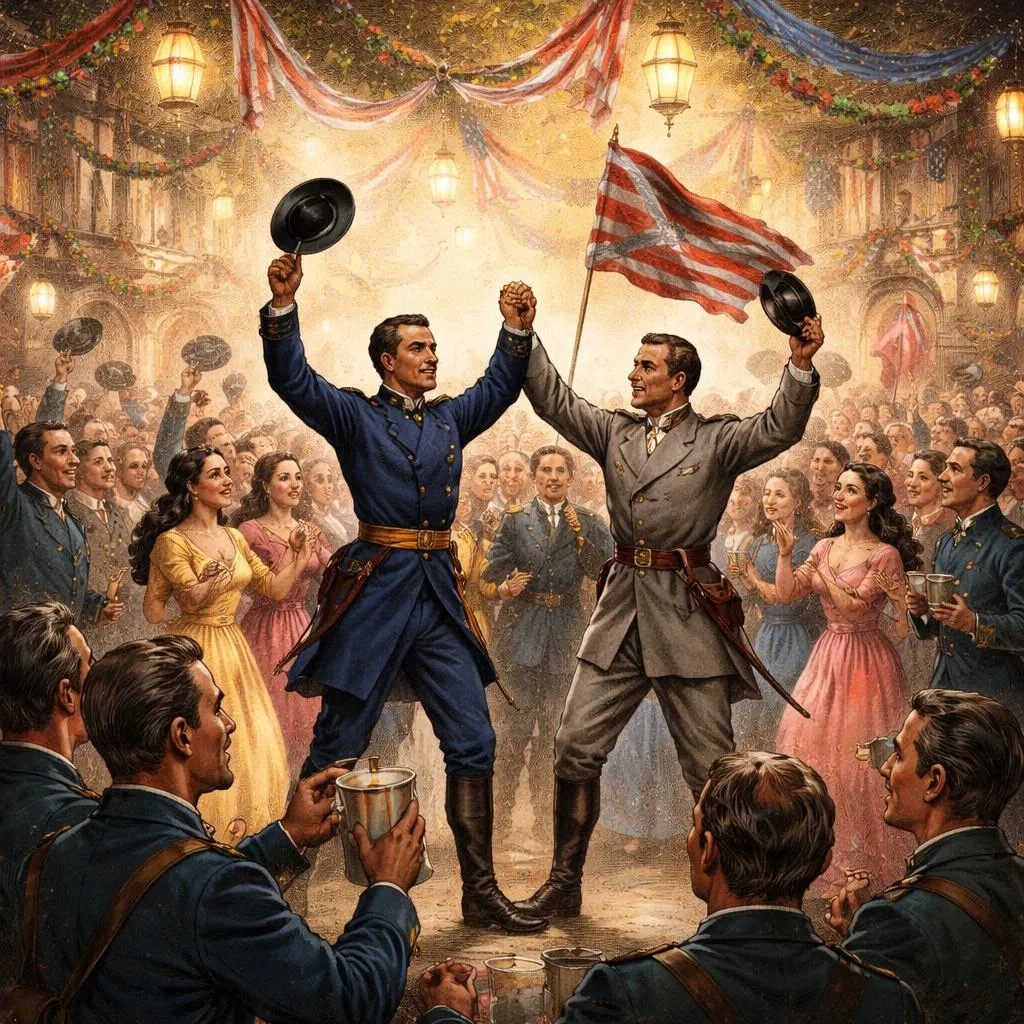

“‘We won’t go home till morning,’” sang the two counterfeit revellers, as they approached the fire of the bivouackers.
The four carousel’s sprang to their feet when the first strain reached their ears. They were not as intoxicated as they might have been, for they were able to stand with considerable firmness on theirfeet, after the frequency with which the bottle had been passed among them. They did not do what soldiers would naturally have done at such an interruption, grasp their muskets, and it was probable they had no muskets to grasp.
“‘We won’t go home till morning, till daylight doth appear,’” continued the two officers, without halting in their march towards the revellers. No weapons of any kind were exhibited; but the tipplers stood as though transfixed with astonishment or alarm where they had risen, but were rather limp in their attitude. They evidently did not know what to make of the interruption, and they appeared to bewaiting for further developments on the part of the intruders.
“It isn’t mornin’ yit, but we just emptied our bottle,” said Christy, with a swaggering and slightly reeling movement, and suiting his speech to the occasion. “How are ye, shipmates?”
“Up to G, jolly tars,” replied one of the men, with a broad grin on his face. “We done got two full bottles left, at your sarvice.”
“Much obleeged,” returned the lieutenant, as he took the bottle the reveller passed to him. “Here’s success to us all in a heap, and success to our side in the battle that’s go’n’on.”
“I’m with you up to the armpits,” added Graines, as another of the four handed him a bottle.
One sniff at the neck of the bottle was enough to satisfy Christy, who was a practical temperance man of the very strictest kind, and he had never drank a glass of anything intoxicating in all his life. The bottle contained “apple-jack,” or apple-brandy, the vilest fluid thatever passed a tippler’s gullet. He felt obliged to keep up his character, taken for the occasion, and he retained the mouth of the bottle at his lips long enough to answer the requirement of the moment; but he did not open them, or permit a drop of the nauseous and fiery liquor to pollute his tongue. It was necessary for him to consider that he was struggling for the salvation of his beloved country to enable him even to go through the form of “taking a drink.”
Graines was less scrupulous on the question of temperance, and he took a swallow of the apple-jack; but that was enough for him, for he had never tasted anything outside of the medicine-chest which was half as noxious. If he had been compelled to keep up the drinking, he would have realized that his punishment was more than he could bear. Fortunately the tipplers had no tumblers, so that the guests were not compelled to pour out the fluid and drink it off. All drank directly from the bottles, so that the two officers could easily conceal in the semi-darkness the extent of their indulgence.
“Who be you, strangers?” asked the man who had acted thus far as spokesman of the party.
“My name is Tom Bulger, born and brought up in the island of Great Abaco, and this feller is my friend and shipmate, Sam Riley,” replied Christy, twisting and torturing his speech as much as was necessary. “Now who be you fellers?”
“Born and fetched up in Mobile: my name is Bird Riley; and I reckon t’other feller is a first cousin of mine, for he’s got the same name, and he’s almost as handsome as I am. Where was you born, Sam?”
“About ten miles up the Alabama, where my father was the overseer on a plantation before the war,” replied Graines as promptly as though he had been telling the truth.
“Then you must be one of my cousins, for I done got about two hundred and fifty on ‘em in the State of Alabammy. Give us your fin, Sam.”
Bird Riley and Sam shook hands in due and proper form, and the relationship appeared to be fully established. The names of the three other revellers were given, but the spokesman was disposed to do all the talking, though he occasionally appealed to his companions to approve of what he said. It was evident that he was the leading spirit of the party, and that he controlled them. He was rather a bright fellow, while the others were somewhat heavy and stupid in their understanding. The bottles were again handed to the guests, both of whom went through the form of drinking without taking a drop of the vile stuff.
“What be you uns doin’ here?” asked Bird Riley, after the ceremony with the bottle had been finished.
“We was both tooken in a schooner that was gwine to run the blockade,” answered Christy. “We was comin’ out’n Pass Christian, and was picked up off Chand’leer [Chandeleur] Island, and fotched over hyer. We didn’t feel too much to hum after we lost our wages, and we done took awhale boat and came ashore here, with only one bottle of whiskey atweenus. That’s all there is on’t. Now, how comes you uns hyer?”
“I’m the mate of the topsail schooner West Wind, and t’others is the crew; all but two we done left on board with the cap’n,” replied Bird, apparently with abundant confidence in his newly found friends.
“You left her?” asked Christy.
“That’s just what we done do.”
“Where is the West Wind now?” inquired Christy, deeply interested in the subject at this point.
“She done come down from Mobile three days ago, and done waited for a chance to run the blockade. Her hole is fullo’ cotton, and she done got a deck-load too,” answered Bird Riley without any hesitation.
“Where does the West Wind keep herself now, Bird?”
“Just inside the p’int, astern of the Trafladagar.”
“The Trafladagar?” repeated Christy.
“That’s her name, or sunthin like it. I never see it writ out.”
“She’s a schooner, I reckon,” continued Christy, concealing what knowledge he possessed in regard to the vessel.
“She ain’t no schooner, you bet; she’s jest the finist steamer that ever runned inter Mobile, and they’ve turned her into a cruiser,” Bird Riley explained.
“How big is she?”
“I heerd some un say she was about eight hun’ed tons: an’ I’ll bet she’ll pick up every Yankee craft that she gits a sight on.”
“And you say the Trafladagar is at anchor off the p’int?” added Christy, not daring to call the steamer by her true name.
“That’s jest where she is; and the West Wind is hitched to her, like a tandem team,” replied Bird Riley. “Look yere, Tom Bulger, you don’t make love to that bottle as though you meant business. Take another drink, and show you done got some manhood in yer.”
The bottle went the rounds again, and the guests apparently took longpulls; but really they did not taste a drop of the infernal liquid.
“That’s good pizen, Bird Riley; but it is not jest the stingo that I like best,” said Christy, as he wiped his mouth with his sleeve in proper form, for he did not like the smell of the fluid lightning that clung to his lips.
“Whiskey suits me most; but they waste the corn makin’ bread on’t, and there ain’t much on’t left to make the staff of life. Howsomever, we don’t choke to death on apple-jack, when we can get enough on’t,” argued Bird Riley.
“Jest now you got a tandem team hitched up out on the Trafladagar and the West Wind,” continued Christy cautiously, and with apparent indifference, drawing the mate of the schooner back to the matter in which he was the most deeply interested. “What’s this team hitched up that way for? Is the steamer go’n’ to tow the schooner up to Mobile?”
“I reckon you’re a little more’n half drunk, Tom Bulger,” replied Bird Riley, with a vigorous horse laugh. “Tow the schooner up to Mobile! Didn’t I tell yer the Trafladagar’s been waiting here three days for agood chance to run out?”
“You said that as true as you was born,” added Graines, who thought it necessary to say something, for he had been nearly silent from the beginning.
“Sam Riley ain’t quite so drunk as you be, Tom Bulger; an’ he knows what’s what; and thar he shows the Riley blood in his carcass,” chuckled the mate.
“And you said the West Wind was loaded with cotton, in the hole and on deck,” added Graines, hoping to hurry the conference along a little more rapidly.
“That’s jest what I said. I reckon you ain’t much used to apple-jack, fur it fusticates your intelleck, and makes yer forget how old y’are. Come, take another, jest to set your head up right,” said Bird, passing the bottle to Christy, who was doing his best to keep up the illusion by talking very thick, and swaying his body about like a drunken man.
Both the guests went through the ceremony of imbibing, which was only a ceremony to them. The fire had exhausted its supply of fuel, and it was fortunate that the darkness prevented the revellers from measuring the quantity left in the bottles as they were returned to the owners, or they might have seen that the strangers were not doing their share in consuming the poison.
“Sam Riley does honor to the blood as runs in his body, for he ain’t no more drunk’n I am; an’ he knows what we been talkin’ about,” said the mate, who seemed to be greatly amused at the supposed effect of the liquor upon Christy. “You won’t know nothin’ about the Trafladagar or the West Wind in half an hour from now, Tom Bulger. I reckon it don’t make no difference to you about the tandem team, and to-morrer mornin’ you won’t know how the team’s hitched up.”
“I don’t think I will,” replied Christy boozily, as he rolled over on the sand, and then struggled for some time to resume his upright position, to the great amusement of Bird Riley and his companions. “But Sam Riley’s got blood in him, the best blood in Alabammy, and he kin tell you all about it if yer want ter know. He kin stan’ up agin a whole bottle o’ apple-jack.”
“I say, Cousin Bird, what’s this tandem team hitched up fer?” asked Graines, permitting his superior officer to carry out the illusion upon which he had entered, in order more effectually to blind the mate, and induce him to talk with entire freedom.
“I reckon you ain’t too drunk to un’erstan’ what I say, Sam, as t’other feller is.”
“I’m jest drunk enough to un’erstan’ yer, Cousin Bird; but I cal’la teI won’t know much about it by to-morrer mornin’,” added Graines.
“Let’s take another round, Sam; but I reckon Tom Bulger’s got more’n he can kerry now,” continued the mate.
Bird took a long draught from the bottle, and then passed it to hisguest. Three of the four revellers had already toppled over at full length on the ground; and Christy thought he could hurry matters by doing the same thing, and he tumbled over all in a heap. Graines drank nothing himself, though he contrived to spill a quantity of the fluid on the ground, so that it might not seem too light to his only remaining wakeful companion. The last dram of Bird had been a very heavy one, and the engineer realized that he could not hold out much longer.
“What’s that tandem team fer?” asked Graines, in the thickest of tones, while he swayed back and forth as Bird was doing by this time.
“The Trafladagar’s gwine to tow the West Wind out; and both on ’em’s sure to be tooken,” stammered the mate. “We uns don’t bleeve in’t, and so we runned away, and left Captain Sullendine to paddle his own punt. They get off at three in the morn in’.”
Bird Riley took another drink, and then he toppled over.
背景与作者介绍
这段文字出自一部以美国内战为背景的历史小说,内战时期充满了冲突、间谍活动和封锁突围。故事捕捉了战时行动中的紧张气氛和狡猾,重点讲述了利用伪装和欺骗来收集情报的人物。作者在19世纪写作,经常探讨忠诚、勇气以及个人在战争动荡中所面临的困境等主题。他生动的描写和真实的对话使那个时代栩栩如生,使故事对读者来说既有教育意义又引人入胜。
详细解读与意义
这一幕描绘了两位军官潜入一群醉酒的水手中,以了解敌人的动向。他们小心翼翼地假装喝酒,同时保持清醒,突出了战争期间的自制、勇敢和情报工作的主题。对话揭示了封锁突围的危险——这是邦联获得补给的一项冒险但必不可少的活动。人物之间的互动也展现了战友之情以及运用快速思维在敌对环境中生存。
这个故事片段教给读者关于战场之外战争的复杂性,强调了战略和精神力量的重要性。它还描绘了士兵和水手的“人性”一面,包括他们的弱点以及他们形成的纽带。
给学生的启示和见解
-
**勇气和自制力:**军官们表现出进入危险境地的勇气,并通过抵制诱惑来展现自制力。学生们可以学习到在面对干扰或同伴压力时,专注于目标的价值。
-
**观察和策略的力量:**在困难的情况下取得成功往往取决于仔细的观察和计划。这个故事鼓励批判性思维和适应不断变化的环境的能力。
-
**通过故事理解历史:**阅读历史小说有助于学生在情感上与过去的事件联系起来,使历史更具关联性和记忆性。
-
**友谊和信任的重要性:**尽管有危险,人物之间还是建立了联系并相互依赖,这表明信任和团队合作在充满挑战的时期至关重要。
在日常生活中应用这些经验
-
**在学习中:**像军官一样,学生们可以练习自律和专注,尤其是在学习或做项目时。避免分心并战略性地思考如何处理任务可以改善结果。
-
**在社交场合:**这个故事突出了理解他人和建立信任的重要性。学生们可以通过成为好的倾听者、表现出同情心以及与同伴合作来应用这一点。
-
**在面对挑战时:**生活常常会带来意想不到的障碍。培养勇气和适应能力,正如人物所展现的那样,可以帮助学生克服困难并保持韧性。
从故事中培养积极的价值观
-
**诚实和正直:**即使在假装时,军官们也保持着他们真正的目的和价值观。学生们应该学会诚实并坚持他们的原则。
-
**尊重他人:**互动虽然紧张,但都以一定程度的尊重进行。这教会了尊重不同观点和背景的重要性。
-
**毅力:**这个故事鼓励坚持不懈,表明成功往往需要忍受艰辛并保持承诺。
结论
这个故事片段为年轻读者提供了丰富的材料,让他们探索历史事件、人物发展和道德教训。通过参与这样的叙事,学生们不仅提高了他们的阅读能力,而且获得了对人性、历史的见解。鼓励他们反思这些主题可以培养同情心、批判性思维,以及对生活和历史复杂性的更深层次的理解。