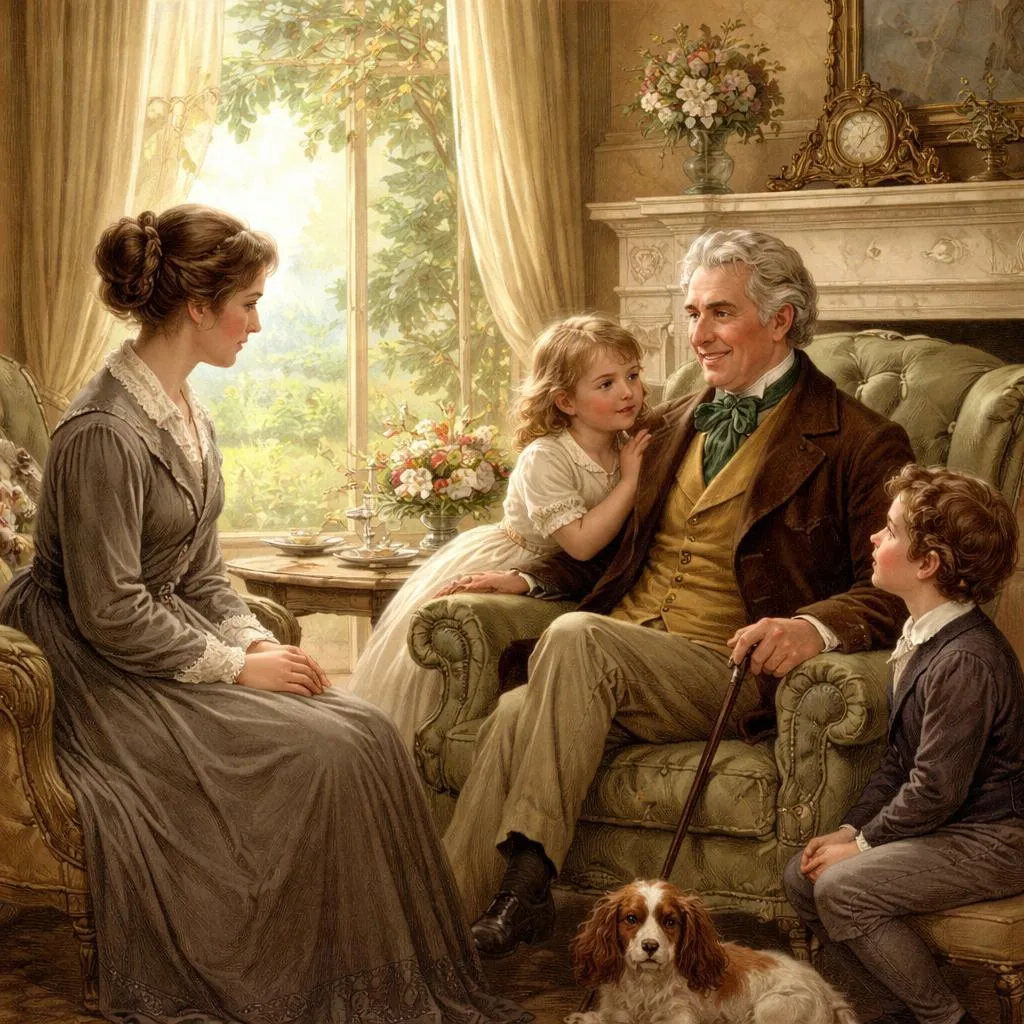

Besides the old lady, there was another relative of the family, whose visits were a great annoyance to me—this was ‘Uncle Robson,’ Mrs. Bloomfield’s brother; a tall, self–sufficient fellow, with dark hair and sallow complexion like his sister, a nose that seemed to disdain the earth, and little grey eyes, frequently half–closed, with a mixture of real stupidity and affected contempt of all surrounding objects. He was a thick–set, strongly–built man, but he had found some means of compressing his waist into a remarkably small compass; and that, together with the unnatural stillness of his form, showed that the lofty–minded, manly Mr. Robson, the scorner of the female sex, was not above the foppery of stays. He seldom deigned to notice me; and, when he did, it was with a certain supercilious insolence of tone and manner that convinced me he was no gentleman: though it was intended to have a contrary effect. But it was not for that I disliked his coming, so much as for the harm he did the children—encouraging all their evil propensities, and undoing in a few minutes the little good it had taken me months of labour to achieve.
Fanny and little Harriet he seldom condescended to notice; but Mary Ann was something of a favourite. He was continually encouraging her tendency to affectation (which I had done my utmost to crush), talking about her pretty face, and filling her head with all manner of conceited notions concerning her personal appearance (which I had instructed her to regard as dust in the balance compared with the cultivation of her mind and manners); and I never saw a child so susceptible of flattery as she was. Whatever was wrong, in either her or her brother, he would encourage by laughing at, if not by actually praising: people little know the injury they do to children by laughing at their faults, and making a pleasant jest of what their true friends have endeavoured to teach them to hold in grave abhorrence.
Though not a positive drunkard, Mr. Robson habitually swallowed great quantities of wine, and took with relish an occasional glass of brandy and water. He taught his nephew to imitate him in this to the utmost of his ability, and to believe that the more wine and spirits he could take, and the better he liked them, the more he manifested his bold, and manly spirit, and rose superior to his sisters. Mr. Bloomfield had not much to say against it, for his favourite beverage was gin and water; of which he took a considerable portion every day, by dint of constant sipping—and to that I chiefly attributed his dingy complexion and waspish temper.
Mr. Robson likewise encouraged Tom’s propensity to persecute the lower creation, both by precept and example. As he frequently came to course or shoot over his brother–in–law’s grounds, he would bring his favourite dogs with him; and he treated them so brutally that, poor as I was, I would have given a sovereign any day to see one of them bite him, provided the animal could have done it with impunity. Sometimes, when in a very complacent mood, he would go a–birds’–nesting with the children, a thing that irritated and annoyed me exceedingly; as, by frequent and persevering attempts, I flattered myself I had partly shown them the evil of this pastime, and hoped, in time, to bring them to some general sense of justice and humanity; but ten minutes’ birds’–nesting with uncle Robson, or even a laugh from him at some relation of their former barbarities, was sufficient at once to destroy the effect of my whole elaborate course of reasoning and persuasion. Happily, however, during that spring, they never, but once, got anything but empty nests, or eggs—being too impatient to leave them till the birds were hatched; that once, Tom, who had been with his uncle into the neighbouring plantation, came running in high glee into the garden, with a brood of little callow nestlings in his hands. Mary Ann and Fanny, whom I was just bringing out, ran to admire his spoils, and to beg each a bird for themselves. ‘No, not one!’ cried Tom. ‘They’re all mine; uncle Robson gave them to me—one, two, three, four, five—you shan’t touch one of them! no, not one, for your lives!’ continued he, exultingly; laying the nest on the ground, and standing over it with his legs wide apart, his hands thrust into his breeches–pockets, his body bent forward, and his face twisted into all manner of contortions in the ecstasy of his delight.
‘But you shall see me fettle ‘em off. My word, but I WILL wallop ‘em? See if I don’t now. By gum! but there’s rare sport for me in that nest.’
‘But, Tom,’ said I, ‘I shall not allow you to torture those birds. They must either be killed at once or carried back to the place you took them from, that the old birds may continue to feed them.’
‘But you don’t know where that is, Madam: it’s only me and uncle Robson that knows that.’
‘But if you don’t tell me, I shall kill them myself—much as I hate it.’
‘You daren’t. You daren’t touch them for your life! because you know papa and mamma, and uncle Robson, would be angry. Ha, ha! I’ve caught you there, Miss!’
‘I shall do what I think right in a case of this sort without consulting any one. If your papa and mamma don’t happen to approve of it, I shall be sorry to offend them; but your uncle Robson’s opinions, of course, are nothing to me.’
So saying—urged by a sense of duty—at the risk of both making myself sick and incurring the wrath of my employers—I got a large flat stone, that had been reared up for a mouse–trap by the gardener; then, having once more vainly endeavoured to persuade the little tyrant to let the birds be carried back, I asked what he intended to do with them. With fiendish glee he commenced a list of torments; and while he was busied in the relation, I dropped the stone upon his intended victims and crushed them flat beneath it. Loud were the outcries, terrible the execrations, consequent upon this daring outrage; uncle Robson had been coming up the walk with his gun, and was just then pausing to kick his dog. Tom flew towards him, vowing he would make him kick me instead of Juno. Mr. Robson leant upon his gun, and laughed excessively at the violence of his nephew’s passion, and the bitter maledictions and opprobrious epithets he heaped upon me. ‘Well, you ARE a good ‘un!’ exclaimed he, at length, taking up his weapon and proceeding towards the house. ‘Damme, but the lad has some spunk in him, too. Curse me, if ever I saw a nobler little scoundrel than that. He’s beyond petticoat government already: by God! he defies mother, granny, governess, and all! Ha, ha, ha! Never mind, Tom, I’ll get you another brood to–morrow.’
‘If you do, Mr. Robson, I shall kill them too,’ said I.
‘Humph!’ replied he, and having honoured me with a broad stare— which, contrary to his expectations, I sustained without flinching—he turned away with an air of supreme contempt, and stalked into the house. Tom next went to tell his mamma. It was not her way to say much on any subject; but, when she next saw me, her aspect and demeanour were doubly dark and chilled. After some casual remark about the weather, she observed—’I am sorry, Miss Grey, you should think it necessary to interfere with Master Bloomfield’s amusements; he was very much distressed about your destroying the birds.’
‘When Master Bloomfield’s amusements consist in injuring sentient creatures,’ I answered, ‘I think it my duty to interfere.’
‘You seemed to have forgotten,’ said she, calmly, ‘that the creatures were all created for our convenience.’
I thought that doctrine admitted some doubt, but merely replied— ‘If they were, we have no right to torment them for our amusement.’
‘I think,’ said she, ‘a child’s amusement is scarcely to be weighed against the welfare of a soulless brute.’
‘But, for the child’s own sake, it ought not to be encouraged to have such amusements,’ answered I, as meekly as I could, to make up for such unusual pertinacity. ‘”Blessed are the merciful, for they shall obtain mercy.”’
‘Oh! of course; but that refers to our conduct towards each other.’
‘”The merciful man shows mercy to his beast,”’ I ventured to add.
‘I think YOU have not shown much mercy,’ replied she, with a short, bitter laugh; ‘killing the poor birds by wholesale in that shocking manner, and putting the dear boy to such misery for a mere whim.’
I judged it prudent to say no more. This was the nearest approach to a quarrel I ever had with Mrs. Bloomfield; as well as the greatest number of words I ever exchanged with her at one time, since the day of my first arrival.
But Mr. Robson and old Mrs. Bloomfield were not the only guests whose coming to Wellwood House annoyed me; every visitor disturbed me more or less; not so much because they neglected me (though I did feel their conduct strange and disagreeable in that respect), as because I found it impossible to keep my pupils away from them, as I was repeatedly desired to do: Tom must talk to them, and Mary Ann must be noticed by them. Neither the one nor the other knew what it was to feel any degree of shamefacedness, or even common modesty. They would indecently and clamorously interrupt the conversation of their elders, tease them with the most impertinent questions, roughly collar the gentlemen, climb their knees uninvited, hang about their shoulders or rifle their pockets, pull the ladies’ gowns, disorder their hair, tumble their collars, and importunately beg for their trinkets.
Mrs. Bloomfield had the sense to be shocked and annoyed at all this, but she had not sense to prevent it: she expected me to prevent it. But how could I—when the guests, with their fine clothes and new faces, continually flattered and indulged them, out of complaisance to their parents—how could I, with my homely garments, every–day face, and honest words, draw them away? I strained every nerve to do so: by striving to amuse them, I endeavoured to attract them to my side; by the exertion of such authority as I possessed, and by such severity as I dared to use, I tried to deter them from tormenting the guests; and by reproaching their unmannerly conduct, to make them ashamed to repeat it. But they knew no shame; they scorned authority which had no terrors to back it; and as for kindness and affection, either they had no hearts, or such as they had were so strongly guarded, and so well concealed, that I, with all my efforts, had not yet discovered how to reach them.
But soon my trials in this quarter came to a close—sooner than I either expected or desired; for one sweet evening towards the close of May, as I was rejoicing in the near approach of the holidays, and congratulating myself upon having made some progress with my pupils (as far as their learning went, at least, for I HAD instilled SOMETHING into their heads, and I had, at length, brought them to be a little—a very little—more rational about getting their lessons done in time to leave some space for recreation, instead of tormenting themselves and me all day long to no purpose), Mrs. Bloomfield sent for me, and calmly told me that after Midsummer my services would be no longer required. She assured me that my character and general conduct were unexceptionable; but the children had made so little improvement since my arrival that Mr. Bloomfield and she felt it their duty to seek some other mode of instruction. Though superior to most children of their years in abilities, they were decidedly behind them in attainments; their manners were uncultivated, and their tempers unruly. And this she attributed to a want of sufficient firmness, and diligent, persevering care on my part.
Unshaken firmness, devoted diligence, unwearied perseverance, unceasing care, were the very qualifications on which I had secretly prided myself; and by which I had hoped in time to overcome all difficulties, and obtain success at last. I wished to say something in my own justification; but in attempting to speak, I felt my voice falter; and rather than testify any emotion, or suffer the tears to overflow that were already gathering in my eyes, I chose to keep silence, and bear all like a self–convicted culprit.
Thus was I dismissed, and thus I sought my home. Alas! what would they think of me? unable, after all my boasting, to keep my place, even for a single year, as governess to three small children, whose mother was asserted by my own aunt to be a ‘very nice woman.’ Having been thus weighed in the balance and found wanting, I need not hope they would be willing to try me again. And this was an unwelcome thought; for vexed, harassed, disappointed as I had been, and greatly as I had learned to love and value my home, I was not yet weary of adventure, nor willing to relax my efforts. I knew that all parents were not like Mr. and Mrs. Bloomfield, and I was certain all children were not like theirs. The next family must be different, and any change must be for the better. I had been seasoned by adversity, and tutored by experience, and I longed to redeem my lost honour in the eyes of those whose opinion was more than that of all the world to me.
背景和作者介绍
这段文字出自一部19世纪的叙事作品,探讨了一位女家庭教师在富裕家庭中面临的挑战。这个故事反映了维多利亚时代的社会和道德态度,重点关注儿童教育、家庭动态,以及个人价值观与社会期望之间的斗争。女家庭教师是维多利亚时代文学中常见的形象,通常象征着责任与个人正直之间的冲突。
作者虽然在这里没有明确提及,但她的写作对心理细节和社会批判有着敏锐的洞察力。她的作品突出了在成年人的影响可能是负面或矛盾的环境中塑造年轻心灵的困难。这类故事在维多利亚时代的英格兰很受欢迎,经常被用来讨论道德、阶级和教育等问题。
详细解读和意义
叙述生动地描绘了女家庭教师对罗布森叔叔的挫败感,罗布森叔叔的坏榜样破坏了她试图在孩子们身上灌输良好礼仪和善良的努力。罗布森叔叔鼓励虐待动物和沉迷于饮酒,这与女家庭教师的价值观形成了鲜明对比,强调了成年人对儿童可能产生的破坏性影响。
女家庭教师与布鲁姆菲尔德夫人的冲突进一步说明了对育儿和道德的不同看法。布鲁姆菲尔德夫人认为动物的存在是为了人类的方便,这反映了那个时代常见的功利主义观点,而女家庭教师则提倡怜悯和同情,引用圣经原则来支持她的立场。
孩子们不守规矩的行为以及女家庭教师尽管尽职尽责却无法控制他们,揭示了教育超越学术的复杂性——它涉及塑造性格和情感发展。女家庭教师最终被解雇,突显了在她这个职位上的女性所面临的残酷现实,她们常常因为超出她们控制范围的失败而受到指责。
给学生的教训和见解
-
**榜样的重要性:**孩子们不仅从正式的教学中学习,也从周围成年人的行为中学习。积极的榜样对于培养善良、尊重和责任感至关重要。
-
**对所有生命的同情和尊重:**这个故事鼓励对动物的同情,并教导虐待是一种严重的道德缺陷。学生们可以反思他们的行为如何影响他人,包括动物。
-
**面对逆境时的毅力:**女家庭教师尽管遭遇挫折,但仍致力于自己的职责,这表明了即使在环境令人沮丧的情况下,坚持和自信的价值。
-
**对权威的批判性思考:**女家庭教师挑战了雇主的既定规范,表明了坚持自己的原则和质疑不公正做法的重要性。
-
**人际关系的复杂性:**这个故事揭示了家庭动态和价值观冲突如何使教育和个人成长复杂化,鼓励学生考虑多种观点。
在日常生活中应用这些教训
-
**在学校:**学生们可以通过表现出善良和尊重来努力成为同伴的好榜样。他们也可以学会礼貌地坚持自己认为正确的事情,即使这不受欢迎。
-
**在社交场合:**了解成年人和同伴的影响有助于学生选择积极的友谊,并寻找鼓励良好行为的导师。
-
**在关爱动物方面:**这个故事激发了对动物负责任和富有同情心的对待,这可以通过志愿服务、宠物护理或仅仅尊重野生动物来实践。
-
**在个人成长方面:**像女家庭教师一样,学生们可以学会克服挑战,理解挫折是学习和成长的一部分。
从故事中培养积极的品质
-
**同情心:**练习从他人的角度看问题,无论是同学、家人还是动物。
-
**正直:**保持诚实和道德勇气,即使这很困难或其他人不同意。
-
**耐心:**理解改变和进步需要时间,并且需要持续的努力。
-
**尊重权威,同时保持独立思考:**尊重规则和传统,但也要批判性地思考它们的公平性和目的。
这个故事虽然发生在不同的时代,但它提供了对人性、教育和道德的永恒见解。通过反思其主题,学生们可以更深入地了解自己和周围的世界,帮助他们成长为有思想、有同情心和负责任的个体。