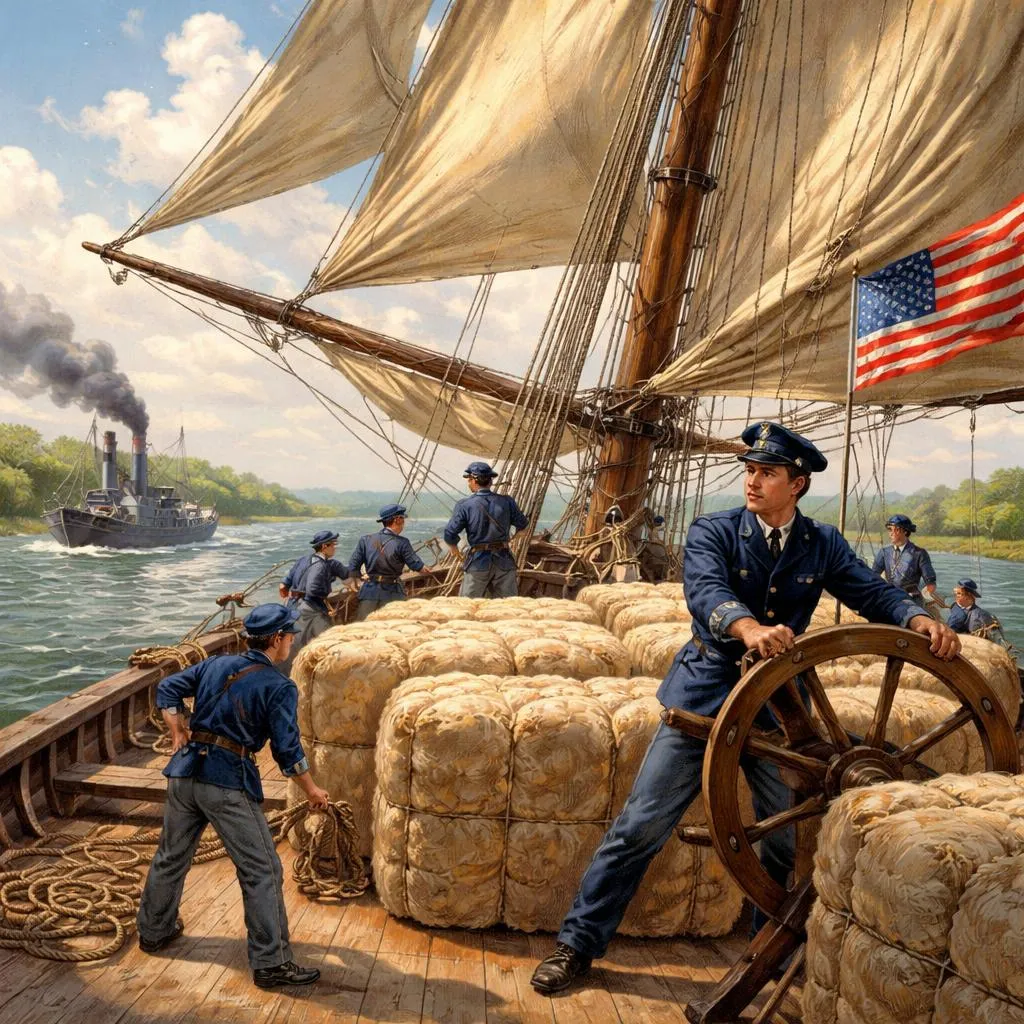

Probably some, if not all, of the six men in the deck-house of the West Wind were in the habit of taking intoxicating liquors when they were ashore, and when it was served out on board of the ship in conformity with the rules and traditions of the navy. The commander and his executive officer labored for the promotion of total abstinence among the officers and crew. More than the usual proportion of the men commuted their “grog ration” for money, through the influence of the principal officers.
While the commander of the present expedition accepted the aid of the powerful ally, “apple-jack,” in the service of his country, drinking freely appeared to him to be about the same thing as going over to the enemy; and he could not permit his men to turn traitors involuntarily, when he knew they would not do so of their own free will and accord. He had settled the liquor question to his own satisfaction in the deck-house, returning the bottle to French.
When Graines went below, a minute or two later than Captain Sullendine, he saw his new superior in the act of tossing off another glass of whiskey, as he concluded it was from the label on the bottle which stood on the cabin table. He had been considerably exhilarated before, and he was in a fair way to strengthen the ally of the loyalists by carrying his powerful influence to the head of the commander of the intending blockade-runner. The captain seated himself at the table, and Christy saw that he had a flat bottle in his breast-pocket.
“Now, Mr. Balker, we had better seal up the bargain we’ve made with forty drops from this bottle,” said he, as he poured out a glass for himself, regardless of the fact that he had just indulged; and at the same time he pushed the bottle and another glass towards the new mate.
Graines covered the lower part of the glass with his hand, and poured a few drops into it. Putting some water with it from the pitcher, he raised the tumbler in imitation of the captain.
“Here’s success to the right side,” added the master, as he drank off the contents of the glass.
“I drink that toast with all my mind, heart, and soul,” added the engineer, with decided emphasis, though he knew that “the right side” did not always convey the same idea.
“Help yourself, Mr.— I’ve forgot your name, Second Mate,” he added as he moved towards the companion ladder.
“Jerry Sandman, sir, and I will help myself to what I want,” replied Christy.
“That’s right, Mr. Sandman; make yourself at home in this cabin. I must go on deck and take a look at the Tallahatchie,” added the master as he went up the ladder, followed by Graines.
The lieutenant helped himself to a glass of water, after rinsing the tumbler, for that was what he wanted. Sopsy the cook immediately appeared, bearing a tray on which were several dishes of eatables, bread and ham being the principal. The bottle was in his way; and after he had drunk off half a tumblerful of its contents, he removed it to the pantry. He proceeded to set the table.
“Oft in der chizzly night, ’fore slumber’s yoke hab tooken me,’ hummed Sopsy as he worked at the table.
“Where is this schooner bound, Sopsy?” asked Christy.
“Bound to dat boon whar no trab’ler returns,” replied the cook, pausing in his occupation and staring the second mate full in the face.
“That bourn is Nassau, I reckon,” laughed the lieutenant.
“I s’pose she’s gwine dar if she don’t go to dat boon where no trab’lers come back agin,” answered Sopsy seriously. “Be you Meth’dis’ o’ Bab’tis’, Massa Mate?”
“Both, Sopsy.”
“Can’t be bof, Massa.”
“Then I’m either one you like.”
“That ain’t right, Massa Secon’ Mate, ’cordin’ as you was brung up,’ said the cook, shaking his head violently, as though he utterly disapproved of the mate’s theology.
“I’m a theosophist, Sopsy.”
“A seehossofist!” exclaimed the cook, dropping a plate in his astonishment. “We don’t hab none o’ dem on shore in de Souf. I reckon dey libs in de water.”
“No; they live on the mountains.”
“We hain’t got no mount’ns down here, and dat’s de reason we don’t hab none on ’em,” added Sopsy as he went to the pantry; but presently returned with a plate of pickles in one hand and the whiskey bottle in the other. “Does dem sea-hosses drink whisker, Massa Secon’ Mate?”
“They never drink a drop of it.”
“Dis colored pusson ain’t no sea-hoss, and he do drink whiskey when he kin git it,” added the cook; and he half filled a tumbler with the contents of the bottle, and drank it off at a single gulp.
He had hardly placed it on the table in the middle of the dishes before the captain came below. His first step was to take a liberal potation from the bottle. As he raised it to the swinging lamp, he discovered that the fluid had been freely expended in his absence.
“You’ve punished this bottle all it deserves,” said he when he perceived that its level had been considerably lowered, and he did not ask the new officer to join him. “That’s all right, Mr. Sandman; but I don’t want you to take more than you can manage to-night, for we have a big job on our hands, and we want our heads where we shall be able to find them. Now go on deck, and learn what you can about the vessel, for we hain’t got but half an hour more before the Tallahatchie goes to sea. We may have lots of music after we get outside; but I reckon our steamer can outsail anything the Yankees have got on the blockade. Don’t drink no more, Mr. Sandman; and when we git to Nassau you can have a reg’lar blowout.”
“I won’t touch another drop before we get out of the bay, Cap’n Sullendine,” protested Christy, without betraying the misdemeanor of the cook, as doubtless it was.
“That’s right, Mr. Sandman; we must all have our heads on our shoulders to-night,” said the captain, as he drank off the potion he had prepared.
Christy wished to hold the commander to his own advice; but that would have been fighting on the wrong side for him, and Sopsy escaped a reprimand, if not a kick or two, by his forbearance. By this time the bottle was nearly empty; but the skipper put it under lock and key in a closet, which seemed to be well filled with others like it. Christy went on deck, in obedience to the order he had received, and found the engineer on the quarter-deck buried in the fog, which was just then more dense than at any time before.
“The captain’s pretty well set ’up,’ isn’t he Christy?” said Graines in a low tone.
“About half seas over; but he knows what he is about, though he took another heavy potion just now,” replied the lieutenant.
“All right; I think we can manage this craft very well without him,” added Graines with a smile, which could not be seen in the darkness.
But the conversation was interrupted at this point by the appearance of the cook, whose legs were more tangled up by his tipples than his master’s. He delivered the request of Captain Sullendine that they should come into the cabin, and partake of the lunch which had been set out for them. As they moved towards the companion, they saw Sopsy creep over to the alley where Bokes had been sleeping, and take up the bottle of apple-jack Christy had given him, and drink from it. It was evident to them that the cook could not be much longer in condition for any duty.
The two mates went below as invited, and found the captain at the table. He had brought out the bottle of whiskey, and was eating of the dishes before him, but plainly with little relish.
“Have another little drink, Mr. Balker; but I think Mr. Sandman had better not take anymore,” said the master, whose speech was rather thick by this time.
“Thank you, Captain Sullendine; I will do a little in that way, for we are likely to have a very damp night of it,” replied Graines, as he helped himself, though he did not take ten drops.
“A little does one good; but it don’t do to take too much when we have very important business on our hands. After that one, Mr. Balker, I advise you not to take any more till we get clear of the blockaders,” added the skipper, as he emptied the bottle into his glass.
The ham on the table was of excellent quality, and the two mates ate heartily of it, with the ship-bread. The last dose the captain had taken appeared to cap the climax, and he could no longer eat, or talk so as to be clearly understood. When the mates had finished their lunch, they saw that the skipper had dropped asleep in his chair. They rose from their places, and rattled the stools. The noise roused the sleeper, and he sprang to his feet with a violent start.
“What’s time’z it, Mr. Zbalker?” he demanded, catching hold of the table to avoid falling on the cabin floor.
He seemed to be conscious that he was not presenting a perfectly regular appearance to his new officers; and he dropped into his chair, making a ludicrous effort to stiffen his muscles and put on his dignity, but it was a failure.
“Quarter-past two, Captain Sullendine,” replied Graines in answer to the question.
“Most an hour more ’fore we git started,” stammered the invalid. “I didn’t sleep none last night, I’m sleepy. I’m go’n to turn in for half an hour, ’n then I’ll be on deck ready for busi— ready for buzness.”
Graines assisted him to his stateroom, for he could not walk, and he was afraid he would fall and hurt himself. He helped him into his berth, and arranged him so that he could sleep it off, and he did not care if he did not do so before the next day. He waited till he had dropped off into a deep slumber, and then joined Christy in the cabin.
“If I had not been a temperance man before, I should be now,” said the lieutenant. “It is just as well that the captain is clean over the bay, for we might have been obliged to shoot him if he had been sober.”
“But we could have taken possession of the vessel in spite of him, if the steamer had not interfered,” replied Graines, as he led the way to the deck. “I don’t see that we have anything to do but wait for the moving of the waters, or for the moving of the steamer. I suppose our men are all right forward.”
“I have no doubt of it, though I have not seen them lately. I gave one of the bottles of apple-jack the captain sent forward for them to Bokes, and poured the contents of the other into Mobile Bay. I think we had better go forward and look the vessel over,” said Christy.
They had gone but a few steps before they stumbled over the body of Sopsy, who had evidently succumbed to the quantity of firewater he had consumed. He had assisted Bokes to empty the bottle given to him, and both of them were too far gone to give an alarm if they discovered at any time that something was wrong about the movements of the West Wind.
They found the Belleviters lounging about on the cotton bales, some of them asleep, and others carrying on a conversation in a low tone. They were glad to see their officers, who told them the time for some sort of action was rapidly approaching. Then they went to the bow of the vessel, where they found that she was anchored, though the chain had been hove short. The hawser by which she was to be towed to sea was made fast to the bowsprit bitts, and led to the stern of the steamer, where it was doubtless properly secured.
While they were looking over the bow, a boat approached from the Tallahatchie, and an officer hailed, asking for Captain Sullendine.
“He is in the cabin; I am the mate,” replied the engineer, “and the captain has shipped a new crew, we are all right now.”
“Weigh your anchor at three short whistles,” added the officer.
“Understood, and all right,” said the new mate.
The boat pulled back to the steamer.
背景介绍和作者介绍
这段文字出自一部经典的海事叙事作品,很可能设定在美国内战时期,重点讲述了涉及封锁突破的海军行动——这是一项危险但至关重要的活动,船只试图躲避敌人的封锁以运送补给。这个故事捕捉了在这种任务中水手们所面临的紧张、友情和挑战。
作者的身份在此处未被具体说明,他以生动的细节和现实主义的笔触进行写作,借鉴了海军传统和海上生活的残酷现实。叙事风格和语言表明其创作于19世纪,反映了当时的社会和文化态度,包括禁酒运动和海军纪律。
详细解读和意义
这个故事探讨了责任、领导力以及个人习惯与职业责任之间的斗争等主题。萨伦丁船长与酒精的复杂关系说明了领导者在维持秩序和纪律方面所面临的挑战,尤其是在压力之下。他最初坚持禁酒与他最终的放纵形成了对比,突出了人性的脆弱性。
船员之间的互动揭示了船上的社会动态,包括等级制度、友情以及个人选择对集体安全和任务成功的影响。厨师索普的过度饮酒及其后果突显了药物滥用的危险性,尤其是在关键角色中。
叙事还触及了文化和宗教的参考,例如关于卫理公会、浸信会和神智学的讨论,增加了人物的深度,并反映了水手们不同的信仰和背景。
给学生的教训和见解
-
领导力和责任感: 故事教导了自律和责任感的重要性,特别是对于那些身居领导职位的人。萨伦丁船长与酒精的斗争是一个关于个人弱点如何影响他人的警示故事。
-
团队合作和信任: 成功的任务取决于相互信任和合作。船员们尽管面临挑战,但仍努力处理情况,这表明了共同努力的价值。
-
选择的后果: 过度饮酒对表现和安全性的负面影响是显而易见的。学生们可以学习做出健康选择的重要性,并了解习惯如何影响他们自己以及周围的人。
-
尊重多样性: 关于宗教信仰的对话鼓励尊重不同的观点和开放的心态。
在日常生活中应用
-
在学校: 学生们可以通过练习自律来应用故事的教训,尤其是在面对同伴压力或紧张局势时。在学校俱乐部或团队中担任领导角色需要树立好榜样。
-
在社交场合: 了解个人行为对朋友和家人的影响有助于建立更牢固的关系。避免有害习惯并鼓励他人这样做可以促进积极的社区。
-
在个人成长中: 反思这个故事鼓励自我意识和追求更健康的生活方式选择。认识到脆弱性并在需要时寻求支持是力量的标志。
从故事中培养积极的价值观
-
自制力: 培养节制和克制的习惯,尤其是在涉及酒精等物质时。
-
责任感: 对自己的行为及其对他人产生的影响负责。
-
同情心: 理解他人的挣扎,例如船长的挣扎,并提供支持而不是评判。
-
批判性思维: 质疑传统和规范,例如“朗姆酒配给”,并做出明智的决定。
结论
这个海事故事提供了丰富的反思和学习材料。除了其历史背景之外,它还传达了关于领导力、个人行为以及做出明智选择的重要性的永恒信息。阅读这个故事的学生可以深入了解人性和社会动态,从而使他们能够以勇气和正直来应对自己的挑战。