
Captain Breaker watched the Tallahatchie with the most earnest attention; and it was not five minutes after he had given out the new course before she changed her direction, though not to the south, but enough to carry her clear of the Passes of the Mississippi. Paul Vapoor was still crowding the engine to the utmost that could be done with safety, and he spent no little of his time in the fire room, personally directing the men in the work of feeding the furnaces.
It was evident to the commander that his ship was gaining on the Tallahatchie, at least a knot an hour, as he estimated it, and the chase could not now be more than four miles distant. This was within the range of her Armstrong gun, if it was of the calibre reported by Bokes, whose information was mere hearsay, and was open to many doubts.
“She is changing her course again, Captain Breaker,” said Mr. Ballard, who had been observing the chase with the best glass on board.
“Probably she has discovered a man-of-war in the distance,” added the captain.
“I cannot make out anything to the westward of her,” said Mr. Ballard, who had directed his glass that way.
“She knows very well that she is liable to encounter a Federal ship on the course she is running. How does she head now?”
“As nearly south as I can make it out.”
“Then we have made something on her by going to the south south-west in good season; and I am sorry I did not do it sooner,” replied the commander, as he went into a fine calculation, estimating sundry angles, and figuring on the gain he was confident he had already made.
“I think she is headed due south now, Captain,” said Mr. Ballard.
“So I should say, and we are headed a little too much to the westward. Make the course south by west half west, Mr. Ballard.”
This course was given to the quartermaster conning the wheel. For another hour the two steamers kept on the course taken, at the end of which time the captain believed they were within three miles of each other; and the appearance, as viewed by skilful and experienced officers, verified his estimate of the relative speed of both—that the Bellevite was gaining about a knot an hour on the chase.
They had hardly agreed upon the situation before a cloud of smoke was seen to rise from the waist of the Tallahatchie, followed by the report of a heavy gun. The projectile struck the water at least a quarter of a mile ahead of the Bellevite, at which the watch on deck gave a half-suppressed cheer.
“They must have better gunners than that indicates on board of that steamer, for she has been fitted out as a cruiser,” said the commander with a quiet smile.
Twenty minutes later another puff of smoke, followed by a second report, excited the attention of an officer on the deck of the loyal ship. The shot struck the water only a little less ahead of the ship than the former, and the crew gave a more vigorous cheer: but it was observed that it hit the sea a little on the starboard bow, so that if it had been better aimed it would not have reached the ship.
“She is wasting her ammunition,” said the captain. “She seems to be jesting, or else she is trying to frighten us.”
“I think it is some thing worse than that, Captain Breaker,” replied Mr. Ballard.
“What could be worse?”
“I am inclined to the opinion that she cannot swing the gun around so as to make it bear on an object so far astern of her as this ship is at the present moment.” said the lieutenant.
“He has an all sufficient remedy for that,” added the captain. “He can swing his ship’s head around so his gun will bear on us.”
“But that would cause him to lose a quarter of a mile or more of his advantage; and she seems to be more inclined to run away from the Bellevite than to fight her,” suggested the lieutenant.
“Call all hands, Mr. Ballard,” said the commander; and in a few minutes all the officers and seamen were at their stations.
The call awoke Christy from his slumber, which the report of the gun and the cheering of the men had failed to do. But he understood the summons, and thought the action was about to begin. He adjusted his dress and hastened to the quarter deck, where he reported in due form to the captain. Mr. Ballard was relieved of his duties as acting executive officer, and went to his proper station to take command of his division. Christy took a careful survey of the situation, and saw that the Bellevite had gained at least two knots on the chase. The Holyoke and the West Wind were no longer in sight, though the fog seemed to be still hanging about the entrance to Mobile Bay.
“The Tallahatchie has fired two shots at us, Mr. Passford; but she wasted her ammunition,” said the commander. “I am inclined to agree with Mr. Ballard that she cannot swing her Armstrong gun so as to cover the Bellevite.”
“She has stopped her screw, sir!” exclaimed the first lieutenant, who was looking at the chase through the best glass.
“Make the course west, Mr. Passford!” said the captain with energy.
“Quartermaster, make it west!” shouted Christy.
“West, sir!” repeated the quartermaster, as he caused the helmsmen to heave over the wheel.
Directing his glass to the chase again, Christy saw the Tallahatchie swing around so that she was broadside to the Bellevite. Almost at the same moment the smoke rose from her deck, and the sound of the gun reached the ears of the officers and crew. The shot passed with a mighty whiz between the fore and main mast of the ship, cutting away one of the fore topsail braces, but doing no other damage. The seamen cheered as they had before. The Tallahatchie started her screw as soon as she had discharged her gun, and resumed her former course, the Bellevite doing the same.
If the loyal ship had not promptly altered her course, the projectile would have raked her, and must have inflicted much greater injury in the spars and rigging. But both vessels promptly resumed their former relative positions, though the Tallahatchie had lost some of her advantage by coming to, while her pursuer had only made a small circuit without stopping her engine for a moment.
“If she does that again, Mr. Passford, we must be ready to return her fire,” said the captain. “Have the pivot gun ready, and aim for her Armstrong, which seems to be sufficiently prominent on her deck to make a good target.”
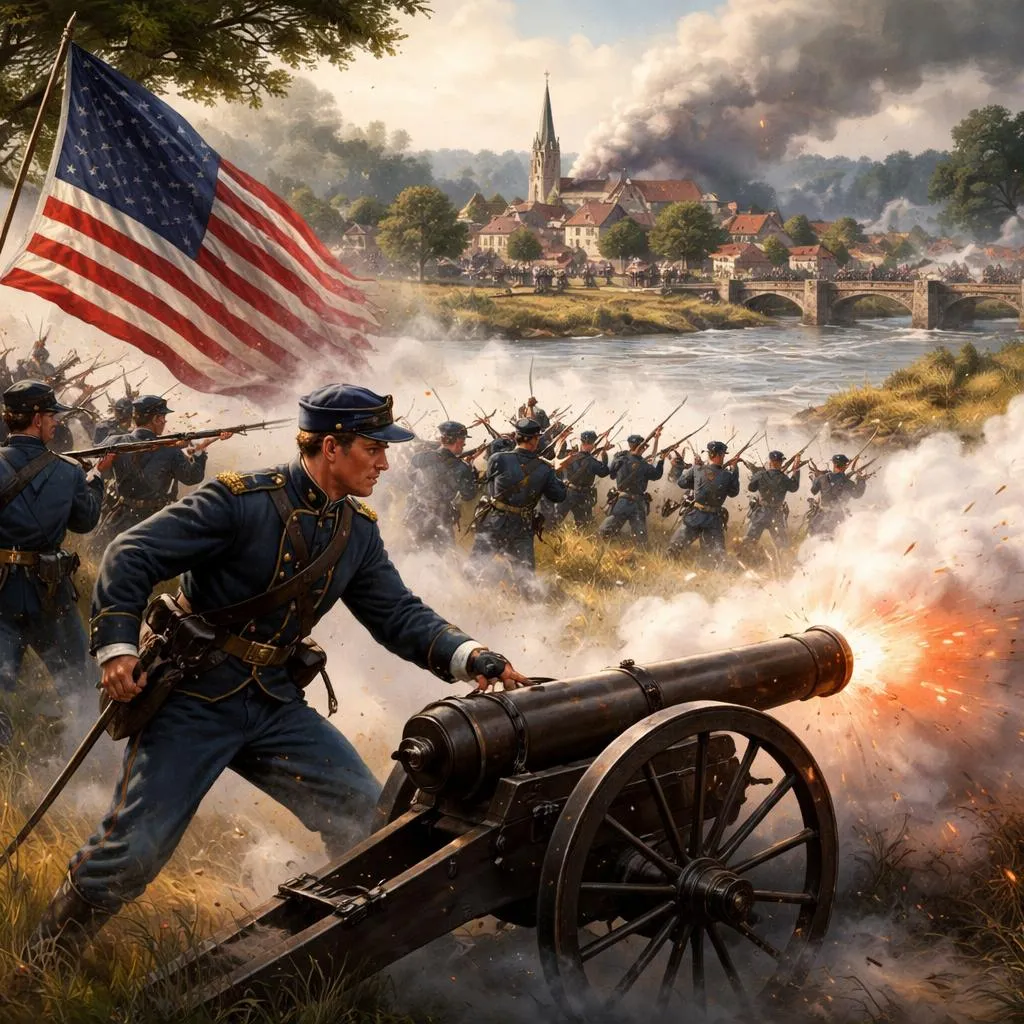
Christy hastened forward, and gave the order to Mr. Ballard, in whose division the great Parrot was included. The signal was promptly given for manning the gun, and seventeen men immediately sprang to their stations. The men were armed with cutlasses, muskets, battle-axes, pistols, and pikes, which were so disposed as to be in readiness for boarding the enemy, or repelling boarders.
“A solid shot, and aim at the pivot gun of the enemy,” said Christy in a low tone to the second lieutenant, who had the reputation of being an expert in the handling of guns of the largest calibre.
There were two captains to the pivot gun, one on each side, stationed nearest to the base of the breech. Seventeen men were required to work the pivot gun, whose duties were defined in the names applied to them, the powderman being the odd one. The first and second captains were numbers one and two; the odd numbers being on the right, and the even on the left of the piece: number three was the first loader, four the first sponger, five the second loader, six the second sponger, seven the first shellman, eight the second shellman, nine the first handspikeman, ten the second handspikeman, eleven the first train tackleman, twelve the second train tackleman (the last two at the breech, next to the captains), thirteen first side tackleman, fourteen second side tackleman, fifteen first port tackleman, sixteen second port tackleman.
The gun crew had been frequently drilled in the management of the piece, and the men were entirely at home in their stations. Other hands had been trained in serving the gun, so that the places of any disabled in action could be replaced. The service at the Parrot was not all that was required of the men forming the gun crew, for each was also a first or second boarder, a pumpman, or something else, and to each number one or two weapons were assigned, as musket and pike, sword and pistol, battle-axe. When the order to board the enemy was given, every man knew his station and his proper officer.
“Silence, men!” commanded the second lieutenant, “Cast loose and provide!”
These orders were repeated by the first captain of the gun. It is his duty to see the piece cleared and cast loose, and everything made ready for action. He and the second captain “provide” themselves with waist belts and primers, and the first with some other implements. But the handling of one of these great guns is about as technical as a surgical operation would be, and it would be quite impossible for the uninitiated to understand it, though it is every-day work to the ordinary man-of-war’s-man.
Prompted by the executive officer, who had been further instructed by the captain, all the series of steps had been taken which put the piece in readiness to be discharged, and all that remained to be done was to adjust the aim, which is done by the first captain. At this time the distance between the two ships had been considerably reduced. The captain and the first lieutenant were closely watching the chase with glasses.
The crew of the Tallahatchie could be seen at work at the long gun, and another shot from it was momentarily expected. The instant the bow of the enemy began to swerve to port, the captain of the Bellevite gave the order to put the helm to starboard. Almost at the same instant the enemy stopped her screw, swung round and fired her long gun. The projectile crashed through the bulwarks between the foremast and top-gallant forecastle, wounding two men with the splinters which flew in every direction.
Dr. Linscott and his mates had established themselves in the cockpit, to which the wounded are conveyed, in action, for treatment. The two men who had been injured by the splinters were not disabled, and they were ordered to report to the surgeon. Before the enemy could resume her course, the captain of the pivot gun had caught his aim, and discharged the Parrot. All hands watched for the result of the shot, and the glasses of the captain and the first lieutenant were directed to the chase.
She was near enough now to be observed with the naked eye with tolerable accuracy, and a shout went up from the men at the pivot gun, in which the rest of the crew on deck joined, as they saw that the shot had struck the midship gun of the enemy, or very near it; and this was the point where old Blumenhoff, the captain of the gun, had been directed to aim. He was a German, but he had served for twenty-one years in the British navy, and had won a brilliant reputation in his present position.
It could not be immediately determined whether or not the Armstrong had been disabled. The Tallahatchie had swung round again and resumed her flight; but her commander must have realized by this time that he was getting the worst of it. Paul Vapoor had not left his post in the engine and fire room, to ascertain how the battle was going, but still plied all his energies in driving the Bellevite to the utmost speed she could possibly attain. The log was frequently heaved, and the last result had been sent down to him by Midshipman Walters, and it was twenty-one knots.
During the next hour the long gun of the enemy was not again discharged, and the officers of the loyal ship were assured that it had been rendered useless by Blumenhoff’s only shot.
背景和作者介绍
这个激动人心的海战追逐场景出自一部经典的海上冒险小说,这种体裁在 19 世纪很受欢迎,它以勇气、策略和海上危险的故事吸引了年轻读者的想象力。这个故事很可能出自一位精通航海生活的作者之手,可能是曾在海军服役或 spent 很多时间在船上的人。这些作者旨在为读者带来现实主义和惊险的动作,生动地描绘了海战和水手们面临的挑战。
叙事围绕着布雷克船长和他的船只贝尔维特号展开,他们追逐塔拉哈奇号,这是一艘改装成巡洋舰的汽船。这个故事突出了海战中所需的战略思维、领导能力和勇气,以及操作复杂武器和管理压力下的船只所需的技术知识。
详细解读和意义
这段话说明了一场紧张而悬疑的海上追逐,强调了警惕、快速决策和团队合作的主题。布雷克船长的仔细观察和计算表明,情报和预判在战胜对手方面的重要性。船员们对命令的反应准备、他们在操作武器时的纪律以及他们在面对危险时的勇气,都反映了忠诚和责任的价值观。
对枢轴炮组及其角色的详细描述,让读者了解了海战的复杂性以及每个人对集体努力的贡献的重要性。这个故事不仅描绘了战斗的身体挑战,还描绘了取得成功所需的精神敏锐度和协调能力。
给学生的经验教训和见解
-
战略思维和解决问题: 布雷克船长分析形势、预测敌人行动并调整战术的能力,教会了学生在充满挑战的情况下批判性思维和适应能力的重要性。
-
团队合作和领导力: 故事强调了从军官到炮手,每个船员都扮演着至关重要的角色。有效的领导力激励和组织团队,而每个人的技能和合作都有助于成功。这对小组项目和社会互动来说是一个宝贵的教训。
-
勇气和责任: 水手们勇敢地面对危险,尽管有风险,但仍履行职责。这鼓励学生们勇敢地面对自己的挑战,并具有责任感。
-
技术知识和准备: 了解船上火炮的操作以及演练的重要性表明,准备和学习技术技能对于有效表现至关重要。学生们可以将此与在学校和生活中学习和练习技能的重要性联系起来。
将故事的精神应用于日常生活
-
在学习中: 就像船员们准备和练习他们的角色一样,学生们应该为考试和项目做好充分的准备,明白知识和实践可以带来信心和成功。
-
在社交场合: 故事中的领导力和团队合作可以激励学生们成为支持性的朋友和负责任的团队成员,帮助他人并共同努力实现共同的目标。
-
在克服挑战中: 布雷克船长和他的船员所表现出的勇气可以激励学生们以决心和冷静的态度面对困难——无论是学业、个人还是社交方面的。
从故事中培养积极的价值观
-
纪律: 船员对命令的纪律性反应,教会了自律和履行责任的重要性。
-
尊重角色: 认识到每个角色的重要性,鼓励尊重他人的贡献,培养同情心和合作精神。
-
战略耐心: 船长在与敌人交战前仔细计划,表明耐心和深思熟虑的行动通常比草率的决定带来更好的结果。
结论
这场海上冒险不仅以其生动的动作和悬念而引人入胜,而且在领导力、团队合作、勇气和战略思维方面提供了丰富的经验教训。通过思考这个故事,学生们可以获得启发,在自己的生活中培养这些品质——无论是在学校、友谊还是未来的职业生涯中。这个故事提醒我们,成功往往取决于准备、合作以及勇敢地迎接挑战。