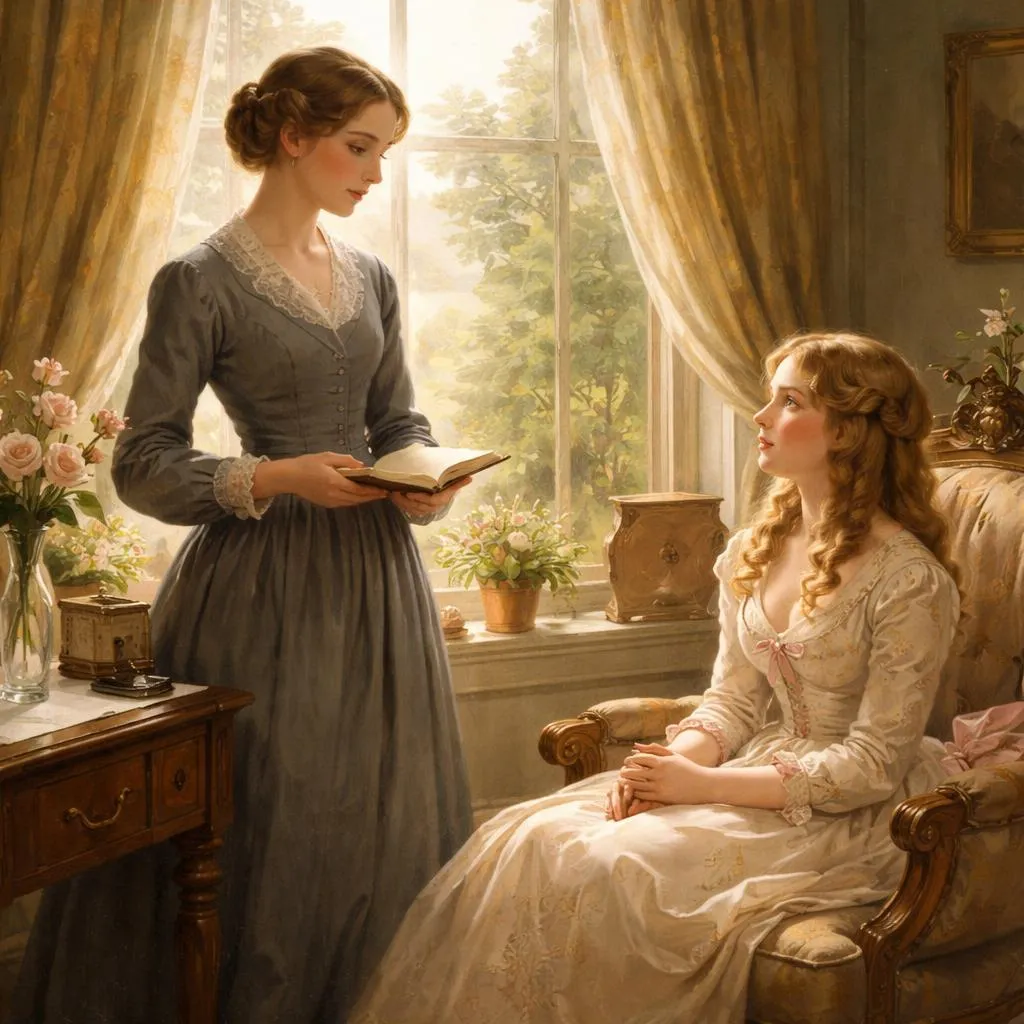

Next Sunday was one of the gloomiest of April days—a day of thick, dark clouds, and heavy showers. None of the Murrays were disposed to attend church in the afternoon, excepting Rosalie: she was bent upon going as usual; so she ordered the carriage, and I went with her: nothing loth, of course, for at church I might look without fear of scorn or censure upon a form and face more pleasing to me than the most beautiful of God’s creations; I might listen without disturbance to a voice more charming than the sweetest music to my ears; I might seem to hold communion with that soul in which I felt so deeply interested, and imbibe its purest thoughts and holiest aspirations, with no alloy to such felicity except the secret reproaches of my conscience, which would too often whisper that I was deceiving my own self, and mocking God with the service of a heart more bent upon the creature than the Creator.
Sometimes, such thoughts would give me trouble enough; but sometimes I could quiet them with thinking—it is not the man, it is his goodness that I love. ‘Whatsoever things are pure, whatsoever things are lovely, whatsoever things are honest and of good report, think on these things.’ We do well to worship God in His works; and I know none of them in which so many of His attributes—so much of His own spirit shines, as in this His faithful servant; whom to know and not to appreciate, were obtuse insensibility in me, who have so little else to occupy my heart.
Almost immediately after the conclusion of the service, Miss Murray left the church. We had to stand in the porch, for it was raining, and the carriage was not yet come. I wondered at her coming forth so hastily, for neither young Meltham nor Squire Green was there; but I soon found it was to secure an interview with Mr. Weston as he came out, which he presently did. Having saluted us both, he would have passed on, but she detained him; first with observations upon the disagreeable weather, and then with asking if he would be so kind as to come some time to–morrow to see the granddaughter of the old woman who kept the porter’s lodge, for the girl was ill of a fever, and wished to see him. He promised to do so.
‘And at what time will you be most likely to come, Mr. Weston? The old woman will like to know when to expect you—you know such people think more about having their cottages in order when decent people come to see them than we are apt to suppose.’
Here was a wonderful instance of consideration from the thoughtless Miss Murray. Mr. Weston named an hour in the morning at which he would endeavour, to be there. By this time the carriage was ready, and the footman was waiting, with an open umbrella, to escort Miss Murray through the churchyard. I was about to follow; but Mr. Weston had an umbrella too, and offered me the benefit of its shelter, for it was raining heavily.
‘No, thank you, I don’t mind the rain,’ I said. I always lacked common sense when taken by surprise.
‘But you don’t LIKE it, I suppose?—an umbrella will do you no harm at any rate,’ he replied, with a smile that showed he was not offended; as a man of worse temper or less penetration would have been at such a refusal of his aid. I could not deny the truth of his assertion, and so went with him to the carriage; he even offered me his hand on getting in: an unnecessary piece of civility, but I accepted that too, for fear of giving offence. One glance he gave, one little smile at parting—it was but for a moment; but therein I read, or thought I read, a meaning that kindled in my heart a brighter flame of hope than had ever yet arisen.
‘I would have sent the footman back for you, Miss Grey, if you’d waited a moment—you needn’t have taken Mr. Weston’s umbrella,’ observed Rosalie, with a very unamiable cloud upon her pretty face.
‘I would have come without an umbrella, but Mr. Weston offered me the benefit of his, and I could not have refused it more than I did without offending him,’ replied I, smiling placidly; for my inward happiness made that amusing, which would have wounded me at another time.
The carriage was now in motion. Miss Murray bent forwards, and looked out of the window as we were passing Mr. Weston. He was pacing homewards along the causeway, and did not turn his head.
‘Stupid ass!’ cried she, throwing herself back again in the seat. ‘You don’t know what you’ve lost by not looking this way!’
‘What has he lost?’
‘A bow from me, that would have raised him to the seventh heaven!’
I made no answer. I saw she was out of humour, and I derived a secret gratification from the fact, not that she was vexed, but that she thought she had reason to be so. It made me think my hopes were not entirely the offspring of my wishes and imagination.
‘I mean to take up Mr. Weston instead of Mr. Hatfield,’ said my companion, after a short pause, resuming something of her usual cheerfulness. ‘The ball at Ashby Park takes place on Tuesday, you know; and mamma thinks it very likely that Sir Thomas will propose to me then: such things are often done in the privacy of the ball–room, when gentlemen are most easily ensnared, and ladies most enchanting. But if I am to be married so soon, I must make the best of the present time: I am determined Hatfield shall not be the only man who shall lay his heart at my feet, and implore me to accept the worthless gift in vain.’
‘If you mean Mr. Weston to be one of your victims,’ said I, with affected indifference, ‘you will have to make such overtures yourself that you will find it difficult to draw back when he asks you to fulfil the expectations you have raised.’
‘I don’t suppose he will ask me to marry him, nor should I desire it: that would be rather too much presumption! but I intend him to feel my power. He has felt it already, indeed: but he shall ACKNOWLEDGE it too; and what visionary hopes he may have, he must keep to himself, and only amuse me with the result of them—for a time.’
‘Oh! that some kind spirit would whisper those words in his ear,’ I inwardly exclaimed. I was far too indignant to hazard a reply to her observation aloud; and nothing more was said about Mr. Weston that day, by me or in my hearing. But next morning, soon after breakfast, Miss Murray came into the schoolroom, where her sister was employed at her studies, or rather her lessons, for studies they were not, and said, ‘Matilda, I want you to take a walk with me about eleven o’clock.’
‘Oh, I can’t, Rosalie! I have to give orders about my new bridle and saddle–cloth, and speak to the rat–catcher about his dogs: Miss Grey must go with you.’
‘No, I want you,’ said Rosalie; and calling her sister to the window, she whispered an explanation in her ear; upon which the latter consented to go.
I remembered that eleven was the hour at which Mr. Weston proposed to come to the porter’s lodge; and remembering that, I beheld the whole contrivance. Accordingly, at dinner, I was entertained with a long account of how Mr. Weston had overtaken them as they were walking along the road; and how they had had a long walk and talk with him, and really found him quite an agreeable companion; and how he must have been, and evidently was, delighted with them and their amazing condescension, &c. &c.
背景和作者介绍
这段文字出自一部19世纪的经典小说,反映了那个时代人物的社会风俗、人际关系和内心想法。故事背景设定在一个社会地位、求爱和外表在日常生活中起着重要作用的时代,尤其是在上流社会。作者的身份在这里没有明确提及,她很可能是一位探讨爱情、道德和社会期望等主题的作家,经常关注年轻女性在社会中遇到的内心冲突。
详细解读和意义
这一幕描写了一个下着雨的星期天下午,罗莎莉,一个意志坚定的角色,坚持要去教堂,尽管天气阴沉。叙述者,深受韦斯顿先生的出现和声音的感动,体验着钦佩和内心冲突的混合情感。她挣扎于爱慕和内疚之间,在精神上的虔诚和世俗的欲望之间挣扎。
默里小姐的行为与叙述者的真诚形成了鲜明对比。罗莎莉被描绘得有些虚荣和善于操纵,目的是为了吸引韦斯顿先生的注意,以获得自己的社会优势。这种真情实感与肤浅野心之间的紧张关系是核心主题,说明了人们对待人际关系和自我价值的不同方式。
这个故事还突出了当时的社会习俗,例如外表的重要性、教堂作为社交聚会场所的作用以及求爱中的微妙权力斗争。叙述者对善良和纯洁的反思暗示了一个关于重视内在品质而非外在魅力的道德教训。
给学生的教训和见解
-
理解内心冲突: 叙述者的挣扎教会学生关于人类情感的复杂性,尤其是在平衡个人欲望与伦理或精神信仰时。认识到这种冲突有助于培养情商。
-
观察社会动态: 角色之间的对比表明了社会地位和个人野心如何影响行为。学生可以学习识别行为背后的动机,并理解社会期望的影响。
-
欣赏真正的品质: 叙述者对韦斯顿先生的善良而不是外表的钦佩,鼓励重视他人的性格和善良,这是一个建立有意义关系的永恒教训。
-
批判性地思考外表: 罗莎莉的操纵策略是对肤浅和欺骗的危险的警示。学生可以反思真诚在友谊和社会互动中的重要性。
在生活和学习中应用这些教训
-
在学校: 学生可以通过在评判他人之前考虑他人的感受和动机来练习同情心。他们还可以反思自己的价值观,并努力以正直的方式行事。
-
在社交场合: 了解人们可能对自己的行为有隐藏的原因,有助于更明智地处理友谊和冲突。认识到真正的善良与肤浅的魅力,可以在人际关系中做出更好的选择。
-
在个人成长中: 叙述者的内省鼓励自我意识。学生可以学会倾听自己的良心,并用理性和道德来平衡自己的情感。
从故事中培养积极的特质
-
诚实和真诚: 效仿叙述者的诚实反思和真诚感受,而不是采取操纵行为。
-
尊重他人: 像叙述者尊重韦斯顿先生的善良一样,学生应该欣赏他人的内在品质,而不仅仅是外表。
-
自我反思: 定期思考自己的动机和感受,以在情感和道德上成长。
-
善良和体贴: 注意到默里小姐对老妇人的小屋的体贴,表明即使是看似漫不经心的人也可以学会体贴。小小的善举很重要。
结论
这段文字为年轻读者提供了丰富的材料,以探索爱情、道德、社会期望和自我意识等主题。通过分析人物的行动和内心想法,学生可以深入了解人性,并培养帮助他们以同情心、正直和智慧来驾驭自己社交世界的能力。