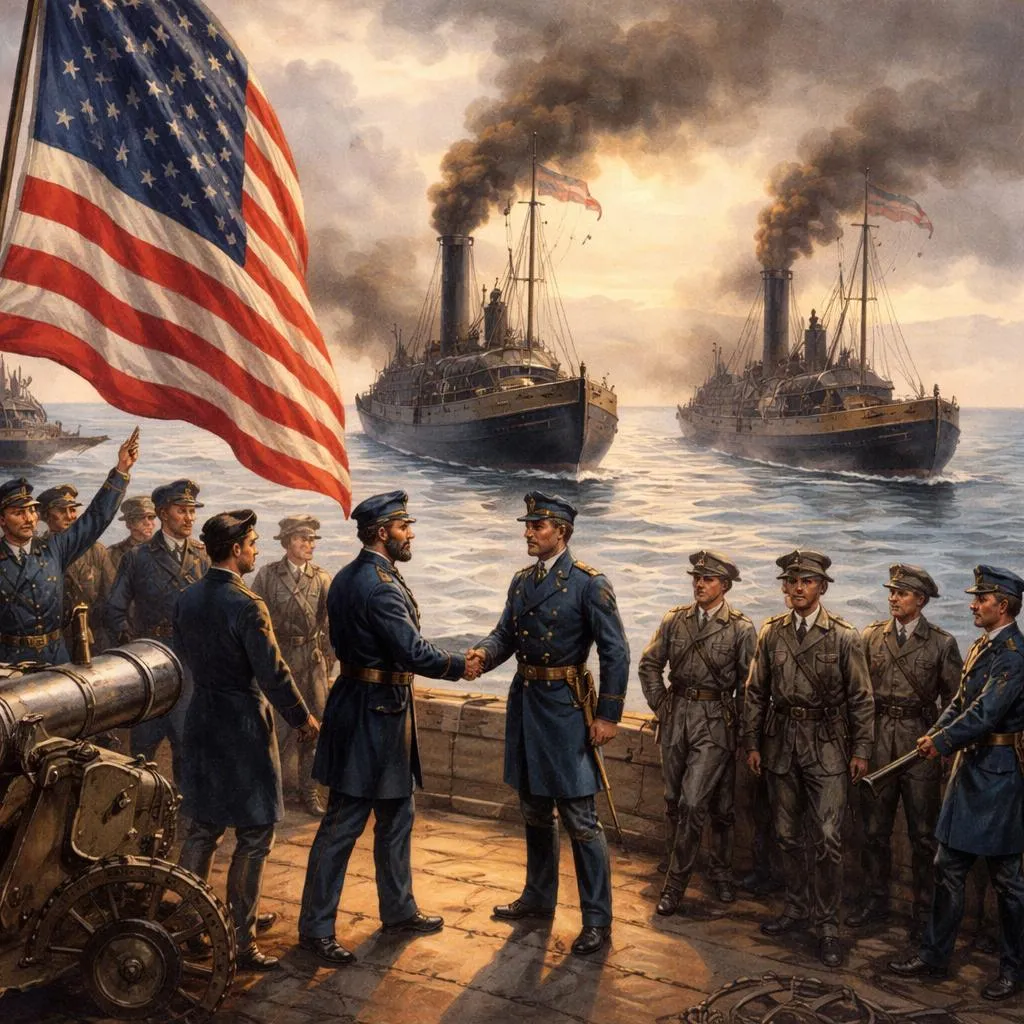

The surgeon reported the condition of the first lieutenant to the commander at once, and a long conversation between them followed. Devoted as Captain Breaker was to his executive officer, and filled with admiration as he was for the gallant exploit of that day, he was not willing to do anything that could be fairly interpreted as favoritism towards the son of Captain Passford. The summer weather of the South was coming on, and the heat was already oppressive, even on board of the ships of war at anchor so much of the time on the blockade, and this was the strong point of the doctor in caring for his patient.
Dr. Linscott was very earnest in insisting upon his point; and the commander yielded, for he could hardly do otherwise in the face of the surgeon’s recommendation, for the latter was the responsible person. The next morning, after the wounded officer had passed a feverish night, Captain Breaker visited him in his stateroom, and announced the decision. Christy began to fight against it.
“I am not so badly off as many officers who have been treated in the hospital down here; and if I am sent home it will be regarded as favoritism to the son of my father,” protested the lieutenant.
“You are too sensitive, my dear boy, as you have always been; and you are entirely mistaken. You have earned a furlough if you choose to ask for it, and every officer and seaman who has served with you would say so,” argued the captain. “I shall insert in my report, with other matter concerning you, Christy, that you were sent home on the certificate of the surgeon; and even an unreasonable person cannot call it favoritism.”
“I don’t know,” added Christy, shaking his head.
“I know, my boy. Merciful Heaven!” exclaimed Captain Breaker. “You did enough yesterday to entitle you to any favor it is possible for the department to extend to you. You saved the lives of a quarter or a third of the ship’s company. But it was not simply a brave and daring exploit, my boy, though even that would entitle you to the fullest commendation; but it included sound judgment on the instant, lightning invention, and consummately skilful action;” and the commander became positively eloquent as he proceeded.
“Come, come, Captain Breaker! You are piling it on altogether too thick,” cried Christy, overwhelmed by the torrent of praise. “I only did what I could not help doing.”
“No matter if you did; it was the right thing to do, and it was done at precisely the right instant. A moment’s delay would have brought the whole force of the enemy down upon you. It was absolutely wonderful how you got that gun off in such a short space of time. I report Captain Rombold’s words to you.”
“He is a magnanimous gentleman,” said Christy.
“He says, too, that a dozen muskets and revolvers were discharged at you, and it is a miracle that only one bullet struck you.”
“I found a bullet-hole in my cap, and two more in the skirt of my coat,” added the patient with a smile, as he pointed to his coat and cap.
“But we are off the subject; and I was only trying to show that you are entitled to a furlough,” said the commander; but the discussion was continued for some time longer, though Christy consented to be sent home in the end.
The thought of going to Bonnydale was exceedingly pleasant to him, and he allowed his mind to dwell upon each member of the family, and to picture in his imagination the greeting they would all give him. Not to the members of his family alone did he confine his thoughts; for they included the beautiful Bertha Pembroke, whom, with her father, he had taken from the cabin of a cotton steamer he had captured. He concluded that the surgeon’s certificate would shield him from adverse criticism, after he had fully considered the matter.
The flag-officer of the Eastern Gulf Squadron was not off Mobile Point; and Captain Breaker, as the senior officer present, was obliged to dispose of his prizes himself. Some necessary repairs had to be made upon both ships before anything could be done; and the carpenter and his gang, with all the other seamen who could handle an axe or an adze, were hurrying forward the work. The prize had lost her mizzen mast, her steering gear had been knocked to pieces both forward and aft, she had been riddled in a dozen places, and shot-holes in the hull had been hastily plugged during the action.
Her Armstrong gun amidships had been disabled by Blumenhoff at his first fire. Christy had not found the opportunity to examine this piece, as he desired; but Mr. Graines had done so for him; and it was found that the gun carriage had been knocked into a shapeless mass so that it could not be put in condition for use. The machinists from the engine room of both vessels, for those of the Tallahatchie had no feeling on the subject, were restoring the steering apparatus, and were likely to have the work completed the next day.
Captain Breaker was in great doubt as to what he ought to do with Colonel Passford. He was certainly a non-combatant; and it could not be shown that he had any mission to Nassau or elsewhere in the service of the Confederacy, though it would have been otherwise if the steamer and the West Wind had not been captures, for he was to sell the cotton in England, and purchase a steamer with the proceeds; but his mission ended with the loss of the vessels. He finally decided to send him to Fort Morgan under a flag of truce.
Before he left he called upon his nephew. He was still in a state of despondency over his own losses, and his failures to benefit the Confederacy, whose loss he counted as greater than his own. He stated that the commander had announced his intention to send him on shore. Christy had seen him but for a moment, for his uncle had not desired to meet him again.
“We will not talk about the war, Uncle Homer,” said Christy. “How are Aunt Lydia, Corny, and Gerty? I hope they are all very well.”
“Your aunt is not very well, for the hardships of the war have worn upon her. Except Uncle Jerry and Aunty Chloe, the cook, all our negroes have left us, or been taken by the government to work on fortifications, and my wife and Gerty have to do most of the housework,” replied Uncle Homer very gloomily; and it was plain to Christy that the mansion at Glenfield was not what it had been in former years.
“How is Corny? I have not heard from him lately.”
“Corny is now a captain in the Army of Virginia, and is doing his duty like a man,” answered the colonel proudly; and this fact seemed to be almost the only pleasant feature of his experience. “We have been called upon to endure a great many hardships; but we still feel that the God of justice will give us the victory in the end, and we try to bear our burdens with resignation. The captain informs me that you are going home, Christy.”
“The surgeon has ordered me to the North on account of the heat in this locality.”
“I learned in Nassau as well as when I was at Bonnydale, that your father holds a very prominent and influential position among your people, and your advancement seems to be made sure,” added the planter.
“He has never held any office under the United States government, and I hope I do not owe my advancement to him; and he has often assured me that he never asked for my promotion or appointment,” said Christy.
“You have been of very great service to your government, as I know to my sorrow, and I have no doubt you deserved whatever promotion you have obtained,” added the colonel, observing that he had touched his nephew in a very tender spot. “But I suppose the boat is waiting for me, and I must bid you good-by. Remember me in the kindliest manner to your father and mother, and to Miss Florry. They were all as good to me when I was on parole at Bonnydale as though no war had ever divided us.”
The colonel took Christy by the hand, and betrayed no little emotion as they parted. The lieutenant realized that his uncle was suffering severely under the hardships and anxieties of the war, and he was profoundly sorry for him, though he uttered no complaint. Both on his own account and on that of the Confederacy, he had shipped several cargoes of cotton to Nassau to be sent from there to England; but every one of them had been captured, most of them by his nephew while in command of the Bronx. But he was still confident that the Confederacy would triumph.
Colonel Passford had been sent to the fort under a flag of truce, and had been received by the commandant. In a couple of days the repairs of both ships had been completed. Captain Rombold, though his wound was quite severe, was getting along very well. Captain Breaker had completed his arrangements for the disposal of the prizes and prisoners; and it became necessary to remove the wounded commander to the cabin of the Tallahatchie, to which he did not object, for the wounded in his cabin had been placed in a temporary hospital between decks. He was permitted to occupy the stateroom he had used while in command, while the other was reserved for the prize-master.
Ensign Palmer Drake, the senior of the two officers waiting appointments, was made prize-master of the Tallahatchie, for he had proved to be an able and brave man in the recent action. Mr. Ballard became executive officer of the Bellevite, and Mr. Walbrook the second lieutenant, while the place of the third was filled by Mr. Bostwick, who had been master. French was appointed prize-master of the West Wind, with a crew of five men, as she was to be towed by the prize steamer.
It was found that the Tallahatchie had gone into the action with ninety-five men, including the forward officers. More than one-third of them had been killed or disabled, without counting those who were still able to keep the deck and sleep in their hammocks. Fifty of them were in condition to do duty; and Captain Breaker did not consider it prudent to send so many prisoners to the North in the prize. He therefore sent forty of them to Key West in the Holyoke, assured that the Bellevite was abundantly able to maintain the blockade, even with her reduced ship’s company, during the absence of his consort.
The engineers of the prize were willing to continue their services at the expense of their new employer, or even to accept permanent appointments; for they did not belong to the upper classes in England who favored the cause of the Confederacy, and were only looking for the highest wages. Weeks, the oiler, and Bingham, a boatswain’s mate, were appointed first and second officers of the Tallahatchie, and twenty seamen were detailed as a prize crew. To insure the fidelity of the four foreign engineers Mr. Graines was sent as a sort of supervisor, with the knowledge and assent of those in actual charge of the machinery.
When all was ready for her departure, Christy went on board of the Tallahatchie in the same boat with the engineer, after a rather sad parting with the captain and his fellow-officers, and amid the cheers of the seamen, who had mounted the rail and the rigging to see him off. Mr. Drake conducted him to the captain’s cabin when he went on board of the prize, where he met Captain Rombold, with whom he exchanged friendly greetings.
“Fellow passengers again, Mr. Passford; but you are going to your reward, and I to my punishment,” said the late commander very cheerfully.
“Hardly to my reward, for I neither desire nor expect any further promotion,” replied Christy. “I am not yet twenty years old.”
“But God makes some fully-developed men before they are twenty-one, and you are one of them.”
“Thank you, Captain.”
“I am willing to wager the salary I have lost that you will be promoted whether you desire it or not.”
“I hope not,” replied the lieutenant, as he went to the temporary stateroom which had been prepared for him.
The apartment was much larger than the permanent ones, and it was provided with everything that could contribute to his comfort. While Mr. Graines was assisting him to arrange his baggage, the steamer got under way.
背景介绍和作者介绍
这个故事的背景设定在一个动荡的海战时期,很可能受到了美国内战时期的启发,封锁和海军交战起着至关重要的作用。故事围绕着布雷克船长、克里斯蒂·帕斯福德中尉和其他海军军官展开,他们经历了战争的艰辛、忠诚和责任。作者的身份在这里没有明确说明,但他展现了对海军作战、人类勇气以及军人所经历的复杂情感的深刻理解。对舰船维修、指挥决策和个人互动等细节的描述,展现了对现实主义和历史准确性的承诺,丰富了故事的真实性。
详细解读和意义
从本质上讲,这个故事探讨了勇气、责任以及领导者在战争中面临的伦理挑战等主题。克里斯蒂·帕斯福德中尉在战斗中的英勇行为,尽管他年轻且身负重伤,但突显了在生死攸关的情况下所需要的勇气和快速的思维。布雷克船长努力平衡对克里斯蒂的敬佩之情和避免偏袒的需要,反映了军事指挥中领导力和公平性的复杂性。
这个故事也触及了战场之外的战争的人力成本。对帕斯福德上校一家遭受战争苦难、仆人损失以及个人情感冲击的描绘,提醒读者战争不仅影响士兵,也影响整个社区。叙事对受伤军官的照料和舰船维修的后勤工作的关注,强调了维持一支作战部队的实际情况。
给学生的教训和启示
-
勇气和责任: 克里斯蒂在炮火下果断行动的意愿,教会了我们勇敢和承担责任的重要性,即使情况危险或不确定。学生们可以了解到,勇气不是没有恐惧,而是在恐惧中正确行动的能力。
-
领导力和公平: 布雷克船长仔细考虑如何公平对待克里斯蒂,不偏袒,这为伦理领导提供了宝贵的教训。在学校或社交场合,这可以转化为公平对待同伴,保持正直,避免偏见,即使涉及个人感情。
-
逆境中的韧性: 故事展示了人物如何忍受身体上的伤痛、情感上的痛苦和战争的艰辛。这种韧性是学生们在学习或个人生活中面临挑战时的一项重要品质,鼓励他们克服困难。
-
同情心和怜悯心: 对伤员的关怀和对家庭困境的描绘鼓励了同情心。学生们可以受到启发去关爱他人,理解不同的观点,并向有需要的人提供支持。
将故事的精神应用于日常生活
-
在学习中: 像克里斯蒂一样,学生们应该准备好在解决问题或在学习中面临意外挑战时迅速思考并运用正确的判断。
-
在社交互动中: 布雷克船长所表现出的公平和尊重可以指导学生们解决冲突,并在朋友和同学之间建立信任。
-
在个人成长中: 克里斯蒂在受到赞扬时的谦逊提醒学生们保持谦虚,专注于做正确的事情,而不是寻求认可。
-
在面对挑战时: 人物所展现的韧性鼓励学生们培养精神和情感力量,帮助他们从挫折中恢复过来。
从故事中培养积极的价值观
-
勇气: 鼓励学生们勇敢地迎接新的挑战,无论是在公开演讲、体育运动中,还是在维护正义时。
-
判断力: 传授批判性思考和做出明智决定的重要性,尤其是在压力之下。
-
同情心: 提倡对同伴的友善和支持,特别是那些可能正在挣扎的人。
-
正直: 在所有行动中培养诚实和公平,强调真正的领导力涉及公正地服务他人。
结论
这个故事富含历史背景和人类情感,为年轻读者提供了不仅仅是一场激动人心的海军冒险。它提供了对性格、领导力和冲突代价的深刻探索。通过学习和反思克里斯蒂·帕斯福德和他的同伴的经历,学生们可以获得对勇气、公平和韧性的宝贵见解——这些品质将在学校、友谊和未来的事业中对他们有所帮助。鼓励学生们体现这些美德将帮助他们成长为有思想、勇敢和富有同情心的人。