
Having assured himself that the ship was fully up with Cape Henlopen, Christy retired to his cabin, and still “alone in his glory,” he broke the seal of the official envelope. He was to cruise outside of the blockaders, and report to the flag-officer when opportunity presented. Just then it was believed that Richmond, which received all its foreign supplies from Wilmington, could not long hold out if it was captured; and the Secretary of the Navy was giving special attention to the forts which protected it.
It was evident to the young commander that he was not to rust in inactivity, as had been the case of late off Mobile Bay, and a wide field of operations was open to him. His instructions were minute, but they did not confine his ship to the immediate vicinity of the mouth of the Cape Fear River. It was evident that the speed of the St. Regis had been an important factor in framing the secret orders.
If a blockade-runner eluded or outsailed the vessels of the fleet near the coast, the St. Regis was expected to “pick her up.” On the other hand, the fastest of the vessels were sent out farther from the shore, and the ship was expected to support them. Christy realized that he should be called upon to exercise his judgment in many difficult situations, and he could only hope that he should be equal to such occasions.
“Good-morning, Captain Passford,” said Paul Vapoor, saluting him on the quarter-deck. “I hope you slept well in your brief watch below.”
“I did not sleep a wink, I was so anxious to read my orders. But I know them now, and I feel as cool as an arctic iceberg. I shall sleep when I turn in again.”
“Well, where are we going, Captain, if it is no longer a secret?” asked the engineer.
“It is not a secret now; and we are to cruise off the mouth of the Cape Fear River,” replied the commander, as he proceeded to give the information more in detail.
“We are not likely to have any hot work then if we are only to chase blockade-runners,” added Paul.
“Probably we can render greater service to our country in this manner than in any other way, or we should not have been sent to this quarter,” said Christy, with a long gape.
Paul saw that his friend was sleepy, and he bade him good-night. The commander went to his stateroom, and was soon fast asleep, from which he did not wake till eight o’ clock in the morning. When he went on deck the ship was carrying all sail. The second lieutenant had the deck, and he asked him what speed the steamer was making.
“The last log showed seventeen knots an hour,” replied Mr. Makepeace.
“I hope you slept well, Captain Passford,” said the chief engineer, saluting him at this minute.
“I slept like a log till eight bells this morning,” replied Christy.
“Mr. Makepeace reports the last log at seventeen knots,” continued Paul. “But the ship is not making revolutions enough per hour for more than fifteen, for I have got the hang of her running now. The wind is blowing half a gale, and the canvas is giving her two knots.”
No events transpired on board worthy a special chronicle during the day. The men were drilled in various exercises, and gave excellent satisfaction to their officers. The next morning the St. Regis was off Cape Hatteras, and though it is a greater bugbear than it generally deserves, it gave the ship a taste of its quality. The wind had hauled around to the south-west, and was blowing a lively gale. The sails had been furled in the morning watch, and off the cape the course had been changed to south-west.
Just before eight bells in the afternoon watch, when the ship was making fifteen knots an hour, the lookout man on the top-gallant forecastle called out “Sail, ho!” and all eyes were directed ahead.
“Where away?” demanded the officer of the deck sharply.
“Close on the lee bow, sir!” returned the lookout.
The commander was in his cabin studying the chart of the coast of North Carolina; but the report was promptly sent to him, and he hastened on deck.
“Another sail on the port bow, sir!” shouted a seaman who had been sent to the fore cross trees with a spy-glass.
“What are they?” asked Christy, maintaining his dignity in spite of the excitement which had begun to invade his being.
“Both steamers, sir,” replied the officer of the deck.
“The head one is a blockade-runner, I know by the cut of her jib, sir,” shouted the man with the glass on the cross trees.
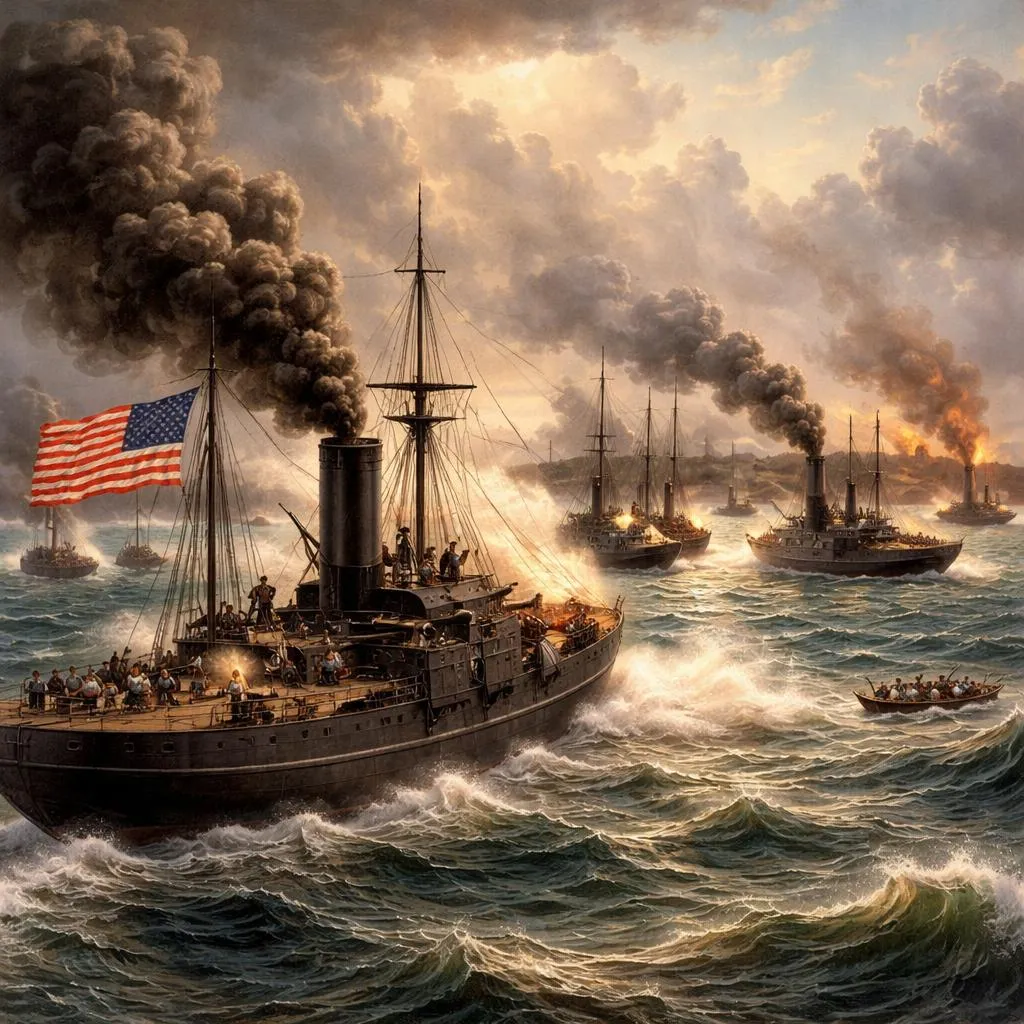
All the glasses on board were immediately directed to the two vessels. Christy could plainly make out the steamer that had the lead. She was a piratical-looking craft, setting very low in the water, with two smoke stacks, both raking at the same angle as her two masts. The wind was not fair, and she could not carry sail; but the “bone in her teeth” indicated that she was going through the water at great speed.
“A gun from the chaser, sir!” shouted the man aloft.
The cloud of smoke was seen, and the report of the gun reached the ears of all on board the St. Regis.
“There is no mistaking what all that means, Mr. Baskirk,” said Christy when he had taken in the situation.
At the first announcement of the sail ahead, the commander had ordered the chief engineer to get all the speed he could out of the ship. The smoke was pouring out of the smoke stacks, for the St. Regis had two, and presently she indicated what was going on in the fire room by beginning to shake a little.
“Another sail dead ahead, sir!” called the man on the fore cross trees.
The glasses were directed to the third sail, and she proved to be a steamer, also pursuing the one first seen. It was soon evident to the observers that the blockade-runner, for the man aloft who had so defined her was entirely correct, was gaining all the time on her pursuers. If she had nothing but her two pursuers to fear, her troubles were really over.
Both of the Federal ships were firing at the chase; but they might as well have spared their powder and shot, for they could not reach her into at least a quarter of a mile. The wind was still at the south-west, and already there were signs of fog. The rakish steamer had probably come from the Bermudas, where she must have obtained a skilful pilot, for without one she would have had no chances at all; and she stood boldly on her course as though she had nothing to fear on account of the navigation.
“What are we going to have for weather, Mr. Makepeace?” asked Christy, after a long look to windward.
“It looks a little nasty off towards the shore, sir,” replied the second lieutenant. “I should say it was going to be just what that pirate would like to have.”
“Why do you call her a pirate?” asked the commander with a smile. “Probably she is not armed.”
“I call her a pirate because she looks like one; but I think a blockade-runner is a hundred degrees better than a pirate; and our British friends plainly look upon them as doing a legitimate business. I rather think that highflyer will run into a fog before she gets to the shore.”
“She has nothing to fear from the two steamers that are chasing her,” added Christy. “We are to have a finger in this pie.”
“No doubt of that; and I hope we shall make a hole through her before she gets to the coast.”
“She is not more than a mile and a half from us now, and our midship gun is good for more than that; but I don’t think it is advisable to waste our strength in firing at her just yet.”
“That’s just my way of thinking,” said Mr. Makepeace, with something like enthusiasm in his manner; and he was evidently delighted to find that the commander knew what he was about, as he would have phrased it.
“The rakish steamer seems to be headed to the west south-west, and she is exactly south-east of us. We can see that she is sailing very fast; but how fast has not yet been demonstrated. How high should you rate her speed, Mr. Makepeace?”
“I should say, Captain Passford, that she was making eighteen knots an hour. She is kicking up a big fuss about it; and I’ll bet a long-nine cigar that she is doing her level best.”
“I don’t believe she is doing any better than that,” added Christy. “Make the course south south-west, Mr. Baskirk.”
“South south-west, sir,” replied the executive officer.
The course of the ship was changed, and Christy planked the deck from the quarter-deck to the forecastle in order to obtain the best view he could of the relative positions of the St. Regis, the chase, and the two steamers astern of her. The blockade-runner showed no colors; and no flag could have been of any service to her. She appeared still to be very confident that she was in no danger, evidently relying wholly upon her great speed to carry her through to her destination.
The “highflyer,” as the second lieutenant called her every time he alluded to the blockade-runner, and the two pursuers, occupied the three angles of a triangle. The latter were both sending needless cannon balls in the direction of the chase, but not one of them came anywhere near her.
On the other hand, the highflyer and the St. Regis formed two angles of another triangle, the third of which was the point where they would come together, if nothing occurred to derange their relative positions. By this time Paul Vapoor had developed all the power of the ship’s boilers, and the screw was making more revolutions a minute than her highest record, which was found in a book the former chief engineer had left in his stateroom.
“I don’t think that highflyer quite understands the situation, Mr. Baskirk,” said the commander, as he observed that she did not vary her course, and stood on to her destination, apparently with perfect confidence.
“I don’t think she does, sir,” replied the first lieutenant. “She can see the American flag at the peak, and she knows what we are. Doubtless she is making the mistake of believing that all the Federal ships are slow coaches.”
“Heave the log, Mr. Baskirk,” added Christy, and he walked forward.
It was a matter of angles when it was desirable to come down to a close calculation, and the young commander found his trigonometry very useful, and fortunately not forgotten. With an apparatus for taking ranges he had procured the bearing of the highflyer accurately as soon as the last course was given out, perhaps half an hour before. He took the range again, and found there was a slight difference, which was, however, enough to show that the form of the triangle had been disturbed.
Both ships were headed for the same point, and the sides of the triangle were equal at the first observation. Now the St. Regis’s side of the figure was perceptibly shorter than its opposite. This proved to the captain that his ship had gained on the other. The two chasers had been losing on the chase for the last half-hour, and Christy regarded them as out of the game.
There was some appearance of fog in the south-west, and no land could be seen in any direction. For another hour the St. Regis drove ahead furiously on her course, and the highflyer was doing the same. The two steamers, regardless of the speed of either, were necessarily approaching each other as long as they followed the two sides of the triangle. They had come within half a mile the one of the other, when the commander gave the order to beat to quarters. Ten minutes later the frame of the ship shook under the discharge of the big Parrot. The shot went over the chase; but she promptly changed her course to the southward.
背景和作者介绍
这个激动人心的海战故事背景设定在美国内战期间,当时海军封锁在联盟和邦联之间的冲突中发挥了关键作用。故事讲述了克里斯蒂船长和他的船圣雷吉斯号追逐一艘封锁线船的故事——这艘船试图偷偷溜过联盟海军,向邦联运送补给。作者写于19世纪末或20世纪初,通过生动的描述和详细的航海知识,捕捉了海战的紧张气氛和战略。
作者可能对海军历史和战争有着浓厚的兴趣,他使用了像赫尔彭角、菲尔角河和哈特拉斯角这样的真实地点,使故事更贴近现实。这增加了故事的真实性,并帮助读者想象那个时代水手们所面临的挑战。
详细解读和意义
从本质上讲,这个故事是关于勇气、领导力和面对危险时的快速反应。克里斯蒂船长必须运用他的知识、判断力和船的速度来智胜封锁线船,并支持他的同伴船只。这个故事突出了团队合作、战略和在压力下保持冷静的重要性。
追逐以及使用几何学和三角学来计算位置表明了科学和数学如何在现实生活中应用,即使是在战争中。这个故事还探讨了毅力和决心的主题,因为追捕者和封锁线船都将他们的船推向极限。
给学生的教训和见解
-
领导力和责任感: 克里斯蒂船长的角色表明了领导者必须如何保持冷静,做出明智的决定,并激发团队的信心。学生们可以学习责任感和在充满挑战的时期保持镇定的价值。
-
知识的应用: 使用图表、计算和理解船的机械原理,教导了将你在学校学到的知识应用于实际情况的重要性。
-
团队合作和沟通: 船员的协调努力和清晰的沟通对于成功至关重要。这提醒我们,与他人良好合作和分享信息是任何小组活动或项目的关键技能。
-
毅力: 船长和封锁线船都表现出了决心。学生们可以受到启发,即使面对障碍,也要不断尝试,永不放弃。
如何在日常生活中应用这些教训
-
在学习中: 像克里斯蒂船长对待他的任务一样对待你的学习——做好充分准备,创造性地运用你的知识,即使事情变得艰难也要保持专注。
-
在社交场合: 练习清晰的沟通和团队合作。无论是在小组项目中还是在解决冲突时,保持冷静和合作都有助于每个人取得成功。
-
在个人成长中: 通过设定目标并克服困难来培养毅力。记住,挑战是学习和变得更强大的机会。
从故事中培养积极的品质
-
勇气: 勇敢地迎接挑战,即使你感到不确定。
-
判断力: 行动前仔细思考,收集信息,并考虑后果。
-
责任感: 保持可靠,并在需要时准备好负责。
-
好奇心和学习: 像克里斯蒂船长使用三角学一样,始终寻求学习新的技能,这些技能可以在意想不到的方式中帮助你。
通过阅读这样的故事,年轻的读者不仅可以享受惊险的冒险,还可以获得对历史、领导力和个人发展的宝贵见解。这个故事鼓励学生们成为有思想、勇敢和坚持不懈的人——这些品质将使他们终身受益。