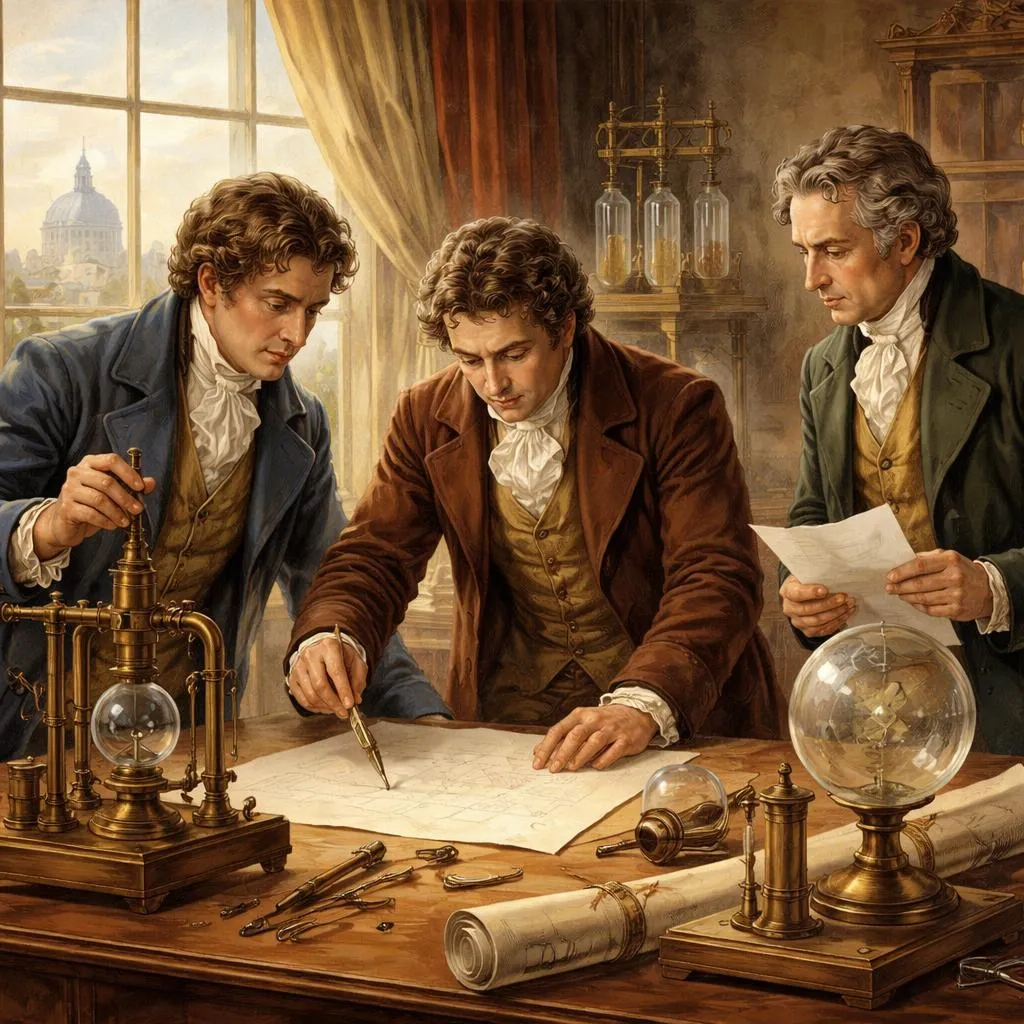

Sadi Carnot
Among Fourier's contemporaries who were interested in the theory of heat the most eminent was Sadi Carnot, a son of the eminent geometrician mentioned above. Sadi Carnot was born at Paris in 1796, and died there of cholera in August 1832; he was an officer in the French army. In 1824 he issued a short work entitled Réflexions sur la puissance motrice du feu , in which he attempted to determine in what way heat produced its mechanical effect. He made the mistake of assuming that heat was material, but his essay may be taken as initiating the modern theory of thermodynamics.
Ampère
André Marie Ampère was born at Lyons on January 22, 1775, and died at Marseilles on June 10, 1836. He was widely read in all branches of learning, and lectured and wrote on many of them, but after the year 1809, when he was made professor of analysis at the Polytechnic school in Paris, he confined himself almost entirely to mathematics and science. His papers on the connection between electricity and magnetism were written in 1820. According to his theory, propounded in 1826, a molecule of matter which can be magnetized is traversed by a closed electric current, and magnetization is produced by any cause which makes the direction of these currents in the different molecules of the body approach parallelism.
Fresnel, Biot
Augustin Jean Fresnel, born at Broglie on May 10, 1788, and died at Ville-d'Avray on July 14, 1827, was a civil engineer by profession, but he devoted his leisure to the study of physical optics. The undulatory theory of light, which Hooke, Huygens, and Euler had supported on a priori grounds, had been based on experiment by the researches of Young. Fresnel deduced the mathematical consequences of these experiments, and explained the phenomena of interference both of ordinary and polarized light. Fresnel's friend and contemporary, Jean Baptiste Biot, who was born at Paris on April 21, 1774, and died there in 1862, requires a word or two in passing. Most of his mathematical work was in connection with the subject of optics, and especially the polarization of light. His systematic works were produced within the years 1805 and 1817; a selection of his more valuable memoirs was published in Paris in 1858.
Arago
François Jean Dominique Arago was born at Estagel in the Pyrenees on February 26, 1786, and died in Paris on October 2, 1853. He was educated at the Polytechnic school, Paris, and we gather from his autobiography that however distinguished were the professors in that institution they were remarkably incapable of imparting their knowledge or maintaining discipline.
In 1804 Arago was made secretary to the observatory at Paris, and from 1806 to 1809 he was engaged in measuring a meridian arc in order to determined the exact length of a metre. He was then appointed to a leading post in the observatory, given a residence there, and made a professor at the Polytechnic school, where he enjoyed a marked success as a lecturer. He subsequently gave popular lectures on astronomy, which were both lucid and accurate ‐ a combination of qualities which was rarer then than now. He reorganized the national observatory, the management of which has long been inefficient, but in doing this his want of tact and courtesy raised many unnecessary difficulties. He remained to the end a consistent republican, and after the coup d'état of 1852, though half blind and dying, he resigned his post as astronomer rather than take the oath of allegiance. It is to the credit of Napoleon III. that he gave directions that the old man should be in no way disturbed, and should be left free to say and do what he liked.
Arago's earliest physical researches were on the pressure of steam at different temperatures, and the velocity of sound, 1818 to 1822. His magnetic observations mostly took place from 1823 to 1826. He discovered what has been called rotatory magnetism, and the fact that most bodies could be magnetized; these discoveries were completed and explained by Faraday. He warmly supported Fresnel's optical theories, and the two philosophers conducted together those experiments on the polarization of light which led to the inference that the vibrations of the luminiferous ether were transverse to the direction of motion, and that polarization consisted in a resolution of rectilinear motion into components at right angles to each other. The subsequent invention of the polariscope and discover of rotatory polarization are due to Arago. The general idea of the experimental determination of the velocity of light in the manner subsequently effected by Fizeau and Foucault was suggested by him in 1838, but his failing eyesight prevented his arranging the details or making the experiments.
It will be noticed that some of the last members of the French school were alive at a comparatively recent date, but nearly all their mathematical work was done before the year 1830. They are the direct successors of the French writers who flourished at the commencement of the nineteenth century, and seem to have been out of touch with the great German mathematicians of the early part of it, on whose researches much of the best work of that century is based; they are thus placed here, though their writings are in some cases of a later date than those of Gauss, Abel and Jacobi.
背景介绍和作者介绍
本文介绍了18世纪末和19世纪初几位在科学史上举足轻重的人物,重点介绍了他们在物理学、数学和光学领域的贡献。这些科学家,包括萨迪·卡诺、安德烈-玛丽·安培、奥古斯丁·菲涅耳、让-巴蒂斯特·比奥和弗朗索瓦·阿拉果,都是为现代科学理论和技术奠定基础的先驱。他们生活的时代,科学正在迅速发展,他们的工作帮助塑造了热力学、电磁学和光的研究等领域。
萨迪·卡诺,通常被称为“热力学之父”,是一位法国军官,他于1824年发表的论文开启了人们对热能如何转化为机械功的现代理解。安德烈-玛丽·安培是一位数学家和物理学家,他最出名的工作是关于电和磁之间的关系,这导致了电磁学的发展。奥古斯丁·菲涅耳推进了光的波动理论,解释了干涉和偏振等现象。让-巴蒂斯特·比奥对光学做出了重大贡献,尤其是在理解偏振光方面。弗朗索瓦·阿拉果是一位天文学家和物理学家,他在磁学和光偏振方面取得了重要发现,并以其对科学和共和主义理想的奉献而闻名。
详细解读和意义
这些科学家的故事不仅仅是关于他们的发现,也是关于面对挑战时的求知精神和毅力。例如,卡诺认为热是一种物质的假设是错误的,但他的工作是基础性的。安培关于磁化物质中分子电流的理论是理解电磁学的重要一步。菲涅耳和比奥对光的研究有助于证实光的波动性质,这是对早期粒子理论的重大转变。
阿拉果的生活故事特别鼓舞人心,因为它既反映了科学成就,也反映了个人 integrity。尽管政治动荡和个人健康问题,他仍然致力于他的原则和推进知识。他与菲涅耳在光偏振实验上的合作对塑造现代光学至关重要。
给学生的经验教训和见解
-
好奇心和批判性思维: 这些科学家表明了提出问题和挑战现有思想的重要性。即使一些假设是错误的,他们探索新概念的意愿也带来了突破。
-
学习的毅力: 这些人物中的许多人都面临着困难——无论是科学上的、政治上的还是个人的——但他们继续他们的工作。这教导学生坚持不懈和韧性的价值。
-
跨学科学习: 这些科学家结合了来自不同领域的知识——数学、物理学、工程学——来解决复杂的问题。学生可以学习跨学科整合知识。
-
伦理和正直: 阿拉果拒绝违背自己信仰的宣誓,提醒我们坚守自己的原则很重要,即使是在压力之下。
-
合作: 菲涅耳和阿拉果之间的合作突出了共同努力如何带来更大的发现。
在日常生活和学习中的应用
- 在学习中: 学生可以养成质疑和探索课本之外的习惯,就像这些科学家对他们的实验和理论所做的那样。
- 在社会生活中: 阿拉果所表现出的伦理立场鼓励人们坚持正义,并在互动中保持诚实。
- 在解决问题中: 像这些科学家一样,结合来自各个学科的知识,可以帮助学生创造性地解决挑战。
- 在个人成长中: 了解失败或错误(如卡诺关于热的假设)是学习的一部分,可以激励学生不断尝试。
从这些故事中培养积极的特质
- 好奇心: 鼓励在日常生活中问“为什么”和“怎么做”。
- 韧性: 学会将挫折视为成长的机会。
- 合作: 与同伴合作,分享想法并解决问题。
- 正直: 培养强大的道德指南针,并坚守自己的价值观。
- 终身学习: 将学习视为一个持续的旅程,而不仅仅是一项学校任务。
通过研究这些先驱科学家的生活和工作,学生们不仅获得了关于重要科学原理的知识,还学习了宝贵的生活技能和态度,这些技能和态度可以帮助他们在学业上和个人生活中取得成功。