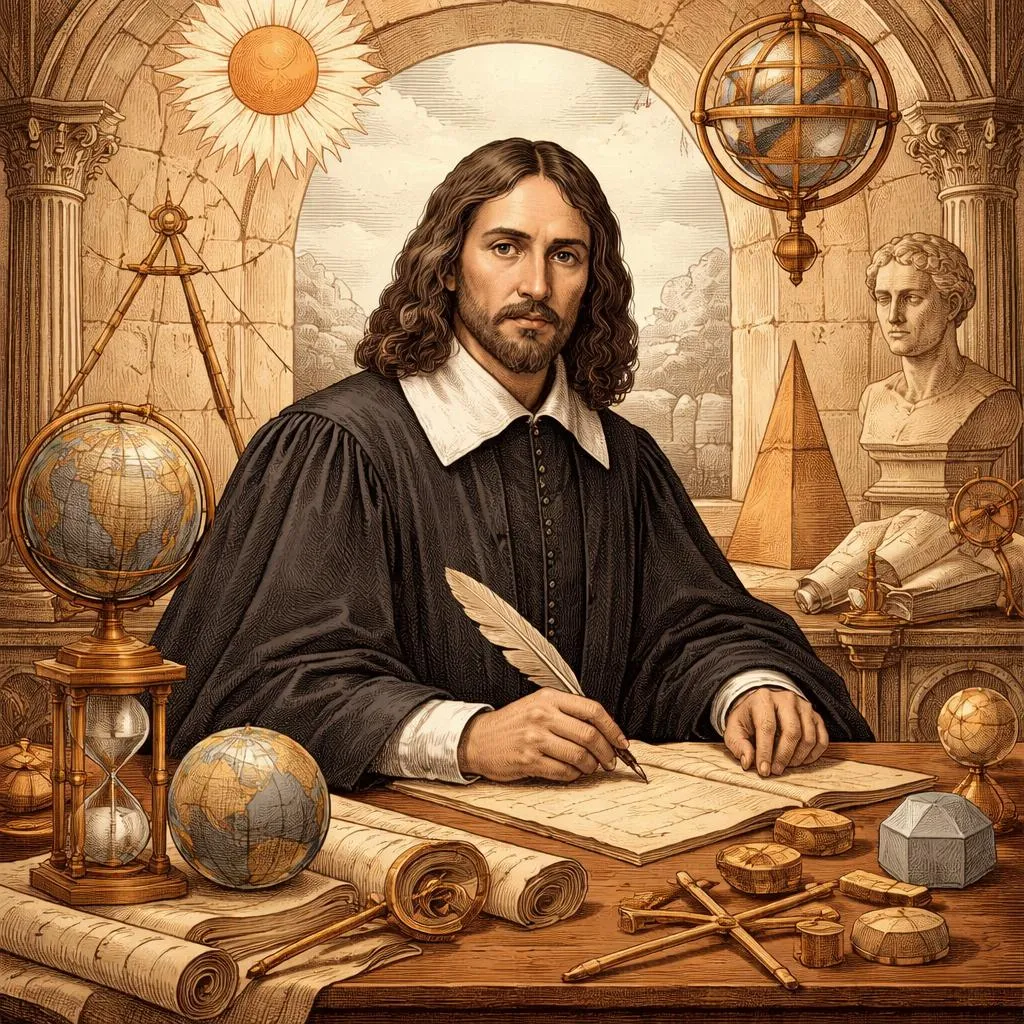

Isaac Barrow was born in London in 1630, and died at Cambridge in 1677. He went to school first at Charterhouse (where he was so troublesome that his father was heard to pray that if it pleased God to take any of his children he could best spare Isaac), and subsequently to Felstead. He completed his education at Trinity College, Cambridge; after taking his degree in 1648, he was elected to a fellowship in 1649; he then resided for a few years in college, but in 1655 he was driven out by the persecution of the Independents. He spent the next four years in the East of Europe, and after many adventures returned to England in 1659. He was ordained the next year, and appointed to the professorship of Greek at Cambridge. In 1662 he was made professor of geometry at Gresham College, and in 1663 was selected as the first occupier of the Lucasian chair at Cambridge. He resigned the latter to his pupil Newton in 1669, whose superior abilities he recognized and frankly acknowledged. For the remainder of his life he devoted himself to the study of divinity. He was appointed master of Trinity College in 1672, and held the post until his death.
He is described as "low in stature, lean, and of a pale complexion," slovenly in his dress, and an inveterate smoker. He was noted for his strength and courage, and once when travelling in the East he saved the ship by his own prowess from capture by pirates. A ready and caustic wit made him a favourite of Charles II., and induced the courtiers to respect even if they did not appreciate him. He wrote with a sustained and somewhat stately eloquence, and with his blameless life and scrupulous conscientiousness was an impressive personage of the time.
His earliest work was a complete edition of the Elements of Euclid, which he issued in Latin in 1655, and in English in 1660; in 1657 he published an edition of the Data. His lectures, delivered in 1664, 1665, and 1666, were published in 1683 under the title Lectiones Mathematicae; these are mostly on the metaphysical basis for mathematical truths. His lectures for 1667 were published in the same year, and suggest the analysis by which Archimedes was led to his chief results. In 1669 he issued his Lectiones Opticae et Geometricae. It is said in the preface that Newton revised and corrected these lectures, adding matter of his own, but it seems probable from Newton's remarks in the fluxional controversy that the additions were confined to the parts which dealt with optics. This, which is his most important work in mathematics, was republished with a few minor alterations in 1674. In 1675 he published an edition with numerous comments of the first four books of the Conics of Apollonius, and of the extant works of Archimedes and Theodosius.
In the optical lectures many problems connected with the reflexion and refraction of light are treated with ingenuity. The geometrical focus of a point seen by reflexion or refraction is defined; and it is explained that the image of an object is the locus of the geometrical foci of every point on it. Barrow also worked out a few of the easier properties of thin lenses, and considerably simplified the Cartesian explanation of the rainbow.
The geometrical lectures contain some new ways of determining the areas and tangents of curves. The most celebrated of these is the method given for the determination of tangents to curves, and this is sufficiently important to require a detailed notice, because it illustrates the way in which Barrow, Hudde and Sluze were working on the lines suggested by Fermat towards the methods of the differential calculus.
Fermat had observed that the tangent at a point P on a curve was determined if one other point besides P on it were known; hence, if the length of the subtangent MT could be found (thus determining the point T), then the line TP would be the required tangent. Now Barrow remarked that if the abscissa and ordinate at a point Q adjacent to P were drawn, he got a small triangle PQR (which he called the differential triangle, because its sides PR and PQ were the differences of the abscissae and ordinates of P and Q), so that
TM : MP = QR : RP.
To find QR : RP he supposed that x, y were the co-ordinates of P, and x - e, y - a those of Q (Barrow actually used p for x and m for y, but I alter these to agree with modern practice). Substituting the co-ordinates of Q in the equation of the curve, and neglecting the squares and higher powers of e and a as compared with their first powers, he obtained e : a. The ratio a/e was subsequently (in accordance with a suggestion made by Sluze) termed the angular coefficient of the tangent at the point. Barrow applied this method to the curves (i) x² (x² + y²) = r²y²;(ii) x³ + y³ = r³; (iii) x³ + y³ = rxy, called la galande; (iv) y = (r - x) tan πx/2r, the quadratrix; and (v) y = r tan πx/2r. It will be sufficient here if I take as an illustration the simpler case of the parabola y² = px. Using the notation given above, we have for the point P, y² = px; and for the point Q, (y - a)² = p(x - e). Subtracting we get 2ay - a² = pe. But, if a be an infinitesimal quantity, a² must be infinitely smaller and therefore may be neglected when compared with the quantities 2ay and pe. Hence 2ay = pe, that is, e : a = 2y : p. Therefore TP : y = e : a = 2y : p. Hence TM = 2y²/p = 2x. This is exactly the procedure of the differential calculus, except that there we have a rule by which we can get the ratio a/e or dy/dx directly without the labour of going through a calculation similar to the above for every separate case.
背景和作者介绍
艾萨克·巴罗是17世纪一位杰出的数学家和神学家。他于1630年出生于伦敦,生活在科学发现和思想变革的伟大时代。巴罗不仅是一位学者,还是一位勇敢的冒险家,以其力量和智慧而闻名。尽管他年轻时有些不羁,但他成为了那个时代最杰出的数学家之一,在剑桥大学担任着享有盛誉的学术职位。巴罗的工作为微积分奠定了重要的基础,而微积分后来由他的著名学生艾萨克·牛顿进一步发展。
巴罗的人生故事教会我们关于毅力、求知欲,以及认识和鼓励他人才能的重要性。他决定辞去享有盛誉的卢卡斯教席让给牛顿,表明了他谦逊的态度和致力于推进知识的决心,超越了个人野心。
详细解释和意义
以上文本描述了巴罗对数学的贡献,尤其是在几何学和光学方面。他研究了涉及光反射和折射的问题,解释了图像如何通过透镜形成——这在今天的物理学和光学中仍然是一个基本主题。他在几何学方面的讲座介绍了寻找曲线切线的新方法,这是微积分中的一个关键概念。
巴罗对切线的处理涉及我们现在所说的“微分三角形”,这是一种巧妙的几何工具,帮助他在微积分正式发展之前近似曲线的斜率。这种方法是通往牛顿和莱布尼茨后来将要形式化的强大技术的一个垫脚石。巴罗对圆锥曲线的研究以及他对阿波罗尼乌斯和阿基米德等古代数学家的评论,也有助于保存和推进古典数学知识。
学生可以学到什么
-
数学的历史背景: 了解巴罗的工作有助于学生欣赏数学思想是如何随着时间的推移而发展的。它表明,微积分这一经常被认为很困难的学科,是由许多思想家一步一步发展起来的,他们建立在彼此的发现之上。
-
跨学科学习: 巴罗将他对数学、神学和哲学的兴趣结合起来,展示了广泛教育的价值以及不同领域之间的相互联系。
-
批判性思维和解决问题: 巴罗分析曲线和光的方法教会学生创造性和逻辑地解决问题,将复杂的想法分解成更简单的部分。
-
谦逊和指导: 巴罗对牛顿卓越才能的认可以及他愿意退位是一个关于谦逊和支持他人成长的重要性的有力教训。
在生活和学习中的应用
-
在学校: 学生可以效仿巴罗的例子,对学习保持好奇心和毅力,尤其是在数学和科学等具有挑战性的科目中。了解概念背后的历史可以使它们变得更有趣,更容易理解。
-
在社交场合: 巴罗的故事鼓励尊重他人的才能和指导的重要性。帮助同学并认识到他们的长处可以建立一个积极的学习社区。
-
在个人成长中: 巴罗的生活表明,早期的错误或困难并不能定义一个人的未来。通过努力和奉献,任何人都可以成就伟业。
如何从巴罗的故事中培养积极的特质
-
好奇心: 像巴罗探索光和曲线的本质一样,永远提出问题并寻求理解事物是如何运作的。
-
勇气: 不要害怕面对挑战或新的体验,就像巴罗在旅行和对抗海盗时所做的那样。
-
谦逊: 认识到别人有更好的想法,并愿意向他们学习。
-
认真: 像巴罗在学术和个人生活中所做的那样,努力保持正直和细致的工作。
反思和欣赏
阅读关于艾萨克·巴罗的故事可以激励学生重视知识和品格。他将智慧和个人勇气融为一体,使他不仅成为有抱负的科学家和数学家的榜样,也成为任何希望成长为有思想、有礼貌和勇敢的人的榜样。通过学习他的生活和工作,年轻的学习者可以看到对学习的奉献和对他人的善良是如何齐头并进,从而对世界产生有意义的影响的。