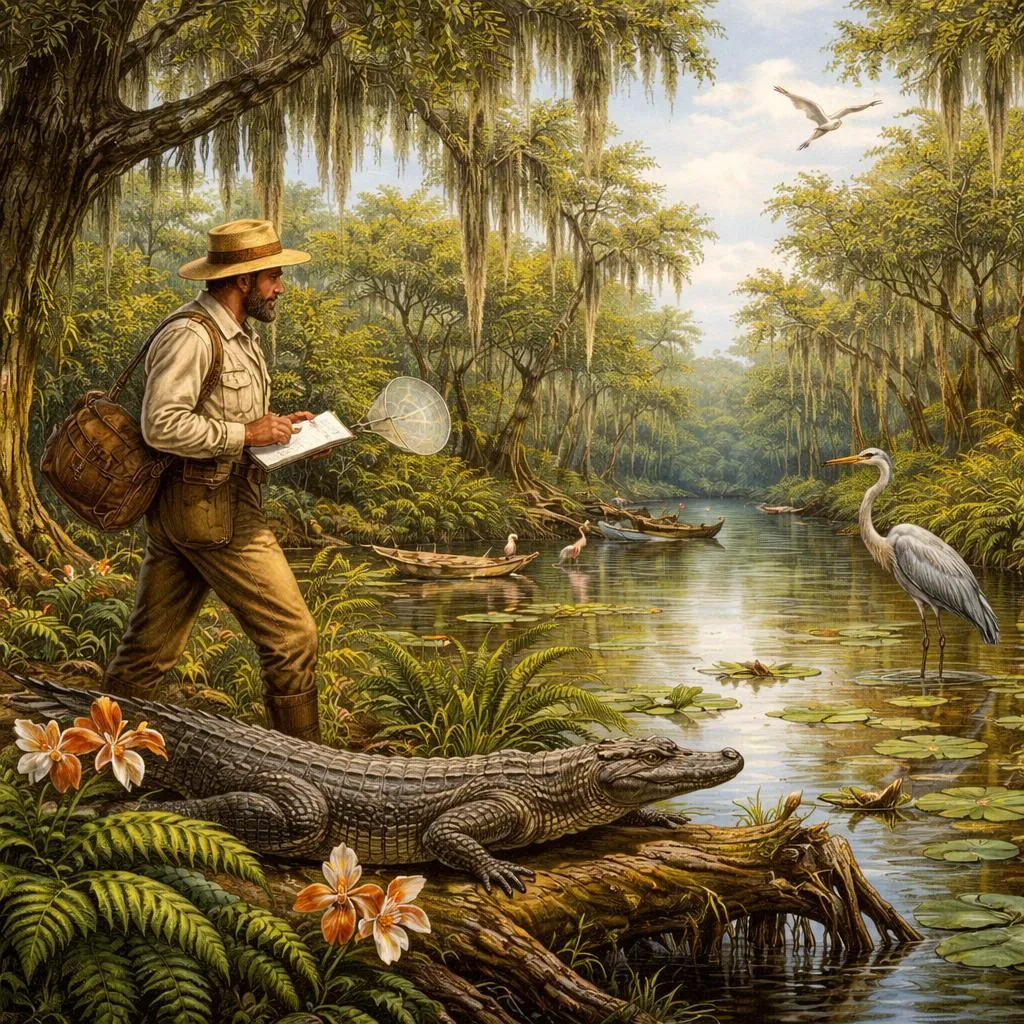

Florida, the "Land of Flowers," the enchanted ground wherein it has been said Ponce de Leon sought for the "fountain of perpetual youth," is not far away; the fountain, quite likely, is as remote as ever, but the land which it was said to bless with its ever flowing and rejuvenating waters, can be reached after a journey of a few days from New York, by steamship if the traveler is not unpleasantly affected by a sea-voyage, or, if the apprehension of "rough weather off Hatteras" should make a different route preferable, then by rail to Charleston, thence by steamer over waters generally smooth to Fernandina, stopping on the way at Savannah just long enough to look about and obtain a general idea of the place.
Fernandina, situated on Amelia Island, is the principal town upon the east coast of Florida, and of importance, being the eastern terminus of a line of railway, which connects the Atlantic Ocean with the Gulf of Mexico. Its population is not far from fifteen hundred. At first sight it is not prepossessing, but a walk about the place reveals many buildings of pleasing architecture hidden among the trees.
Within a small enclosure not far from the landing, "the ...forefather of the hamlet sleeps." Upon a marble stone may be seen the name of
DOMINGO FERNANDEZ, NATIVE OF VIGO IN GALLICIA, SPAIN. BORN THE FOURTH DAY OF AUGUST, 1766. AND DIED THE THIRD DAY OF SEPTEMBER, 1833. IN THE SIXTY-SEVENTH YEAR OF HIS AGE.
Senor Fernandez, it is presumed, never found the fabled fountain, or, drinking of its waters they were powerless to avert the inevitable doom of man. The morning was pleasant; the sun shone brightly; it lighted up the cross and gave roundness to the skull and bones that are carved above his name. From an oak near by the Spanish moss hung drooping midway to the ground, casting a filmy shadow, and hiding a choir of mocking-birds, who filled the air with music.
Leaving the grave of Fernandez and following the streets, a careful search in the loose sand of which they are composed will disclose fragments of pottery of the size of a penny, perhaps a part of the debris of some aboriginal tribe once camped hereabout, the souvenirs of a race, of whose history how little is known! Farther on is an ancient mound of large size, nearly three hundred yards in circumference. Undisturbed ten years ago its surface was as the builders left it, but its slopes and summit were so changed, through the military purposes for which it was used during the recent civil war, that its original proportions are destroyed, and its former outline obliterated.
About a mile from the town towards the ocean is the lighthouse, built upon somewhat elevated ground, forming with the adjacent buildings and moss-festooned oaks, a bit of highly picturesque and pleasing scenery.
Between the lighthouse and the road to the beach, not far distant, is another mound in the centre of an ancient camping ground, the latter covered with bleaching shells, the remnants of unrecorded clambakes and oyster-feasts. This mound is much smaller than the first, only about one hundred yards in circumference and about fifteen feet in height; it was covered with trees and shrubs, the largest of the former being perhaps nine inches in diameter; their roots penetrating the loose material of which the mound is composed, and in their ramifications wound and twisted among the skeletons of unknown men whose decayed bones crumbled at a touch. Stone implements were found, and in the surrounding field fragments of earthenware less perishable than the hands that made them.
From here to the ocean the path lies through a low and, in some places, dense growth of Saw palmetto, interspersed with one or more species of Cactus. The leaf stalks of the former have sharp points along the edges, hence the name; and the prickly Cactaceae may be considered the porcupines and hedgehogs of the vegetable kingdom. Though painful to the touch and dangerous to the apparel they should not be denounced; many of the Cacti, as well as of the Palmaceae, to which family the Saw palmetto belongs, bear delicious fruit, and some species of Cacti are the feeding parks of the insect, from which the celebrated scarlet dyestuff, known as cochineal, is derived.
Without enlarging upon the merits of the Palms and Cacti, which would require a volume, we will consider the species we have encountered as unworthy representatives of noble families, and proceed upon our way.
It is hard work for either man or beast toiling through shifting sands, but pressing on we soon achieve the summit of the mimic mountain range, which the wind and sea always pile up on the landward side of the shore. Descending the slope we are face to face with Old Ocean, whose majesty, whether in storm or calm, is ever impressive; the sea is smooth, the surf beats gently on the beach. We pause a while to admire the glories of sky and water; to ponder upon the mysteries of life and form that dwell within the broad blue bosom of the deep; to peer into the hazy beauty of the atmosphere which hangs like a curtain at the remote horizon, implying hidden and greater beauty beyond; to note the distant sails of coming or departing ships; or watch the gulls riding upon the ripples like tiny shallops at anchor; to recall how in the north the wintry winds nipped us on New Year's day, only a week or two ago, and how bland and genial are the breezes here; to behold at our feet as we follow the more recent drift-rows, the rejected treasures which the sea has cast aside, forms different from any that we have elsewhere found, and each curious in its way.
There are but few sea-weeds (algae) on the beach, and not many species of shells; of some of the species, however, many individuals can be obtained. Here are numerous specimens of the Fan Mussels (Pinna). What is written of the lilies of the field, "they toil not, neither do they spin," does not apply to them; for these submarine weavers spin a byssus, or beard, by which they attach themselves to the bottom of the sea: the byssus serves as a mooring cable, and its fibers are tubular, like human hair. When fresh and flexible, gloves and stockings can be woven from it, and at Tarento it is manufactured into articles of wear "According to Verany the byssus is a successful remedy for the earache, but he does not say in what manner it is applied." Pinna rudis, an English species, is sometimes eaten, and Henry and Arthur Adams also mention that some species are used for food.
A dead fish, half eaten by the birds, is not an attractive object; it is in an unsavory state, but doubtless its scales would, under a microscope, astonish us with many lines of beauty. The butterflies, so unlike the fishes in form and habits, also have minute scales, hence the metallic luster and brilliancy of their coloring; impalpable to the naked eye, their tiny scales resemble the pollen of flowers. Columbus "gave a new world to Castile and Leon;" but think of the world of enchantment, of the precious treasures that the microscope has opened to all.
A thin slice cut from a spine of the Sea-urchin (Echinus) that we have just picked up, if magnified, would furnish a partial insight to the wonders of its plan of structure.
We find the oblong pouch-like egg-cases of a species of Skate (Raia) quite common. The texture and color of these pouches are such, that a person not knowing would sooner suppose that in some way they rather belonged to the sea-weeds, perhaps the pod of a species of Alga, than pertaining to the fishes. If we were strolling along the shores of California or Europe we should meet with the same queer forms. In England the people call them"pixy-purses," "fairy-purses," etc. A species of Dog-fish (Scyllium) makes a similar purse-like egg-case, with long strings at the corners. The Skate-fishes are eaten in England, and appear in the stalls of the Italian fish-market in San Francisco, the Californian species may generally be found, but they are eaten only by the foreign population. The common English Skate sometimes attains the weight of two hundred pounds; it is used by the fishermen for bait.
The skates and dog-fishes are not the only marine animals that make curious egg-cases. We have here three species of univalve shells, called by the Floridians, Conchs (Busycon), which also makes egg-cases. Each case is round and flat, about one-half to three-fourths of an inch in diameter, and one-sixth of an inch in thickness; the edge of each flat case is coarsely ribbed or milled, and numbers of them are strung together, only they are immovable upon the string, which is situated upon one side or edge, instead of being central as in a bead necklace. These egg-chains are sometimes two feet in length, and the cases are frequently bored into by different species of carnivorous mollusks to obtain the contents for food. These Conch animals were probably eaten by the aborigines, as we find the shells quite numerous in their Kjoekkenmoeddings; they are now sometimes eaten by both the whites and negroes of Florida, but from appearances they must be tough chewing, and as indigestible as a rubber boot.
At the edge of the beach, rolling in the surf-ripples, a large fleet of Ark shells is coming ashore; these prettily ribbed bivalves look like the Cockles (Cardium), but the animal and the hinge are quite different. The velvety epidermis which generally covers the surface has been worn off by the friction of sand and water in the surf, exposing the clean white fabric of the shells; lighted by the sun they look like a squadron of little dismasted hulls. Two of the three species that we have here obtained are widely distributed, and may be picked up near Galveston, on the Gulf of Mexico. Some of the family may be found in every sea, and many species are used for food. The animal of Arca grandis, which is found in the Bay of Panama, is eaten by the natives; a single valve of this giant Ark sometimes weighs two and a quarter pounds. Odd valves of the Ark shells are found in the shell heaps, but are not common.
A mile and a half from where the road enters the beach are the remains of two wrecks; the planking of the decks and sides has long ago been broken up and swept away by the sea, and the timbers projecting from the sands resemble the ribs of some gigantic mammal. No vestige of name is left; their wooden skeletons tell of fierce storms, when wind and waves, acting in unison, hurled ships and shells, and sea-weeds, like weightless bubbles, upon the beach. A wreck is a sad sight, but the crevices of an old hulk are a fine field for the naturalist, for many forms of marine life have a home therein. Here we found a tiny species of Mussel (Mytilus cubitus), and a new species of Siphonaria, a univalve shell shaped like a small shield, with elevated lines or ribs radiating from centre to circumference.
Without farther enumerating or explaining the prizes that are ours through the bounty of old ocean, we must retrace our steps towards the road, for the sun has so nearly set that its level rays are shining in our eyes. With baskets and pockets packed and full we jog along, stopping occasionally to pick up a fine specimen of a white bivalve shell, Dosinia discus, which is very abundant, thanks to a storm which threw them high and dry above the reach of ordinary tides. The Fish-crows (Corvus ossifragus) and a large species of Blackbird (Quiscalus baritus) are running over the wet sands, stooping sometimes to pick up some tit-bit for their suppers. Bidding them good-bye, we hurry on, and after a weary walk of what seemed many miles, made longer by the toilsome tug through sand and chapparal, we reach our haven; tired as dogs (at times are said to be) we gladly cast aside our packs, and after a refreshing wash, rush to supper with appetites as keen as hungry wolves!
The evenings here are chilly, and a fire of the Pitch-pine wood (Pinus palustris Linn.) is pleasant, aside from the warmth, for its bright flames fill the room with a cheerful light...How glorious is sleep after a day of toil; of toil, yet still of pleasure. How gently it descends upon us, how quietly we yield to its embrace; it touches the drowsy eye, and we feel that
"The day is done, and the darkness Falls from the wing of night."
背景介绍和作者介绍
这篇生动的叙述提供了对佛罗里达东海岸的丰富描述性之旅,特别关注了费尔南迪纳及其周边地区。 这篇文章可能源于 19 世纪的游记或博物学家的记述,反映了那个时代对探索、自然和未知的迷恋。 这样的作品通常由探险家、博物学家或历史学家撰写,他们试图记录新探索或鲜为人知地区的地理、历史和自然奇观。 作者对植物、动物和当地历史的详细观察,揭示了对自然的深刻欣赏,以及与远方读者分享这个“鲜花之地”的美丽和神秘的愿望。
详细解读和意义
这个故事不仅仅是一本日记,更是对发现和自然世界的庆祝。 作者邀请读者想象从纽约到佛罗里达的旅程,唤起探索的兴奋和对诸如庞塞·德·莱昂寻找“青春之泉”等神话的吸引力。 通过对古老土堆、本土文物和自然环境的描述,本文将过去与现在联系起来,提醒我们景观之下的历史层。
叙述还突出了自然与人类活动之间的微妙平衡。 提到军事用途改变了古老的土堆、沉船的遗骸以及多样化的海洋生物,都说明了人类的存在如何与环境相互作用并影响环境。 作者对小细节的迷恋——海螺壳、鱼卵囊,甚至微观结构——鼓励读者欣赏经常被忽视的生命形式的复杂性和美丽。
给学生的经验教训和见解
-
好奇心和探索: 本文激发了好奇心和冒险精神。 学生可以学习探索新地方、提问和仔细观察世界的价值。 这种心态不仅在地理和科学中至关重要,而且在日常学习和解决问题中也至关重要。
-
对自然的尊重: 对植物、动物和自然现象的详细描述鼓励对环境的尊重和关爱。 了解生态系统和生命的相互联系有助于学生认识到保护的重要性。
-
历史意识: 提到土著人民、古老的土堆和多明戈·费尔南德斯等历史人物,为历史和文化遗产打开了一扇窗户。 学生可以学习重视和保护历史,认识到过去如何塑造现在。
-
科学观察: 作者对细节的关注,为科学观察技能树立了榜样。 学生可以练习仔细观察周围环境、注意模式并得出结论——这些技能在科学、艺术和批判性思维中都很有价值。
在日常生活和学习中的应用
-
在学校: 学生可以通过积极参与学习、提问和寻求深入理解主题而不是肤浅地理解主题来运用探索精神。 受此文本启发,可以进行关于当地动植物的科学项目,或关于土著文化的历史作业。
-
在社交场合: 故事中对历史和自然的重视可以转化为对他人背景和经历的尊重。 了解不同的文化和环境可以培养同情心和开放的心态。
-
个人成长: 叙述中对穿越困难地形的毅力以及辛勤工作后休息的喜悦的描绘,教会了韧性以及平衡努力与自我关怀的重要性。
从故事中培养积极的价值观
-
对自然的欣赏: 鼓励学生花时间在户外,观察动植物,并反思他们在环境中的作用。 这培养了环境管理。
-
好奇心和终身学习: 培养广泛阅读、探索新主题和将挑战视为成长机会的习惯。
-
对历史和文化的尊重: 让学生参与探索当地历史或文化传统的项目,培养自豪感和理解。
-
正念和反思: 海边描述的平静时刻和夜晚的宁静表明了正念的价值——花时间欣赏当下,并在生活的忙碌中找到平静。
通过学习这篇叙述,学生不仅可以获得关于特定地点及其自然历史的知识,还可以培养丰富他们的教育和个人生活的态度和技能。 故事中冒险、科学、历史和诗歌的融合使其成为永恒的灵感和学习的源泉。