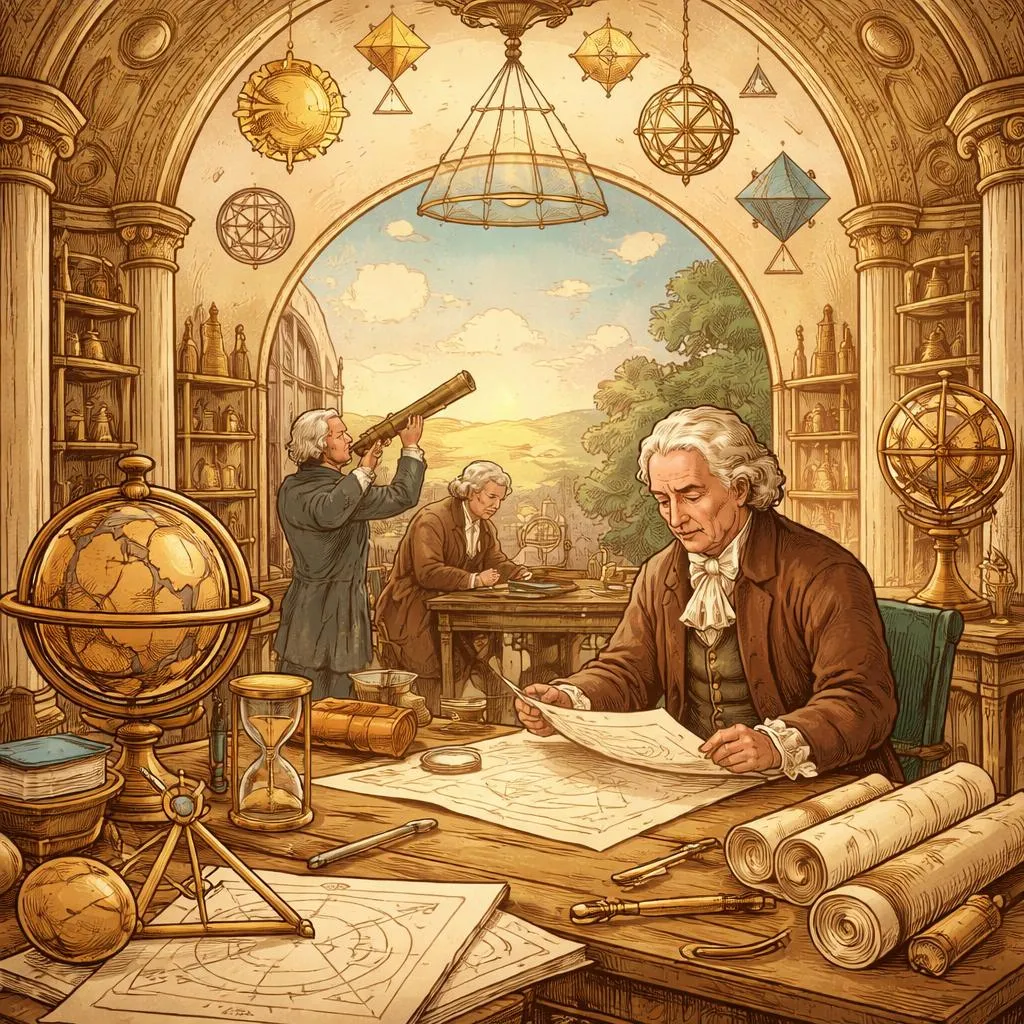

The last member of the English school whom I need mention here is Thomas Simpson, who was born in Leicestershire on August 20, 1710, and died on May 14, 1761. His father was a weaver and he owed his education to his own efforts. His mathematical interests were first aroused by the solar eclipse which took place in 1724, and with the aid of a fortune-telling pedlar he mastered Cocker's Arithmetic and the elements of algebra. He then gave up his weaving and became an usher at a school, and by constant and laborious efforts improved his mathematical education, so that by 1735 he was able to solve several questions which had been recently proposed and which involved the infinitesimal calculus. He next moved to London, and in 1743 was appointed professor of mathematics at Woolwich, a post which he continued to occupy till his death.
The works published by Simpson prove him to have been a man of extraordinary natural genius and extreme industry. The most important of them are his Fluxions , 1737 and 1750, with numerous applications to physics and astronomy; his Laws of Chance and his Essays , 1740; his theory of Annuities and Reversions (a branch of mathematics that is due to James Dodson, died in 1757, who was a master at Christ's Hospital, London), with tables of the value of lives, 1742; his Dissertations , 1743, in which the figure of the earth, the force of attraction at the surface of a nearly spherical body, the theory of the tides, and the law of astronomical refraction are discussed; his Algebra , 1745; his Geometry , 1747; his Trigonometry , 1748, in which he introduced the current abbreviations for the trigonometrical functions; his Select Exercises , 1752, containing the solutions of numerous problems and a theory of gunnery; and lastly, his Miscellaneous Tracts , 1754.
The work last mentioned consists of eight memoirs, and these contain his best known investigations. The first three papers are on various problems in astronomy; the fourth is on the theory of mean observations; the fifth and sixth on problems in fluxions and algebra; the seventh contains a general solution of the isoperimetrical problem; the eighth contains a discussion of the third and ninth sections of the Principia , and their application to the lunar orbit. In this last memoir Simpson obtained a differential equation for the motion of the apse of the lunar orbit similar to that arrived at by Clairaut, but instead of solving it by successive approximations, he deduced a general solution by indeterminate coefficients. The result agrees with that given by Clairaut. Simpson solved this problem in 1747, two years later than the publication of Clairaut's memoir, but the solution was discovered independently of Clairaut's researches, of which Simpson first heard in 1748.
背景介绍和作者介绍
托马斯·辛普森是一位杰出的数学家,出生于18世纪初的英格兰莱斯特郡。尽管他出身卑微——他的父亲是一名织工——但辛普森对学习和数学的热情,源于1724年目睹的一次日食。这次事件激发了他的好奇心,促使他独立学习算术和代数,甚至在一位算命先生的帮助下。他的决心非常坚定,以至于他放弃了织布,成为一名教师,并继续严格地自学。最终,他成为了伍利奇的数学教授,在那里工作直到1761年去世。
辛普森的故事鼓舞人心,因为它表明自我激励和努力工作可以克服障碍,例如有限的正规教育和社会地位。他对数学的贡献,尤其是在微积分、概率和天文学方面,具有开创性和影响力。
辛普森作品的详细分析和意义
辛普森的出版作品涵盖了广泛的数学领域。他关于流数(微积分的早期术语)的著作展示了在物理学和天文学中的实际应用,有助于弥合理论数学与现实世界现象之间的差距。他对机会法则的研究为概率论奠定了重要的基础,这在从统计学到经济学的各个领域都至关重要。
他的一项显著成就,是他对年金和逆转的研究,这涉及计算预期寿命的价值——这个概念在今天的保险和金融领域仍然很重要。他的论文探讨了复杂的主题,如地球的形状、潮汐力以及天文学中的光线弯曲,显示了他广泛的科学兴趣。
辛普森还对代数、几何和三角学做出了贡献,引入了至今仍在使用的三角函数的缩写。他的解决问题的能力延伸到炮术,他运用数学来提高火炮的准确性,展示了他的研究的实际影响。
他的最后一批回忆录包括对天文学和微积分问题的深入讨论,例如月球轨道的运动,他使用创新方法独立解决了这些问题。这突出了他的独创性和对数学原理的深刻理解。
给学生的启示和灵感
-
自学的重要性: 辛普森的一生告诉学生,好奇心和毅力可以带来伟大的成就,即使没有获得特权教育的机会。这鼓励年轻的学习者在学习中主动,并且永远不要因为他们的背景而气馁。
-
跨学科学习: 辛普森的作品展示了数学如何与物理学、天文学、金融学甚至军事科学联系起来。学生可以学习跨不同领域应用知识以解决复杂问题的重要性。
-
解决问题的能力: 他致力于解决困难的数学问题,激励学生培养批判性思维和毅力。这些技能不仅在学术上,而且在日常生活中都很有价值。
-
创新和独创性: 辛普森独立发现解决方案,这表明创造力和独创性在科学进步中的重要性。应该鼓励学生探索他们的想法,并超越标准方法进行思考。
在生活和学习中的实际应用
- 在学校: 学生可以利用辛普森的例子,在他们觉得困难的科目中保持动力,理解掌握来自于持续的努力和实践。
- 在社交场合: 这个故事鼓励谦逊和尊重他人的才能和背景,因为伟大可以来自意想不到的地方。
- 在未来的职业生涯中: 学习连接不同的学科并实际应用知识,为学生准备了多样化的职业道路,尤其是在 STEM 领域。
- 在个人成长中: 辛普森的一生体现了终身学习和韧性,这些品质有助于个人适应并成功地适应快速变化的世界。
从辛普森的故事中培养积极的特质
为了体现托马斯·辛普森的精神,学生可以:
- 设定个人学习目标,并稳步朝着目标努力。
- 将挑战视为成长的机会,而不是障碍。
- 通过书籍、实验和好奇心驱动的项目,在课堂之外寻求知识。
- 与同伴合作,分享想法并共同解决问题。
- 反思他们的进步,并庆祝小的成功以建立信心。
通过研究辛普森的旅程和贡献,学生不仅可以获得关于数学和科学的知识,还可以培养一种重视努力工作、创造力和毅力的心态——这些品质将在他们的生活中为他们提供良好的服务。