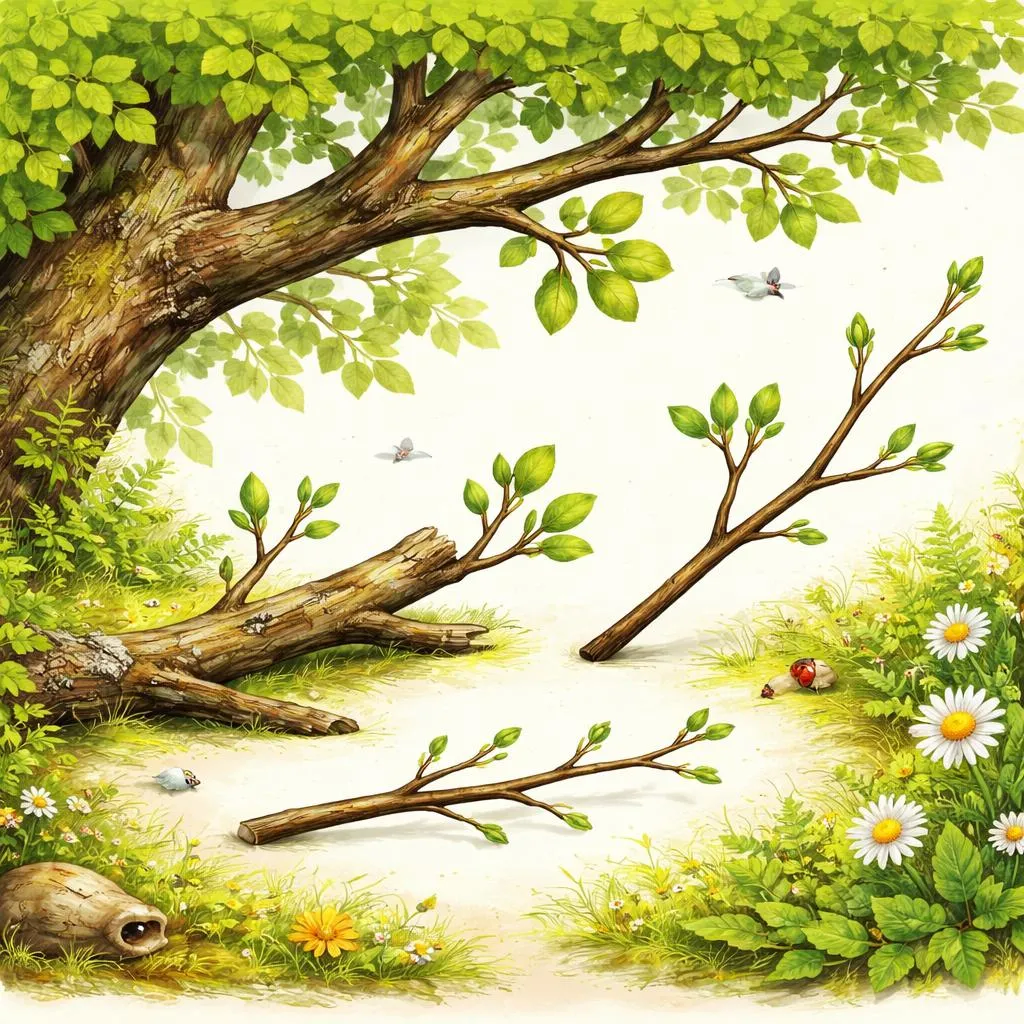

Hello, tree explorer! You look at a big, strong branch. You look at a small, thin twig. Both grow from a tree. But are they the same thing? They are two different parts of a tree. One is like a strong, thick arm. One is like a thin, little finger. Let's discover their secret! Today, we explore the word pair "branch" and "twig". Knowing the difference makes you a word expert. Let's begin.
First, let's be Language Listeners. Listen at home. Here are two sentences. "The swing hangs from a thick branch." "I found a small twig for my art project." Both talk about tree parts. A thick branch for a swing. A small twig for art. Do they sound the same? One sounds big and strong. One sounds small and thin. Can you sense the difference? Great listening! Now, let's explore.
Adventure! Into the World of Tree Parts
Welcome to understanding trees. A "branch" and a "twig" are both parts of a tree. But their size and feel are different. Think of a "branch" as a strong, thick arm. It is a large, woody part growing from the trunk. It is big and solid. Think of a "twig" as a thin, little finger. It is a very small, thin branch. It is easy to snap. Both are woody parts. But one is the "strong arm". One is the "little finger". Let's learn about each one.
A Strong Arm vs. A Little Finger Think about the word "branch". A "branch" is a large, main arm of a tree. Squirrels run along the branch. Now, think about "twig". A "twig" is a very small, thin branch. Birds use twigs for nests. The big branch held the treehouse. A small twig snapped in my hand. "Branch" is the strong arm. "Twig" is the little finger.
Big and Strong vs. Small and Thin Let's compare their size and strength. A "branch" is thick and strong. You can sit on a big branch. You can hang a swing from it. A "twig" is thin and weak. You can easily break a twig. A nest is made of many twigs. One is for holding weight. One is for small details.
Their Special Word Partners and Common Uses Words have best friends. "Branch" often partners with words for big, strong things. Tree branch. Main branch. Broken branch. Branch out. "Twig" often partners with words for small, thin things. Small twig. Snap a twig. Bundle of twigs. Dry twig. Note: "Branch" is for the large, main parts. "Twig" is for the smallest, thinnest parts. You can climb a branch. You can collect twigs.
Let's visit a school scene. In science, we drew the main branches of a tree. This is about the big, structural parts. For craft, we collected dry twigs and leaves. The word "branch" fits the big, main parts we draw. The word "twig" fits the small, collected pieces for craft. One is for structure. One is for material.
Now, let's go to the playground. We hung our bags on a low branch. This describes a thick, strong part that can hold weight. I used a straight twig to draw in the sand. The word "branch" fits the sturdy part that holds bags. The word "twig" fits the thin, small tool for drawing. One is a support. One is a tool.
Our Little Discovery So, what did we find? A "branch" and a "twig" are both woody parts of a tree. But a "branch" is big, thick, and strong. It is like a main arm of the tree. A "twig" is a very small, thin branch. It is like a little finger. The bird sat on a high branch. The nest had many small twigs. A twig grows from a branch. "Branch" is the strong arm. "Twig" is the little finger.
Challenge! Become a Word Champion
Ready for a nature test? Let's try your new skills!
"The Best Choice" Challenge Let's imagine a natural scene. The owl slept on a thick, high branch. This describes a large, sturdy part that can hold a heavy bird. The mouse carried a thin twig to its home. The word "branch" is the champion for the thick, high perch for an owl. The word "twig" is the best choice for the thin, light piece a mouse can carry. One is a sturdy perch. One is a light material.
"My Sentence Show" Your turn to create! Here is your scene: Walking in the woods. Can you make two sentences? Use "branch" in one. Use "twig" in one. Try it! Here is an example: "A big branch fell in the storm." This describes a large, heavy part that fell. "I made a tiny cross from a twig." This describes a very small, thin piece used for craft. Your sentences will show a heavy part versus a thin piece!
"Eagle Eyes" Search Look at this sentence. Can you find the word that could be better? Let's check a home context. "Be careful of that low twig above your head; you might bump it." Hmm. If it is low and you might bump your head, it is probably bigger and thicker. A "twig" is very small and thin. A better word is "branch". A better sentence is: "Be careful of that low branch above your head; you might bump it." Using "branch" correctly describes a larger, more solid piece to avoid. "Twig" is for very small pieces. Did you spot it? Super thinking!
Harvest and Action! Turn Knowledge Into Your Superpower
Great exploring! We started thinking "branch" and "twig" were just sticks on a tree. Now we know they are different in size and strength. A "branch" is a big, thick, strong arm of a tree. A "twig" is a very small, thin branch, easy to snap. You can now talk about tree parts with perfect clarity.
What you can learn from this article: You can now see that a "branch" is a large, thick, and strong part of a tree. It grows directly from the trunk or other branches. You can now understand that a "twig" is a very small, thin branch. It is easy to break and often at the very end of a branch. You know that a treehouse needs a strong branch. A bird's nest uses many small twigs. You learned to match the word to the size: "branch" for the strong, thick arm; "twig" for the thin, little finger.
Life practice application: Try your new skill today! Be a tree detective. Look at any tree or bush. Can you see a thick, strong part growing from the trunk? That is a branch. Can you see the very thin, small pieces at the ends, easy to snap? Those are twigs. Remember, branch is for the big, strong parts, twig is for the smallest, thinnest parts. Use "branch" when you talk about climbing or hanging something. Use "twig" when you talk about collecting or snapping something small. You will describe the wonderful world of trees like a real explorer!