
Opening Introduction
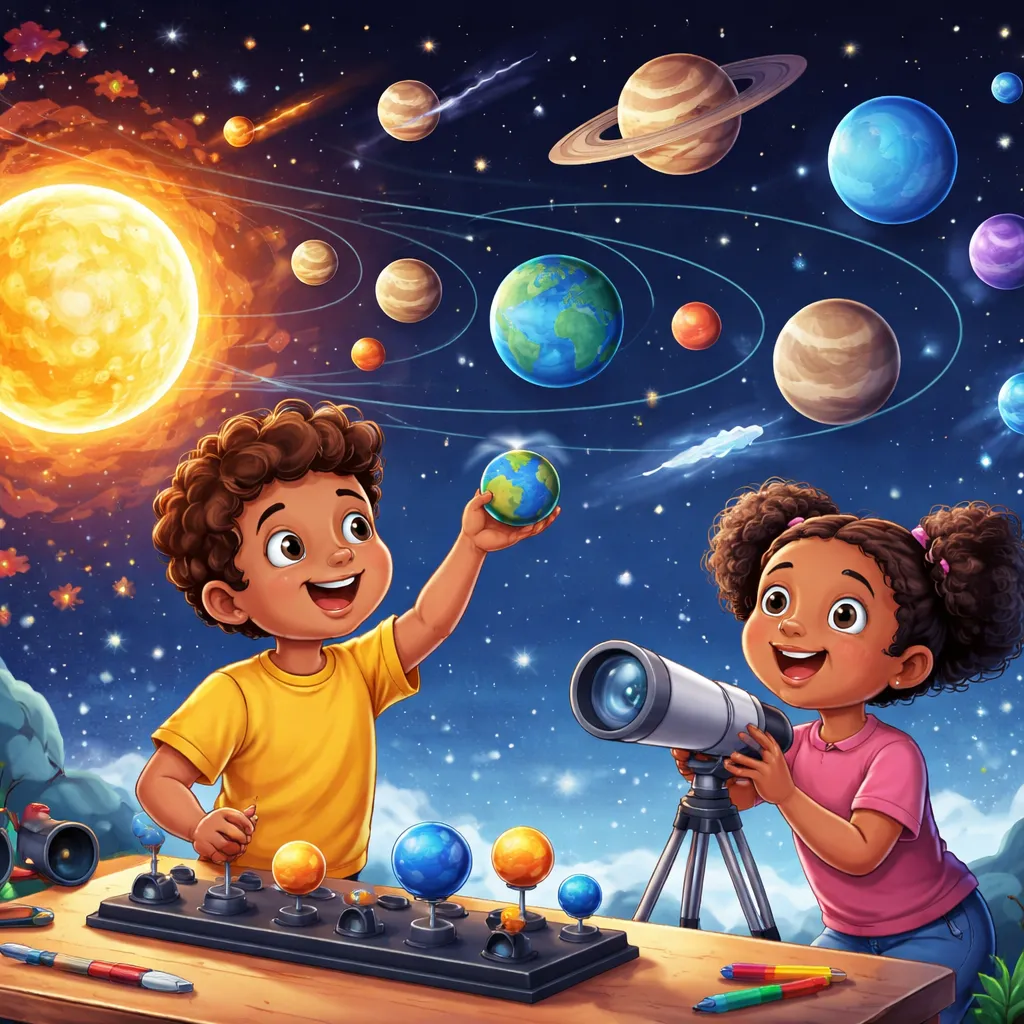
Leo loves clear nights. He looks up at the sky. He sees many tiny, shiny dots. "Are those all stars?" he asks his dad. "Most of them are stars," says Dad. "But some are not stars. Some are planets. They are part of our solar system. They circle our sun, just like Earth does." Leo's eyes get wide. "How many are there? What are their names?" Dad smiles. "Let's take a journey. Let's learn the solar system planets order and names. It is like learning the names of the houses on our street, but in space!" Leo is ready for this space adventure. Let's blast off together.
Core Knowledge Explanation
What is a solar system? A solar system is a sun and all the things that go around it. Our solar system has one sun, eight planets, and many moons, asteroids, and comets. Today, we are learning about the eight planets. They travel around the sun in paths called orbits. The order never changes. To remember the solar system planets order and names, we start with the planet closest to the sun and go out.
The first planet is Mercury. Mercury is the smallest planet. It is very close to the sun. It is very hot during the day and very cold at night. The second planet is Venus. Venus is very bright. We sometimes call it the "Evening Star." It is covered in thick clouds. It is the hottest planet. The third planet is Earth. That is our home! Earth has water and air. It is just right for life. The fourth planet is Mars. Mars is called the "Red Planet." It has red rocks and dust. Scientists look for signs of water there.
Now we go past a ring of asteroids. These are rocky objects. After the asteroids, we find the giant planets. The fifth planet is Jupiter. Jupiter is the biggest planet. It has a big red spot. That spot is a giant storm. The sixth planet is Saturn. Saturn is famous for its beautiful rings. The rings are made of ice and rock. The seventh planet is Uranus. Uranus spins on its side. It looks like a blue-green marble. The eighth planet is Neptune. Neptune is very windy and very cold. It is blue and far, far away.
So, the solar system planets order and names are: Mercury, Venus, Earth, Mars, Jupiter, Saturn, Uranus, Neptune. A fun way to remember is a silly sentence. The first letter of each word matches the planet: My Very Educated Mother Just Served Us Noodles. M for Mercury, V for Venus, E for Earth, M for Mars, J for Jupiter, S for Saturn, U for Uranus, N for Neptune. Try making your own silly sentence. Learning the solar system planets order and names helps us understand our place in the huge, amazing universe.
Fun Interactive Learning
Let's play a game to remember the order. It is called "Planet Hop." Get eight pieces of paper. Write one planet name on each paper. Lay them on the floor in a line, in the correct order. Start at the sun (you can use a yellow ball or a lamp). Now, hop from one planet to the next. Say the name as you land on it. "Mercury! Venus! Earth! Mars!" Jump over the asteroid belt. Then, "Jupiter! Saturn! Uranus! Neptune!" This uses your body to learn. It is a fun way to practice the solar system planets order and names.
Another game is "Planet Pictionary." Get a friend or family member. Whisper a planet name to them. They must draw it without using letters. Can you guess which planet it is? Is it the one with rings? Saturn! Is it the red one? Mars! This game makes you think about each planet's special feature. You can also create a "Planet Song." Use a simple tune like "Twinkle, Twinkle, Little Star." Make up lyrics: "Mercury, Venus, Earth, and Mars, spinning round the sun. Jupiter, Saturn, Uranus, Neptune, our solar system's done!" Sing it loud. Music helps memory. These activities make learning the solar system planets order and names an active, joyful experience.
Expanded Learning
The names of the planets are very old. They come from Roman mythology. Mercury was the messenger god. Venus was the goddess of love. Mars was the god of war. Jupiter was the king of the gods. Saturn was Jupiter's father. Uranus was the god of the sky. Neptune was the god of the sea. Even the word "planet" comes from a Greek word meaning "wanderer." Long ago, people saw these bright objects "wander" across the sky, unlike the fixed stars.
Did you know scientists are still discovering things? They have found new objects in our solar system, like dwarf planets. Pluto used to be called the ninth planet. Now, scientists call it a dwarf planet. It is in an area beyond Neptune called the Kuiper Belt. The study of the solar system planets order and names is always growing. Maybe you will be a scientist who discovers something new one day. In other countries, the planets have different names in other languages. But the English names are used by scientists all over the world. This makes English a language of space discovery.
Let's make a chant to help us remember. Chants have a strong beat.
Sun is in the middle, shining bright and hot! Mercury, Venus, Earth, and Mars, in the inner spot! Asteroids are in a belt, a rocky zone! Jupiter, Saturn, Uranus, Neptune, on their own! Eight planets in a row, around the sun they go!
What You Will Learn
You are learning about astronomy and space science. You are learning the eight solar system planets order and names: Mercury, Venus, Earth, Mars, Jupiter, Saturn, Uranus, Neptune. You are also learning new words: solar system, orbit, asteroid, mythology, dwarf planet, universe.
You are learning descriptive and comparative sentences. You can say, "Jupiter is the largest planet." You can explain, "Saturn has rings made of ice." You can describe order: "Earth is the third planet from the sun." You are using English to explain scientific facts. This builds a strong academic vocabulary.
You are building fantastic skills. You are building memory skills. You remember a sequence of names. You are building observation skills. You link names to features. You are building curiosity about science and the world beyond Earth. You are building pronunciation skills. You practice saying names like "Uranus" correctly. You are building confidence. You can talk about space knowledgeably.
You are forming an inquisitive habit. The habit of looking up and wondering. You see that English is a key to understanding the world and the cosmos. Learning the solar system planets order and names teaches you that with a little effort, you can grasp big, wonderful ideas and share them with others.
Using What You Learned in Life
Use your new knowledge. On a clear night, try to find a planet. Venus is often very bright near the sunset or sunrise. Jupiter is also very bright. You can say, "Look, I think that's Jupiter!" When you visit a science museum, look for the planet models. Read the signs in English. When you draw, draw the solar system. Label the planets. Make a mobile with the planets in order.
At school, share the silly sentence with your friends. Teach them the order. You can be the class space expert. When you read a book or watch a show about space, you will understand more. The knowledge of the solar system planets order and names makes you a citizen of the universe. It connects you to explorers and scientists of the past, present, and future.
Closing Encouragement
You are a space explorer. You are a knowledge collector. You are a curious and bright learner. I am so proud of you. Learning the order and names of the planets shows you have a mind that loves to explore big ideas.
Keep looking at the stars. Keep wondering. Keep learning. Remember, you live on a beautiful planet called Earth, in an amazing solar system with seven fascinating neighbors. You are connected to something vast and wonderful.
You are smart, you are capable, and you have just learned something out of this world. Great work, my fantastic space cadet.