
Opening Introduction
Mia came home from school. She threw her backpack on the floor. She crossed her arms and frowned. Her dad asked, "How was your day?" Mia just mumbled, "Fine." But her face said something else. Her dad gently said, "Sometimes, it's hard to find the right word for a feeling. It's like having a big box of crayons but only using red and blue. What if we had more colors? What if we had a map for feelings? Let's look at an emotions wheel and feeling words list. It's a tool that helps us find the exact word for our heart. Then we can talk about it." Mia was curious. A map for her feelings? She wanted to see it. Let's explore this colorful map of emotions together.
Core Knowledge Explanation
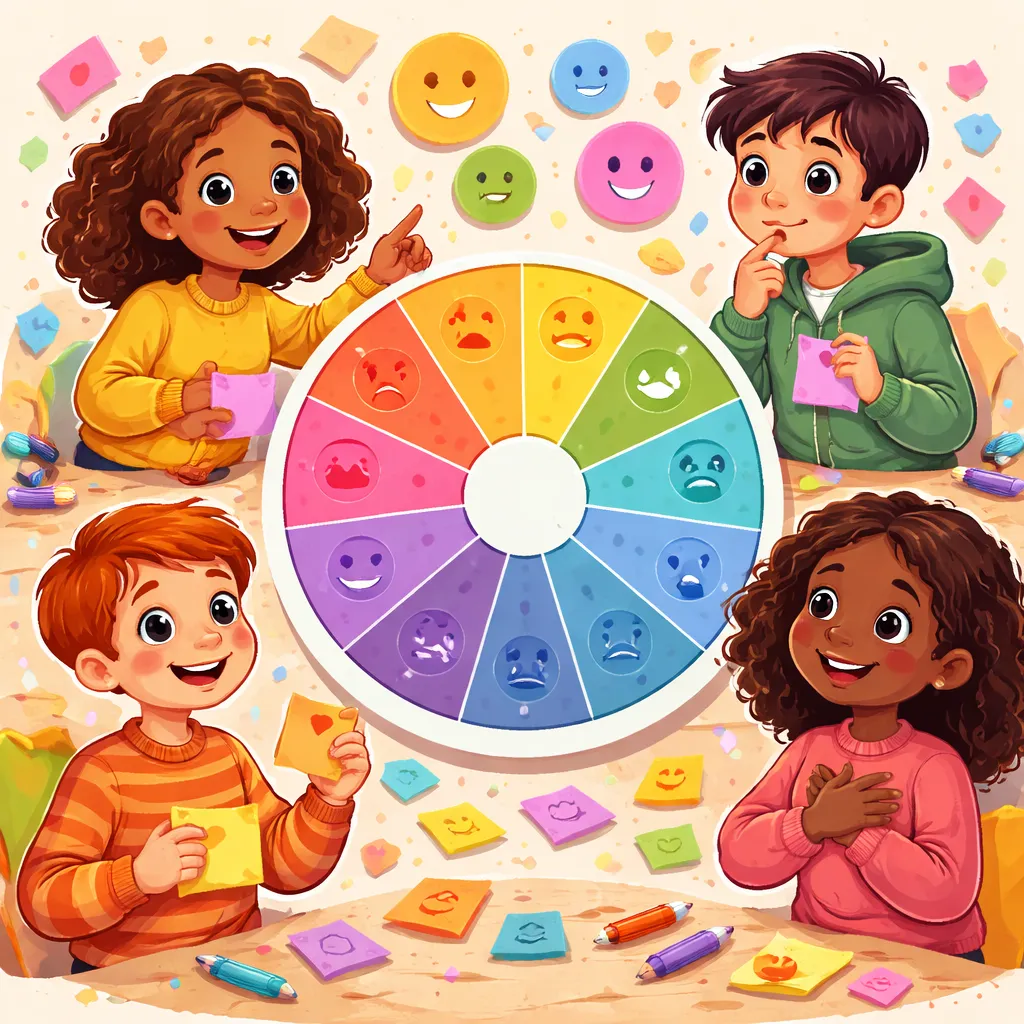
Feelings, or emotions, are what we feel inside. Happy, sad, angry, scared. But our hearts are more colorful than just four words. Sometimes we feel more than one thing. Sometimes we feel something in between. An emotions wheel is a circle that shows many feelings. In the center, there are a few basic emotions. Then, like the petals of a flower, more specific feelings branch out. Learning to use an emotions wheel and feeling words list helps us understand ourselves and others better. It gives us a bigger vocabulary for our hearts.
Let's build a simple emotions wheel. In the very center, we often put four or six basic feelings. Let's use six: Happy, Sad, Angry, Scared, Surprised, and Disgusted. These are like the primary colors of feelings. Now, let's add more words around each one. Around "Happy," we can put: Joyful, Excited, Proud, Peaceful, Hopeful, Grateful. These are all types of happy. If you win a game, you might feel "proud." If you are waiting for a fun trip, you might feel "excited."
Around "Sad," we can put: Lonely, Disappointed, Hurt, Tired, Bored. If your friend can't play, you might feel "disappointed." If you miss someone, you might feel "lonely." Around "Angry," we can put: Frustrated, Annoyed, Jealous, Grumpy. If your puzzle piece won't fit, you might feel "frustrated." If your brother takes your toy, you might feel "jealous."
Around "Scared," we can put: Anxious, Nervous, Worried, Insecure. If you have a test, you might feel "nervous." If you hear a loud noise at night, you might feel "scared." Around "Surprised," we can put: Shocked, Amazed, Confused. A great gift might make you feel "amazed." A tricky riddle might make you feel "confused." Around "Disgusted," we can put: Dislike, Disturbed. Eating a food you hate might make you feel "disgusted."
This is a simple emotions wheel and feeling words list. The wheel shows that feelings are connected. You can start in the center and move out to find a word that fits just right. The more words you know, the better you can describe the weather inside your heart. It is a superpower for your feelings.
Fun Interactive Learning
Let's make our own emotions wheel! This is a fun art project. Draw a big circle on a piece of paper. Divide it into six sections, like a pizza. In each section, write one core emotion: Happy, Sad, Angry, Scared, Surprised, Disgusted. Color each section a different color. Happy can be yellow. Sad can be blue. Now, around each section, draw smaller circles or write words for the related feelings. For "Happy," draw a smiling sun and write "joyful." For "Sad," draw a cloud and write "lonely." Decorate your wheel. This is your personal emotions wheel and feeling words list. Hang it in your room. Point to it when you have a feeling.
Another activity is "Feeling Charades." Write different feeling words from your list on cards: Excited, Frustrated, Nervous, Proud, Disappointed. Put them in a bowl. One player picks a card and acts out the feeling without words. The others guess. Are you jumping up and down? You must be "excited!" Are you stomping your foot? You might be "frustrated!" This game helps connect the word to the face and body language.
You can also play "How Would You Feel?" Make up short stories. "You practiced for weeks for the school play. On the day, you do a great job and everyone claps. How do you feel?" The answer could be "proud" or "joyful." "You built a tall tower of blocks, and then someone bumped the table and it fell. How do you feel?" The answer could be "disappointed" or "frustrated." This helps you practice the new words in situations.
Expanded Learning
All people, everywhere in the world, have feelings. The emotions wheel and feeling words list is a tool used in many languages. In Spanish, "happy" is "feliz." In French, "sad" is "triste." The feelings are the same, but the words are different. Some cultures have words for feelings that don't have a direct English word. This shows that feelings are universal, but we can always learn new ways to talk about them.
Long ago, people thought about feelings too. The ancient Greeks talked about emotions. Today, scientists study the brain to see how we feel. They know that naming our feelings, using a list like this, can actually help calm the brain. It is called emotional literacy. Just like reading words helps you understand a book, reading your feelings helps you understand yourself. Let's make a feeling words chant. Chants are fun and help us remember.
Happy, joyful, proud, and glad, these are feelings, not too bad! Sad and lonely, hurt and blue, it's okay to feel them too! Angry, frustrated, grumpy, cross, sometimes we feel a little lost! Scared and nervous, worried, shy, it's okay to ask the reason why! Surprised, amazed, and confused, feelings can be lightly used! Knowing words for how we feel, helps our hearts to gently heal!
What You Will Learn
You are learning about emotional intelligence, vocabulary, and self-awareness. You are learning to use an emotions wheel and feeling words list that includes core emotions (Happy, Sad, Angry, Scared, Surprised, Disgusted) and more specific words (Joyful, Proud, Lonely, Disappointed, Frustrated, Jealous, Nervous, Anxious, Amazed, Confused). You are also learning what an emotions wheel is and why it is useful.
You are learning precise and expressive sentences. You can say, "I'm not just sad, I feel disappointed." You can explain, "My feeling is closer to frustrated than angry." You can ask, "Are you feeling nervous or excited?" You are using English to communicate subtle and important information about your inner state. This is a key life skill.
You are building essential emotional and social skills. You are building emotional vocabulary. You have more words for your feelings. You are building self-awareness. You understand your own emotions better. You are building empathy. You can better guess how others feel. You are building communication skills. You can explain your feelings clearly. You are building self-regulation. Naming a feeling is the first step to managing it.
You are forming a reflective and articulate habit. The habit of checking in with your heart and finding the right word. You learn that all feelings are okay, and having the right word for them is powerful. Learning to use an emotions wheel and feeling words list gives you a lifelong tool for understanding yourself and connecting with others.
Using What You Learned in Life
Use your emotions wheel every day. In the morning, point to how you feel. "I feel hopeful about today." After school, check in. "I feel tired and a little grumpy." When you are upset, look at the wheel. Try to find the exact word. Then tell someone. "Mom, I feel frustrated with my homework." This helps people help you. You can also use it for characters in books or movies. "The hero feels brave, but also a little scared."
At school, if you see a friend sitting alone, you might guess they feel "lonely." You can go talk to them. During a conflict, use your words. "I felt jealous when you played with Sam instead of me." This is better than just getting angry. You can also keep a feeling journal. Draw a picture of your feeling from the wheel each day. The more you use your emotions wheel and feeling words list, the more natural it will become. You are becoming the author of your own emotional story.
Closing Encouragement
You are a feeling explorer. You are a heart word collector. You are a kind and self-aware friend. I am so proud of you. Learning to use an emotions wheel and feeling words list shows you have a deep and caring heart.
Keep exploring the beautiful, colorful world of your emotions. Remember, every feeling is a part of you, and every feeling has a name. You are learning the language of the heart, and that is the most important language of all.
You are empathetic, you are expressive, and you are learning to navigate your inner world with wisdom. Great work, my wonderful emotion expert.