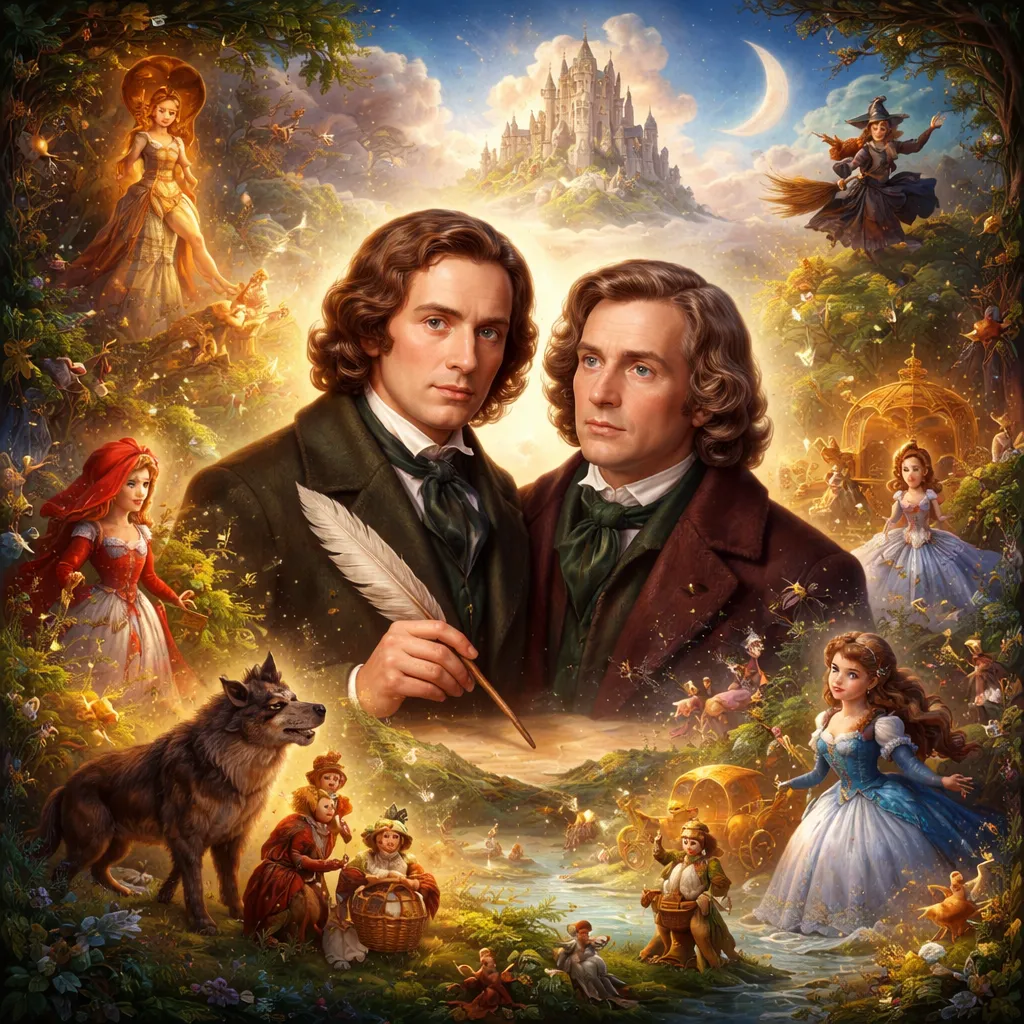

Introduction to Grimm Brothers
The Grimm brothers were two German academics, linguists, and cultural researchers. Their names were Jacob Grimm and Wilhelm Grimm. This celebrity story: Grimm Brothers shows that collecting old stories can make you famous forever. The brothers did not invent their tales. They traveled across Germany listening to ordinary people tell stories. They wrote them down. Children can learn that treasures are often hidden in plain sight. Parents can use their story to teach the value of listening, preserving history, and sharing culture. The Grimms published "Children's and Household Tales" in 1812. It included "Cinderella," "Snow White," "Hansel and Gretel," "Rapunzel," and "The Frog Prince." Their work is second only to the Bible in popularity in the German language. Their life proves that two brothers who loved language could save hundreds of stories from disappearing forever.
Early Life and Background
Jacob Ludwig Carl Grimm was born on January 4, 1785. Wilhelm Carl Grimm was born on February 24, 1786. They were born in Hanau, Germany. Their father, Philipp Grimm, worked as a lawyer. Their mother, Dorothea Grimm, took care of nine children. Only six survived infancy. The family lived comfortably. The brothers were very close. They shared a bed and a desk as children. They did everything together. Their father died in 1796. He was only 44 years old. The family became poor. Dorothea struggled to feed her children. Jacob and Wilhelm were sent to live with their aunt in Kassel. They attended the Friedrichsgymnasium, a prestigious school. They graduated at the top of their classes. Both brothers studied law at the University of Marburg. There, a professor named Friedrich von Savigny changed their lives. He taught them to love old German literature and language. He showed them how to study history through texts. The brothers began collecting old books and manuscripts. They wanted to save German culture from disappearing. At that time, France under Napoleon was conquering German lands. Many people feared that German language and stories would be lost forever.
Career Highlights and Achievements
Jacob and Wilhelm Grimm began collecting fairy tales around 1806. They asked friends, family, and neighbors to tell them stories. They visited villages and listened to women, servants, and farmers. One of their best storytellers was a woman named Dorothea Viehmann. She was a tailor's wife. She told them over 40 tales. The brothers wrote the stories exactly as they heard them. They did not add fancy language. They kept the simple, direct words of the storytellers. In 1812, they published the first volume of "Children's and Household Tales." It contained 86 stories. The second volume followed in 1815 with 70 more stories. The books did not sell well at first. People said the stories were too dark for children. The brothers disagreed. They believed children needed to learn that life is hard. The Grimms also worked on a German dictionary. They planned to define every German word from Martin Luther to Goethe. They completed letters A through F. Jacob reached the word "Frucht" meaning fruit. They never finished. But their method became the model for all historical dictionaries. They also wrote "German Grammar" and "German Mythology." These books founded the scientific study of German language and folklore. Jacob discovered a sound shift rule. It explained how consonants changed from ancient to modern German. This became known as Grimm's Law.
Famous Works or Performances
The Grimm brothers' most famous work is "Children's and Household Tales." It has over 200 stories. Some of the most famous include "Cinderella." In the Grimm version, the stepsisters cut off parts of their feet to fit into the glass slipper. Birds peck out their eyes at the wedding. "Snow White" features the evil queen who asks for Snow White's lungs and liver. She plans to eat them. "Hansel and Gretel" is about two children abandoned in the woods. They find a house made of candy. A witch lives there. She wants to cook and eat them. "Rapunzel" tells of a girl locked in a tower with very long hair. She lets down her hair so the witch can climb up. A prince climbs up and they fall in love. "The Frog Prince" is about a princess who promises to befriend a frog. She breaks her promise. The frog becomes a handsome prince. "Rumpelstiltskin" is about a little man who spins straw into gold. A queen must guess his name to save her baby. "Little Red Riding Hood" features a wolf who eats the grandmother and tries to eat the girl. A hunter cuts open the wolf to save them. The brothers also published "German Legends" in 1816. It contained over 500 German folk legends. They worked on these books for decades. The final edition of the fairy tales came out in 1857. It contained 211 stories.
Personal Life and Fun Facts
The Grimm brothers had many interesting personal stories. They lived together their entire lives. Jacob never married. Wilhelm married Dorothea Wild, called Dortchen, in 1825. She had told the brothers several fairy tales. A fun fact is that Dortchen told the brothers the story of "Hansel and Gretel." Another fun fact is that the brothers burned their own manuscripts. They revised the fairy tales seven times. They threw away early versions. They wanted the stories to be perfect. Wilhelm did most of the editing. He softened some of the violence in later editions. In the first edition, Cinderella's stepsisters cut off their toes, not their heels. Wilhelm changed it. The brothers loved to laugh. They told jokes and funny stories to each other. They also loved to walk. They took long walks together every day. They talked about their work while walking. The brothers had very different personalities. Jacob was serious and scholarly. He worked alone in his study. Wilhelm was warmer and more social. He enjoyed talking to people. He was often sick. He suffered from heart problems and asthma. Jacob took care of him. When Wilhelm died in 1859, Jacob was devastated. He wrote, "Wilhelm has left me. I feel alone and abandoned." Jacob died in 1863. They are buried next to each other in Berlin.
Legacy and Influence
The Grimm brothers saved German folk tales from disappearing. Before them, most people told stories but never wrote them down. The Grimms wrote them down. They preserved a whole culture. Their fairy tales have been translated into over 160 languages. Disney adapted many of their stories. "Snow White and the Seven Dwarfs" (1937) was Disney's first feature film. "Cinderella" (1950) and "Sleeping Beauty" (1959) followed. "The Frog Prince" became "The Princess and the Frog" (2009). "Rapunzel" became "Tangled" (2010). The Grimms' work also influenced other storytellers. Charles Dickens, J.R.R. Tolkien, and C.S. Lewis all read the Grimms' tales. The Brothers Grimm Museum in Kassel, Germany, holds their original manuscripts. Visitors can see their desks, letters, and first editions. The German government named a prize after them. The Brothers Grimm Prize honors outstanding cultural work. UNESCO added the Grimms' original manuscripts to the Memory of the World Register. Their dictionary project, though unfinished, inspired the Oxford English Dictionary. Their legacy proves that two brothers with a mission can change the world. They did not write for money. They wrote to save their culture. That passion created stories that will live forever.
Quotes or Famous Sayings
The Grimm brothers wrote a famous preface to their fairy tales. They said, "We wanted to let the tales speak for themselves. We did not add anything of our own." Jacob Grimm once wrote, "The German language is the most beautiful in the world." Wilhelm Grimm said, "Fairy tales are not just for children. They are for everyone who remembers being a child." Children might like this one from "Hansel and Gretel": "We will find our way home. The moon will light our path." Families can read these quotes together. Ask children, "Why do you think the Grimms did not change the stories?" They wanted to keep the storytellers' voices. Parents can help children see that listening to others is a kind of respect. The Grimms listened to poor women and farmers. Those people became famous through the brothers' books. Their quotes remind us that every voice matters.
How to Learn from Grimm Brothers
Children can learn several lessons from the Grimm brothers. First, listen to older people. The Grimms collected stories from grandparents and neighbors. Older people hold memories that can teach us. Second, write things down. If you do not write a story, it might disappear. Keep a journal of family stories. Third, work with a partner. Jacob and Wilhelm worked together for over 50 years. They helped each other succeed. Parents can encourage young children to ask a grandparent for a story. Write it down. Draw pictures. Make a family storybook. Older children can record a relative telling a story. Use a phone or a computer. Save the recording. Share it with the family. Families can also read a Grimm fairy tale together. Compare it to the Disney version. Which one is scarier? Which one do you like better? Talk about why the Grimms did not soften the endings. Another activity is to start a family storytelling night. Each week, one person tells a story. It can be true or made up. Write it down in a family notebook. The Grimm brothers started with nothing. They had no money. No fame. No support. They had each other. They had a mission. They saved stories that would have been lost. Every family has stories. Every child has a voice. Write down your stories. Share them. Keep them alive. That is the Grimm way. That is how you become immortal. One story at a time.