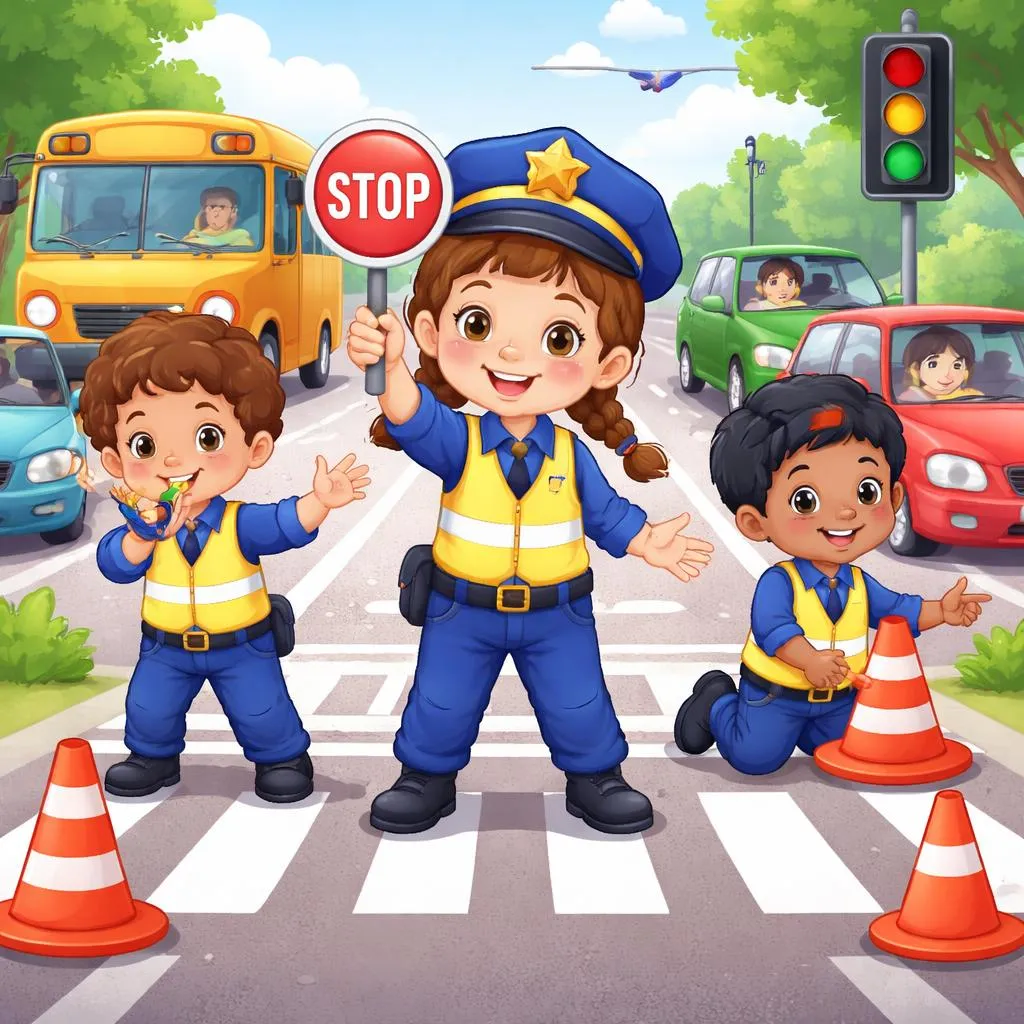

Hello, little word director! Do you know about a traffic officer? The officer stands in the street. They tell cars what to do. "Stop! Go! Turn left!" Their directions keep everyone safe. Your words can be directions too! These direction sentences are called imperative sentences. An imperative sentence gives a command, makes a request, or gives instructions. It tells someone to do something. Today, you will be a traffic officer and give sixty wonderful directions. Our guide is Officer Ian the Imperative Iguana. Ian loves to direct the jungle animals! He will show us imperative sentences at home, the playground, school, and in the jungle. Let's direct some traffic!
What Is an Imperative Sentence? An imperative sentence is your word direction. It is a sentence that tells someone to do something. It can be a command, a request, or an instruction. The most important part is the verb at the beginning. Often, the subject "you" is hidden but understood. At home, you say "Close the door, please." This is an imperative sentence. It gives a polite request. At the playground, you say "Push me!" This is a command. At school, the teacher says "Listen carefully." In nature, Officer Ian says "Look both ways before crossing!" "Ian directs the ants." Learning these must-know imperative sentences helps you be helpful, safe, and clear.
Why Are Word Directions So Important? Imperative sentences are your action tools! They help your ears listen. You can follow instructions to play a game or stay safe. They help your mouth speak. You can ask for help politely. "Please pass the milk." They help your eyes read. You will see them in recipes, game rules, and safety signs. They help your hand write. You can write notes to remind someone of something. Giving clear directions makes you a good friend and a responsible person.
What Are the Main Types of Directions? We have a few main types of imperative sentences. Each one has a different tone.
First, direct commands. These tell someone to do something. They often end with a period or an exclamation mark. "Sit down." "Watch out!"
Next, polite requests. These use the word "please". They are very important for good manners. "Please help me."
We also have negative commands. These tell someone not to do something. They use the word "don't" or "do not". "Don't run." "Do not touch."
For 5-year-olds, we will focus on polite requests and simple, positive commands.
How Can You Spot a Word Direction? Spotting an imperative sentence is easy! Look for a sentence that starts with a verb. The subject "you" is usually not there. It is like the sentence is talking directly to you. Also, look at the end mark. It can be a period (.) for a calm direction or an exclamation mark (!) for a strong command. Listen to Officer Ian. "Stop at the line!" The sentence starts with the verb "Stop" and ends with an exclamation mark. It is an imperative. Another trick: The sentence tells you to do something. Try to act it out. Can you do what it says?
How Do We Give Good Directions? Using an imperative sentence is about starting with the action word. The pattern is: Verb + (the rest) + . or !. "Come here." "Please be quiet." You can add "please" to be polite. Put it at the start or the end. "Please wash your hands." "Wash your hands, please." Officer Ian shows us. "Walk slowly. Please wait for the signal." Start by telling yourself to do something. "Get dressed." That is an imperative you can use every morning.
Let's Fix Some Direction Mix-ups. Sometimes our directions get a little mixed up. Let's fix that. A common mix-up is adding the subject "you". A child might say "You give me that." This is a statement. To make it an imperative, remove "you". "Give me that, please." Another mix-up is forgetting the verb. "Quiet, please" is a fragment. Add the verb: "Be quiet, please." Also, remember your tone. Saying "Go away!" can sound mean. Saying "Please go play over there" is kinder. Use "please" often.
Can You Be a Direction Expert? You are a great expert! Let's play a game. The "Give a Direction" game. I will describe a situation. You give an imperative sentence. Situation: Your friend is about to step in a puddle. You say: "Stop!" or "Watch out!" Situation: You need the ketchup at dinner. You say: "Please pass the ketchup." Great! Here is a harder challenge. Think of your morning routine. Can you give three imperative sentences to describe it? "Brush your teeth. Make your bed. Eat your breakfast." You are using must-know imperative sentences.
Your Direction Handbook of 60 Must-Know Imperative Sentences. Ready to read the handbook? Here are sixty wonderful imperative sentences. Officer Ian the Iguana uses them every day. They are grouped by the scene. Each one gives a direction, request, or command.
Home Directions (15). Please set the table. Eat your vegetables. Wash your hands. Brush your teeth. Pick up your toys. Go to bed. Take a bath. Close the door. Turn off the light. Be kind to your sister. Help me, please. Listen to your parents. Put on your shoes. Hang up your coat. Drink your milk.
Playground Directions (15). Take turns. Push me, please. Throw the ball. Catch! Slide down. Climb carefully. Share your toys. Wait in line. Swing higher. Kick the ball to me. Dig here. Run to the tree. Stop at the fence. Be a good sport. Have fun!
School Directions (15). Line up quietly. Raise your hand. Listen to the teacher. Write your name. Color inside the lines. Cut on the dotted line. Glue the paper. Share the crayons. Sit on the carpet. Open your book. Read the story. Work together. Try your best. Clean up your area. Walk, do not run.
Nature and Animal Directions (15). Look at the bird. Listen to the wind. Smell the flowers. Touch the bark gently. Plant the seed here. Water the garden. Feed the ducks. Walk on the path. Don't pick the flowers. Be very quiet. Watch for cars. Put litter in the bin. Respect the animals. Enjoy the sunshine. Protect our planet.
These sixty sentences are your must-know imperative sentences. They are your word directions. Use them to be helpful, safe, and polite.
Directing Your World with Kindness and Clarity. You did it! You are now an imperative sentence expert. You know an imperative sentence is a word direction. It tells someone to do something. It often starts with a verb and can end with a period or an exclamation mark. You know how to make it polite with "please". Officer Ian the Imperative Iguana is proud of your directing skills. Now you can give clear instructions, ask politely, and help keep things running smoothly. Your words can guide and help others.
Here is what you can learn from our traffic adventure. You will know what an imperative sentence is. You will understand that it gives a command or makes a request. You can identify imperative sentences by their structure and purpose. You can form polite and clear imperative sentences. You have a direction handbook of sixty key imperative sentences.
Now, let's do some life practice! Your mission is today. Be a word traffic officer. Give three kind directions. Tell a friend or family member: "Please hold my hand. Look at that butterfly. Let's play together." You just used three imperative sentences! Keep directing with your word directions every day. Have fun, little officer!