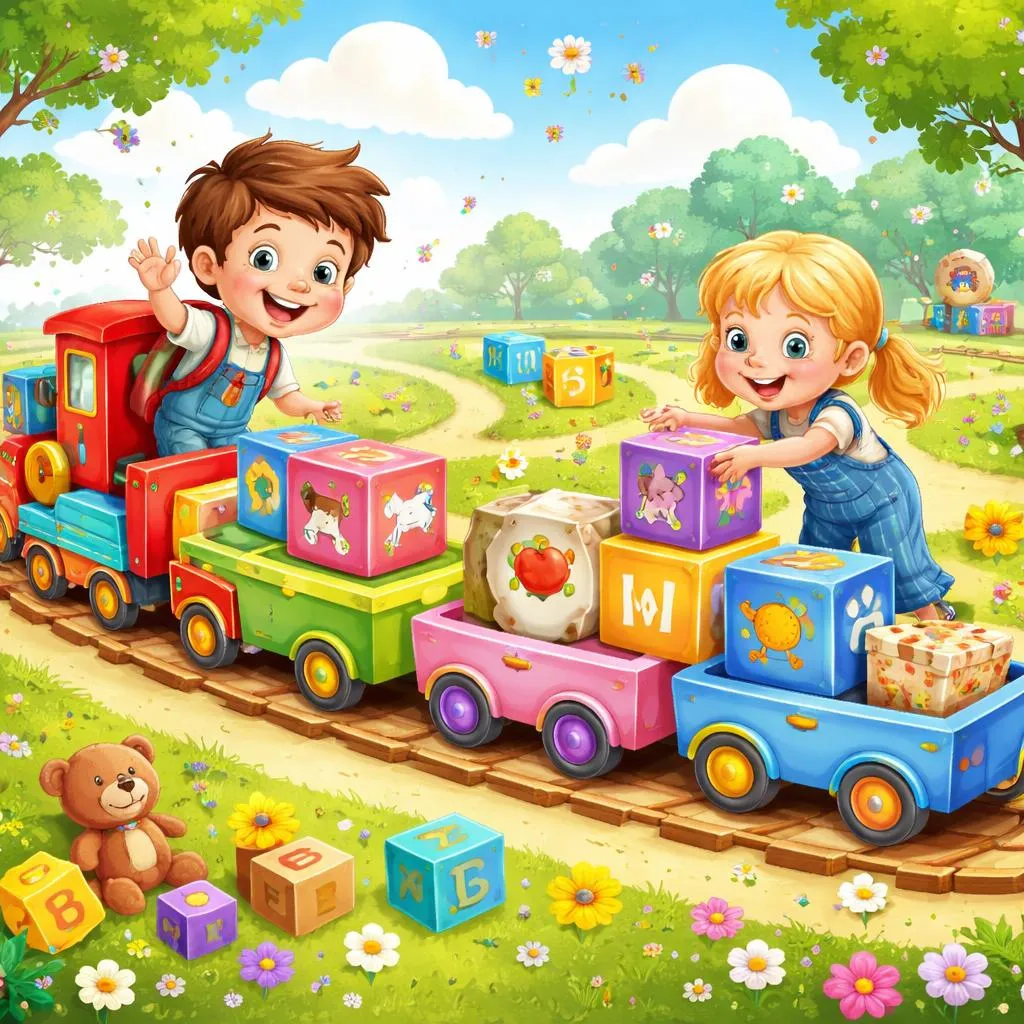

Hello, little word engineer! Have you ever seen a train? A train has an engine. The engine pulls the train cars. The cars carry things. A sentence is like a word train! The engine is the subject. It is the "who" or "what". The first car is the verb. It is the action. More cars can be added to carry extra details. Together, they make a complete thought that travels to the listener. Today, we will build sixty wonderful word trains. Our guide is Conductor Cassie. She loves to build sentence trains! She will show us sentences at home, the playground, school, and at the train yard. All aboard!
What Is a Sentence? A sentence is a complete word train. It is a group of words that expresses a full idea. It starts with a capital letter. It ends with a punctuation mark. It must have an engine (a subject) and an action car (a verb). At home, you say "I see my mom." This is a sentence. The engine is "I". The action is "see". The idea is complete. At the playground, you say "The swing is fun." At school, you say "We read books." In nature, Cassie says "Birds sing songs." "Conductor Cassie drives the train." Learning these must-know sentences gives you the power to share all your ideas.
Why Are Word Trains So Important? Sentences are your communication tracks! They help your ears listen. You can follow the whole idea someone is sharing. They help your mouth speak. You can tell stories, ask for things, and share feelings clearly. They help your eyes read. Every book is made of these word trains. They help your hand write. You can write notes, stories, and lists. Building strong word trains makes you a great talker, listener, and thinker.
What Are the Main Types of Word Trains? We have a few main types of sentence trains. Each type has a different job and a different end mark.
First, the statement train. This train tells something. It ends with a period. "I have a red ball."
Next, the question train. This train asks something. It ends with a question mark. "Where is my ball?"
The exclamation train. This train shows strong feeling. It ends with an exclamation mark. "I found my ball!"
The command train. This train tells someone to do something. It often ends with a period. "Give me the ball, please."
We will build all kinds of trains today.
How Can You Spot a Complete Word Train? Spotting a complete sentence is easy! Check if it has an engine (subject) and an action car (verb). Then, see if it expresses a complete thought. Ask: "Does this make sense on its own?" Also, look for the capital letter at the start and the punctuation at the end. Look at Cassie's train. "The train is fast." Engine: The train. Action: is. Complete thought? Yes. You found a sentence! Another trick: Can you act it out or picture it? "The big dog runs." You can picture that.
How Do We Build a Word Train? Building a sentence starts with your engine. Who or what is your sentence about? Then, add your action car. What is the subject doing or being? That's your basic train: Subject + Verb. "Dogs bark." You can add more cars. Add an object car. "Dogs bark at cars." Add a describing car. "Big dogs bark at loud cars." Cassie shows us. "I + drive + the long, fast train." Start simple. Then make your train longer and more interesting.
Let's Fix Some Derailed Trains. Sometimes our word trains get derailed. Let's fix them. A common problem is a fragment. It is missing an engine or an action car. A child might say "The big, red truck." This is not a train. Add an action: "The big, red truck stops." Another problem is a run-on. Two trains crash together. "I like cake I like ice cream." Connect them properly. "I like cake, and I like ice cream." Also, remember your punctuation! Every train needs an end mark.
Can You Be a Master Engineer? You are a great engineer! Let's play a game. The "Complete the Train" game. I will give you an engine. You add an action car to make a sentence. Engine: "The cat". You say: "The cat sleeps." Great! Here is a harder challenge. Take the same engine and make three different types of sentences. Statement: "The cat is soft." Question: "Is the cat soft?" Exclamation: "The cat is so soft!" You are building must-know sentences.
Your Train Yard of 60 Must-Know Sentences. Ready to fill your train yard? Here are sixty wonderful, complete sentences. Conductor Cassie uses them every day. They are grouped by the scene and the type of sentence. We have statements, questions, exclamations, and commands.
Home Sweet Home (15 Trains). Statements: I love my family. My bed is cozy. We eat dinner together. Dad reads stories. The house is warm. Questions: Where is my teddy? What is for snack? Can I help you? Is it bath time? Do you see my sock? Exclamations: I'm home! This soup is yummy! Look at my drawing! I did it! What a mess! Commands: Please set the table. Wash your hands. Give me a hug. Pick up your toys. Close the door.
Playground Pals (15 Trains). Statements: The sun is shining. My friend is funny. The slide is slippery. We play games. I can climb high. Questions: Will you play with me? Whose ball is this? Can I have a turn? Is the swing free? How do I do this? Exclamations: Whee! This is fun! I won! Watch me! Awesome catch! Commands: Push me, please. Throw the ball. Wait your turn. Share the shovel. Be careful!
School Time (15 Trains). Statements: My teacher is nice. School is fun. I am learning. The book has pictures. We follow rules. Questions: What is today? May I go now? How do you spell that? Is this right? Can I try? Exclamations: I know the answer! A gold star! We have art today! I finished! This is easy! Commands: Line up quietly. Raise your hand. Listen to the story. Write your name. Share the crayons.
Nature and Animals (15 Trains). Statements: The sky is blue. Flowers are pretty. A bird is singing. Water is wet. Trees are tall. Questions: What is that sound? Where is the rabbit? Do you see the bug? Why is the grass green? Is it going to rain? Exclamations: Look at the rainbow! A butterfly! The puppy is so cute! It's windy! Beautiful! Commands: Look over there. Be very quiet. Don't touch that. Pick up that litter. Watch your step.
These sixty sentences are your must-know word trains. Practice them. Use them to share your world.
Driving Your Ideas All Around Town. You did it! You are now a sentence expert. You know a sentence is a complete word train with a subject and a verb. You know the four main types: statements, questions, exclamations, and commands. You can build them and fix them. Conductor Cassie is proud of your train yard. Now you can drive your ideas anywhere. Your communication will be clear, fun, and powerful.
Here is what you can learn from our train yard adventure. You will know what makes a complete sentence. You will understand the four types of sentences and their punctuation. You can build a simple sentence from a subject and a verb. You can turn a statement into a question or an exclamation. You have a train yard of sixty essential sentences for everyday use.
Now, let's do some life practice! Your mission is today. Be a sentence engineer. For the next hour, try to make your sentences complete. Tell someone: "I am building with blocks. Can you help me? Look at my tall tower! Please pass the red block." You just used all four types of sentences! Keep building your word trains every day. Have fun, little engineer!