
What Is The Rhyme? Many songs help children learn the sequence of the days of the week. These rhymes often highlight each day in turn. A song that spotlights Wednesday within the sequence is particularly useful. It helps anchor the middle of the week. A common rhyme goes: "Sunday, Monday, Tuesday, Wednesday, Thursday, Friday, Saturday!" The melody is simple and repetitive. Singing the full list repeatedly builds automatic recall. Focusing on the position of Wednesday—right in the center—helps children understand order and sequence. Music makes this foundational concept of time both fun and memorable.
The Lyrics of Nursery Rhymes The lyrics of nursery rhymes for the days are clear and sequential. They often follow a steady beat. "Monday's child is fair of face, Tuesday's child is full of grace, Wednesday's child is full of woe..." This older rhyme associates a trait with each day. Modern educational songs are more direct. "There are seven days, there are seven days, there are seven days in a week. Sunday, Monday, Tuesday, Wednesday, Thursday, Friday, Saturday!" The name Wednesday stands out in the middle of the list. Its three syllables create a distinct rhythm in the chant. This helps with pronunciation and placement.
Vocabulary Learning Learning the days of the week builds essential vocabulary. The keyword is, of course, Wednesday. We learn it as the fourth day. We also master the full set: Sunday, Monday, Tuesday, Wednesday, Thursday, Friday, Saturday. We can group them. Weekdays (Monday to Friday) and the Weekend (Saturday and Sunday). Wednesday is the midpoint, the "hump day." We learn related words: week, today, tomorrow, yesterday, next, last, middle. We practice phrases like "On Wednesday..." or "This Wednesday..." Connecting the day to common routines solidifies its meaning. "We have music class on Wednesday."
Phonics Points The name Wednesday offers a special phonics challenge and opportunity. It is often mispronounced. We focus on its three distinct syllables: Wed-nes-day. We practice the /w/ sound at the beginning. The middle syllable has a short 'e' sound, /nes/. The final syllable has the long 'a' sound, /day/, just like the other days. The silent 'd' after the 'n' is a notable feature. We compare it to other days. The /z/ sound in Wednesday and Tuesday. The /r/ sound in Thursday and Friday. Clapping the syllables for each day name builds strong phonological skills.
Grammar Patterns Using the days of the week correctly involves key grammar. We always use the preposition "on" before a specific day. "On Wednesday, we go to the library." We use "on" for all days: on Monday, on Saturday. We practice asking and answering questions. "What day is it today?" "Today is Wednesday." "What day comes after Tuesday?" "Wednesday comes after Tuesday." We can use the past and future tense. "Yesterday was Tuesday. Tomorrow will be Thursday." We also learn to use capital letters for each day name, as they are proper nouns.
Learning Activities Targeted activities make Wednesday and the other days memorable. Try "Day Before & After." Hold up a card that says "Wednesday." Children must say, "Tuesday comes before Wednesday. Thursday comes after Wednesday." Another activity is "Weekly Schedule." Create a simple pictorial schedule for the week. Have children place a special sticker or drawing on Wednesday. Ask, "What do we do on Wednesday?" For a physical game, play "Day Line-Up." Give seven children cards, each with a day. They must arrange themselves in order, with Wednesday in the exact center.
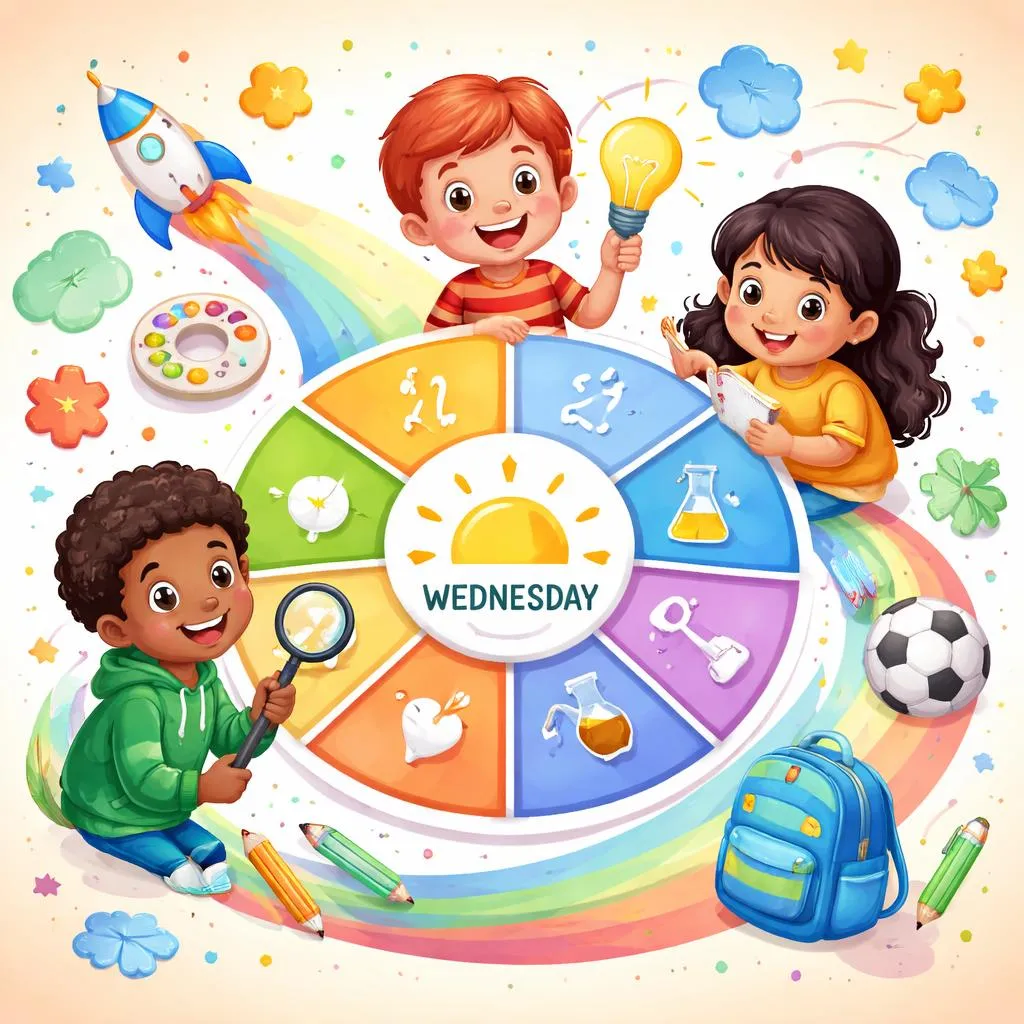
Printable Materials Printable resources provide visual and hands-on learning. Create a "Days of the Week" wheel. Wednesday is highlighted in a different color. A spinner points to the current day. Design "Wednesday Worksheet." It has activities like tracing the word, coloring it, and drawing something that happens on that day. A "Sequence Strip" with all seven days can be cut apart and glued back in order. A "My Week" mini-book can have a dedicated page for Wednesday with the sentence starter: "On Wednesday, I always..."
Educational Games Games turn practice into play. "Wednesday Detective" is a listening game. Give clues about its position. "I am not at the beginning or end. I have three syllables. I come after Tuesday. What day am I?" Play "Calendar Bingo." Use bingo cards with the days of the week. The caller gives clues like, "The middle weekday" or "The day with a silent 'd'." For an active game, play "Day Hopscotch." Draw seven squares. Label them with the days. Children hop through the sequence, saying each name, paying extra attention to landing correctly on the Wednesday square.
Focusing deeply on one day, like Wednesday, creates a strong anchor point. It makes the abstract list of the days of the week more concrete and manageable. By mastering its spelling, pronunciation, and position, children gain confidence. This confidence then spreads to the days before and after it. Understanding Wednesday means understanding the concepts of "middle," "before and after," and "sequence." This knowledge is a cornerstone for planning, storytelling, and building routines. From singing its name to finding it on a calendar, each activity reinforces not just a word, but a fundamental structure of time, empowering children to navigate their week in English with growing assurance.