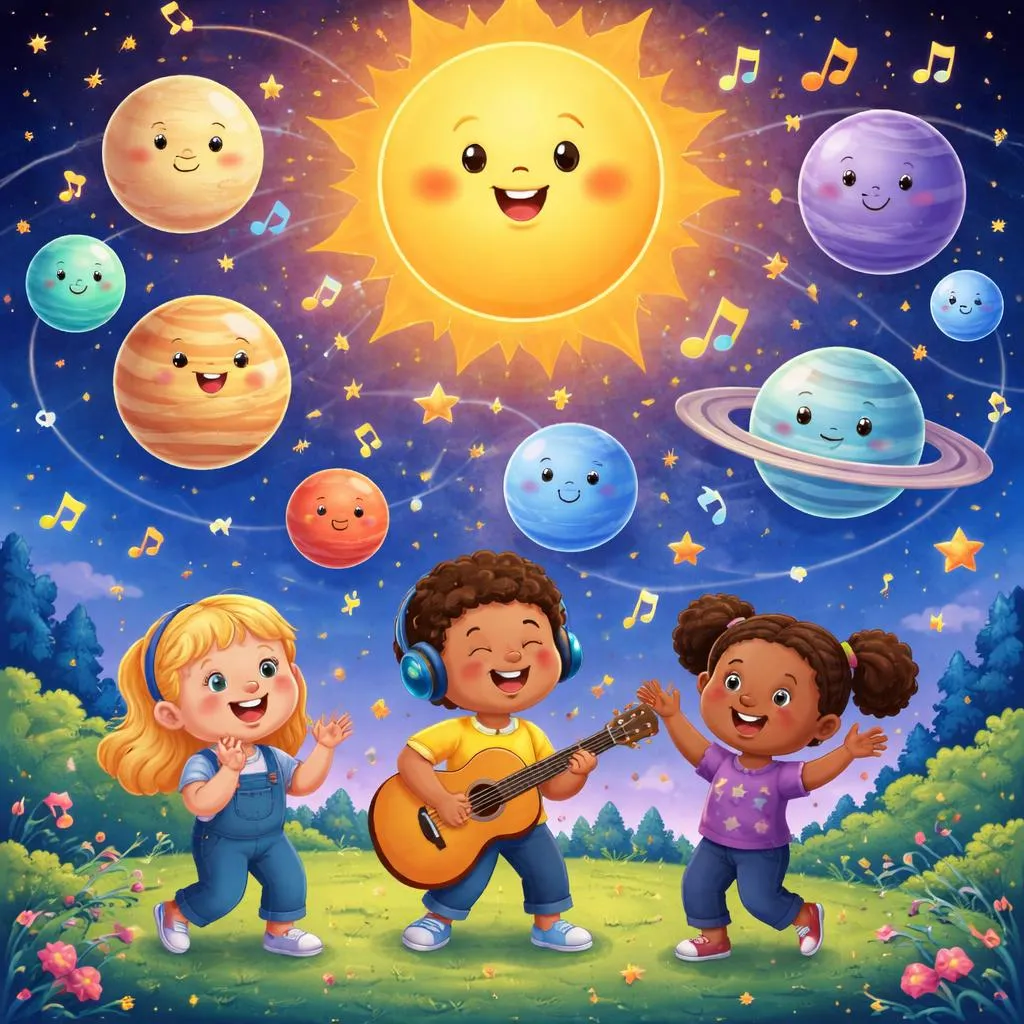

The universe stretches far beyond what eyes can see. Children look up at the night sky with wonder. They see twinkling stars and sometimes a bright moon. Teaching about the planets can feel overwhelming. There are so many names to remember. So many facts to learn. This is where music helps. The planet song turns complex information into something simple and fun. Melody carries the names into memory. Rhythm makes the facts stick. Children sing about Mercury, Venus, Earth, and Mars without even trying. Let us explore how to use this powerful teaching tool in the young learners' classroom.
What Is The Planet Song? A planet song is a musical piece that introduces the planets in our solar system. Most versions list the planets in order from the sun. Some include facts about each planet. Others just focus on the names and sequence.
The most common version uses a simple, memorable tune. Children learn the order of the planets. Mercury is closest to the sun. Neptune is farthest away. The song helps children remember this order for life.
Many versions exist. Some include Pluto, though it is now called a dwarf planet. Others focus only on the eight major planets. Teachers can choose the version that matches their curriculum goals.
The song typically has one verse for each planet or a list of all planets in one verse. The repetition helps children remember. The music adds enjoyment to what could be a dry memorization task.
The Lyrics of a Simple Planet Song Here is a common version of the planet song. This one lists the planets in order from the sun.
Mercury is the closest planet to the sun. Venus shines brightly when the day is done. Earth is our home, where we all live. Mars is the red planet, ready to give.
Jupiter is giant with a great red spot. Saturn has rings with many dots. Uranus spins on its side, oh so slow. Neptune has winds that really blow.
These are the planets that orbit the sun. Learning about space is so much fun!
Another popular version uses the tune of "Twinkle, Twinkle, Little Star."
Twinkle, twinkle, little star, I know what the planets are. Mercury, Venus, Earth, and Mars, Jupiter, Saturn, Uranus, Neptune, Twinkle, twinkle, little star, I know what the planets are.
The simple tune makes the names easy to remember. Children can sing it anywhere.
Vocabulary Learning from the Song The planet song introduces rich scientific vocabulary. Children learn these words in a memorable musical context.
Planet: A large object that orbits a star. Earth is a planet. The song lists all eight.
Mercury: The closest planet to the sun. It is very hot during the day and very cold at night.
Venus: The second planet from the sun. It is the brightest planet in our night sky.
Earth: Our home planet. The only planet we know that has life.
Mars: The red planet. It looks red because of iron oxide on its surface.
Jupiter: The largest planet. It has a giant red spot that is a huge storm.
Saturn: The planet with beautiful rings. The rings are made of ice and rock.
Uranus: A planet that spins on its side. It looks like it rolls around the sun.
Neptune: The farthest planet from the sun. It has very strong winds.
Sun: The star at the center of our solar system. All planets orbit around it.
Orbit: The path a planet takes around the sun. The song mentions orbiting.
Solar system: The sun and everything that orbits around it. This includes planets, moons, and asteroids.
Use these words in other contexts. Show pictures of each planet. Read books about space. The song provides a foundation for deeper learning.
Phonics Points in the Song The planet song offers opportunities for phonics practice. The planet names contain various sounds.
The "er" sound: Mercury, Jupiter, Saturn. These planets have the "er" sound in different positions. Children hear this common pattern.
The "ar" sound: Mars, star. These words share the "ar" sound. Other words with this sound include car, far, and jar.
The "us" ending: Venus, Uranus. These planets end with "us." This is a common ending in Latin-derived words.
The "une" sound: June, Neptune. The "une" pattern appears in June and tunes.
Syllable counting: Clap the syllables in each planet name. Mer-cu-ry has three claps. Ve-nus has two. Jup-i-ter has three. U-ra-nus has four. This builds phonemic awareness.
Initial sounds: Each planet name starts with a different letter. M, V, E, M, J, S, U, N. Practice saying the first sound of each planet.
Rhyming words: Some planet names have rhyming partners. Mars rhymes with stars. Sun rhymes with fun. This extends phonics learning.
Grammar Patterns in the Lyrics The song demonstrates several grammar patterns. Children absorb these through repetition.
Present tense verbs: Is, shines, spins, has, blow. The song uses present tense to describe facts about planets. These facts are always true.
Adjectives describing nouns: Red planet, great red spot, giant planet. The adjective comes before the noun. Children internalize this word order.
Prepositional phrases: To the sun, on its side, around the sun. These phrases tell location and direction.
Comparatives: Closest, farthest. The song uses superlatives to describe planets' positions. Children learn that -est means the most.
Conjunctions: And connects ideas in the song. "Jupiter is giant and Saturn has rings."
Exclamations: "So much fun!" ends the song with excitement. Children learn that exclamation points show strong feeling.
Pronouns: It, they refer back to planets. Children see how pronouns replace nouns in sentences.
The song provides rich language input. Children do not need to analyze the grammar. They absorb it through joyful repetition.
Learning Activities with the Song Songs become powerful teaching tools when we add activities. Here are ideas for using the planet song in the classroom.
Planet Walk: Create a large model of the solar system in the classroom or playground. Place signs for each planet at the correct relative distances from a sun sign. Children walk from Mercury to Neptune, naming each planet as they pass.
Planet Painting: Children paint pictures of each planet. Use the correct colors. Mercury is gray. Venus is yellowish. Earth is blue and green. Mars is red. Jupiter is orange with white bands. Saturn is yellow with rings. Uranus is light blue. Neptune is deep blue.
Planet Order Game: Give children cards with planet names. They arrange themselves in the correct order from the sun. The class checks their order. This builds teamwork and reinforces sequence.
Planet Facts Chart: Create a large chart with all eight planets. As children learn facts from the song and other sources, add them to the chart. Jupiter is biggest. Saturn has rings. Mars is red.
Playdough Planets: Use playdough to create models of the planets. Make Jupiter biggest. Make Saturn with a ring. Add a stick and label each planet. Display them in order.
Planet Mobile: Create hanging mobiles with planets in order. Use paper plates or styrofoam balls painted as planets. Hang them from a coat hanger or stick in the correct order.
Sing and Point: While singing the song, point to pictures of each planet. Use a pointer and a planet poster. This connects the words to the images.
Printable Materials for Classroom Use Having printable resources makes lesson planning easier. Here are materials to prepare for the planet song.
Planet Posters: Create eight posters, one for each planet. Include a clear picture, the name, and one or two simple facts. Display them in order around the room.
Planet Flashcards: Make flashcards with planet pictures on one side and names on the other. Use them for review games and matching activities.
Planet Order Cards: Create cards with the numbers one through eight. Children match each planet card to its number card. Mercury is 1. Venus is 2. Continue through Neptune.
Mini Planet Books: Create simple foldable books with one page for each planet. Children write the planet name and color the picture. They can take these home to share.
Planet Coloring Pages: Design coloring pages showing each planet. Include the name for tracing or writing practice. Children color while listening to the song.
Planet Word Search: Create a simple word search with the eight planet names. Children find and circle them. This builds word recognition.
Planet Fact Cards: Create cards with simple facts about each planet. "I am the closest to the sun." "I have beautiful rings." Children match each fact to the correct planet.
Educational Games for Deeper Learning Games make learning about planets joyful. Here are games centered around the planet song.
Planet Bingo: Create bingo cards with planet pictures or names. Call out planet facts. "This planet is the largest." Children cover Jupiter. The first to cover a row wins.
Planet Memory Match: Create two sets of planet cards. One set has pictures. One set has names. Place them face down. Children turn over two cards trying to match the picture to the name. When they make a match, they say the planet name.
Planet Hop: Place planet cards on the floor in order. Children hop from Mercury to Neptune, naming each planet as they land. This combines movement with learning.
Who Am I?: Give clues about a mystery planet. "I am the red planet. Who am I?" Children guess Mars. "I have the most rings. Who am I?" Children guess Saturn.
Planet Sorting Relay Race: Place two hoops on the floor. Label one "inner planets" and one "outer planets." Children run to a pile of planet cards, grab one, and place it in the correct hoop. Inner planets are Mercury, Venus, Earth, Mars. Outer planets are Jupiter, Saturn, Uranus, Neptune.
Planet Order Race: Give each child a planet card. Time how fast they can arrange themselves in the correct order from the sun. Try to beat the previous time.
Pin the Planet on the Solar System: Create a large sun poster on the wall. Make paper planets with tape on the back. Blindfolded children try to place their planet in the correct position. This is a fun variation of a classic game.
Connecting to Science Learning The planet song naturally leads to deeper science exploration.
Size Comparison: Use different sized balls to represent the planets. A grape for Mercury. A pea for Mars. A basketball for Jupiter. Children see the dramatic size differences.
Distance from Sun: Use a long strip of paper to show relative distances. Place the sun at one end. Mark where each planet would be. Children see that outer planets are very far apart.
Day and Night: Explain how planets spin. Earth's spin creates day and night. Some planets spin faster or slower. Some spin backward.
Seasons on Other Planets: Explain that some planets have seasons like Earth. Others are very different. Uranus has extreme seasons because it spins on its side.
Moons: Many planets have moons. Jupiter has over seventy. Saturn has many too. Earth has one moon. Children can learn moon names.
Space Exploration: Discuss spacecraft that have visited planets. Rovers on Mars. Probes to Jupiter and Saturn. This connects to current events.
Planet Colors: Talk about why planets have different colors. Mars is red from rust. Jupiter has bands of clouds. The blue planets get their color from gases.
Creating New Verses Encourage children to create new verses with facts about each planet. This builds creativity and science knowledge.
Mercury verse: "Mercury is closest to the hot, hot sun. It has no moons for having fun."
Venus verse: "Venus is the brightest in the evening sky. It spins so slowly as the years go by."
Earth verse: "Earth is our home with water and air. It has one moon and life everywhere."
Mars verse: "Mars is the red planet with mountains so high. Rovers explore it way up in the sky."
Jupiter verse: "Jupiter is giant with storms that rage. It has more moons than any other page."
Saturn verse: "Saturn has rings of ice and dust. They circle the planet because they must."
Uranus verse: "Uranus spins sideways, rolling through space. It has a pale blue and pretty face."
Neptune verse: "Neptune is blue with winds so fast. It is the eighth planet and it is last."
Children can perform their verses for the class. This builds confidence and deepens learning.
The planet song opens the door to the universe. Children learn the names of distant worlds. They understand their place in the solar system. They begin to grasp the vastness of space. Music makes this possible. The melody carries knowledge into young minds. The rhythm makes facts stick. Years later, when children see Jupiter in the night sky, they will remember the song. They will know its name. They will know it is the giant. And they will smile at the memory of learning through music.