
Opening Introduction
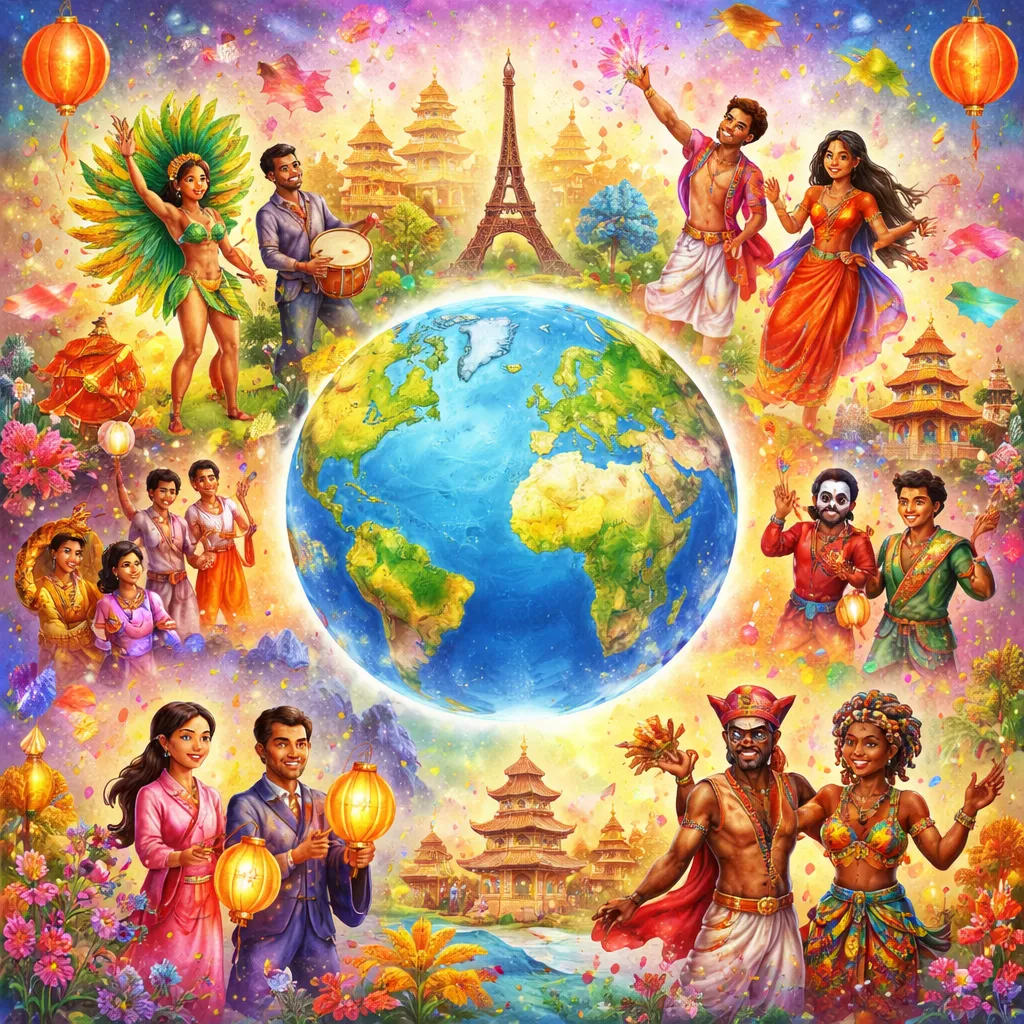
Mia got a postcard from her cousin, Anya. Anya lived in India. The postcard showed a night sky full of lights. "It's Diwali, the Festival of Lights!" Anya wrote. That same week, Leo's friend, Carlos, talked about a big parade with amazing costumes. "It's Carnival in Brazil!" Carlos said. Mia and Leo were amazed. The world had so many different parties! Their teacher said, "These are traditional festivals. Each one has special words for the food, clothes, and activities. Let's pack our imaginary suitcases and learn the traditional festivals around the world vocabulary. It's like collecting souvenirs in words!" The children loved the idea of a word-collecting trip. Let's start our celebration journey.
Core Knowledge Explanation
What is a traditional festival? It is a special day or time that people have celebrated for many, many years. It is part of their culture. Festivals often have stories, special food, music, and clothes. Today, we are traveling the world to learn the traditional festivals around the world vocabulary. Knowing these words helps us understand and respect how other people celebrate. Let's visit some famous festivals.
First, let's go to China for the Lunar New Year, also called Chinese New Year. It is the most important festival. People clean their homes to sweep away bad luck. They have a big family dinner called a reunion dinner. Children get red envelopes with money inside. These are called hongbao. There are dragon dances and lion dances in the street. People set off firecrackers. The words are: Lunar New Year, reunion dinner, hongbao, dragon dance, firecrackers.
Now, let's fly to India for Diwali, the Festival of Lights. People light small oil lamps called diyas. They put them in rows. They make beautiful patterns on the floor with colored powder. These are called rangoli. They share sweets and watch fireworks. The words are: Diwali, diya, rangoli, sweets, fireworks.
Next, we travel to the United States for Thanksgiving. Families gather for a big meal. They eat roast turkey, stuffing, cranberry sauce, and pumpkin pie. They say what they are thankful for. The main word is Thanksgiving, and the food words are turkey, stuffing, cranberry sauce, pumpkin pie.
Let's go to Mexico for D赤a de los Muertos, or Day of the Dead. It is not a sad day. It is a happy time to remember family members who have died. People build altars with photos, flowers, and favorite foods. The altars are called ofrendas. There are colorful skulls made of sugar, called sugar skulls. The words are: D赤a de los Muertos, ofrenda, sugar skull, marigold (a special flower).
Now, let's go to Brazil for Carnival. It is a huge party before Lent. There are big parades with floats. People wear incredible costumes and masks. They dance the samba in the streets. The words are: Carnival, parade, float, costume, mask, samba.
We can't forget Christmas, celebrated in many countries. People decorate a Christmas tree. They hang stockings by the fireplace. Santa Claus brings gifts. They sing Christmas carols. The words are: Christmas tree, stocking, Santa Claus, carol, gift. These are just a few examples of the traditional festivals around the world vocabulary. Each word is a key to understanding the joy of that festival.
Fun Interactive Learning
Let's play a festival game. It is called "Festival Charades." Write the names of festivals and their vocabulary words on cards: Diwali, dragon dance, turkey, costume, ofrenda. Put them in a bowl. One player picks a card and acts it out. How do you act out "dragon dance"? You might move in a line with friends, like a dragon. How do you act out "turkey"? You might gobble and flap your arms. The others guess. This is a fun way to remember the traditional festivals around the world vocabulary.
Another activity is "Festival Passport." Make a small booklet, your passport. For each "country" (festival) you visit, draw a picture of one key item. For Diwali, draw a diya. For Chinese New Year, draw a hongbao. For Thanksgiving, draw a turkey. Write the word below it. Stamp the page as if you visited. This passport is your own collection of the traditional festivals around the world vocabulary.
You can also have a "Mini-Festival" at home. Choose one festival. For example, have a small Diwali. Draw a rangoli pattern with chalk on the sidewalk. Light a small candle (with a grown-up's help). Say, "We are lighting a diya for Diwali." Or, have a Thanksgiving thankful circle. Say one thing you are thankful for. This makes the words come alive.
Expanded Learning
Festivals are as old as human civilization. Long ago, people had festivals for the harvest, for the sun, for their gods. Today, these traditional festivals around the world vocabulary connects us to those old traditions. In different countries, the same festival might have different words. Christmas in England is similar to Christmas in Mexico, but in Mexico, they also have pi?atas and posadas. The vocabulary changes a little.
Some festivals are based on the moon, like Eid al-Fitr. It marks the end of Ramadan, a month of fasting. The words are Eid, Ramadan, fasting, feast. Some are based on history, like Independence Day in the USA, with fireworks and barbecues. Learning about these festivals teaches us about history, religion, and the seasons. Let's make a festival chant. Chants are fun and easy to remember.
Dragon dance and firecrackers, for the Lunar New Year! Diyas bright and rangoli, for the festival of light and cheer! Turkey, stuffing, pumpkin pie, for the thankful time gone by! Ofrendas, flowers, sugar skulls, for the memories that are full! Costumes, samba, parade, for the fun that's being made! Christmas tree and Santa's sleigh, for the happy holiday! Festival words, learn them all, for the world both big and small!
What You Will Learn
You are learning about world cultures, traditions, and celebrations. You are learning key traditional festivals around the world vocabulary: for Chinese New Year (Lunar New Year, reunion dinner, hongbao, dragon dance, firecrackers), for Diwali (Diwali, diya, rangoli, sweets, fireworks), for Thanksgiving (Thanksgiving, turkey, stuffing, cranberry sauce, pumpkin pie), for D赤a de los Muertos (D赤a de los Muertos, ofrenda, sugar skull, marigold), for Carnival (Carnival, parade, float, costume, mask, samba), and for Christmas (Christmas tree, stocking, Santa Claus, carol, gift). You are also learning what a traditional festival is.
You are learning descriptive and respectful sentences. You can say, "During Diwali, people light diyas." You can explain, "An ofrenda is an altar for the Day of the Dead." You can share, "We eat turkey on Thanksgiving." You are using English to talk about diverse cultural practices with accuracy and respect. This is a wonderful social skill.
You are building important knowledge and abilities. You are building cultural vocabulary. You learn specific words for specific traditions. You are building global awareness. You appreciate the diversity of celebrations. You are building empathy. You understand what is important to other people. You are building observation skills. You notice details in celebrations. You are building confidence. You can talk about world festivals.
You are forming an open-minded and curious habit. The habit of learning about and honoring different ways of celebrating life. You see that every festival, with its special words, is an expression of joy, memory, or hope. Learning this traditional festivals around the world vocabulary makes you a citizen of the world, ready to join any celebration with a smile and understanding.
Using What You Learned in Life
Use your new words when you see a festival happening. If you see a dragon dance in your city, you can say, "Look, it's for the Lunar New Year!" If a friend celebrates Diwali, you can wish them "Happy Diwali!" and ask about their rangoli. When you watch a parade, you can point out the floats and costumes. You can also use these words when you read books or watch shows about other countries.
At school, you can share during cultural show-and-tell. "Today, I will tell you about D赤a de los Muertos. People make ofrendas with marigolds and sugar skulls." You can also draw pictures and label them with the new words. The more you use the traditional festivals around the world vocabulary, the more you will remember it. You are becoming a little cultural ambassador.
Closing Encouragement
You are a festival explorer. You are a word collector. You are a kind and curious global friend. I am so proud of you. Learning all these festival words shows you have an open heart and a mind ready for the world's wonders.
Keep celebrating diversity. Keep learning new words for new joys. Remember, every festival is a invitation to learn, share, and smile. You now have the words to accept that invitation anywhere.
You are knowledgeable, you are respectful, and you are learning the language of global celebration. Great work, my wonderful festival ambassador.