
Opening Introduction
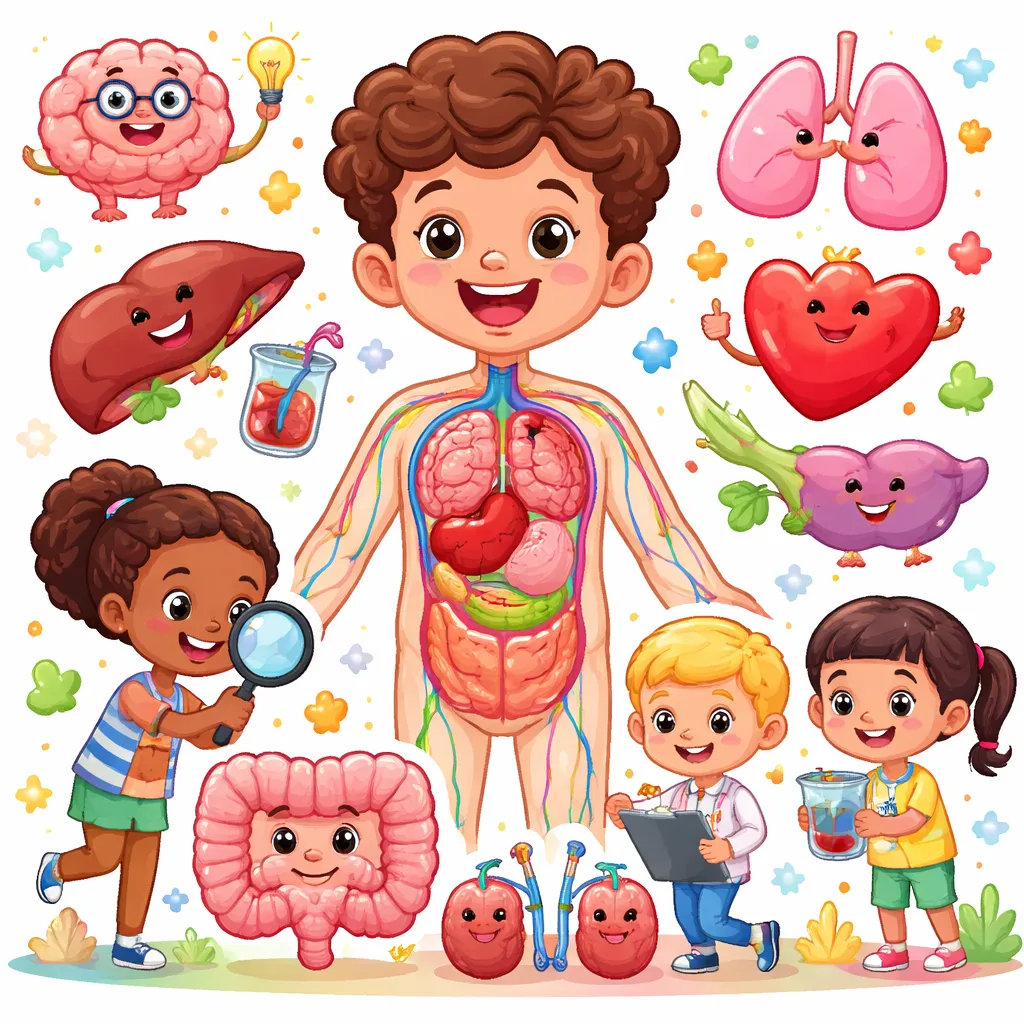
Leo was running in the park. He could feel his heart beating fast in his chest. He could feel his lungs breathing in the cool air. His legs were moving, and his eyes were watching the path. "My body is doing so many things at once!" he thought. Later, he told his mom, a doctor. "It feels like a big team is working inside me." His mom smiled. "You are exactly right! Your body is made of different teams, or systems. Each system has a special job. Together, they make you, you! Let's learn about human body systems simplified for kids. It's the story of the amazing team inside you." Leo was fascinated. He wanted to meet his inner team. Let's meet them together.
Core Knowledge Explanation
Your body is the most amazing machine you will ever own. It runs, thinks, feels, and grows. It does this because of different groups of organs working together. These groups are called systems. Learning about human body systems simplified for kids helps us understand how we live and move. Let's meet the main systems. First, the skeletal system. This is your body's framework. It is made of bones. Your bones give your body shape, like the frame of a house. They protect soft parts. Your skull protects your brain. Your rib cage protects your heart and lungs. Bones also store minerals and make blood cells inside.
The second system is the muscular system. Muscles are attached to your bones. They are like elastic bands. When a muscle gets a message, it contracts, or gets shorter. This pulls on the bone and makes you move. You use muscles to smile, to walk, and to blink. Your heart is also a very special muscle that never gets tired. The third system is the circulatory system. This is your body's delivery service. The heart is the pump. It pumps blood through tubes called blood vessels. Blood carries oxygen and food to every cell in your body. It also takes away waste. This is a key part of human body systems simplified for kids.
The fourth system is the respiratory system. This is your breathing system. You breathe in air through your nose and mouth. The air goes down your windpipe into your lungs. Your lungs take the oxygen from the air and put it into your blood. Then, you breathe out the waste gas, carbon dioxide. The fifth system is the digestive system. This is your body's food processor. It starts in your mouth. You chew food. It goes down to your stomach and intestines. There, it is broken down into tiny pieces. The good parts, nutrients, go into your blood. The waste leaves your body.
The sixth system is the nervous system. This is your body's control center. Your brain is the boss. It sends and receives messages through nerves, like tiny wires. These messages tell your body what to do. "Move your hand!" "That stove is hot!" Your five senses (sight, hearing, touch, taste, smell) are part of this system. They send information to your brain. These are the main human body systems simplified for kids. They all work together, every second, to keep you alive and playing.
Fun Interactive Learning
Let's play a game called "Which System Am I?" One person thinks of a body system. The others ask yes-or-no questions to guess. "Do you help me move?" "Yes." "Do you have muscles?" "Yes." "Are you the muscular system?" "Yes!" This game makes you think about the jobs of each system. Another activity is "Act Out the System." In a group, each person becomes a part of a system. For the skeletal system, stand very straight and still like a bone. For the muscular system, flex your arm muscles. For the circulatory system, make a fist and pump it like a heart. For the respiratory system, take deep breaths in and out. This is a fun, active way to remember the human body systems simplified for kids.
You can also do a "Body System Drawing." Draw a simple outline of a person. Now, draw and color one system at a time. Draw red lines for blood vessels (circulatory) and a heart. Draw a brain and squiggly lines for nerves. Draw bones inside. Label them. Talk about your drawing. "Here is the heart. It pumps blood." This combines art and science. It helps you see how the systems fit together inside one body.
Expanded Learning
All animals have body systems, but they are different. A fish has gills for its respiratory system. A bird has hollow bones to help it fly. But the idea of systems working together is the same in all living things. Learning about human body systems simplified for kids connects you to the whole animal kingdom. Your body is a universe of tiny cells. Each system is made of organs. Each organ is made of tissues. Each tissue is made of cells. Cells are the tiny building blocks of life. It is like a city: cells are the people, tissues are neighborhoods, organs are important buildings, and systems are the city services like transportation and police.
Long ago, people did not know about these systems. Doctors like Hippocrates and Galen started to figure them out. Today, we have machines that can look inside the body without cutting it open. We can see the heart beating and the brain thinking. When you learn the human body systems simplified for kids, you are learning knowledge that took thousands of years to discover. Let's make a body systems chant. Chants are rhythmic and fun.
Bones and muscles, strong and true, help in everything you do! Heart and blood, a pumping race, delivering to every place! Lungs breathe in and breathe out air, showing us how much they care! Stomach, guts, they break down food, putting you in a happy mood! Brain and nerves, the bossy team, making you think and dream! These are systems, what a sight, working day and night!
What You Will Learn
You are learning about anatomy, biology, and how your own body works. You are learning the names of the human body systems simplified for kids: skeletal system, muscular system, circulatory system, respiratory system, digestive system, nervous system. You are also learning words like organ, cell, tissue, nutrient, oxygen, and contract.
You are learning descriptive and explanatory sentences. You can say, "My skeletal system is made of 206 bones." You can explain, "The circulatory system delivers oxygen to my muscles." You can connect, "When I run, my respiratory and circulatory systems work together." You are using English to talk about complex science in a simple, accurate way. This builds a strong foundation for all future learning.
You are building essential knowledge and skills. You are building science vocabulary. You learn the terms for your own body. You are building systems thinking. You see how parts work together for a bigger job. You are building health awareness. You understand why you need to eat, move, and rest. You are building curiosity. You want to know more about how you work. You are building confidence. You can talk about your body intelligently.
You are forming a respectful and curious habit. The habit of listening to and caring for your body. You see your body as a wonderful, interconnected team that you are the leader of. Learning about human body systems simplified for kids empowers you to make choices that help your inner team win at life every day.
Using What You Learned in Life
Use your new knowledge to make healthy choices. When you eat vegetables, think, "This is good fuel for my digestive system and gives nutrients to my blood." When you run and your heart beats fast, say, "My circulatory and respiratory systems are giving energy to my muscles." When you are tired, remember your body needs rest to let all the systems repair. Be kind to your body. Drink water for your cells. Wear a helmet to protect your nervous system (your brain!).
At school, you can be the body expert in science class. You can explain why we need to breathe during exercise. You can also teach a younger sibling about their bones or their heartbeat. When you get a cut, you can say, "My circulatory system is sending blood to fix this, and my skin will heal it." The more you use the human body systems simplified for kids to explain your world, the more you will appreciate the incredible machine you live in.
Closing Encouragement
You are a body explorer. You are a systems thinker. You are a curious and caring learner. I am so proud of you. Learning all about your body's systems shows you have a brilliant mind and a deep appreciation for life.
Listen to your body. Nourish it, move it, and rest it well. You are the captain of the most incredible team in the universe〞your own. You are learning the language of life, and that is the most important language of all.
You are knowledgeable, you are attentive, and you are ready to take great care of your amazing self. Great work, my wonderful body scientist.