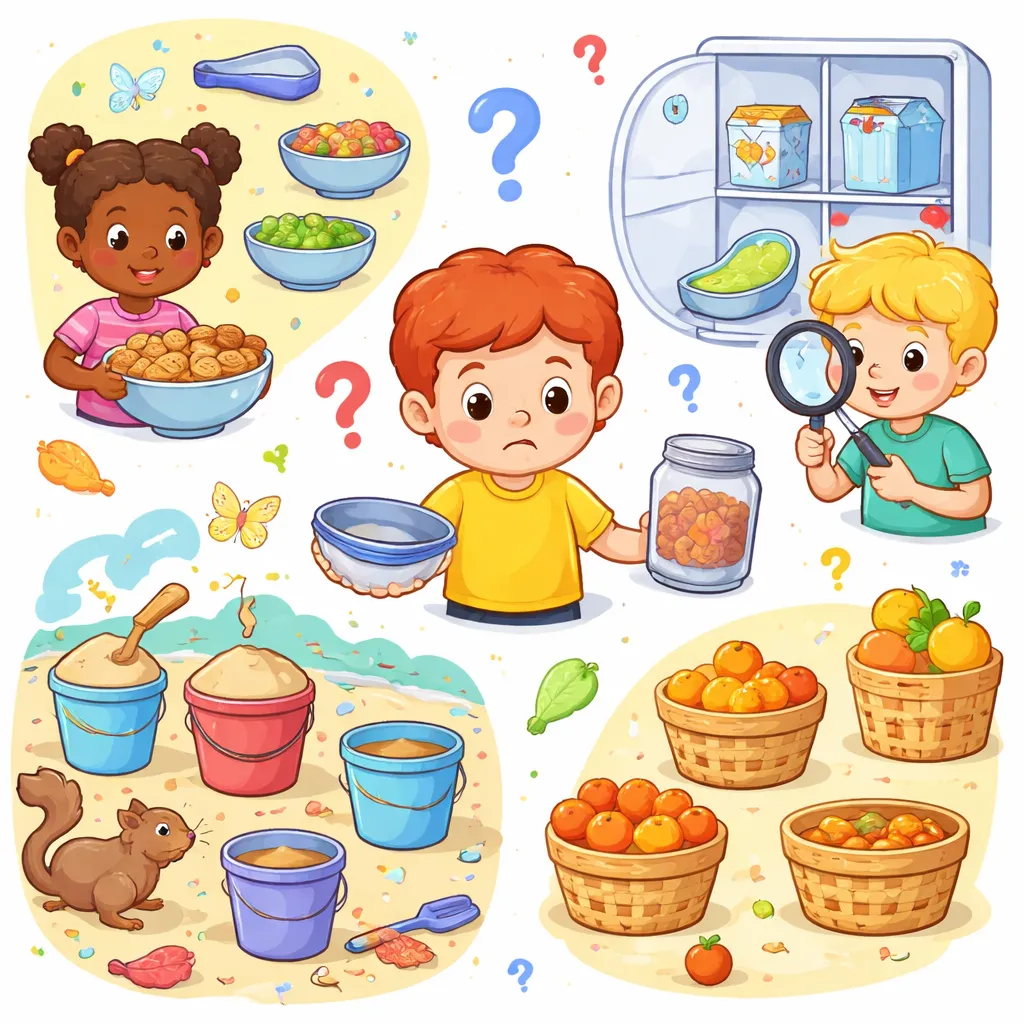

Look at your toy box. Are there some toys inside? Is there any LEGO? Maybe there is no puzzle. The words 'some', 'any', and 'no' are your quantity helpers. They are the "Amount Ambassadors." They tell us about how much or how many. They do not give an exact number. They give an idea. Let's learn how to use these helpful word friends.
What Are These 'Amount Ambassadors'?
'Some', 'any', and 'no' are like little measuring cups for words. They work with nouns. They tell us about the amount. 'Some' suggests a positive amount. It is not zero. It is not all. It is in the middle. 'Any' is used in questions or negative sentences. It is like a detective looking for an amount. 'No' means zero. It is the absence of something. At home, you might say, "I want some juice." This means you want an amount of juice. At the playground, you could ask, "Do you have any balls?" You are asking if balls exist for play. In school, you might state, "There is no chalk." This means zero chalk exists. In nature, we say, "Some birds are singing." This means a number of birds, not all. These helpers make your English precise and clear.
Why Are These Ambassadors So Valuable?
Knowing these words makes you a master of description. It helps your ears, your mouth, your eyes, and your pencil in many ways.
First, it helps your listening. You watch a cartoon. A character says, "I need some help!" Now you understand. They need an amount of help. It is not specific. Your mom might ask, "Is there any milk?" You know she is checking if milk exists. You catch the key question about availability. You learn to listen for these clues about quantity.
Next, it makes your speaking accurate and natural. You can ask for things politely. You say, "May I have some water?" This sounds much better than "May I have water?" The word 'some' makes it soft. You can check for things. "Do you have any ideas?" This invites suggestions. You can state a problem clearly. "There is no time left!" Your words become powerful and exact.
Then, it gives you a reading superpower. You read a recipe. It says, "Add some salt." You know it means an amount, not a precise spoonful. You read a mystery: "There weren't any clues." You see 'any' and know the detective found zero clues. This helps you understand the story's tension. You follow the plot better.
Finally, it makes your writing more descriptive. Your diary entries come alive. Instead of writing "I have cookies," you write "I have some cookies." This tells us you have a few. You can write a story: "The explorer had no food left." Using 'no' creates drama. Your sentences move from simple to detailed and engaging.
Meet the Three Ambassadors: SOME, ANY, and NO
Let's meet our three amount helpers. They each have a special job and personality.
First, meet the Positive Pal: SOME. SOME is used for positive statements. It talks about an unspecified amount. It is used with both countable and uncountable nouns. SOME is friendly and affirmative. Look at these examples. At home: "We have some apples in the kitchen." This is a positive fact. At the playground: "Let's buy some popcorn." This is a suggestion for an amount. In school: "I need some paper for my project." This is a request for an amount. In nature: "Some flowers are red." This describes a part of the whole. SOME is your go-to word for positive, unknown quantities.
Now, meet the Questioning Detective: ANY. ANY is used in most questions and in negative sentences. It is like a detective asking, "Is there an amount?" or stating there isn't one. Look at these examples. At home: "Do we have any bread?" This is a question about existence. At the playground: "I don't have any jump ropes." This is a negative statement. In school: "Are there any questions?" The teacher is inviting questions. In nature: "I don't see any clouds." This is a negative observation. ANY is versatile. It works in questions and negatives.
Finally, meet the Zero Hero: NO. NO means "not any" or zero. It makes a sentence negative by itself. It is a strong word. Look at these examples. At home: "There is no sugar left." This means zero sugar. At the playground: "There are no swings free." This means all swings are taken. In school: "I have no homework today!" This is a happy statement of zero work. In nature: "The tree has no leaves." This describes an absence. NO is simple and direct. It is often used for emphasis.
Let's compare them. Use SOME in positive sentences. "I have some money." Use ANY in questions and negatives. "Do you have any money? I don't have any money." Use NO in positive sentences to express a negative idea. "I have no money." The meaning of "I don't have any money" and "I have no money" is the same. But 'no' is a bit stronger. Remember: ANY is for questions and negatives. SOME is for positives. NO is for positive sentences with a negative meaning.
Your Detective Tool: How to Spot Them
Finding these quantifiers is easy. Here is a simple secret. Look for the words 'some', 'any', or 'no' right before a noun. The pattern is: Some/Any/No + Noun. Ask yourself: "Is this word telling me about an amount of the noun?" If yes, you have found an Amount Ambassador. Another clue: Is the sentence a question? Then 'any' is likely. Is it a positive statement? Then 'some' or 'no' is likely. Is it a negative statement with 'not'? Then 'any' is likely after 'not'.
How to Use Your Ambassadors Correctly
Using these words follows clear maps. Remember the basic rules. For positive statements about an unknown amount, use the map: [Subject] + [have/are/is] + some + [noun]. "I have some friends." "There is some noise."
For questions, use the map: [Do/Does/Are/Is] + [subject] + have/are/is + any + [noun]? "Do you have any pencils?" "Is there any problem?"
For negative sentences, you have two choices. First map: [Subject] + do not/does not/is not/are not + have/are/is + any + [noun]. "I don't have any pencils." Second map: [Subject] + have/are/is + no + [noun]. "I have no pencils." Both are correct. The first is more common in speaking.
Oops! Let's Fix Common Mistakes
Everyone mixes these up sometimes. Let's fix common errors. One mistake is using 'some' in questions. A child might ask, "Do you want some water?" This is actually correct for offers! But for normal questions, we use 'any'. The rule: Use 'some' in questions when you are offering something. "Would you like some tea?" Use 'any' for normal questions. "Do you have any tea?"
Another mistake is using 'any' in positive sentences. Do not say, "I have any books." Say, "I have some books." 'Any' is for questions and negatives.
A third mistake is using 'no' with 'not'. Do not say, "I don't have no money." This is a double negative and is incorrect. Say, "I have no money" or "I don't have any money." Choose one negative word, not two.
Are You Ready for a Challenge?
Let's test your new skills. Look in your backpack. Make three sentences. One with 'some' about what you have. One with 'any' in a question about what you might need. One with 'no' about what is missing. Now, imagine you are at a zoo. Ask a keeper a question using 'any'. Tell a friend about an animal using 'some'. Describe an empty cage using 'no'. Finally, think about a game. Make a rule using one of these words. For example, "There are no time limits." Be creative!
You Are Now an Amount Expert
You have learned all about 'some', 'any', and 'no'. You know they are your quantity helpers. You understand their different jobs. You have the simple rules to use them. You can spot them in sentences. You can even fix common mistakes. Your English is now more precise and powerful.
You can learn many things from this article. You now know that 'some', 'any', and 'no' are quantifiers that talk about an unspecified amount. You understand that 'some' is used in positive statements, 'any' in questions and negatives, and 'no' to mean zero in positive sentences. You learned the special rule that 'some' can be used in questions when making an offer. You saw the important grammar rule to avoid double negatives like "I don't have no...". You also know how to form correct sentences and questions with each of these words.
Now, try using your new knowledge in real life. Here are two fun ideas. First, play the "Some, Any, No" scavenger hunt. Go to your kitchen. Find three things you have 'some' of. Find one thing you have 'no' of. Ask a family member a question with 'any' about the fridge. Second, during your next meal, practice offers. Use "Would you like some...?" to offer food to everyone at the table. Listen to how they answer. Have fun being an Amount Ambassador!