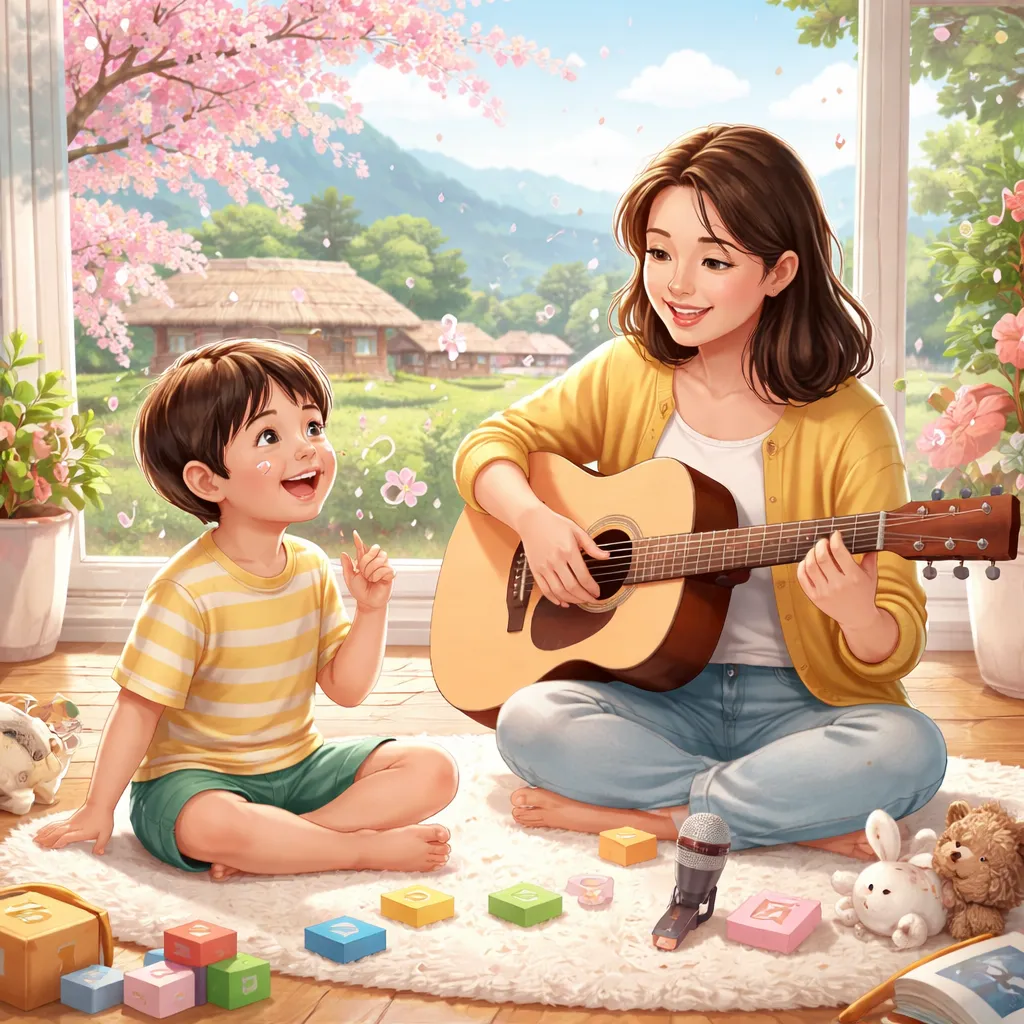

Spring comes to the hometown. Flowers bloom. Birds sing. A song can capture that feeling of home and bring it into language learning. Today, we explore a beloved Korean children’s song called “고향의 봄” (Gohyang-ui bom), which translates to “Spring in My Hometown.” This gentle song celebrates the beauty of spring and the memories of home. We will use this melody as a warm, nostalgic path into English. Together, we will learn new words, explore important sounds, and discover how a simple song can make language learning feel like remembering a beautiful spring day. Spring comes to my hometown. Your child can learn English with that same sense of warmth and memory.
What is the rhyme? “Spring in My Hometown” (고향의 봄) is one of Korea’s most beloved children’s songs. It has been sung for generations. The song describes the beauty of spring in the countryside—willow trees, flowers, birds, and children playing. The song has a slow, gentle rhythm. Children often use hand movements. They sway like willow trees. They pretend to pick flowers. They listen to birds. The song creates a warm, nostalgic atmosphere. It celebrates the beauty of nature and the love of home. When we bring this song to English learning, we keep its warm, gentle spirit. We use the familiar melody to introduce English words in a way that feels like remembering a beautiful place.
The lyrics of nursery rhymes To appreciate this song, we first look at the original Korean words. Then we see how they translate into English. This shows children that the same warm spring song can be told in different languages. You do not need to know Korean to enjoy the slow, gentle rhythm of the words.
Original Version (Korean)
나의 살던 고향은 꽃피는 산골 복숭아꽃 살구꽃 아기 진달래 울긋불긋 꽃대궐 차린 동네 그 속에서 놀던 때 그리운 고향
English Version
My hometown where I lived A mountain village where flowers bloom Peach blossoms, apricot blossoms Baby azaleas A village dressed in colorful flower palaces The time I played there My beloved hometown
A simpler version for children focuses on the spring images:
고향의 봄 고향의 봄 버드나무 실 늘어지고 꽃은 핀다
English Version
Spring in my hometown Spring in my hometown Willow branches hang low Flowers bloom
As you read these words, notice the slow, gentle repetition. The rhythm moves like a spring breeze. The story is simple and warm. My hometown where I lived, a mountain village where flowers bloom. Peach blossoms, apricot blossoms, baby azaleas. A village dressed in colorful flower palaces. The time I played there, my beloved hometown. Spring in my hometown, willow branches hang low, flowers bloom. This narrative invites children to imagine a beautiful spring day.
Vocabulary learning This song offers a lovely set of words that connect to spring, nature, and home. We can explore these words through conversation, pictures, and gentle reflection.
Start with the main ideas: spring and hometown. In Korean, they are 봄 (bom) and 고향 (gohyang). In English, we say “spring” and “hometown.” Spring is the season when flowers bloom. Hometown is the place you grew up.
Here are the key words to focus on from the song:
Spring: The season after winter. Spring in my hometown.
Hometown: The place where you grew up. My hometown.
Mountain village: A village in the mountains. A mountain village.
Flowers bloom: Flowers open. Flowers bloom.
Peach blossoms: Flowers of the peach tree. Peach blossoms.
Apricot blossoms: Flowers of the apricot tree. Apricot blossoms.
Azaleas: Colorful flowers. Baby azaleas.
Colorful: Having many colors. Colorful flower palaces.
Willow: A tree with long, hanging branches. Willow branches hang low.
Played: Had fun. The time I played there.
Beloved: Loved very much. My beloved hometown.
Use these words in natural moments. In spring, say “spring has come.” When you remember a special place, say “my beloved hometown.” These connections make the vocabulary meaningful.
Phonics points Phonics helps children understand the sounds that build English words. This song gives us several clear sounds to explore in a warm, gentle way.
First, focus on the ‘s’ sound at the beginning of “spring.” This is a soft, airy sound. Say “s s s” like a snake. Practice with “sun,” “song,” and “spring.” This sound is soft and fresh.
Next, notice the ‘pr’ blend in “spring.” Say “s,” then quickly add “p,” then “r.” Then add “ing.” Practice with “spring,” “sprinkle,” and “spring.” This blend is fresh and new.
The word “blossom” contains the ‘bl’ blend and the short ‘o’ sound. Say “b,” then quickly add “l.” Then add “ossom.” Practice with “blue,” “blow,” and “blossom.” The short ‘o’ is like “hot.”
Finally, look at the ‘w’ sound in “willow.” This is a voiced sound made with rounded lips. Say “w w w.” Practice with “water,” “wind,” and “willow.” The song also has “village,” which contains the ‘v’ sound. Say “v v v.”
Grammar patterns Even a simple song contains grammar that we can introduce gently. We do not need to use technical terms. Instead, we show how words work together through examples and play.
The song uses the past tense to talk about memories. “Lived,” “played,” and “dressed” describe things that happened in the past. You can practice telling about memories. “I lived in a village.” “I played there.” This builds understanding of past tense.
Notice the repetition of “spring in my hometown.” Repetition adds warmth and emphasis. You can practice repeating for effect. “Spring, spring.” “Hometown, hometown.” This adds loving language.
The phrase “where I lived” is a relative clause. You can practice with other “where” phrases. “The place where I played.” “The town where I grew up.” This builds complex sentences.
Also, look at the descriptive words “colorful” and “beloved.” You can practice describing things. “A colorful village.” “A beloved hometown.” “Beautiful blossoms.” This builds descriptive language.
Learning activities Activities bring the song into the body and the imagination. They transform listening into active participation. These ideas are simple and require little preparation.
Spring Walk Go for a walk in spring. Look for flowers blooming. Look for willow trees. Say “spring has come!” This connects the song to real nature.
Spring Drawing Draw a picture of your hometown in spring. Draw flowers, trees, and children playing. Label the parts. “Peach blossoms.” “Willow tree.” This builds creativity and vocabulary.
Memory Game Talk about memories of spring. “I remember playing outside.” “I remember flowers blooming.” This builds language about memory.
Printable materials Printable resources offer a quiet way to reinforce the song’s vocabulary. They are perfect for moments when children want to create or focus calmly.
Flashcards Create a set of flashcards. One card shows spring flowers for “spring.” One shows a village for “hometown.” One shows peach blossoms. One shows apricot blossoms. One shows azaleas. One shows a willow tree. Use these cards for a matching game. Sing a line from the song and ask your child to find the matching card. This builds word recognition.
Coloring Page Draw a simple spring scene. Show a mountain village with flowers blooming. Show peach blossoms, apricot blossoms, and azaleas. Show a willow tree. Children can color the flowers pink, white, and purple, and the leaves green. As they color, talk about the scene. “What flowers do you see?” “What season is it?” This keeps the language flowing naturally.
Memory Box Create a memory box for your hometown or special place. Draw pictures or bring small objects that remind you of home. Talk about them. This builds connection and vocabulary.
Educational games Games encourage repetition without boredom. They invite children to use the language in new and creative ways.
Spring Says Play a game similar to “Simon Says.” Give commands using the song’s vocabulary. “Spring says flowers bloom.” “Spring says willow branches hang low.” “Spring says remember your hometown.” “Spring says be beloved.” If you give a command without saying “spring says,” the child does not move. This game builds listening skills.
Flower Hunt Find flowers outside or in pictures. Name them. “Peach blossoms.” “Apricot blossoms.” “Azaleas.” This builds observation and vocabulary.
Memory Game Take turns sharing a happy memory. “I remember playing with friends.” “I remember the flowers.” This builds social and emotional language.
As you share “고향의 봄” with your child, remember that you are celebrating memory and home. My hometown where I lived, a mountain village where flowers bloom. Peach blossoms, apricot blossoms, baby azaleas. A village dressed in colorful flower palaces. The time I played there, my beloved hometown. Spring in my hometown, willow branches hang low, flowers bloom. Learning a new language can be like remembering a beautiful spring day. You collect words like flowers. You hold them in your heart. They become part of your home. Let this gentle song be your guide. Remember the beauty. Let the warm spirit of the song remind you both that every new word you learn is like a flower blooming in your language hometown, and your heart is where they all belong.