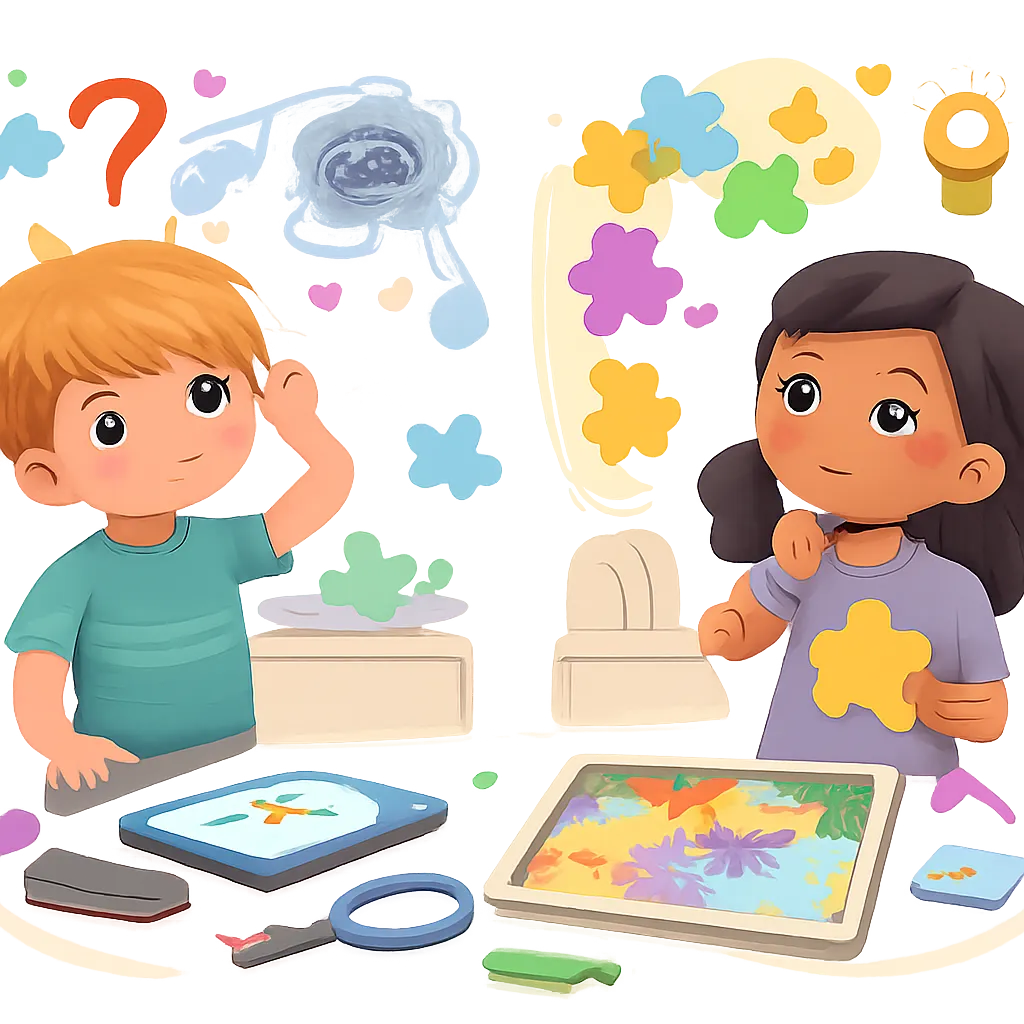

Are Similar Words Really Interchangeable?
Many English words share similar meanings. This often creates confusion for young learners. Words like confused and puzzled both describe not understanding something. They seem easy to use in the same way.
However, they are not always interchangeable. Small differences affect tone and meaning. These differences help children express thoughts more clearly.
When children learn these details, they improve both language skills and thinking skills. This supports better communication and learning.
Set 1: confused and puzzled — Which One Is More Common?
The word confused is very common in daily English. Children hear it often at school and at home. For example, “I feel confused about this question.”
Puzzled appears less often. It sounds slightly more descriptive and thoughtful. For example, “She looked puzzled by the answer.”
Because of this, confused becomes part of early vocabulary. Children use it naturally in many situations.
Parents can introduce confused first. Then they can add puzzled to expand expression.
Set 2: confused and puzzled — Same Meaning, Different Contexts
Both words describe a lack of understanding. Yet they appear in slightly different contexts.
Confused often describes a stronger feeling:
I am confused about the homework. He felt confused during the lesson.
It can suggest difficulty or frustration.
Puzzled often describes a lighter and more curious reaction:
She looked puzzled by the riddle. He felt puzzled by the strange sound.
Puzzled often connects with thinking and curiosity.
Children should learn that confused can feel heavier. Puzzled can feel lighter and thoughtful.
Set 3: confused and puzzled — Which Word Is “Bigger” or More Emphatic?
When comparing intensity, confused is often stronger than puzzled.
Confused suggests a deeper lack of understanding. It may feel uncomfortable.
Puzzled suggests mild confusion mixed with curiosity. It may encourage thinking.
For example:
A child feels confused when instructions are unclear. A child feels puzzled when solving a fun problem.
This difference helps children describe their thinking and feelings more clearly.
Set 4: confused and puzzled — Concrete vs Abstract
Both confused and puzzled describe abstract mental states. They express thoughts, not physical objects.
Confused can connect to visible signs:
a confused face a confused voice
Children can easily recognize these signs.
Puzzled often appears in expressions of thinking:
a puzzled look a puzzled expression
It suggests thinking rather than strong emotion.
This makes confused easier for beginners. Puzzled adds depth to thinking language.
Set 5: confused and puzzled — Verb or Noun? First Understand the Role
Understanding parts of speech helps children use words correctly.
Confused comes from the verb confuse:
The question confused him. He felt confused.
It connects to the noun confusion:
There was confusion in the room.
Puzzled comes from the verb puzzle:
The problem puzzled her. She felt puzzled.
It connects to the noun puzzle:
The puzzle was difficult.
Learning these word families helps children expand vocabulary step by step.
Set 6: confused and puzzled — American English vs British English
Both words appear in American and British English. Their meanings stay the same.
Confused is very common in both regions. It appears in daily conversation and learning.
Puzzled also appears in both, but it sounds slightly more descriptive and reflective.
Children can safely use confused in most situations. Learning puzzled adds variety and nuance.
Set 7: confused and puzzled — Which Fits Formal Situations?
Word choice matters in formal communication.
Confused works in both informal and formal contexts:
“I am confused about the result” sounds clear and direct.
Puzzled can sound more thoughtful and descriptive:
“She seemed puzzled by the findings” sounds more reflective.
Both words can appear in writing. However, puzzled often adds a softer tone.
Teaching this difference helps children adjust their language.
Set 8: confused and puzzled — Which One Is Easier for Kids to Remember?
Children learn best with simple and familiar words.
Confused is easier because:
it appears often it connects to clear learning situations it has simple meaning
Puzzled is less common and slightly more complex. It may take more time to learn.
However, once children enjoy solving problems, they can understand puzzled more easily.
Parents can use games and riddles to teach this word.
Mini Exercise: Can You Spot the Differences Between These Similar Words?
Try these exercises together.
Choose the correct word: confused or puzzled.
He felt ______ during the difficult lesson. She looked ______ at the strange picture. The child was ______ by the instructions. He seemed ______ while solving the riddle.
Answers:
confused puzzled confused puzzled
Encourage children to explain their choices. This builds deeper understanding.
Parent Tips: How to Help Kids Learn and Remember Similar Words
Parents can support vocabulary learning with simple steps.
Start with confused. Use it in daily learning situations. Talk about problems and questions.
Then introduce puzzled. Explain that it describes thinking and curiosity.
Ask guiding questions:
Is this feeling strong or light? Does the child feel stuck or curious?
Use real-life examples. A child may feel confused during a hard lesson. A child may feel puzzled while solving a game.
Encourage children to use both words in speaking and writing. Practice builds confidence.
Keep learning positive and supportive. When children understand words like confused and puzzled, they gain tools to describe their thinking clearly and confidently.