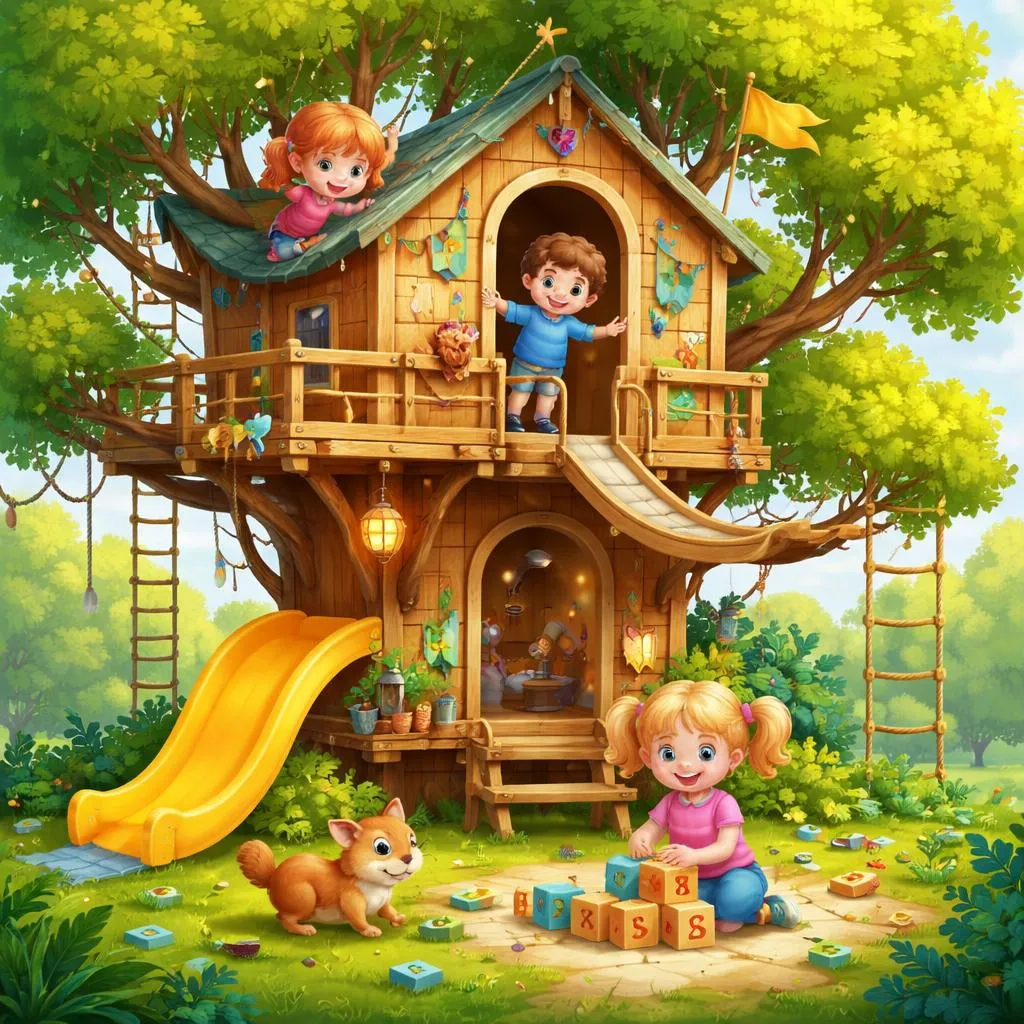

Hello, little word architect! Do you know about a treehouse? A treehouse has a big, strong main room. It also has a special rope ladder to get up. A complex sentence is like a word treehouse. It has a main room. That is the main clause. It also has a rope ladder. That is the dependent clause. The ladder adds extra detail but cannot stand alone. Today, we will build forty wonderful word treehouses. Our guide is Buddy the Bird. Buddy loves to build nests and sentences with different parts! He will show us complex sentences at home, the playground, school, and in the forest. Let's start building!
What Is a Complex Sentence? A complex sentence is a word treehouse. It has one main clause. The main clause is a complete thought. It can stand alone. It is like the main room. It also has one or more dependent clauses. A dependent clause is not a complete thought. It needs the main clause. It starts with a special word like "because", "when", "if", "after". It is like the rope ladder. At home, you say "I cry because I am sad." The main room is "I cry." The rope ladder is "because I am sad." At the playground, you say "When the bell rings, we go inside." The rope ladder is "When the bell rings." The main room is "we go inside." At school, you say "If I finish my work, I get a sticker." This is a complex sentence. In nature, Buddy says "After the rain stops, worms come out." "Buddy sings when he is happy." This is a complex sentence. Learning these must-know complex sentences helps you explain reasons and times.
Why Build a Word Treehouse? Complex sentences are your explaining tools! They help your ears listen. You can understand why or when something happens. They help your mouth speak. You can give reasons. "I want a cookie because I am hungry." They help your eyes read. You will see them in longer stories. They help your hand write. You can write sentences that show cause and effect. A word treehouse makes your ideas deeper. It connects a main event to its reason, time, or condition.
What Are the Main Rope Ladders? We have different rope ladders. Each one starts with a special word. These words are called subordinating conjunctions.
First, the reason ladder. It starts with BECAUSE, SINCE. It tells why. "I am happy because I see you."
Next, the time ladder. It starts with WHEN, WHILE, AFTER, BEFORE, UNTIL. It tells when. "I wash my hands before I eat."
Here is the condition ladder. It starts with IF, UNLESS. It tells under what condition. "You can play if you are good."
We have the place ladder. It starts with WHERE. It tells where. "I sit where you sit."
Last, the contrast ladder. It starts with ALTHOUGH, EVEN THOUGH. It shows a difference. This is harder. "I went out although it was cold."
How Can You Spot a Word Treehouse? Spotting a complex sentence is a fun hunt. Look for the rope ladder word. Words like "because", "when", "if", "after". These words often start the dependent clause. Then find the main clause. Ask yourself: "Can this part stand alone as a sentence?" If yes, it is the main room. The other part is the ladder. Look at Buddy's treehouse. "Because Buddy is small, he lives in a nest." The rope ladder is "Because Buddy is small." The main room is "he lives in a nest." You found it! Another trick: The dependent clause often sounds incomplete by itself. "When I am big " What happens? It needs the main room.
How Do We Build a Word Treehouse? Building has a simple rule. You can put the rope ladder first or the main room first. If the rope ladder comes first, use a comma after it. Rope Ladder + Comma + Main Room. "After I wake up, I make my bed." If the main room comes first, you usually do not need a comma. Main Room + Rope Ladder. "I make my bed after I wake up." Buddy uses this pattern. "Buddy flies home when the sun sets." Main room: Buddy flies home. Rope ladder: when the sun sets. No comma needed. Start with putting the rope ladder second. It is easier.
Let's Fix Some Wobbly Treehouses. Sometimes our treehouses are wobbly. Let's fix them. A common wobble is using the rope ladder as a full sentence. A child might say "Because I said so." This is just a rope ladder. Where is the main room? The right way is "You must listen because I said so." Another wobble is forgetting the comma when the rope ladder is first. "When you finish you can play." This runs together. Use a comma: "When you finish, you can play." Also, make sure your rope ladder connects to the right main room. "I ate my sandwich after I played at the park." The order makes sense.
Can You Be a Treehouse Builder? You are a great builder! Let's play a game. The "Add a Ladder" game. I will give you a main room. You add a rope ladder with "because". Main room: "The dog is barking." You say: "The dog is barking because he sees a cat." Great! Here is a harder challenge. Take a main room and add two different rope ladders. Main room: "I will share my toy." Add a "when" ladder: "I will share my toy when you ask nicely." Add an "if" ladder: "I will share my toy if you are my friend." You are building must-know complex sentences.
Your Forest of 40 Must-Know Complex Sentences. Ready to see the forest? Here are forty wonderful word treehouses. Buddy the Bird has built them. They are sorted by their rope ladder word. These are your must-know complex sentences.
BECAUSE (Reason) Treehouses. I am smiling because I am happy. I am crying because I fell down. We stay inside because it is raining. I wear a coat because it is cold. I eat veggies because they are good. The baby sleeps because he is tired. I help you because I love you. I run fast because I am excited. I am quiet because the baby sleeps. I share because it is nice.
WHEN (Time) Treehouses. When I grow up, I will drive. I clap when the music ends. When you are sad, I hug you. I go to bed when the moon is out. When the phone rings, we answer it. I wash my hands when they are dirty. I say thank you when you help. When I see a friend, I say hello. I listen when my teacher talks. I get a treat when I am good.
IF (Condition) Treehouses. If you are hungry, eat an apple. You can play if you clean up. If it snows, we make a snowman. I will come if you call me. If you drop it, pick it up. I am happy if you are happy. We can go if you are ready. If the light is red, stop. I will read if you sit down. You can have it if you want.
AFTER / BEFORE (Time Order) Treehouses. After I eat, I wash my plate. Before we cross, we look both ways. I brush my teeth after I eat. Before I sleep, I read a book. After the bath, I am clean. I say goodbye before I leave. After you finish, you may go. I get dressed before breakfast. Before you touch, please ask. I feel better after I nap.
WHERE (Place) Treehouses. I sit where you are sitting. Put the toy where it belongs. The cat sleeps where it is warm. I play where the grass is green. We eat where the table is. Flowers grow where there is sun. I stand where I can see. The book goes where it was. I wait where you told me. The bird flies where it wants.
These forty sentences are your must-know complex sentences. Practice building treehouses with "because", "when", and "if" first.
Explaining Your World with Deeper Sentences. You did it! You are now an expert on complex sentences. You know a complex sentence is a word treehouse. It has a main clause and a dependent clause. The dependent clause starts with a word like "because" or "when". You know why we use them to give reasons and set conditions. You can spot the dependent clause. You know the comma rule. Buddy the Bird uses complex sentences to explain his day in the forest. Now you can too! You can tell people why you feel a certain way. You can explain what needs to happen first. Your ideas will have more depth and clarity.
Here is what you can learn from our treehouse adventure. You will know what a complex sentence is. You will understand the role of main and dependent clauses. You can identify common subordinating conjunctions. You can use commas correctly when the dependent clause comes first. You have a forest of forty essential complex sentences.
Now, let's do some life practice! Your mission is today. Explain your actions with a "because" clause. Tell your grown-up: "I am putting on my shoes because we are going out." Ask about time with a "when" clause: "When is dinner time?" Make a deal with an "if" clause: "I will put my toys away if we can read a story." You just built three different word treehouses! Keep building your sentences. Have fun, little architect!