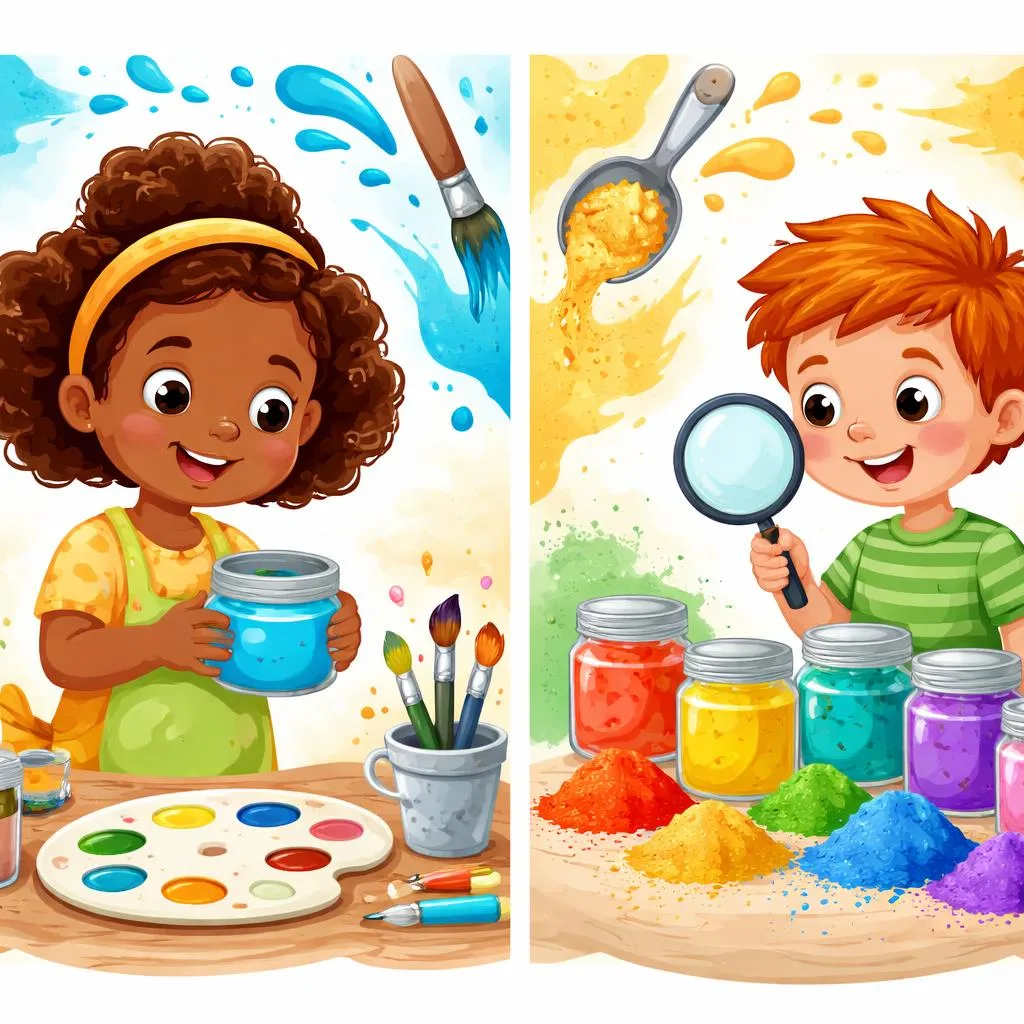

Start! Find a Pair of 'Color Twin' Words
Hello, word artist! Do you love to create colorful pictures? You squeeze a tube and out comes paint. It is wet and ready. Now, think about what gives that paint its color. It is a dry powder called pigment. They are both about color. Are they the same? This is a fun art puzzle. Today we explore a word pair. We explore paint and pigment. They are like a smoothie and a berry. One is the drink. One is the fruit that colors it. Knowing the difference is a superpower. Your talk about art will be clear and smart. Let us start our colorful word mixing!
Be a Language Observer now. Our first clue is at home. You paint a picture. Your mom says, "Use the red paint." Your dad shows you a spice jar. He says, "This turmeric is a yellow pigment." They are both about color. But are they the same? Let us test with two sentences.
"She brushed blue paint onto the canvas." This is about the wet, spreadable mixture. "The pigment for the paint came from crushed lapis lazuli stones." This is about the dry, colorful powder.
They both are involved in making color. But one is the final, usable product. One is the raw, color-giving ingredient. Your observation mission starts. Let us mix our way into their word world.
Adventure! Mix Into the Word World
Feel the Word's Wet and Dry Vibe!
Feel the word paint. It is a wet, ready word. It feels like a tube, a brushstroke, and a finished wall. It is a mixture you can use now. The word pigment is a dry, raw word. It feels like a powder, a crushed rock, or a fine dust. It is the pure color source. Paint is the soup. Pigment is the spice. One is prepared. The other is an ingredient. Let us see this at school.
In an art class, you dip your brush into paint. This is the material you apply. In a science class, you look at pigment under a microscope. This is the tiny color particle. Saying "dip your brush into pigment" is not right. The state of the words is different. One is liquid or paste. The other is powder.
Compare Their Mixture and Ingredient Nature!
Think about a delicious cake and a bag of flour. The word paint is the cake. It is a mixture of many things. The word pigment is the flour. It is one important part of the mixture. Their composition is the key. Paint is made of pigment (color), a binder (glue), and a solvent (liquid). Pigment is just the color part. Let us test this on the playground.
You have a pot of finger paint. It is gooey and fun. Your friend has a bag of brightly colored chalk dust. That dust is a pigment. The word paint describes the ready-to-use goo. The word pigment describes the dry powder that could become paint. The playground shows the difference.
Meet Their Best Word Friends!
Words have favorite color partners. The word paint likes art and application words. It teams up with 'oil', 'water', 'finger', 'spray', 'fresh', and 'room'. Do not touch the wet paint. It is finger paint. The word pigment likes source and science words. It teams up with 'natural', 'organic', 'skin', 'mineral', 'earth', and 'powdered'. It is a natural pigment. He has a skin pigment disorder. Their partners are different. Let us go back to school.
In a history class, you learn about cave paint. This is the mixture on the wall. In the same lesson, you learn about the pigments from plants they used. This is the color source. You would not usually say "cave pigment." The word friends set the context.
Our Little Discovery!
We mixed colors in the word world. We made a clear discovery. The words paint and pigment are different. Paint is a colored liquid or paste that you spread on a surface. It is a ready-to-use mixture. Pigment is a dry, powdered substance that gives paint its color. It is the raw colorant. Paint is the product. Pigment is a key ingredient. One is wet and usable. The other is dry and powdery. This is the main difference.
Challenge! Become a Color Word Expert
"Best Choice" Challenge!
Let us look at a nature scene. A flamingo gets its pink color from the shrimp it eats. The shrimp contain a natural pink pigment. Is it Paint or Pigment? The champion is Pigment! This is the natural colorant inside the shrimp. Now, an artist wants to paint that flamingo. She squeezes pink paint from a tube. Is it paint or pigment? The champion is paint! This is the ready-made mixture she applies with a brush. Excellent!
"My Sentence Show"!
Now, create your own sentences. Here is a fun scene: Imagine covering a wall with a new color. Use the word paint in one sentence. Now imagine describing the ground-up minerals that make an ancient dye. Use the word pigment in another. Try it! Here is an example. Sentence one: "We need two cans of white paint for the fence." Sentence two: "The ancient pigment was made from grinding blue stones into dust." See the difference? The first is about the material for covering a surface. The second is about the raw, powdered color source.
"Eagle Eyes" Search!
Can you find the word that needs help? Read this sentence: "The old master mixed his own paints by grinding different colored paints with oil." Hmm. This is a mix. He grinds dry pigments, not paints, to mix with oil. A better sentence is: "The old master mixed his own paints by grinding different colored pigments with oil." You fixed it!
What a colorful and creative mixing session in the word world! You started as a curious painter. Now you are a word chemist. You know the secret of paint and pigment. You can feel their different wet and dry vibes. You see that paint is a mixture and pigment is an ingredient. You know their best word friends. This is a real language superpower.
You can learn amazing things from this article. You now know that 'paint' is the wet, colored mixture you use for art and decoration. You understand that 'pigment' is the dry, powdered substance that gives paint, ink, and even natural things their color. You can explain that pigment is the source of color, and paint is what happens when you mix pigment with other ingredients. You learned terms like 'finger paint' and 'natural pigment'.
How can you use this today? It is easy and fun. Next time you paint, remember the pigment inside your paint. Look at a tube of paint. The color comes from a pigment. In a museum, you might hear about the pigments used in old paintings. Try a project: mix chalk dust (pigment) with glue to make your own paint. Draw two pictures. Draw a hand using paint. Draw a jar of powdered pigment. You are using your new skill every day.
Keep your explorer eyes open. The world is full of amazing paints and the pigments that make them. You are learning the words to describe them all. Great work, word expert. Your English journey is getting more colorful and precise with every new word pair you discover!