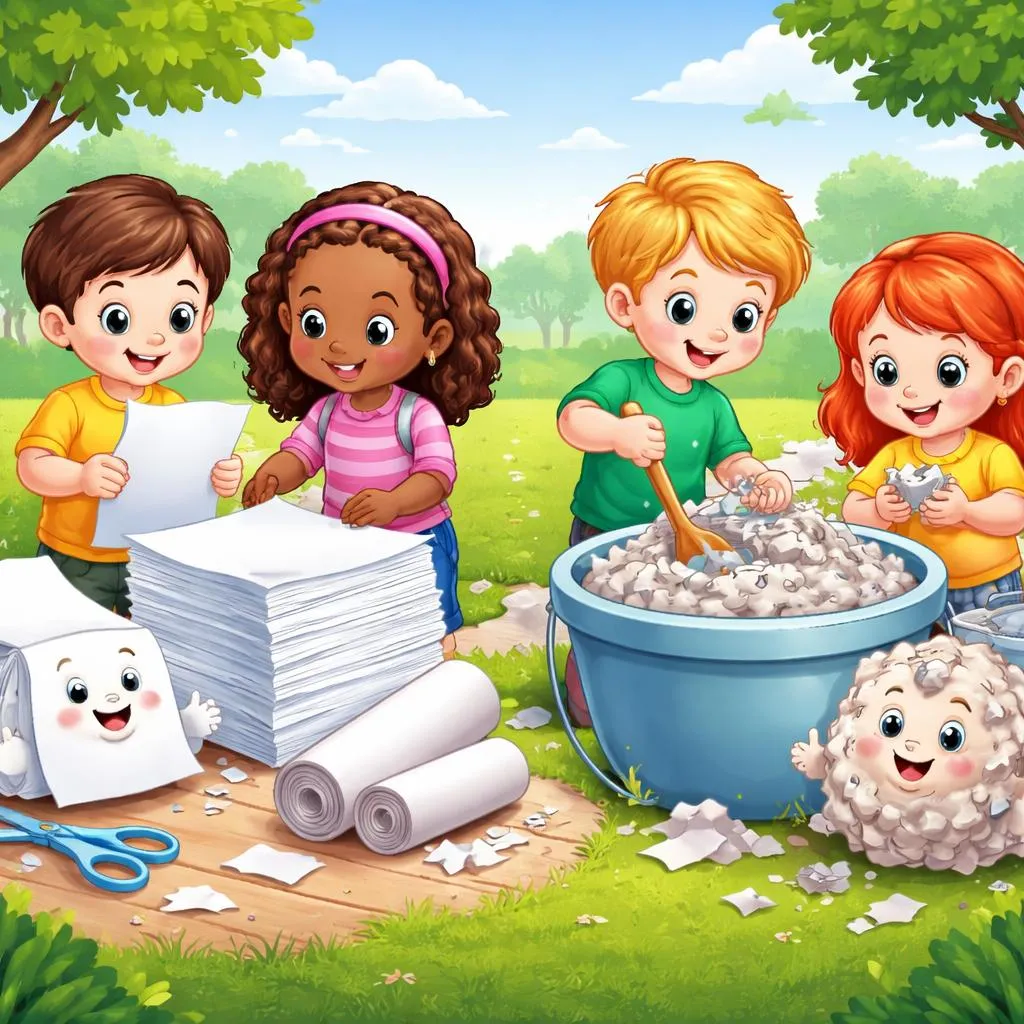

Start! Find a Pair of 'Material Twin' Words
Hello, word explorer! Do you love to draw and create? What do you draw on? You use smooth, flat paper! Now, think about how paper is made. It starts as a wet, mushy mixture called pulp. They are both about the same material. Are they the same? This is a fun science puzzle. Today we explore a word pair. We explore paper and pulp. They are like a cookie and cookie dough. One is the final product. One is the raw mix. Knowing the difference is a superpower. Your talk about making things will be clear and smart. Let us start our word creation!
Be a Language Observer now. Our first clue is at home. You write a note on a piece of paper. Your mom shows you a craft project. She says, "We will make new paper from recycled pulp." They are both about the same substance. But are they the same? Let us test with two sentences.
"Please hand me a clean sheet of paper to write a letter." This is about the finished, dry, flat product. "The pulp for the paper was made from mashed-up old newspapers and water." This is about the wet, mushy material.
They both relate to the material we write on. But one is the final, usable object. One is the messy, beginning mixture. Your observation mission starts. Let us create our way into their word world.
Adventure! Create Into the Word World
Feel the Word's Finished and Raw Vibe!
Feel the word paper. It is a finished, smooth word. It feels like a book, a drawing, or a note. It is ready to use. The word pulp is a raw, messy word. It feels like a goo, a mash, or a thick soup. It is the material before it becomes paper. Paper is the butterfly. Pulp is the caterpillar. One is the end. The other is the beginning. Let us see this at school.
In an art class, you create a beautiful drawing on paper. This is the final product of your work. In a science class, you learn how wood is turned into pulp to make paper. This is about the process. Saying "draw on pulp" is not right. The stage of the words is different. One is the result. The other is the ingredient.
Compare Their State and Use!
Think about a slice of bread and a bowl of flour paste. The word paper is the bread slice. It is solid, dry, and useful. The word pulp is the flour paste. It is wet, shapeless, and needs to be processed. Their state is the key. Paper is for writing, printing, and folding. Pulp is for making, mixing, and molding. Let us test this on the playground.
You have a dry, crisp paper airplane. You say, "My paper plane flies far!" Your friend mixes water and shredded paper in a bucket. He says, "I am making pulp to form a new sheet." The word paper describes the finished airplane. The word pulp describes the wet mixture to make new paper. The playground shows the difference.
Meet Their Best Word Friends!
Words have favorite material partners. The word paper likes finished and functional words. It teams up with 'tissue', 'newspaper', 'toilet', 'towel', 'scrap', and 'graph'. Wrap it in paper towel. Read the paper. The word pulp likes raw and process words. It teams up with 'wood', 'orange', 'beat into a', 'soy', 'mash into', and 'fruit'. It is orange pulp. Beat it into a pulp. Their partners are different. Let us go back to nature.
A wasp might use wood pulp to build its nest. This is the raw material. A bird might line its nest with soft paper. This is the finished material. You would not usually say a "pulp nest" for the bird. The word friends set the form.
Our Little Discovery!
We created in the word workshop. We made a clear discovery. The words paper and pulp are different. Paper is the thin, flat material made from dried pulp. It is used for writing, printing, and packaging. Pulp is the soft, wet mass of fibers. It is made by crushing raw materials like wood or recycled paper. Paper is the product. Pulp is the ingredient. One is the end result. The other is the beginning mixture. This is the main difference.
Challenge! Become a Material Word Expert
"Best Choice" Challenge!
Let us look at a nature scene. A squirrel finds a soft, dry material to line its drey. It uses shredded paper. Is it Paper or Pulp? The champion is Paper! The squirrel uses the finished, dry material. Now, imagine a beaver chews on a tree. It breaks the wood into a soft, wet mass. This mass is like wood pulp. Is it paper or pulp? The champion is pulp! This describes the raw, chewed-up wood fibers. Excellent!
"My Sentence Show"!
Now, create your own sentences. Here is a fun scene: Imagine a crisp, new notebook. Use the word paper in one sentence. Now imagine the gooey mixture inside a blender when making a smoothie. Use the word pulp in another. Try it! Here is an example. Sentence one: "The notebook's paper was perfect for writing stories." Sentence two: "The smoothie had delicious fruit pulp in it." See the difference? The first is about the smooth writing surface. The second is about the thick, fibrous part of the fruit.
"Eagle Eyes" Search!
Can you find the word that needs help? Read this sentence: "After the recycling truck came, the old newspapers were turned into a sloshy, gray paper at the factory." Hmm. This is a mix. The old newspapers are turned into pulp, not paper, at that stage. A better sentence is: "After the recycling truck came, the old newspapers were turned into a sloshy, gray pulp at the factory." You fixed it!
What a creative and messy adventure in the word world! You started as a curious user. Now you are a word maker. You know the secret of paper and pulp. You can feel their different finished and raw vibes. You see that paper is the product and pulp is the ingredient. You know their best word friends. This is a real language superpower.
You can learn amazing things from this article. You now know that 'paper' is the smooth, flat, finished product we use for writing, drawing, and wrapping. You understand that 'pulp' is the wet, mushy mixture of fibers that is pressed and dried to make paper. You can explain that paper comes from pulp, and pulp is made from materials like wood or recycled paper. You learned terms like 'newspaper' and 'orange pulp'.
How can you use this today? It is easy and fun. Look at a piece of notebook paper. That is paper. Think about the juice with bits in it. Those bits are pulp. Do a recycling craft. Shred old paper and mix it with water to make pulp. Then press it into new paper. Draw two pictures. Draw a stack of clean paper. Draw a blender with fruit pulp. You are using your new skill every day.
Keep your explorer eyes and hands ready. The world is full of amazing products and the materials that make them. You are learning the words to describe them all. Great work, word expert. Your English journey is getting more creative and precise with every new word pair you discover!