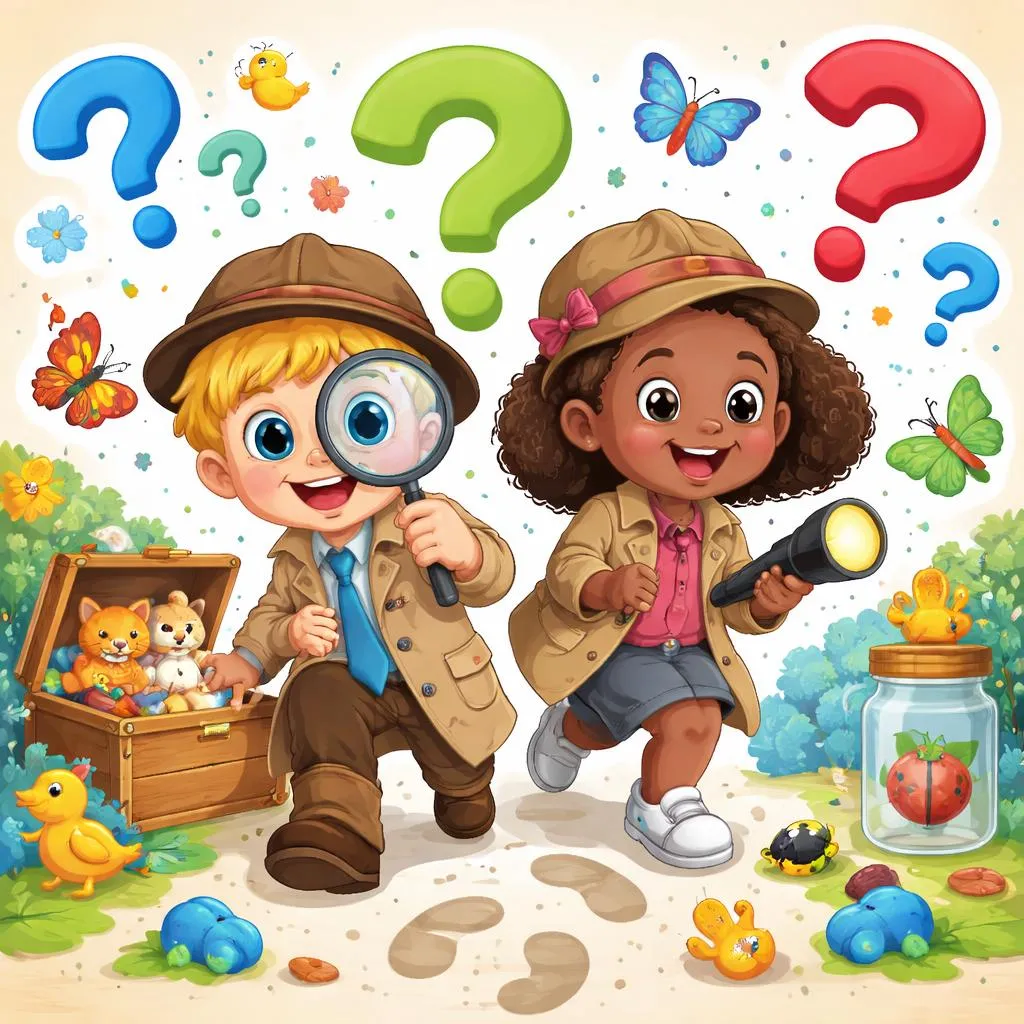

Hello, little detective! Do you know about detectives? They look for clues. They ask lots of questions to find answers. "Who did it?" "What is that?" "Where is the clue?" Interrogative sentences are question sentences. They are your detective tools! An interrogative sentence asks something. It wants an answer. Today, we will learn forty wonderful detective questions. Our guide is Detective Digby, a clever owl. Digby loves to ask questions to solve mysteries! He will show us how to ask questions at home, the playground, school, and in the forest. Put on your detective hat! Let's start asking.
What Is an Interrogative Sentence? An interrogative sentence is a question sentence. Its job is to ask for information. It wants to know something. Every time you ask "why?" or "what's that?", you are using an interrogative sentence. At home, you ask "Where is my teddy?" This is an interrogative sentence. At the playground, you ask "Can I go on the swing?" This is an interrogative sentence. At school, you ask "What is your name?" This is an interrogative sentence. In nature, Detective Digby asks "Who is singing?" This is an interrogative sentence. "Digby wonders what that sound is." But to ask, he would say "What is that sound?" Learning these must-know interrogative sentences turns you into a super detective of the world.
Why Are Question Sentences So Important? Questions are your learning tools! They help your ears listen. You can get the information you need to understand. They help your mouth speak. You can find out about things you don't know. "May I have some water?" They help your eyes read. You will see question marks in books and know someone is asking. They help your hand write. You can write down your questions to remember them. Asking questions is how you explore and grow. It is the first step to knowing everything!
What Kinds of Questions Can We Ask? We have a few main types of detective questions. Each one looks for a different kind of clue.
First, Yes/No questions. These are the simplest detective tools. They ask for a "yes" or "no" answer. They often start with a helper verb like "is", "are", "can", "do", "may". "Is this your ball?" "Can you help me?" "Do you like it?"
Next, Wh- questions. These are your super-sleuth tools. They start with a question word: Who, What, Where, When, Why, How. "Who is there?" "What is that?" "Where are you?" "When is snack time?" "Why is the sky blue?" "How do you do that?"
We also have choice questions. These give options. "Do you want juice or milk?" "Is it red or blue?"
And tag questions. These are like little check-ins. "You're happy, right?" "This is fun, isn't it?"
How Can You Spot a Question Sentence? Spotting a question is detective work! Here are three big clues. Clue one: It ends with a question mark (?). This is the most important clue! Clue two: It often starts with a question word (Who, What, Where, When, Why, How) or a helper verb (Is, Can, Do, May). Clue three: Your voice usually goes up at the end when you say it. Listen to Detective Digby. "What is in the box?" His voice goes up on "box". There's a question mark. It starts with "What". You found an interrogative sentence! Another trick: The word order is often mixed up. Instead of "You are here," a question says "Are you here?"
How Do We Build a Good Detective Question? Building a question is about mixing up the usual order. For a Yes/No question, take a telling sentence and move the helper verb to the front. Telling: "You are happy." Question: "Are you happy?" For a Wh- question, start with the Wh- word, then add the helper verb, then the subject. "What is your name?" The basic formula for a Yes/No question is: Helper Verb + Subject + Main Verb? "Can I play?" For a Wh- question: Wh- Word + Helper Verb + Subject + Main Verb? "Where is my cup?" Detective Digby uses these formulas. "Where did the bug go?" Wh- word: Where. Helper: did. Subject: the bug. Main verb: go. Question mark. Perfect.
Let's Fix Some Clueless Questions. Sometimes our detective questions get a little mixed up. Let's fix them. A common mix-up is forgetting the helper verb. A child might say "Where you are?" This order is wrong. The right way is "Where are you?" Another mix-up is using a period instead of a question mark. Writing "What is that." looks like you're telling, not asking. Always use a question mark for a question! Also, remember to use the right Wh- word. "Why is your name?" sounds funny. We usually ask "What is your name?" for the name, and "Why are you called that?" for the reason.
Can You Be a Question Detective? You are a great detective! Let's play a game. The "Question Toss" game. I will say an answer. You make up the question. Answer: "My name is Sam." You ask: "What is your name?" Answer: "Yes, I am three." You ask: "Are you three?" Great! Here is a harder challenge. Go on a "Five Senses Question Hunt". Look around. Ask one question for each sense. "What do I see? (I see a lamp.) What do I hear? (I hear a fan.) What do I smell? (I smell soap.) What do I feel? (I feel the carpet.) What do I taste? (I taste my snack.)" You are using must-know interrogative sentences to explore.
Your Detective Notebook of 40 Must-Know Interrogative Sentences. Ready to fill your detective notebook? Here are forty essential question sentences. Detective Digby uses them every day. Let's group them by the type of clue they seek.
Yes/No Questions (Simple Clues). These ask for a yes or no answer. Can I go? May I have it? Is it mine? Are you ready? Do you like this? Does it hurt? Did you see that? Will you play? Was it fun? Were you there?
Who/What Questions (People and Things). These ask about nouns. Who is that? Who are you? What is this? What is that? What are you doing? What is your name? What do you want? What is in there? What happened? What time is it?
Where/When Questions (Place and Time). These ask about location and time. Where is Mommy? Where is my toy? Where are you going? Where do you live? When is lunch? When are we leaving? When is my birthday? When can I play? Where did it go? When will you come?
Why/How Questions (Reason and Method). These ask for explanations and ways. Why is the baby crying? Why is the sky blue? Why are you sad? Why can't I go? How are you? How old are you? How do you do that? How many are there? How does it work? How can I help?
Choice and Polite Questions. These give options or are extra nice. Is it red or blue? Do you want juice or milk? Can you help me, please? Would you like some? Could you pass that? Shall we go? Will you read to me? May I be excused? Is that okay? Are you sure?
These forty sentences are your must-know interrogative sentences. Practice them. Use them to be a curious and polite detective every day.
Unlocking the World's Mysteries with Your Questions. You did it! You are now an expert on interrogative sentences. You know an interrogative sentence is a question. It asks for information and ends with a question mark. You know the different types of questions and why they are so powerful. You can spot them by their question words, word order, and that important "?". You know how to build your own questions. Detective Digby uses questions to solve every mystery. Now you can too! Your curiosity will lead you to amazing discoveries. Never stop asking "why?" and "how?".
Here is what you can learn from our detective adventure. You will know what an interrogative sentence is. You will understand the main types of questions. You can identify a question by its structure and punctuation. You can form your own yes/no and Wh- questions. You have a notebook of forty essential question sentences.
Now, let's do some life practice! Your mission is today. Be a detective with your family. Ask them three different types of questions. Ask a yes/no question: "Are you happy today?" Ask a Wh- question: "What are you making for dinner?" Ask a choice question: "Should I wear the red shirt or the blue one?" You just used three interrogative sentences! Keep your detective tools sharp. The world is full of mysteries waiting for your questions. Have fun, little detective!